Synthetic Brake Fluid: Why Buyers Should Treat It as a Specification, Not a Commodity
Synthetic brake fluid is one of those product categories where the label can sound simple, but the buying decision is anything but. For engineers, sourcing managers, and private-label teams, the real question is not whether the fluid is “good” in a generic sense. It is whether the formulation, packaging, and supply arrangement fit the vehicle platform, the service environment, and the commercial model behind it. That is where many purchase decisions go wrong.
Brake fluid sits in a demanding part of the vehicle. It must transmit force reliably, resist moisture pickup, and remain stable under heat and storage. If the product is selected casually, the result may not show up at the dock. It shows up later, in field complaints, service issues, or a mismatch between product claims and actual performance expectations. That is why sourcing teams should look beyond the name on the bottle and ask how the fluid is made, what standard it is meant to support, and how consistently it can be supplied.
What synthetic means in the brake fluid market
In practice, synthetic brake fluid usually refers to a formulation built from engineered chemical components rather than a simple conventional blend. Buyers often compare it with conventional brake fluid when they are trying to understand compatibility, boiling-point expectations, and service behavior. The comparison matters, but it should be handled carefully because “synthetic” is not a free pass for every application. A product still needs to match the vehicle and the intended DOT category.
For procurement teams, the key takeaway is straightforward: the label should not drive the decision by itself. Ask what performance class the fluid is designed for, what vehicle systems it supports, and how it behaves in storage and distribution. A smart buyer also checks whether the product is intended for passenger vehicles, commercial fleets, or broader aftermarket use. Those details shape everything from packaging to after-sales support.
Synthetic vs Conventional Brake Fluid: the practical differences buyers care about
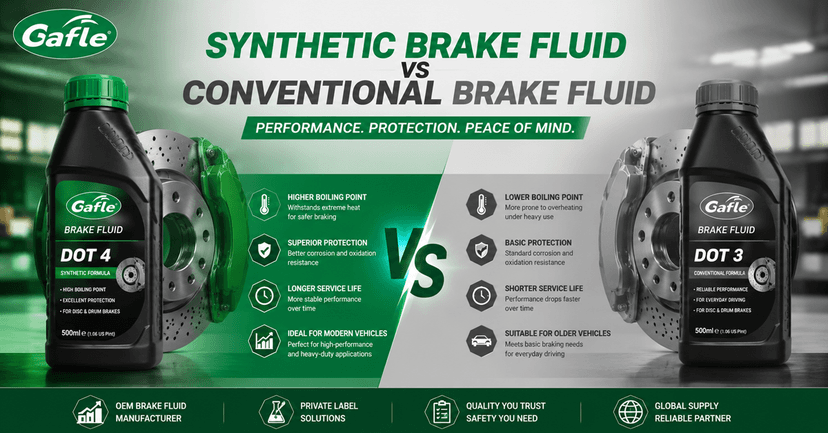
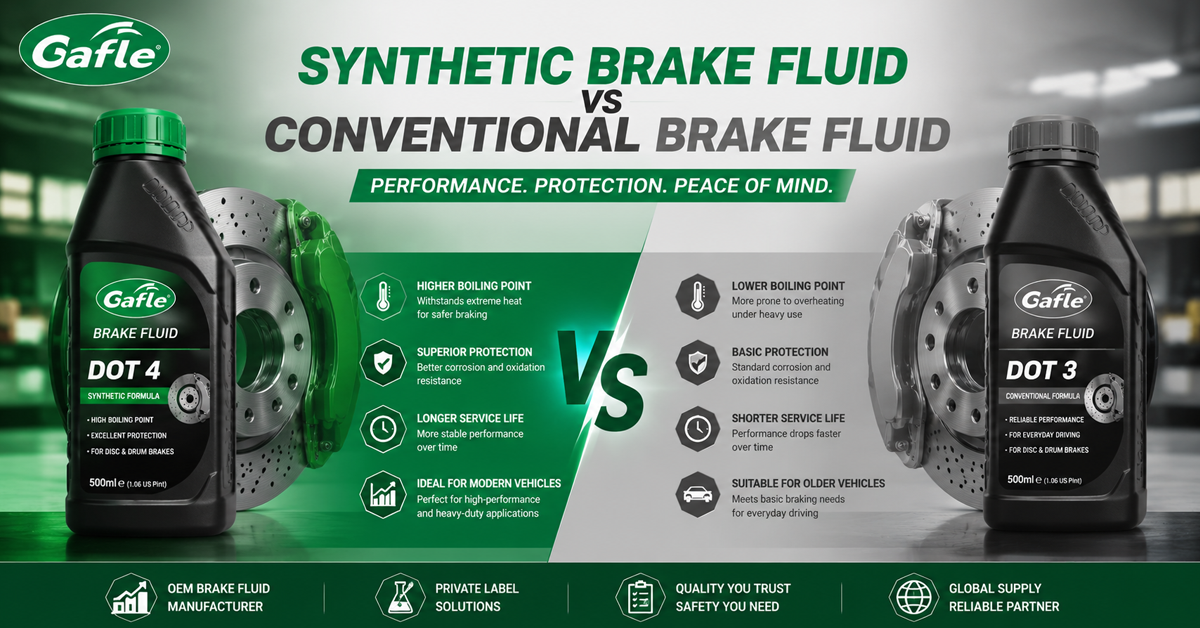
The most useful way to compare synthetic vs conventional brake fluid is not by marketing language but by use case. Conventional products are often chosen for cost-sensitive applications where the specification is stable and the operating environment is familiar. Synthetic formulations are more often selected when the buyer wants stronger performance consistency, a more premium market position, or a product line that can support higher expectations from end users.
That does not mean conventional fluid is obsolete. It means the buyer has to match the fluid to the market. A fleet operator may care most about predictable service intervals and broad compatibility. A private-label retailer may care about shelf appeal, packaging options, and whether the product can support an OEM-style positioning without overclaiming. A repair channel may care about the ease of stocking one fluid across multiple applications. Each of these decisions points to a different commercial answer.
Where OEM and private label programs change the equation
When a buyer sources OEM Brake Fluid or builds a Private Label Brake Fluid program, the product is only part of the job. The rest is supply control. Bottle design, label accuracy, fill consistency, carton configuration, and repeatable production matter just as much as formulation. In this segment, a Brake Fluid Manufacturer is not merely a filler. It becomes a partner in brand presentation and compliance discipline.
If your business is comparing a DOT 3 DOT 4 Brake Fluid Supplier, do not stop at the product title. Confirm how the supplier handles product families, whether they can support multiple packaging formats, and how they manage batch traceability. Even a strong fluid can become a sourcing headache if the packaging line is inconsistent or the documentation is thin. That is a boring point, but it is usually the one that saves a program from trouble.
Selection criteria that deserve more attention
First, define the application. Is the fluid for aftermarket resale, workshop supply, fleet maintenance, or a branded retail program? Second, verify compatibility expectations. Brake systems are not forgiving, and the wrong fluid class can create avoidable risk. Third, ask about manufacturing capability. A reliable supplier should be able to explain production control, filling options, and how they protect product integrity during storage and transit.
Fourth, look at commercial stability. A supplier such as a dedicated Brake Fluid Manufacturer should be able to support repeat orders without changing the product experience from one lot to the next. For international buyers, communication matters too. If a Gafle Brake Fluid Factory or any comparable factory can provide clear product documentation and consistent service, that often matters more than a glossy sales pitch. Buyers rarely regret asking more questions up front; they often regret asking too few.
Common mistakes in brake fluid sourcing
The most common mistake is treating all brake fluids as interchangeable. They are not. Another mistake is choosing on price alone and discovering later that packaging, labeling, or supply continuity is weak. A third is assuming a “synthetic” claim automatically means premium performance across every vehicle or climate. It may not.
Another caution: some teams focus heavily on the formula and ignore market positioning. If you are building a retail or distributor line, the product has to make sense on the shelf as well as in the workshop. A Private Label Brake Fluid program lives or dies on trust. The bottle, the copy, and the back-end supply all have to support that trust.
What buyers should ask before placing an order
Ask what performance category the product is designed for. Ask whether the supplier can provide matching packaging and private-label support. Ask how the product is handled from filling to shipment. Ask whether the supplier can support a stable DOT 3 DOT 4 Brake Fluid Supplier relationship if your portfolio includes multiple grades. And ask what happens when you need a repeat order under the same specification six months later. That last question is often where supplier quality becomes visible.
For sourcing teams, the goal is not merely to buy fluid. It is to secure a product that fits the technical requirement and the business model. When synthetic brake fluid is selected well, it becomes a quiet part of a reliable vehicle system. When it is selected badly, it becomes a problem everyone notices.
Next step for buyers and brand owners
If you are evaluating a new supplier, start with the product specification, then move to packaging, documentation, and production consistency. That order keeps the conversation grounded. A serious buyer should be able to tell quickly whether a supplier is ready for OEM work, private-label programs, or straightforward aftermarket supply. The right brake fluid partner will answer those questions directly, without drifting into vague promises.