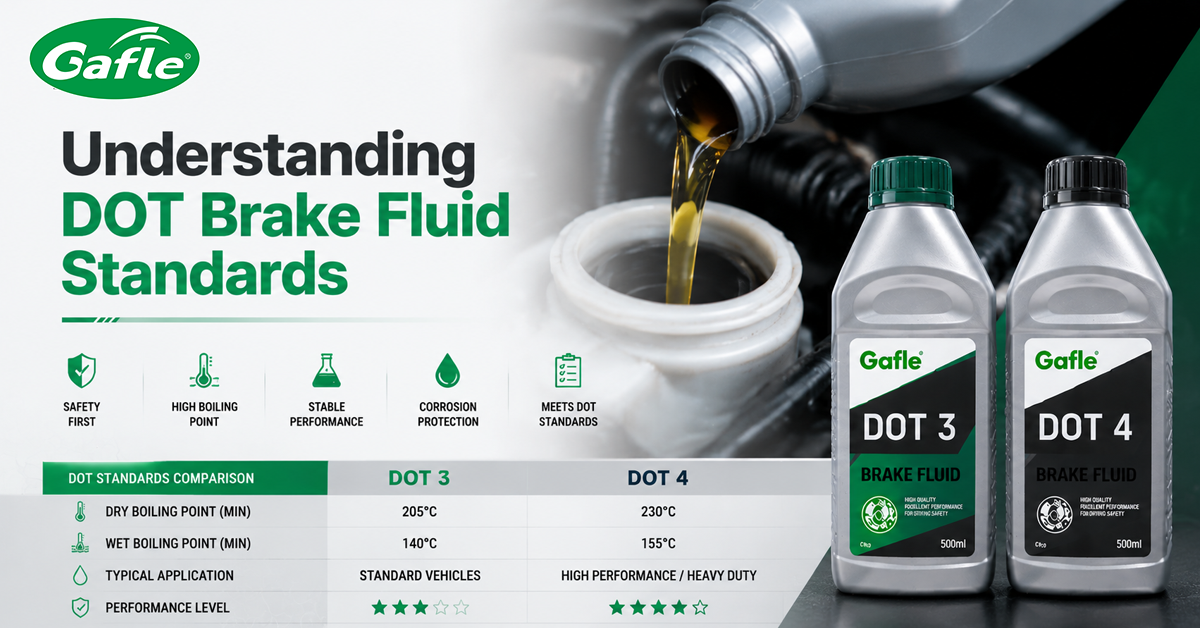
Understanding DOT Brake Fluid Standards
Brake fluid is one of the most important components in a vehicle’s braking system. To ensure braking safety and stable hydraulic performance, brake fluid products must meet specific technical requirements and testing standards. Among the most widely recognized standards are DOT brake fluid standards, which are used globally throughout the automotive industry.
For distributors, workshops, and vehicle owners, understanding DOT brake fluid classifications and performance differences is essential when selecting the right product for different driving conditions.
At Gafle Brake Fluid Factory, we manufacture professional brake fluid products according to international quality and testing standards to support global automotive markets.
What Are DOT Brake Fluid Standards?
DOT brake fluid standards are technical specifications established to evaluate brake fluid performance, safety, and reliability.
These standards focus on important performance factors such as:
- Boiling point performance
- Viscosity stability
- Moisture resistance
- Corrosion protection
- Hydraulic system compatibility
DOT standards help ensure brake fluid can maintain stable braking performance under different operating conditions.
DOT 3 vs DOT 4 Brake Fluid
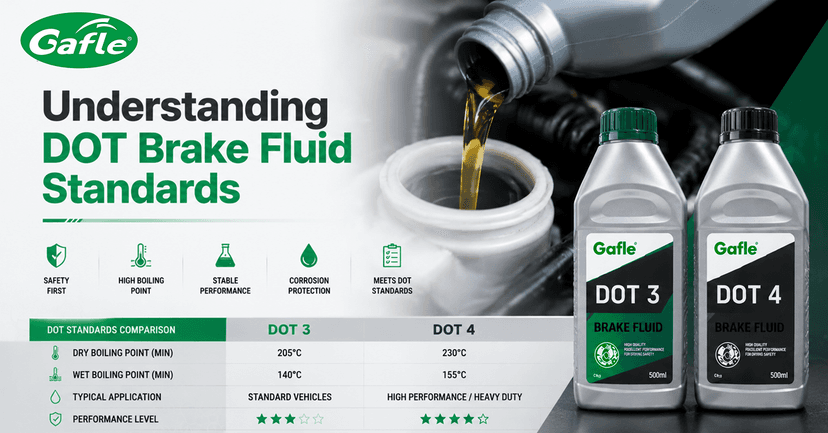
One of the most common questions in the automotive aftermarket is the difference between DOT 3 vs DOT 4 brake fluid.
Although both are widely used hydraulic brake fluids, they differ in several important areas.
DOT 3 Brake Fluid
DOT 3 brake fluid is commonly used in standard passenger vehicles and daily driving conditions.
Main characteristics include:
- Stable braking performance
- Suitable for regular driving conditions
- Moderate boiling point performance
- Cost-effective maintenance solution
DOT 4 Brake Fluid
DOT 4 brake fluid performance is generally stronger under high-temperature and demanding driving conditions.
DOT 4 brake fluid provides:
- Higher boiling point performance
- Better moisture resistance
- Improved high-temperature stability
- More suitable for heavy braking environments
DOT 4 brake fluid is commonly used in:
- Performance vehicles
- Commercial transportation
- Mountain driving
- High-temperature environments
Brake Fluid Boiling Point Standards
One of the most important technical indicators is brake fluid boiling point standards.
Brake systems generate heat during braking. If brake fluid overheats and begins to boil, vapor bubbles may form inside the hydraulic system, reducing braking effectiveness.
DOT standards evaluate:
Dry Boiling Point
The boiling point of new brake fluid before moisture absorption.
Wet Boiling Point
The boiling point after brake fluid absorbs moisture over time.
Higher boiling point performance helps improve braking stability under demanding driving conditions.
Why DOT 4 Brake Fluid Performance Matters
Professional DOT 4 brake fluid performance is especially important for vehicles operating under heavy braking conditions.
DOT 4 brake fluid helps provide:
- Stable hydraulic pressure
- Reduced brake fade risks
- Better moisture resistance
- Improved braking reliability
At Gafle Brake Fluid Factory, DOT 4 products undergo strict laboratory testing to help maintain stable performance consistency.
Brake Fluid Quality Standards and Product Reliability
Professional brake fluid quality standards help manufacturers maintain stable product quality and support customer safety expectations.
Quality standards focus on:
- Product consistency
- Formula stability
- Moisture resistance
- Corrosion protection
- Production cleanliness
- Long-term reliability
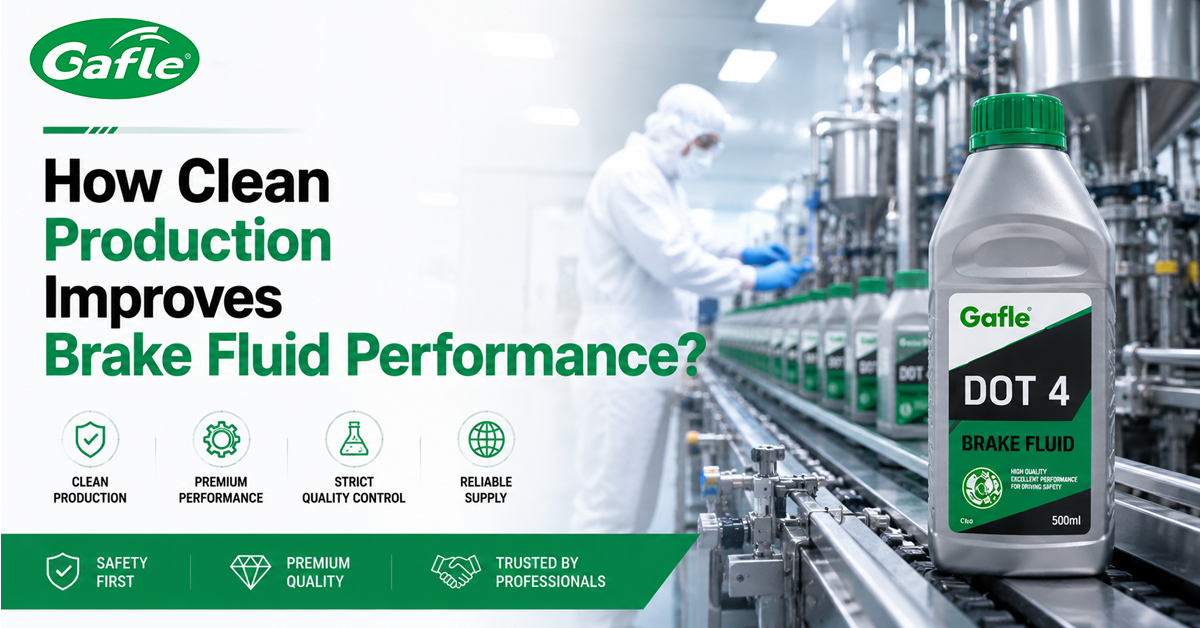
At Gafle Factory, strict quality control procedures are implemented throughout every production stage.
Importance of Brake Fluid Testing Standards
Professional brake fluid testing standards are essential for verifying product performance before products enter the market.
Testing procedures may include:
- Boiling point testing
- Viscosity testing
- Corrosion resistance testing
- Moisture contamination evaluation
- Product stability analysis
These laboratory procedures help manufacturers maintain reliable brake fluid performance under different driving environments.
Professional DOT Brake Fluid Manufacturer
As a professional DOT brake fluid manufacturer, Gafle focuses on stable production systems, strict quality management, and advanced laboratory testing.
Our products include:
- DOT 3 brake fluid
- DOT 4 brake fluid
- DOT 5.1 brake fluid
Our manufacturing systems include:
- Automatic production lines
- Dust-free production environments
- Professional laboratory testing systems
- Export-oriented quality management
These systems help support reliable brake fluid performance for international markets.
Brake Fluid Safety Standards and Driving Protection
Professional brake fluid safety standards are directly related to braking stability and vehicle safety.
High-quality brake fluid helps:
- Maintain stable braking response
- Protect hydraulic systems
- Reduce overheating risks
- Improve long-term braking reliability
For distributors and automotive service providers, choosing products manufactured according to strict safety standards is essential for customer confidence and long-term business reputation.
Why Choose Gafle Brake Fluid Factory?
At Gafle Brake Fluid Factory, we combine over 25 years of manufacturing experience with professional production systems and export capability.
Our advantages include:
- Professional DOT brake fluid manufacturing
- Strict laboratory testing procedures
- Stable product quality
- OEM & ODM support
- International export experience
- Advanced clean production systems
We remain committed to providing reliable brake fluid solutions for customers worldwide.
Conclusion
Understanding DOT brake fluid standards helps distributors, workshops, and vehicle owners choose the right brake fluid products for different driving conditions and performance requirements.
At Gafle Brake Fluid Factory, we continue supporting global automotive markets through professional manufacturing systems, strict testing procedures, and high-quality brake fluid solutions designed for safety, reliability, and long-term performance.