When purchasing brake fluid, many buyers naturally compare prices, packaging, and delivery times. However, experienced distributors, importers, and automotive brands understand that the true value of brake fluid lies in its quality and long-term performance.
Brake fluid is one of the most critical safety fluids in any vehicle. It transfers the force applied by the driver’s foot to the braking system, enabling the vehicle to stop safely under various driving conditions. Poor-quality brake fluid can lead to vapor lock, corrosion, reduced braking efficiency, and even brake failure.
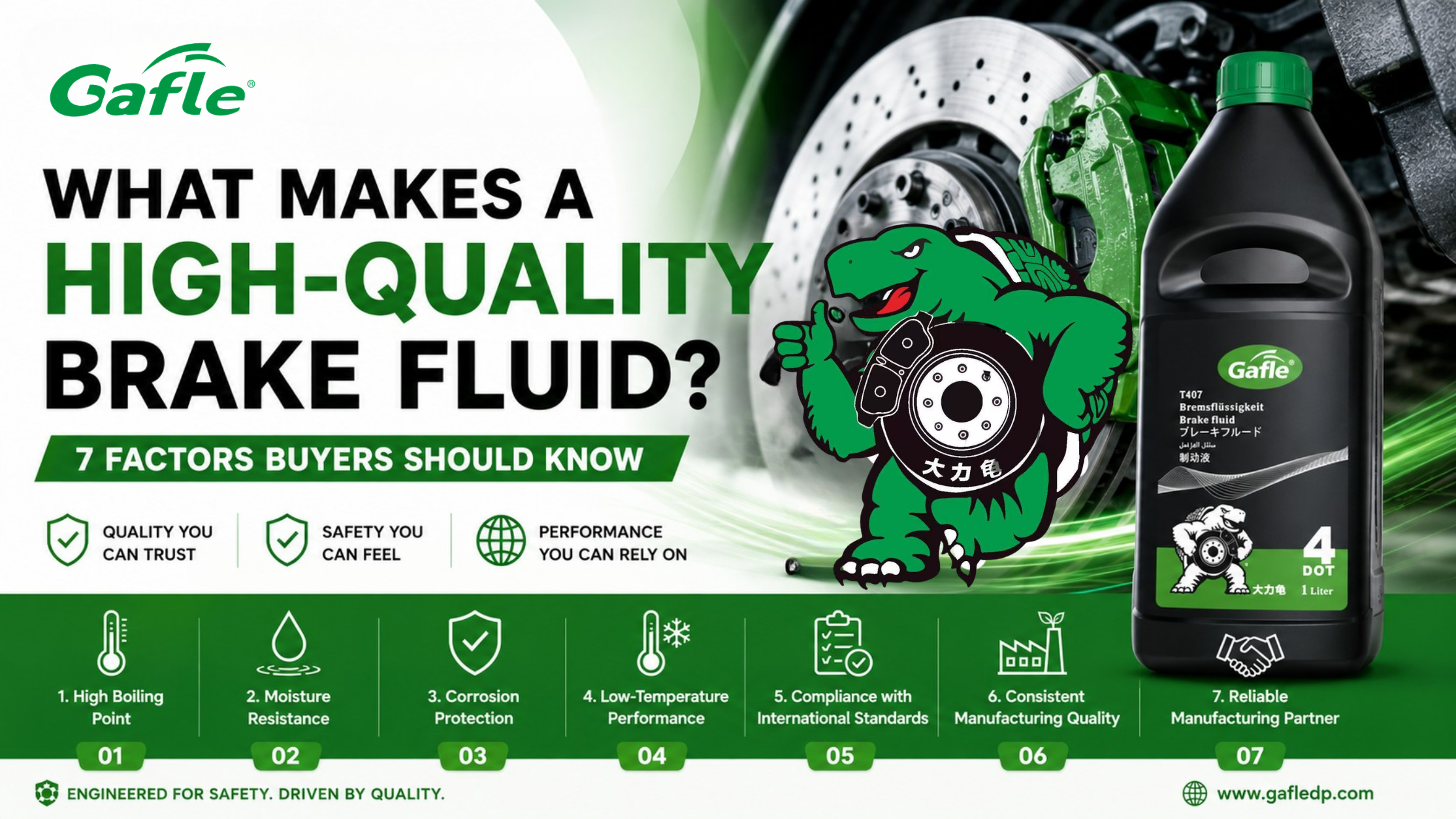
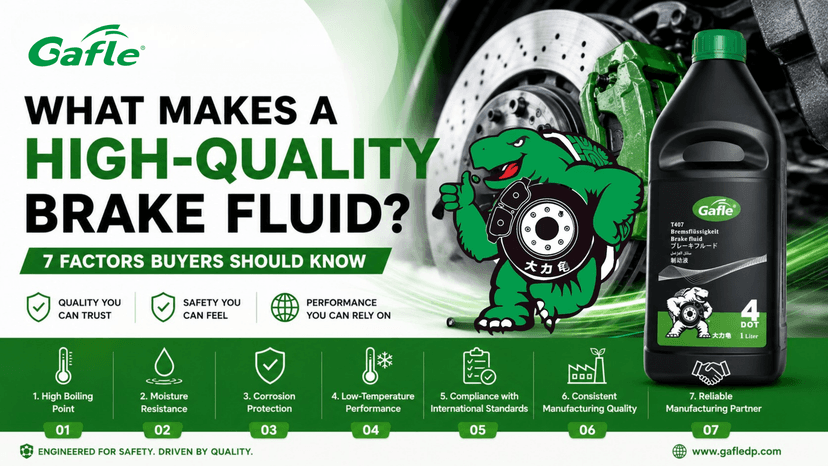
So, what separates a high-quality brake fluid from an average one? Here are seven key factors every buyer should understand before selecting a supplier .
.
1. Compliance with International Standards
The first indicator of quality is whether the brake fluid meets recognized international standards.
Depending on the target market, brake fluids may need to comply with:
- FMVSS No.116
- ISO 4925
- SAE J1703 & J1704
- JIS K2233
- GB12981
These standards define critical performance requirements, including boiling points, viscosity, corrosion protection, chemical stability, and compatibility with braking system materials.
Reliable manufacturers should provide complete testing reports and certification to demonstrate compliance.
For global distributors and private-label brands, choosing products that meet multiple international standards simplifies market entry and regulatory approval.
2. High Dry and Wet Boiling Points
The boiling point is one of the most important performance indicators for brake fluid.
Brake systems generate significant heat during operation. Under heavy braking conditions, temperatures can rise rapidly.
Brake fluid is measured by two boiling points:
Dry Boiling Point
This measures the performance of fresh brake fluid with minimal moisture content.
A higher dry boiling point provides better resistance to extreme temperatures.
Wet Boiling Point
Brake fluid naturally absorbs moisture from the atmosphere over time.
As water content increases, the boiling point decreases.
A high wet boiling point ensures the brake fluid continues to perform safely throughout its service life.
Low-quality brake fluids may initially meet specifications but experience rapid performance degradation after absorbing moisture.
3. Excellent Moisture Resistance
Unlike engine oil or transmission fluid, brake fluid is hygroscopic, meaning it naturally absorbs water from the surrounding air.
Moisture contamination can cause:
- Lower boiling points
- Internal corrosion
- Reduced braking efficiency
- Shorter service intervals
High-quality formulations are designed to slow moisture absorption while maintaining stable performance over time.
Good moisture resistance helps extend the life of both the brake fluid and the braking system itself.
4. Superior Corrosion Protection
Modern braking systems contain various metal components, including steel, aluminum, cast iron, copper, and brass.
Without proper corrosion inhibitors, moisture can damage:
- Brake master cylinders
- Calipers
- ABS valves
- Brake lines
- Hydraulic pumps
Corrosion may reduce braking performance and increase maintenance costs.
Premium brake fluids contain advanced additive packages that protect metal components against rust and chemical attack throughout the service life of the fluid.
This is particularly important for modern ABS and ESP braking systems, which contain complex hydraulic components with tight tolerances.
5. Stable Low-Temperature Performance
Brake fluid must perform not only under high temperatures but also in cold environments.
Low-temperature viscosity affects how quickly hydraulic pressure builds inside the braking system.
If viscosity becomes too high, drivers may experience:
- Slower brake response
- Reduced ABS effectiveness
- Delayed ESP activation
Modern vehicles equipped with advanced electronic braking systems require brake fluids with excellent low-temperature flow characteristics.
Products such as DOT 4 LV, CLASS 6, and CLASS 7 are specifically developed to meet these demanding requirements.
6. Consistent Manufacturing Quality
Even an excellent formulation can fail if manufacturing conditions are poorly controlled.
Brake fluid production requires strict control over:
- Raw material quality
- Mixing accuracy
- Moisture exposure
- Filtration
- Filling processes
- Batch testing
A fully enclosed, automated, dust-free production environment helps prevent contamination and ensures consistent product quality.
Consistency is especially important for OEM and private-label customers because every bottle represents their brand reputation.
Professional manufacturers also maintain rigorous quality control systems to verify that every production batch meets performance specifications before shipment.
7. A Reliable and Experienced Manufacturing Partner
Quality extends beyond the product itself.
An experienced manufacturer provides value through:
- Technical expertise
- Product customization
- Packaging flexibility
- OEM and ODM services
- Stable supply capacity
- Export experience
- Regulatory support
A strong manufacturing partner understands that customers need more than a product—they need dependable service and long-term business support.
Manufacturers with years of industry experience are often better equipped to adapt to changing market requirements and provide tailored solutions for different regions and applications.
Why These Factors Matter
Choosing brake fluid based solely on price can create hidden costs.
Poor-quality products may result in:
- Customer complaints
- Product returns
- Warranty claims
- Damage to brand reputation
- Increased maintenance costs
High-quality brake fluid helps improve vehicle safety, enhance customer satisfaction, and strengthen long-term business relationships.
For distributors, wholesalers, and private-label brands, selecting the right manufacturing partner is just as important as selecting the right product.
How Gafle Brake Fluid Delivers Quality
At Gafle Brake Fluid, quality is built into every stage of production.
With over 20 years of industry experience, our brake fluids are manufactured in fully automated, dust-free facilities and comply with major international standards, including FMVSS No.116, ISO 4925, SAE J1703 & J1704, JIS K2233, and GB12981.
Our product portfolio includes DOT 3, DOT 4, DOT 4 LV, DOT 5.1, CLASS 6, and CLASS 7 brake fluids, serving customers in more than 40 countries worldwide.
As a trusted OEM and ODM partner, we combine advanced technology, strict quality control, flexible packaging solutions, and global export expertise to help our customers build successful automotive brands.
Final Thoughts
High-quality brake fluid is about much more than meeting minimum specifications.
It requires advanced formulations, strict manufacturing standards, reliable quality control, and long-term technical expertise.
Whether you are a distributor, importer, automotive brand, or private-label business, understanding these seven factors can help you make better purchasing decisions and reduce long-term business risks.
When it comes to brake fluid, quality is not simply a feature—it is a commitment to safety, reliability, and lasting performance.