Ethylene Glycol vs Propylene Glycol Coolant
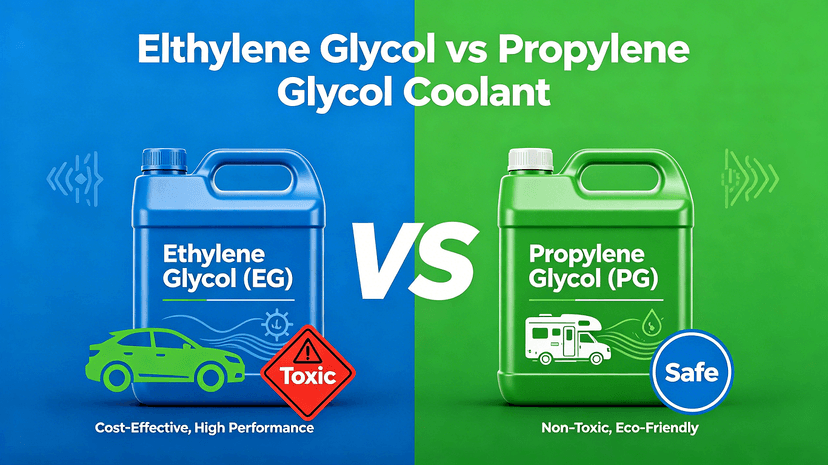
Antifreeze coolant is the core heat transfer medium for automotive cooling systems, split into two mainstream chemical base formulas: ethylene glycol (EG) and propylene glycol (PG). Global auto parts wholesalers, repair chains and OEM brand owners often confuse the two types, leading to wrong product matching, mixing failures and safety hazards for end vehicle users. This article systematically compares their chemical properties, performance parameters, application scenarios, toxicity risks and bulk sourcing standards, to help you select the correct coolant for different market demands.
1. Core Chemical & Toxicity Distinction
1.1 Ethylene Glycol (EG) Coolant
EG is the most widely used base fluid for passenger car antifreeze worldwide.
- Toxicity feature: Moderately toxic to humans, pets and wildlife. Ingestion of small doses can cause kidney failure or fatal poisoning; spilled coolant pollutes soil and water bodies severely. Ocean shipping requires clear hazard labeling in MSDS documents.
- Molecular characteristic: Low viscosity, excellent heat conduction efficiency, stable anti-freezing and anti-boiling performance under standard dilution ratios (30%–60% concentration).
1.2 Propylene Glycol (PG) Coolant
PG is classified as low-toxicity, food-grade safe glycol derivative.
- Toxicity feature: Non-toxic to mammals, aquatic organisms and domestic animals. Even accidental ingestion poses no fatal risk, making it the preferred coolant for RVs, agricultural machinery, food transport trucks and regions with strict environmental protection laws.
- Molecular characteristic: Slightly higher kinematic viscosity than EG, slightly weaker heat transfer efficiency, but compatible with all metal and rubber cooling system components.
2. Performance Parameter Comparison Table
| Test Item | Ethylene Glycol Coolant | Propylene Glycol Coolant |
|---|---|---|
| Freezing Point (-35℃ mix ratio) | 50% EG + 50% deionized water | 55% PG + 45% deionized water (higher concentration required) |
| Boiling Point (108kPa pressure) | 108℃–113℃ | 105℃–110℃ |
| Thermal Conductivity | Higher, faster engine heat dissipation | Slightly lower, suitable for low-load engines |
| Low-temperature Viscosity (-40℃) | Lower, smoother cold start circulation | Thicker, slight flow delay in extreme cold |
| Metal Corrosion Resistance | Excellent for iron, aluminum, copper | Equal anti-corrosion performance |
| Rubber Seal Compatibility | Matches EPDM, nitrile hoses | Fully compatible with all cooling system elastomers |
3. Applicable Vehicle & Market Scenarios
3.1 Ethylene Glycol Coolant Main Application
- Standard gasoline/diesel passenger cars, light commercial vehicles, most heavy-duty trucks (global mainstream market);
- Regions with extreme cold winters (Canada, Northern Europe, Northeast China, Russia): Lower low-temperature viscosity guarantees fast cold circulation;
- Mass aftermarket repair shops, low-to-medium cost wholesale orders with strict cost control.
3.2 Propylene Glycol Coolant Main Application
- RVs, camper vans, farm tractors, livestock transport trucks (risk of animal contact with coolant leaks);
- European Union, Australia, New Zealand markets with strict environmental pollution control regulations;
- Electric vehicles, food delivery vehicles, equipment with high human contact risk;
- Municipal machinery, marine small engine cooling systems with high spill exposure risk.
4. Critical Risk: Never Mix EG & PG Coolant
The two glycol bases are chemically incompatible when blended, triggering irreversible quality failures:
- Mixed liquid produces flocculent precipitate, blocking radiator micro-channels and engine water jackets;
- Composite anti-corrosion additives react and lose efficacy within 3–6 months, accelerating cylinder rust and pitting corrosion;
- Viscosity surges sharply, slowing heat dissipation and easily causing engine overheating and boiling.
Standard operation rule: If switching from EG to PG coolant, the entire cooling system must be fully flushed with clean deionized water 2–3 times to eliminate residual EG before refilling PG coolant.
5. Bulk Sourcing Guidance For Global Importers
- Label separation: EG and PG coolant barrels must use distinct color labels to avoid warehouse misdelivery;
- Document differentiation: MSDS files clearly mark base glycol type, toxicity grade and environmental disposal requirements for customs clearance;
- Formula customization: For cold northern markets, prioritize EG coolant; for EU/Australian eco-regulated regions, stock PG low-toxicity coolant;
- Batch inspection focus: Verify glycol base content via gas chromatography lab testing to prevent suppliers from diluting PG coolant with cheap EG to cut costs.
Closing Summary
Ethylene glycol coolant balances cost and thermal performance for standard passenger and commercial vehicles, while propylene glycol coolant solves toxicity and environmental risks for special machinery and high-regulation overseas markets. As a professional coolant manufacturer supplying both EG and PG formulas, we provide complete test reports and region-tailored formulations for all bulk and OEM private label orders, helping distributors avoid mixing risks and market compliance barriers.
Welcome to contact GAFLE for more information & cooperation!
peter
ZHEJIANG GAFLE AUTO CHEMICL CO.,LTD
Tel:86-579-8222 1665
Fax:86-579-8246 4690
Cel/Wechart:86-13335993986
E-mail:peter@gafle.net
Web:www.gafle.net
peter
ZHEJIANG GAFLE AUTO CHEMICL CO.,LTD
Tel:86-579-8222 1665
Fax:86-579-8246 4690
Cel/Wechart:86-13335993986
E-mail:peter@gafle.net
Web:www.gafle.net