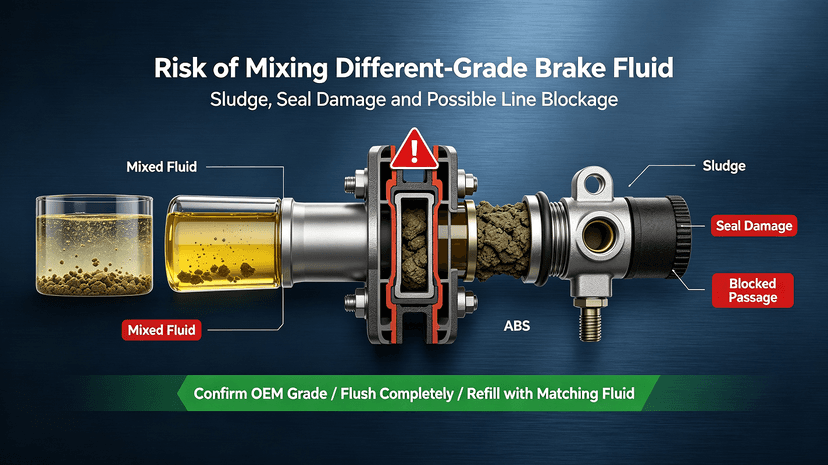
1. Mixed incompatible brake fluid creates sludge deposits inside hydraulic brake circuits
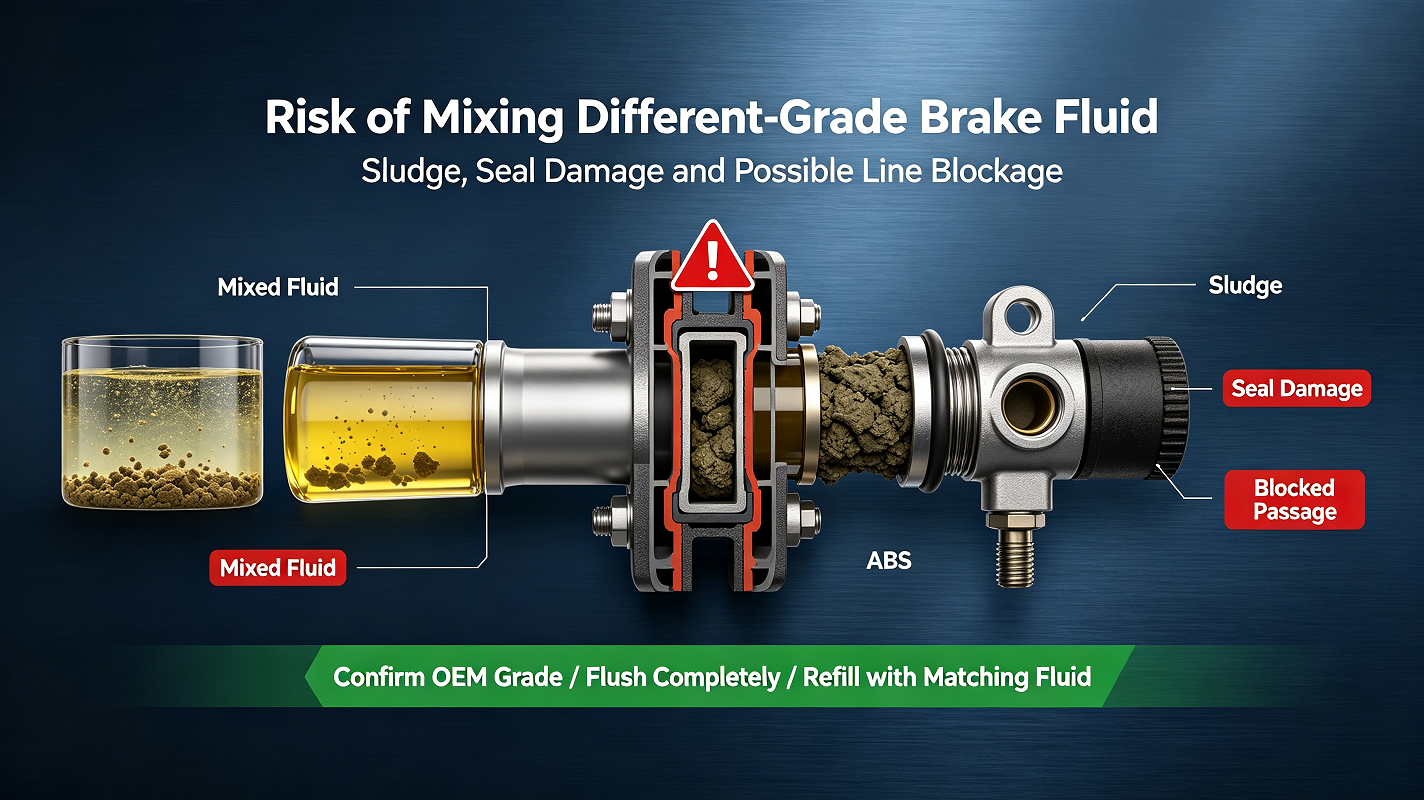
Mixing different brake fluid formulas does not always block lines immediately, but chemical reactions slowly form sediment.
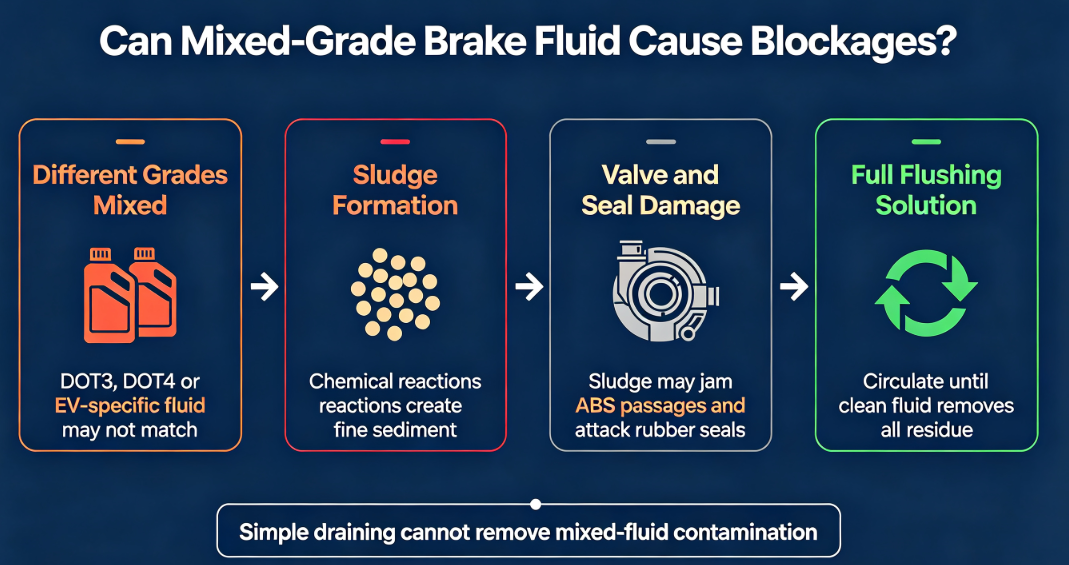
Different glycol‑based brake fluids contain distinct additive packages. When non‑compatible grades blend together, chemical reactions produce fine sludge particles suspended in the fluid. Over weeks and months, these sediments settle in low‑position sections, master cylinder and narrow ABS valve channels. This sludge is the root source of potential brake‑system blockages.
2. Sludge from mixed fluid may jam precision ABS and EHB valve passages
The biggest risk of mixed‑grade fluid targets modern electronic brake hardware.
Brake pipelines have relatively wide diameters, yet ABS / EHB modules contain tiny, precise valve openings. Tiny sludge particles from incompatible‑fluid mixing can stick inside these micro‑channels. Partial jamming causes uneven brake force, warning lamp illumination and poor brake response. In severe cases, the whole electronic brake module needs replacement, which brings high repair bills for vehicle owners.
3. Mixed‑grade fluid also damages rubber sealing components
Besides forming blocking sludge, formula‑mismatched mixtures attack rubber parts.
Wrong additive combinations make seals, O‑rings and brake hoses swell, soften or turn brittle. Damaged rubber creates more rubber debris circulating within the system. More debris further raises blockage probability, while also leading to slow brake‑fluid leakage. A single top‑up with mismatched fluid can start this slow chain‑reaction damage.
4. Simple draining cannot eliminate mixed‑grade fluid contamination
Many mechanics think draining the reservoir is enough after discovering mixed fluid inside the system.
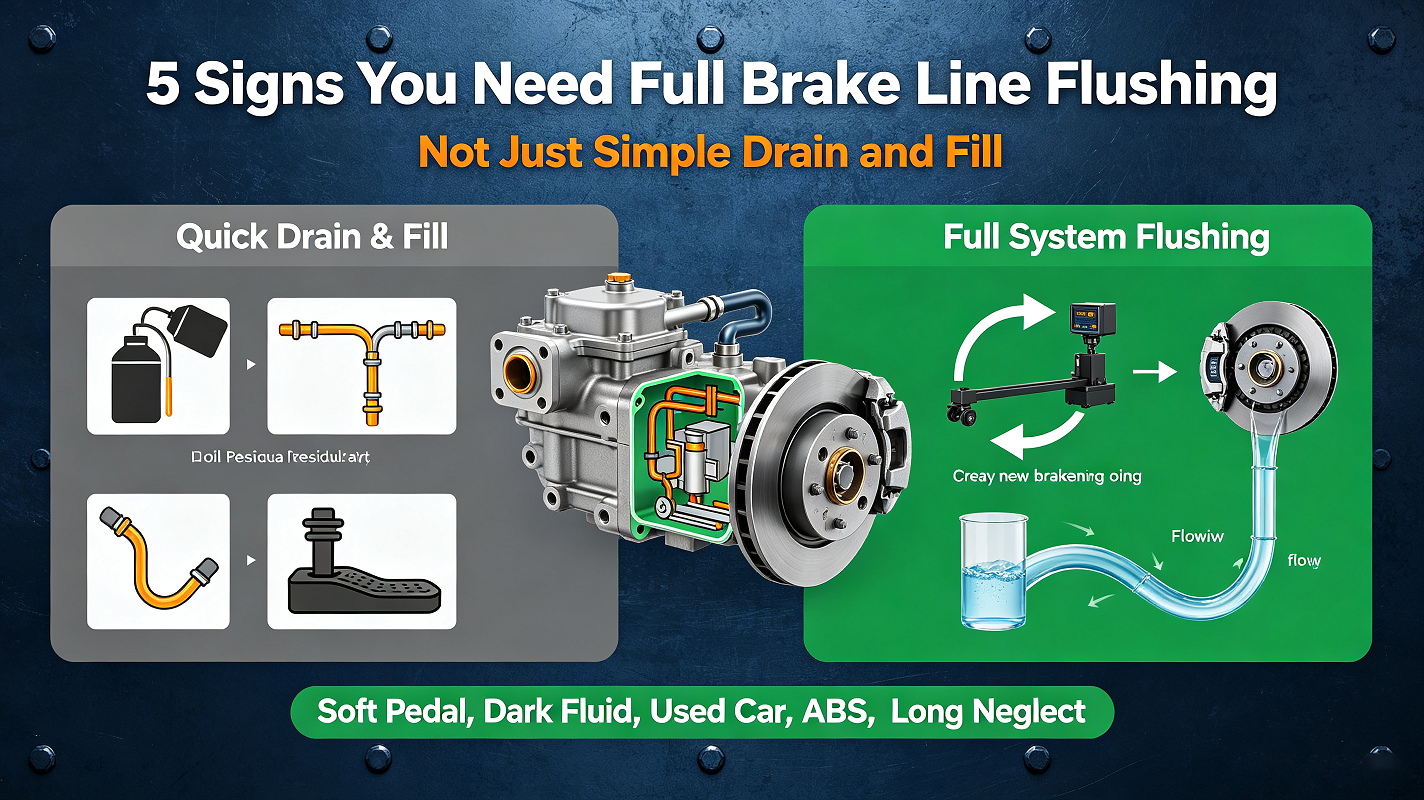
However, large volumes of old mixed fluid remain trapped in calipers, hoses and module interiors. Partial draining only removes fluid in the reservoir tank. Residual incompatible blend stays circulating in the working circuit. That is why full system flushing becomes essential for vehicles with confirmed mixed‑grade brake fluid history. Continuous circulation pushes mixed‑fluid residues completely out of every component.
5. Practical garage rules to avoid mixed‑grade fluid hazards
Repair shops can adopt simple workflows to prevent mixing‑related failures.
First, always confirm OEM‑specified brake‑fluid grade before opening any brake‑system work. For vehicles with unknown maintenance background, perform complete flushing instead of partial top‑up. Never use leftover fluid from different containers. For EV cars fitted with EHB units, strictly use EV‑specified brake fluid such as DOT4 EV608 instead of ordinary DOT3 or DOT4. These steps stop mixed‑grade risks before they start.
Conclusion
Mismatched mixed‑grade brake fluid generates sludge, which may jam precision ABS/EHB passages and indirectly lead to block‑like failures, alongside seal swelling and leakage. Simple draining cannot solve this hazard; complete brake‑system flushing removes residual incompatible fluid. Always stick to vehicle‑required brake‑fluid specifications.
GAFLE supplies full‑series DOT3, DOT4 and DOT4 EV608 brake fluid for flushing and refilling. OEM private‑label service is available for global auto‑chemical importers.
Contact our sales team for stable brake‑fluid supply.
Welcome to contact GAFLE for more information & cooperation!
peter
ZHEJIANG GAFLE AUTO CHEMICL CO.,LTD
Tel:86-579-8222 1665
Fax:86-579-8246 4690
Cel/Wechart:86-13335993986
E-mail:peter@gafle.net
Web:www.gafle.net
peter
ZHEJIANG GAFLE AUTO CHEMICL CO.,LTD
Tel:86-579-8222 1665
Fax:86-579-8246 4690
Cel/Wechart:86-13335993986
E-mail:peter@gafle.net
Web:www.gafle.net