
What Is Brake Fluid & Its Core Role In Hydraulic Braking
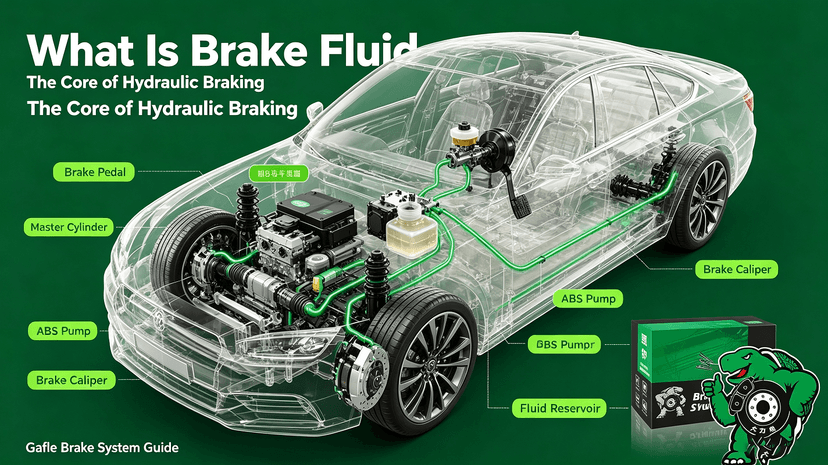
Most drivers only focus on brake pads and rotors when servicing brakes, completely ignoring the invisible core component that makes every stop possible: brake fluid. It acts as the critical hydraulic medium connecting your brake pedal to every wheel’s caliper, forming the complete closed braking circuit including master cylinder, ABS pump, brake lines and reservoirs. This article breaks down the full working logic of hydraulic brake systems and explains why brake fluid is the unsung safety core of your car.
1. The Complete Hydraulic Brake System Layout
A full hydraulic braking system forms a closed loop with these key parts: brake pedal, booster, master cylinder, brake fluid reservoir, ABS modulator, steel brake pipelines, brake calipers, brake pads and brake rotors.
Brake fluid fills every pipeline and component cavity without gaps. Unlike air, incompressible glycol-based brake fluid delivers pressure instantly with zero delay. When you step on the brake pedal, mechanical force is converted into hydraulic pressure inside the master cylinder, and brake fluid carries this pressure evenly to all four wheels simultaneously.
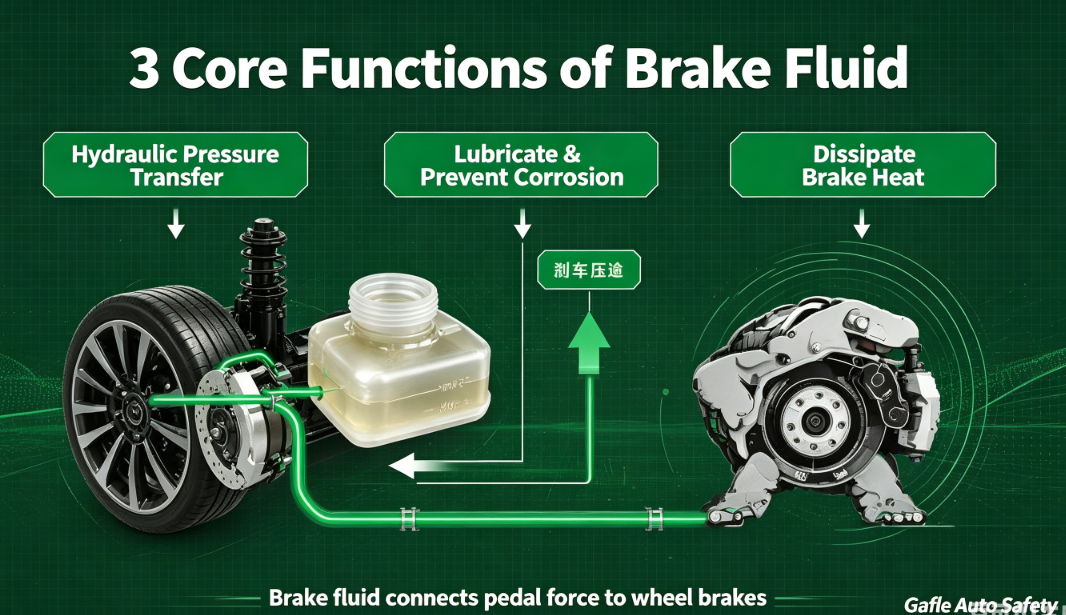
2. Three Irreplaceable Core Functions Of Brake Fluid
- Hydraulic Pressure Transmission
Brake fluid is non-compressible, which is the fundamental requirement for stable braking. Air bubbles or moisture will turn part of the liquid into compressible vapor, breaking pressure transmission and creating a spongy pedal feel.
- Lubrication & Anti-Corrosion Protection
High-quality certified brake fluid mixes special additives to lubricate internal pistons, rubber seals and metal channels inside master cylinders and ABS pumps. It stops rust and pitting on steel pipelines and aluminum calipers year-round.
- High-Temperature Heat Dissipation
Continuous braking generates massive heat on calipers. Brake fluid absorbs excess thermal energy and prevents local overheating that would warp brake rotors or damage rubber seals.
3. Why Brake Fluid Is Critical For ABS & ESP Systems
Modern vehicles equipped with ABS, ESP and stability control rely on fast, precise hydraulic pressure adjustment hundreds of times per second. Degraded, moisture-contaminated brake fluid cannot transmit pressure uniformly, delaying ABS response during emergency anti-lock braking.
Gafle high-performance brake fluid is fully compatible with all ABS/ESP hydraulic modules, maintaining stable viscosity and boiling point under rapid pressure fluctuations.
4. How To Judge If Your Brake Fluid Fails Its Duty
- Spongy, sinking brake pedal during normal stops
- Slow brake response with obvious delay after stepping the pedal
- Dark, murky brown fluid visible in the reservoir
- Frequent ABS warning lights triggered during hard braking
All these signs mean the brake fluid has lost its hydraulic performance and needs a full system flush immediately.
Final Takeaway
Brake pads and discs only provide friction for stopping power, while brake fluid is the medium that delivers your braking command to each wheel. Ignoring brake fluid maintenance damages the whole hydraulic circuit and creates hidden safety risks. Inspect your brake fluid’s water content and clarity regularly, and replace it following official maintenance cycles to keep your entire brake system stable.
Welcome to contact GAFLE for more information & cooperation!
peter
ZHEJIANG GAFLE AUTO CHEMICL CO.,LTD
Tel:86-579-8222 1665
Fax:86-579-8246 4690
Cel/Wechart:86-13335993986
E-mail:peter@gafle.net
Web:www.gafle.net
peter
ZHEJIANG GAFLE AUTO CHEMICL CO.,LTD
Tel:86-579-8222 1665
Fax:86-579-8246 4690
Cel/Wechart:86-13335993986
E-mail:peter@gafle.net
Web:www.gafle.net