
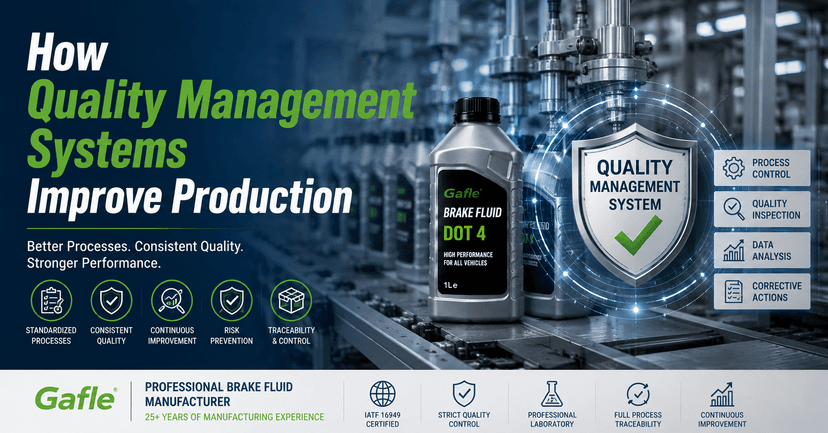
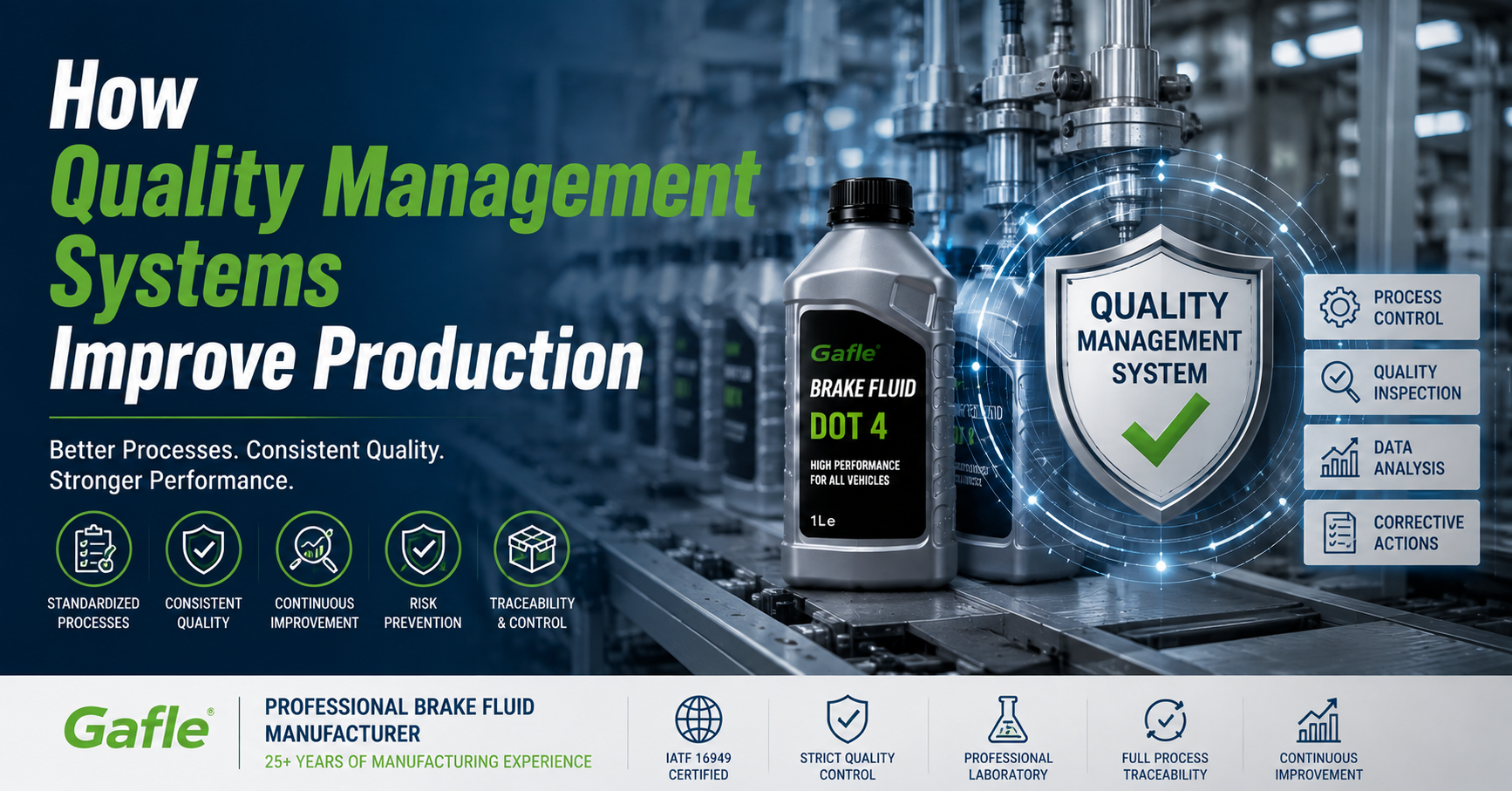
How Quality Management Systems Improve Production
Quality is not something that can simply be checked at the end of a production line. In professional manufacturing, quality must be built into every stage of the process—from raw material selection and production control to laboratory testing, filling, packaging, and final inspection.
This is where a Quality Management System (QMS) becomes important.
A well-implemented quality management system helps manufacturers standardize processes, reduce unnecessary variation, improve traceability, prevent defects, and continuously improve production.
For automotive products such as brake fluid, these controls are particularly important because consistent product performance and manufacturing reliability matter to vehicle manufacturers, automotive brands, distributors, and aftermarket businesses.
Gafle is a professional brake fluid manufacturer with more than 25 years of manufacturing experience. Quality management is integrated throughout our brake fluid production process to support consistent manufacturing, professional testing, traceability, and reliable supply for customers in global automotive markets.
In this article, we explore how quality management systems improve production and how these principles apply to professional brake fluid manufacturing.
What Is a Quality Management System?
A Quality Management System is a structured framework that helps an organization manage the processes, responsibilities, procedures, records, and resources required to achieve consistent quality.
It is much more than a certificate displayed on a factory wall.
An effective QMS connects multiple parts of manufacturing:
People → Materials → Equipment → Processes → Testing → Records → Improvement
Instead of relying on individual experience or final inspection alone, the system establishes standardized procedures that can be followed, measured, reviewed, and improved.
In manufacturing, this can cover areas such as:
- Supplier management
- Raw material inspection
- Production procedures
- Equipment management
- Employee responsibilities
- Process monitoring
- Laboratory testing
- Finished-product inspection
- Batch traceability
- Nonconformance management
- Corrective actions
- Continuous improvement
The goal is not simply to detect defective products.
A strong quality management system aims to reduce the possibility of defects occurring in the first place.
How Quality Management Systems Improve Manufacturing
A properly implemented QMS can influence almost every stage of production.
Here are some of the most important benefits.
1. Standardizing Production Processes
Consistency begins with standardization.
Without clearly defined procedures, different employees, production shifts, or batches may follow slightly different processes.
Even small variations can affect manufacturing consistency.
A quality management system establishes documented procedures for critical production activities.
This helps answer questions such as:
- Which raw materials should be used?
- How should materials be inspected?
- What production parameters must be controlled?
- Which tests should be performed?
- Who is responsible for each process?
- How should results be recorded?
- What happens if a result falls outside requirements?
Standardization reduces unnecessary variation and makes production more repeatable.
2. Improving Product Consistency
For B2B customers, quality is not only about receiving a good first order.
They expect the same level of quality from future orders.
This makes batch-to-batch consistency especially important.
Effective quality control in manufacturing helps control variables throughout production so that products are manufactured according to defined requirements.
For an automotive importer or private label brand, this consistency can be essential.
The first container, fifth container, and future repeat orders should all follow the same controlled manufacturing approach.
3. Preventing Problems Instead of Only Detecting Them
Traditional quality inspection often focuses on finding defects after production.
Modern quality management takes a broader approach.
Instead of asking only:
“Is the finished product acceptable?”
manufacturers also ask:
“What could cause the process to produce an unacceptable product?”
This changes quality management from reactive to preventive.
Potential risks can be identified during:
- Raw material sourcing
- Storage
- Production
- Equipment operation
- Testing
- Filling
- Packaging
Controls can then be established to reduce these risks.
This is one of the most important ways a QMS improves production efficiency.
Preventing a problem is generally more effective than discovering it after an entire batch has already been manufactured.
4. Improving Manufacturing Traceability
Traceability is another major benefit of professional manufacturing quality control.
A structured system creates records connecting different stages of production.
For example:
Raw Material Batch → Production Batch → Laboratory Test Record → Filling Record → Finished Product → Shipment
If a quality issue needs to be investigated, these records can help identify which materials, production processes, test results, and finished products were involved.
Without traceability, identifying the source of a problem can be much more difficult.
For international customers purchasing products in large quantities, batch traceability provides an important additional layer of supply-chain control.
5. Supporting Continuous Improvement
Quality management is not intended to keep a factory permanently operating in exactly the same way.
A strong system should also help the organization improve.
Production data, inspection results, customer feedback, internal audits, nonconformities, and corrective actions can all provide information for improvement.
The process can be viewed as:
Identify → Analyze → Correct → Verify → Improve
Over time, this approach can help manufacturers:
- Reduce recurring problems
- Improve process stability
- Optimize production
- Improve employee training
- Strengthen supplier management
- Reduce unnecessary waste
- Improve customer satisfaction
Quality management therefore becomes part of long-term manufacturing development.
Quality Control in Manufacturing: From Raw Materials to Finished Products
Professional quality control in manufacturing should cover the complete production chain.
A typical process may look like this:
Raw Material Inspection
Quality begins before manufacturing starts.
Raw materials should be appropriately identified, inspected, and managed according to established procedures.
Production Process Control
Production should follow defined formulas, procedures, equipment requirements, and process parameters.
In-Process Monitoring
Important production conditions should be monitored where necessary to ensure that the process remains within defined requirements.
Laboratory Testing
Product characteristics should be evaluated using appropriate test methods and equipment.
Filling and Packaging Control
The correct product, container, label, and packaging should be confirmed during filling and packaging.
Finished-Product Inspection
Finished products should be inspected according to applicable specifications and internal quality procedures before release.
Batch Release
Only products that satisfy the required release procedures should proceed toward shipment.
This approach makes quality control part of production rather than a single inspection step at the end.
Why IATF 16949 Matters in Automotive Manufacturing
The automotive industry places strong emphasis on consistent processes, defect prevention, traceability, and risk management.
This is why the IATF 16949 Quality Management System is particularly relevant to automotive manufacturing.
IATF 16949 builds on quality-management principles while addressing requirements specific to the automotive supply chain.
Important areas include:
- Customer-specific requirements
- Risk-based thinking
- Process control
- Defect prevention
- Supplier management
- Product and process traceability
- Corrective actions
- Continuous improvement
For an automotive quality management system, the objective is not simply to inspect more products.
The objective is to build more reliable processes.
It is also important to understand that IATF 16949 is a quality management system certification, not a product certification for an individual brake fluid.
Product performance must still be evaluated according to the relevant brake fluid specifications and applicable requirements.
Quality Management vs Final Product Inspection
These two concepts are related, but they are not the same.
Final inspection asks:
“Does this finished product meet the required criteria?”
Quality management asks:
“How can we control the entire process so that products consistently meet the required criteria?”
Final inspection is important, but it happens after most of the manufacturing work has already been completed.
If quality is controlled only at the final stage, problems may already have affected:
- Raw materials
- Production time
- Labor
- Packaging
- An entire manufacturing batch
A stronger approach combines prevention and inspection.
Quality Is Built Into the Process, Not Just Tested at the End.
This principle is particularly important for brake fluid manufacturing.
How Quality Management Improves Brake Fluid Production
Professional brake fluid quality control involves multiple stages.
Brake fluid may look like a relatively simple automotive liquid, but producing it consistently requires careful control of materials, formulation, production, testing, and packaging.
At Gafle, quality management principles are applied throughout the manufacturing process.
Raw Material Control
Brake fluid performance begins with the materials used in its formulation.
Raw materials should be managed according to established purchasing, inspection, identification, and storage procedures.
Formula Management
Controlled formulations help ensure that production follows the correct product requirements.
Unauthorized or accidental formula changes can create quality risks, making formula control an important part of manufacturing.
Production Control
Manufacturing should follow standardized procedures and defined process requirements.
Production records help document how each batch was manufactured.
Laboratory Testing
Depending on the applicable brake fluid specification, testing may evaluate characteristics such as:
- Dry boiling point
- Wet boiling point
- Low-temperature viscosity
- Chemical stability
- Corrosion performance
- Fluid appearance
- Relevant material compatibility
Professional laboratory capabilities help manufacturers verify whether products meet their intended specifications.
Filling Control
Correct filling procedures help ensure that the right brake fluid is filled into the correct container and packaging.
Packaging Inspection
Labels, bottles, caps, cartons, and other packaging components should be checked according to the relevant production requirements.
Finished-Product Inspection
Before products are released for shipment, finished-product inspection provides another quality-control checkpoint.
Together, these processes create a more complete approach to brake fluid manufacturing.
Why Batch Consistency Matters for Brake Fluid
For international buyers, one successful batch is not enough.
Importers, distributors, and automotive brands may place repeat orders over many years.
They need confidence that the manufacturer's processes can provide consistent products over time.
This makes batch consistency an important part of brake fluid quality control.
Consider an automotive brand purchasing private label brake fluid.
The company may begin with one order and later expand to:
First Order → Repeat Orders → Container Orders → Multiple Markets
If product characteristics vary significantly between batches, the buyer may face customer complaints, inventory problems, or brand-reputation risks.
A professional quality management system helps reduce unnecessary process variation and supports more consistent repeat production.
How Traceability Reduces Manufacturing Risk
Traceability is particularly valuable when a manufacturer needs to investigate a quality concern.
Imagine a finished brake fluid batch requires further review.
A structured traceability system can help the manufacturer identify relevant:
- Raw material batches
- Production dates
- Production records
- Laboratory results
- Filling information
- Packaging records
- Finished-product batches
This makes investigation more efficient and helps determine the appropriate scope of any corrective action.
For B2B customers, traceability also demonstrates that the manufacturer has established systems for managing production records.
How Quality Management Supports OEM Brake Fluid Production
Quality management becomes even more important when a factory produces products for multiple customer brands.
An OEM customer may require:
- A particular brake fluid specification
- A specific bottle
- Custom labels
- Different carton designs
- Different languages
- Market-specific information
With multiple customers and product configurations, mistakes can occur if information is not properly controlled.
A quality management system helps manufacturers manage:
Product Specification → Customer Requirement → Packaging Version → Production Order → Inspection → Shipment
This can reduce risks such as using the wrong label, bottle, carton, or product specification.
For OEM and private label customers, these controls are an important part of reliable manufacturing.
How Quality Management Can Improve Production Efficiency
Quality management is sometimes viewed only as an additional cost.
In reality, well-designed quality systems can also improve manufacturing efficiency.
By standardizing processes and reducing errors, manufacturers may reduce:
- Rework
- Material waste
- Production interruptions
- Packaging mistakes
- Repeated quality problems
- Customer complaints
Clear procedures can also make employee training more efficient because workers have defined requirements to follow.
The objective is not to create unnecessary paperwork.
The objective is to create a controlled production system in which responsibilities, processes, risks, and quality requirements are clearly understood.
Why Quality Management Matters to Global Buyers
For international importers and distributors, manufacturing takes place thousands of kilometers away.
They cannot personally supervise every production batch.
This makes the manufacturer's internal quality system particularly important.
A strong QMS can support:
Consistent Quality
Production follows standardized procedures.
Traceability
Relevant manufacturing records can be reviewed when necessary.
Risk Reduction
Potential problems can be identified and controlled earlier.
Stable Repeat Orders
The same production system supports future orders.
Better Communication
Specifications and quality requirements can be documented more clearly.
Long-Term Cooperation
A structured manufacturing system provides a stronger foundation for ongoing supply.
For global automotive businesses, these factors can be just as important as price.
Why Choose Gafle as Your Brake Fluid Manufacturer?
Gafle is a professional brake fluid manufacturer with more than 25 years of manufacturing experience.
Quality management is integrated throughout our brake fluid manufacturing process—from raw material control and production to laboratory testing, filling, inspection, and shipment.
Gafle's manufacturing and quality capabilities include:
- 25+ years of brake fluid manufacturing experience
- IATF 16949 quality management system
- Professional brake fluid laboratory
- Raw material quality management
- Controlled manufacturing processes
- DOT 3 and DOT 4 brake fluid production
- Professional product testing
- Finished-product inspection
- Batch management and traceability
- OEM brake fluid manufacturing
- Private label brake fluid solutions
- Customized packaging support
- International export experience
- Participation in drafting China's national brake fluid standards
For importers, distributors, wholesalers, and automotive brands, Gafle provides more than a finished product.
Our objective is to provide a controlled and reliable manufacturing process that supports long-term customer cooperation.
From Quality Control to Customer Confidence
A quality management system begins inside the factory, but its value extends far beyond production.
Better process control can contribute to more consistent products.
Better traceability can make quality investigations more efficient.
Better documentation can improve communication with customers.
Better preventive controls can reduce manufacturing risks.
And greater consistency can help build confidence between manufacturers and long-term B2B customers.
This is why quality management should not be viewed simply as a certification requirement.
It is part of how a professional manufacturer operates.
Frequently Asked Questions
What is a Quality Management System in manufacturing?
A Quality Management System is a structured framework used to manage processes, responsibilities, procedures, records, risks, and continuous improvement to support consistent manufacturing quality.
How does quality management improve production?
Quality management can improve production by standardizing processes, reducing unnecessary variation, preventing errors, improving traceability, strengthening quality control, and supporting continuous improvement.
What is the difference between quality management and quality inspection?
Quality inspection focuses primarily on checking whether products meet defined criteria. Quality management covers the broader system used to control and improve the processes that produce those products.
What is IATF 16949?
IATF 16949 is a quality management system standard for the automotive industry. It emphasizes areas such as process control, defect prevention, risk management, traceability, supplier management, and continuous improvement.
Why is quality control important in brake fluid manufacturing?
Brake fluid quality depends on controlled raw materials, formulation, manufacturing, testing, filling, and packaging. Professional quality control helps support consistent product characteristics and batch-to-batch reliability.
Does Gafle provide OEM brake fluid manufacturing?
Yes. Gafle provides OEM and private label brake fluid manufacturing solutions for international automotive businesses, including DOT 3 and DOT 4 products and customized packaging options.
Conclusion
So, how do quality management systems improve production?
They create a structured approach to controlling manufacturing from beginning to end.
Instead of relying only on final inspection, a professional Quality Management System helps manufacturers standardize processes, manage risks, improve traceability, reduce unnecessary variation, prevent recurring problems, and continuously improve production.
For brake fluid manufacturing, this means quality should be considered at every stage:
Raw Materials → Production → Laboratory Testing → Filling → Packaging → Inspection → Shipment
With more than 25 years of brake fluid manufacturing experience, Gafle applies quality management throughout its manufacturing operations to support consistent production, professional testing, traceability, OEM manufacturing, and reliable international supply.
For automotive importers, distributors, and private label brands, choosing a manufacturer with a structured approach to quality can provide greater confidence in every order.
Quality is built into the process, not just tested at the end.
Gafle — Professional Brake Fluid Manufacturing Built on Quality.