Why leak-proof coolant packaging matters before the first pallet leaves the dock
Leak-proof coolant packaging is one of those supply chain details that only gets attention when something goes wrong. A drum drips in transit, a pail loosens under vibration, a liner fails in cold weather, and suddenly the issue is no longer packaging. It becomes a customer complaint, a cleanup bill, a lost shipment, and a question about whether the supplier understood the job at all.
For buyers handling industrial coolants, antifreeze, or other aqueous fluids, the packaging decision is not just about keeping product in the container. It affects warehouse handling, export readiness, contamination risk, and the cost of moving heavy liquids through a chain that is already under pressure. The right package helps reduce claims and preserve product quality. The wrong one can create a mess that reaches far beyond the freight invoice.
What buyers are really solving for
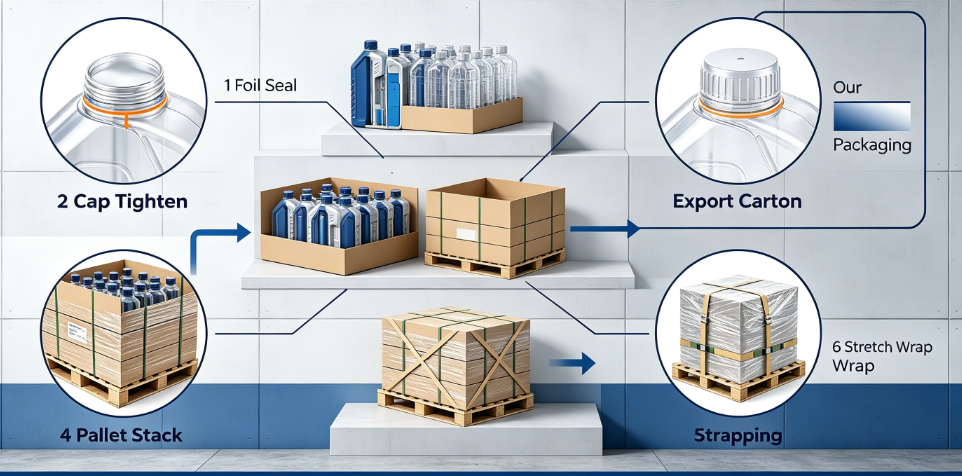
Most sourcing teams are not shopping for packaging in the abstract. They need a container system that can survive filling, sealing, palletizing, stacking, temperature swings, and the abuse that comes with real-world transit. That is especially true for bulk liquid transport protection, where the payload is dense, sloshy, and hard to recover if it escapes. Coolant and antifreeze products are unforgiving in this respect: a tiny leak may not sound dramatic until it contaminates a warehouse floor or turns a pallet into a hazmat-style cleanup.
In practice, buyers usually weigh three questions. Will the package stay closed? Will it stay stable under transport conditions? And can operators fill and handle it without slowing the line? Those questions matter whether the shipment is going by truck across a region or in an antifreeze ocean shipping package bound for export lanes where humidity, pressure change, and rough handling can all become part of the story.
Common package formats and where they fit
There is no single container that suits every coolant program. The right choice depends on fill volume, distribution model, and the degree of risk your route creates.
Small containers and pails
Smaller formats are often used when end users need easy dispensing or when the product is sold through industrial channels in modest quantities. They are simpler to handle, but closures and liner integrity matter more than many buyers expect. A good cap design is only useful if it stays consistent during production and shipping.
Drums and intermediate bulk options
For higher volumes, drums and larger liquid containers offer better efficiency per unit shipped. They can also improve bulk fluid transit protection when paired with proper closures, secondary containment, and pallet discipline. Still, larger containers are not automatically safer. The bigger the volume, the bigger the consequence of a failure, so fill control and sealing discipline become more important, not less.
Export-oriented packaging
When coolant moves overseas, packaging takes on another layer of scrutiny. An antifreeze ocean shipping package must withstand longer dwell times, more handling points, and more environmental variation than a domestic shipment. Buyers should be wary of assuming that a package that performs well on a short truck route will behave the same way on a sea lane. That is a common mistake, and it is expensive.
What makes a package truly leak-proof
“Leak-proof” is a practical term, not a decorative one. In the field, it usually comes down to the full system: container body, closure, liner or seal, filling method, and how the pallet is secured. One weak element can undermine the rest. A closure that is technically sound but inconsistently applied is still a risk. A robust bottle or jug with poor cap torque is still a liability.
Buyers should also consider compatibility between the coolant formula and the package materials. Some fluids are benign, while others can stress seals or create long-term degradation. General industry practice is to validate package-fluid compatibility before scaling up, especially when a product will sit in storage for extended periods.
Selection criteria that save trouble later
When comparing leakproof coolant containers, practical buyers often look past the catalog photo and ask for information on closure design, pallet configuration, material compatibility, and transport testing approach. That is the right instinct. A supplier should be able to explain how the package is intended to perform, not just what it looks like on paper.
It also helps to match package choice to route conditions. Short domestic lanes may tolerate one format; export and high-vibration routes may require another. If a supplier cannot speak clearly about filling discipline, stacking limits, or how their package supports bulk liquid transport protection, that is a sign to slow down and ask more questions.
Common mistakes buyers still make
One recurring mistake is treating coolant packaging as a commodity and choosing only on unit price. Another is assuming that a package used successfully for one fluid will work for every formulation. Teams also get into trouble when they skip a pilot run and move straight to production volume. That is usually where minor problems become visible: cap variation, seepage at the closure, label damage, or handling issues at the pallet stage.
A more subtle mistake is overlooking downstream handling. If the package is hard to pour, hard to stack, or prone to scuffing, the problem eventually shows up in the customer’s receiving area. At that point, it is no longer just a packaging issue. It becomes a product experience issue.
Practical buyer advice before you place the order
Request samples. Review the closure method. Ask how the package behaves in temperature changes and in transit. If the shipment is export-bound, ask whether the design is intended for long-distance distribution rather than only local delivery. If your program involves multiple SKUs, confirm that the same packaging approach will not create confusion on the line.
And if the application is sensitive, build in a little margin. Packaging that is merely adequate on a good day tends to fail on a bad one. That is especially true in industrial fluids, where weight, vibration, and human handling all work against you.
FAQ
Is leak-proof coolant packaging only for export?
No. Domestic shipments can fail too. Export simply increases the number of variables.
Do larger containers always increase risk?
They increase the consequence of failure, so they require tighter control. That is not the same as being inherently unsafe.
What should a buyer ask first?
Start with closure reliability, material compatibility, and whether the package matches the actual shipping route.
Next step
If you are comparing packaging options for coolant, antifreeze, or other bulk fluids, build the decision around transit conditions rather than appearance alone. A container that protects product through filling, movement, and delivery is usually the one that protects margin as well. For sourcing teams, that is the real test.
Welcome to contact GAFLE for more information & cooperation!
peter
ZHEJIANG GAFLE AUTO CHEMICL CO.,LTD
Tel:86-579-8222 1665
Fax:86-579-8246 4690
Cel/Wechart:86-13335993986
E-mail:peter@gafle.net
Web:www.gafle.net