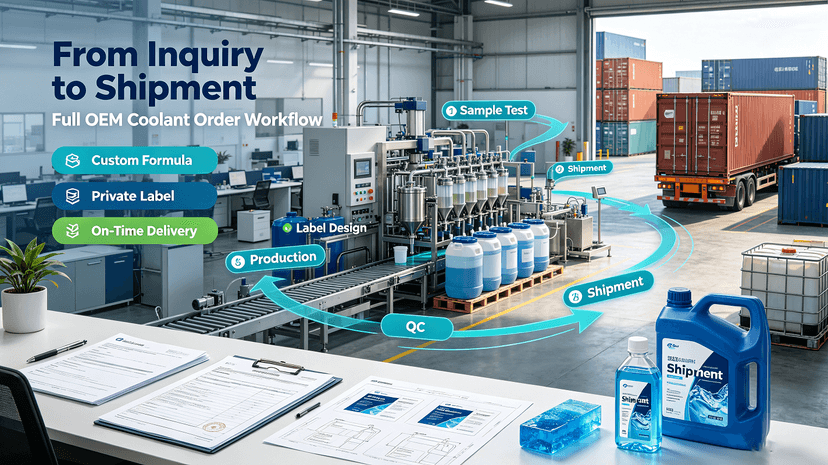
What the OEM coolant order process is really solving
The OEM coolant order process is not just a purchasing formality. For engineers, sourcing teams, and product managers, it is the point where formulation, packaging, labeling, logistics, and end-use expectations have to line up without surprises. Coolant sounds straightforward until a program needs the right base chemistry, the right pack size, the right brand presentation, and a supply plan that does not interrupt production or aftersales support.
That is why buyers usually want more than a price quote. They need to understand how the antifreeze workflow is structured, what information the supplier needs up front, and where the common bottlenecks show up. A missed spec, a vague label requirement, or an incomplete forecast can slow a launch more than the product itself.
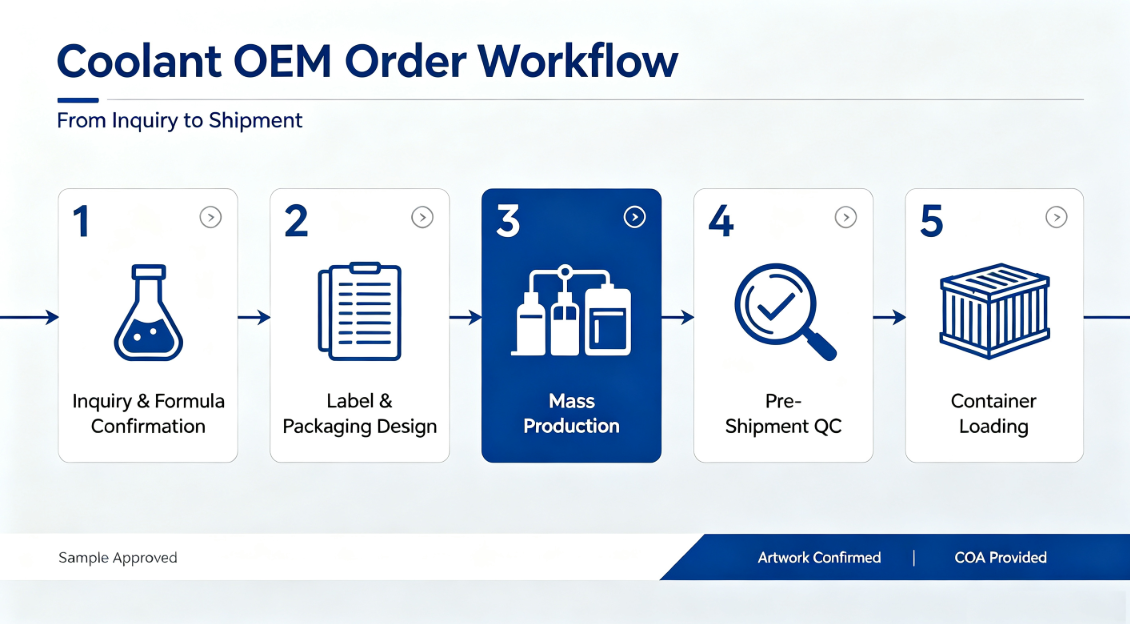
What typically happens from inquiry to shipment
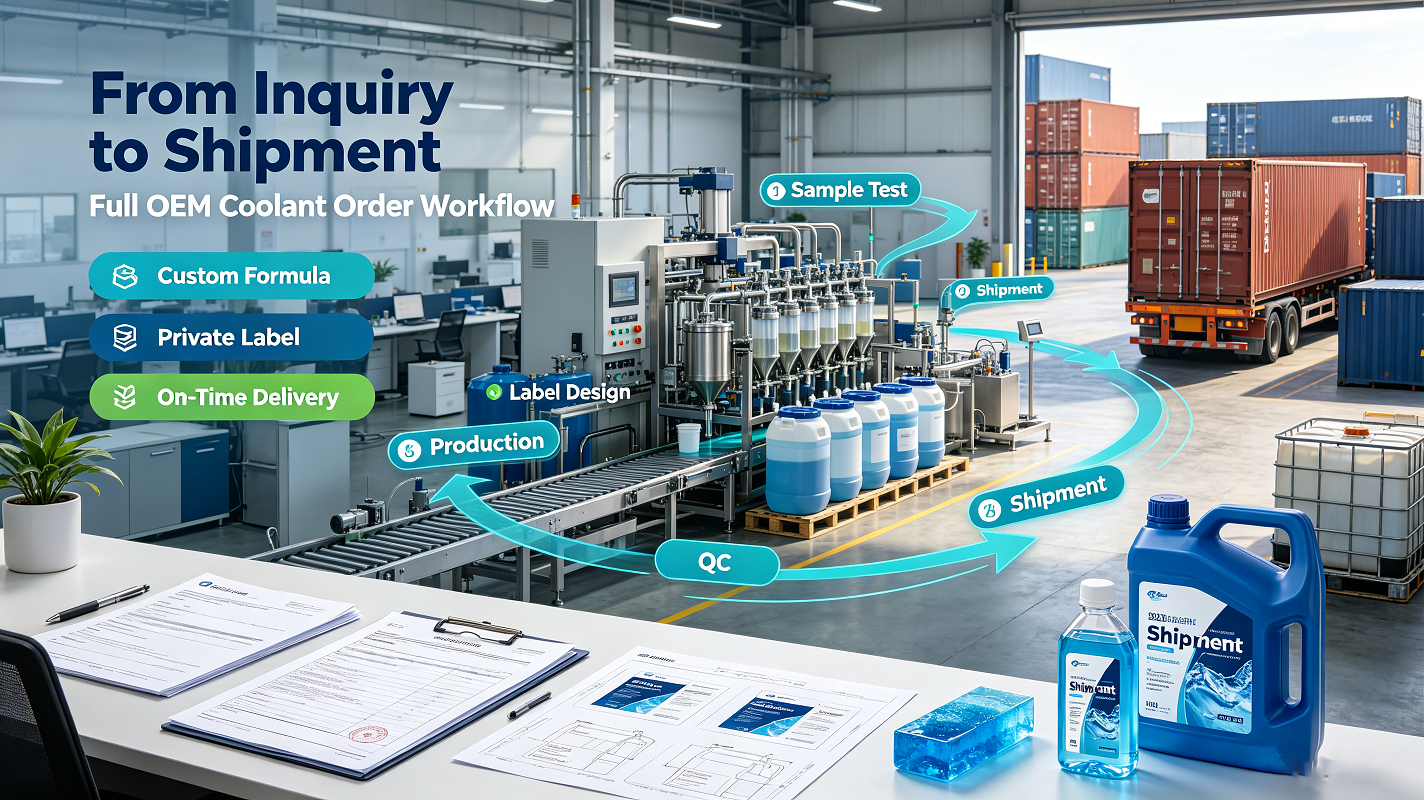
Most programs move through a fairly standard sequence, even if each supplier names the steps differently.
1. Product definition
The buyer starts by defining the application: passenger vehicle, heavy-duty equipment, industrial use, or another cooling system environment. At this stage, the supplier usually needs the target performance profile, packaging format, and whether the customer wants private label antifreeze or a standard branded product.
For sourcing teams, this is where small wording differences matter. “Universal” and “application-specific” are not interchangeable, and neither are concentrate and premix. If the order brief is loose, the quote will usually be loose too.
2. Formulation and packaging alignment
If the request involves custom bulk antifreeze or a tailored fill volume, the supplier has to confirm whether the product chemistry and packaging line can support it. That can include container type, case configuration, pallet pattern, and label placement. Some buyers focus only on formulation, but packaging often creates the real schedule pressure.
In custom coolant branding projects, the label becomes part of the product strategy. That means artwork approval, regulatory text placement, and brand consistency all need to be handled before production starts. A clean formulation can still be delayed by a badly prepared label file.
3. Sampling, approval, and documentation review
Before a full run, many buyers request samples or pre-production references. This is the stage to check appearance, packaging fit, and any paperwork needed for internal approval. Depending on the project, buyers may also ask for product data sheets, handling guidance, or other documentation that supports incoming inspection and market launch.
A practical caution here: do not approve a sample only because the liquid looks right in the bottle. The commercial risk is usually in consistency, not appearance.
4. Production and fulfillment
Once the order is confirmed, the supplier schedules production, fills the containers, applies branding, and arranges shipment. Lead time depends on many variables: order size, packaging complexity, artwork readiness, and raw material availability. There is no useful shortcut around that reality. The best buyers ask early how each variable affects the schedule.
Quick comparison: what buyers are usually choosing between
A good way to approach the OEM coolant order process is to separate the decision into a few choices rather than one large yes-or-no approval.
- Standard product versus private label antifreeze
- Small packaged quantity versus custom bulk antifreeze
- Concentrate versus premixed fill
- Simple label update versus full custom coolant branding
- Off-the-shelf packaging versus program-specific packaging
These choices affect cost, schedule, storage, and customer perception. A distributor launching a house brand will care far more about branding and shelf presentation than a plant maintenance buyer. An equipment OEM may care more about packaging consistency and documentation than retail-facing graphics.
Selection criteria that matter more than the brochure
When buyers compare suppliers, they often over-focus on the technical language and under-focus on execution. In practice, the important questions are simpler.
Does the supplier understand the intended application? Can they support the packaging format you need? Are they responsive during artwork and sample review? Can they handle repeat orders without forcing you to rebuild the specification every time?
Those questions matter because coolant purchasing is usually not a one-time event. It is a recurring supply relationship, and recurring programs fail when the first order is treated as the only order.
Common mistakes buyers still make
One common mistake is assuming the same spec can be reused across all markets without checking local label or handling expectations. Another is leaving artwork approval until the production window has already started. That usually creates avoidable delays.
A third mistake is ordering too close to inventory depletion. Coolant is not glamorous inventory, but when a production line or distributor network needs it, there is little room for improvisation.
Practical buyer advice for a smoother workflow
Prepare the core inputs before you request a quote: application, product type, package size, expected annual volume, branding needs, and any document requirements. If you already know you need private label antifreeze or custom coolant branding, say so early. If the order may grow into a recurring program, mention that too.
It also helps to assign one internal owner for artwork, one for technical approval, and one for purchasing. Too many parallel approvals can slow a simple order more than a complex formulation does.
FAQ: the questions buyers ask most
Is the OEM coolant order process the same for every supplier?
Not exactly. The basic flow is similar, but the details vary by packaging capability, documentation handling, and whether the supplier is set up for branded programs.
Do I need to know the full formulation before I start?
Not always. Many buyers begin with the intended application and packaging goals, then refine the product choice with the supplier.
What slows these projects down most often?
Artwork delays, incomplete specs, and last-minute changes. Those are the usual suspects.
What to do next
If you are planning a coolant launch, a private-label refresh, or a supply switch, the best next step is to collect the basic program details in one brief and send them for review. A clear brief makes the OEM coolant order process faster, reduces back-and-forth, and gives you a more realistic picture of what can ship cleanly the first time.
Welcome to contact GAFLE for more information & cooperation!
peter
ZHEJIANG GAFLE AUTO CHEMICL CO.,LTD
Tel:86-579-8222 1665
Fax:86-579-8246 4690
Cel/Wechart:86-13335993986
E-mail:peter@gafle.net
Web:www.gafle.net