Why premium brake fluid deserves more attention than it usually gets
Most buyers do not think about premium brake fluid until the pedal feels different, the reservoir is due for service, or a workshop is trying to explain why a simple top-up can turn into a proper flush. That is a mistake, because brake fluid is not just another consumable. It is the hydraulic medium that helps a vehicle stop predictably, and in a braking system there is not much room for sloppiness.
For sourcing managers, service teams, and product buyers, the real decision is usually straightforward: which brake fluid specification matches the vehicle, what packaging size makes sense for the channel, and how much weight to give to supplier claims such as “high boiling point” or “professional grade.” The label may look simple, but the buying decision is not.
What the DOT rating tells you
The products described here are DOT 4 brake fluid offerings for automotive hydraulic braking systems. That matters more than the branding on the bottle. DOT 4 is a widely used specification for passenger cars, performance-oriented road vehicles, motorcycles, and light vehicles that call for it. It is also commonly used in workshop service and fleet maintenance.
In practical terms, brake fluid must transmit force from the pedal to the brake components without compressing, while also coping with heat and moisture over time. As brake systems get hotter during repeated stops, fluid quality becomes more important. That is why buyers compare DOT 3 brake fluid, DOT 4 brake fluid, DOT 5 brake fluid, and DOT 5.1 brake fluid so carefully. They are not interchangeable by habit or guesswork.
A quick note on the DOT families
DOT 3 and DOT 4 are commonly glycol-based brake fluids, while DOT 5 is the outlier in many applications and is not the same type of fluid. DOT 5.1 sits closer to DOT 4 in some service discussions, but compatibility still depends on the vehicle specification and the system requirements. The safe move is always to check the OEM or service manual rather than assuming that “higher number” means better fit.
What is visible in the supplied product data
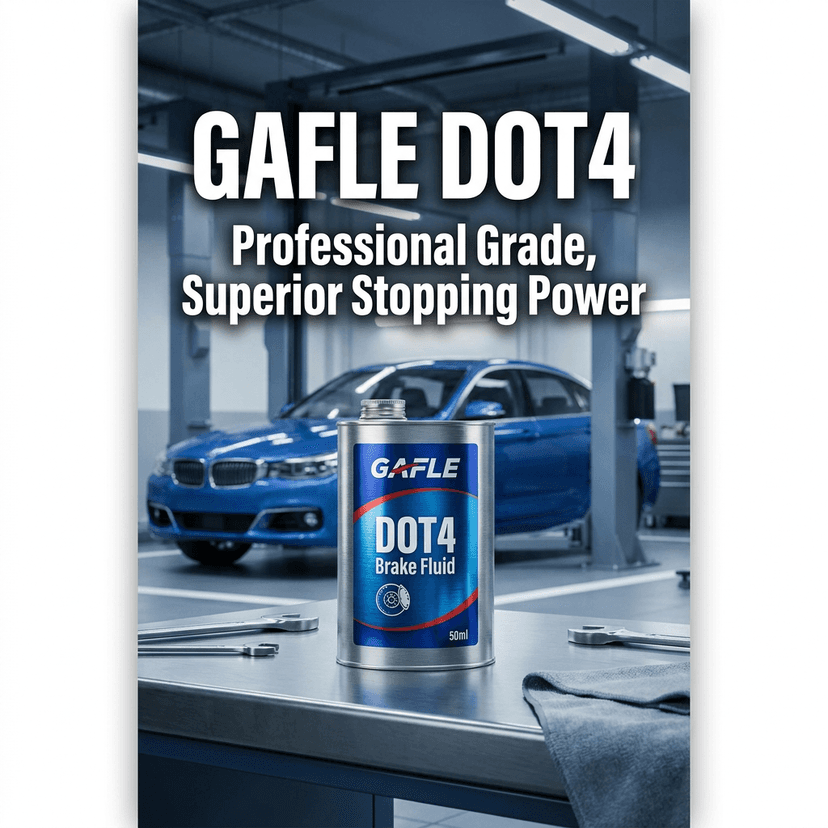
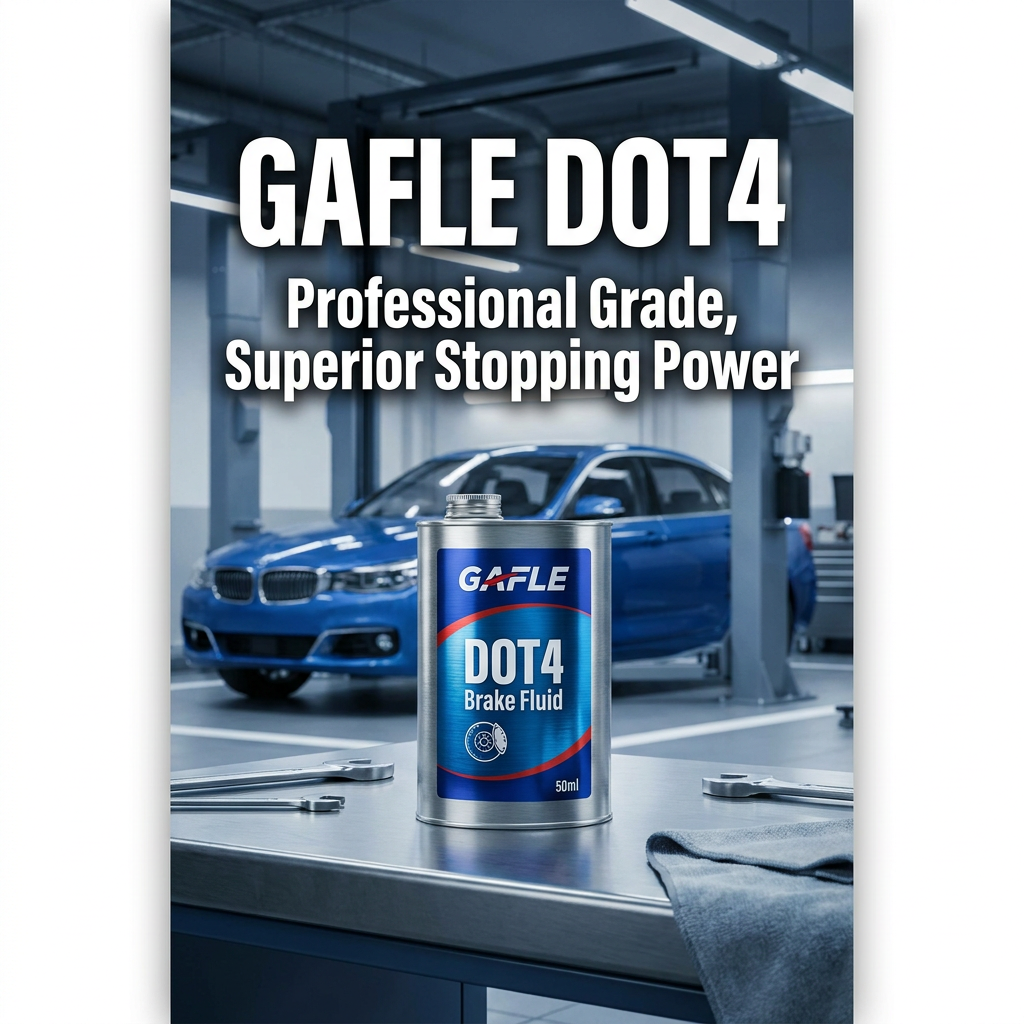
The supplied product information shows a few concrete points worth noting. One version is labeled GAFLE DOT4 BRAKE FLUID in a clear plastic bottle with a black ribbed screw cap, and the visible fill size appears to be 30 ml. Another version is shown in a metallic cylindrical canister with a threaded cap and printed label, with 50 ml indicated on the label. A third description shows a metal-looking bottle labeled GAFLE, BRAKE FLUID, HIGH-PERFORMANCE SYNTHETIC FORMULA, and DOT 4.
Those details are useful for packaging decisions. Small-format bottles can suit retail shelves, workshop trial packs, or compact maintenance kits. Metal canisters may present a more technical or professional look. But packaging is not a substitute for verified performance data, and the claims on the label should be treated as supplier marketing unless independently documented.
How buyers should evaluate a DOT 4 brake fluid product
For engineering and procurement teams, the first filter is compatibility. If a vehicle or service program specifies DOT 4, then a DOT 4 product is the starting point, not an upsell. From there, buyers should look for consistency in labeling, container integrity, and traceability across the supply batch. In this category, a clean package and a clear specification matter more than flashy graphics.
The second filter is use case. A workshop that does routine brake fluid replacement needs reliable replenishment packaging. Auto parts retail may prioritize shelf appeal and recognizable labeling. Fleet maintenance tends to care about repeatability and service discipline. The same fluid can serve different channels, but the pack format should match the job.
Common mistakes to avoid
One common mistake is treating all brake fluids as interchangeable because they “all stop the car.” They do not. Another is buying by price alone and ignoring the specification on the cap or label. A third is assuming marketing phrases like “superior stopping power” mean the product has verified performance data published somewhere. That may be true, but it is not demonstrated in the information provided here.
Also, don’t ignore contamination control. Brake fluid is sensitive stuff in a workshop setting. Once a container is opened, handling practices matter. Loose caps, dirty funnels, and mixed storage can create problems that have nothing to do with the formulation itself.
Where premium positioning actually helps
The term premium brake fluid is not just a branding exercise when it is used carefully. Buyers often use it to describe a product that combines the correct DOT specification with stable packaging, dependable labeling, and a message that signals confidence to end users. In retail, that can support easier shelf selection. In service environments, it can reduce hesitation when a technician is choosing a replacement fluid for a DOT 4 system.
Still, premium should be earned, not assumed. If you are comparing suppliers, ask for the basics: the exact DOT grade, packaging size, storage guidance, and any available technical documentation. If those items are vague, the product may still be usable, but the buying decision becomes weaker.
Practical buying advice for sourcing teams
If you are evaluating this kind of automotive maintenance chemical for a catalog, workshop, or private-label program, start with the specification and then work outward. Check whether the packaging format suits your channel. Confirm whether the label language matches your market. Make sure no one is relying on an unsupported assumption about DOT 3 brake fluid or DOT 5 brake fluid compatibility.
For product teams, the packaging sizes shown here — 30 ml and 50 ml — suggest compact maintenance use rather than bulk service supply. That may be exactly right for retail add-on sales or small repair kits. It is less useful for high-volume workshop dispensing, where larger formats usually make more sense.
FAQ
Is DOT 4 brake fluid the right choice for every vehicle?
No. It is the right choice only when the vehicle or service specification calls for DOT 4.
Can DOT 4 replace DOT 3 by default?
Not by default. Compatibility should be checked against the OEM recommendation and service requirements.
Does “high-performance synthetic formula” guarantee better braking?
No verified claim can be made from the supplied data alone. It is a label statement, not test evidence.
Are the small bottle sizes useful?
Yes, for top-ups, retail sales, and compact service kits. They are not designed for every workshop scenario.
What to do next
If you are selecting a premium brake fluid for retail, workshop, or fleet use, treat DOT 4 as the starting point and packaging as the second decision. Ask for technical data, verify the intended vehicle fit, and make sure the format matches your channel. That saves time later, and in brake service, avoiding uncertainty is worth more than a clever label.