1. Strict local traffic safety regulations are the primary root cause
Every country and region formulates independent automotive safety standards based on local traffic accident data, which directly defines the minimum brake fluid grade allowed for road vehicles.
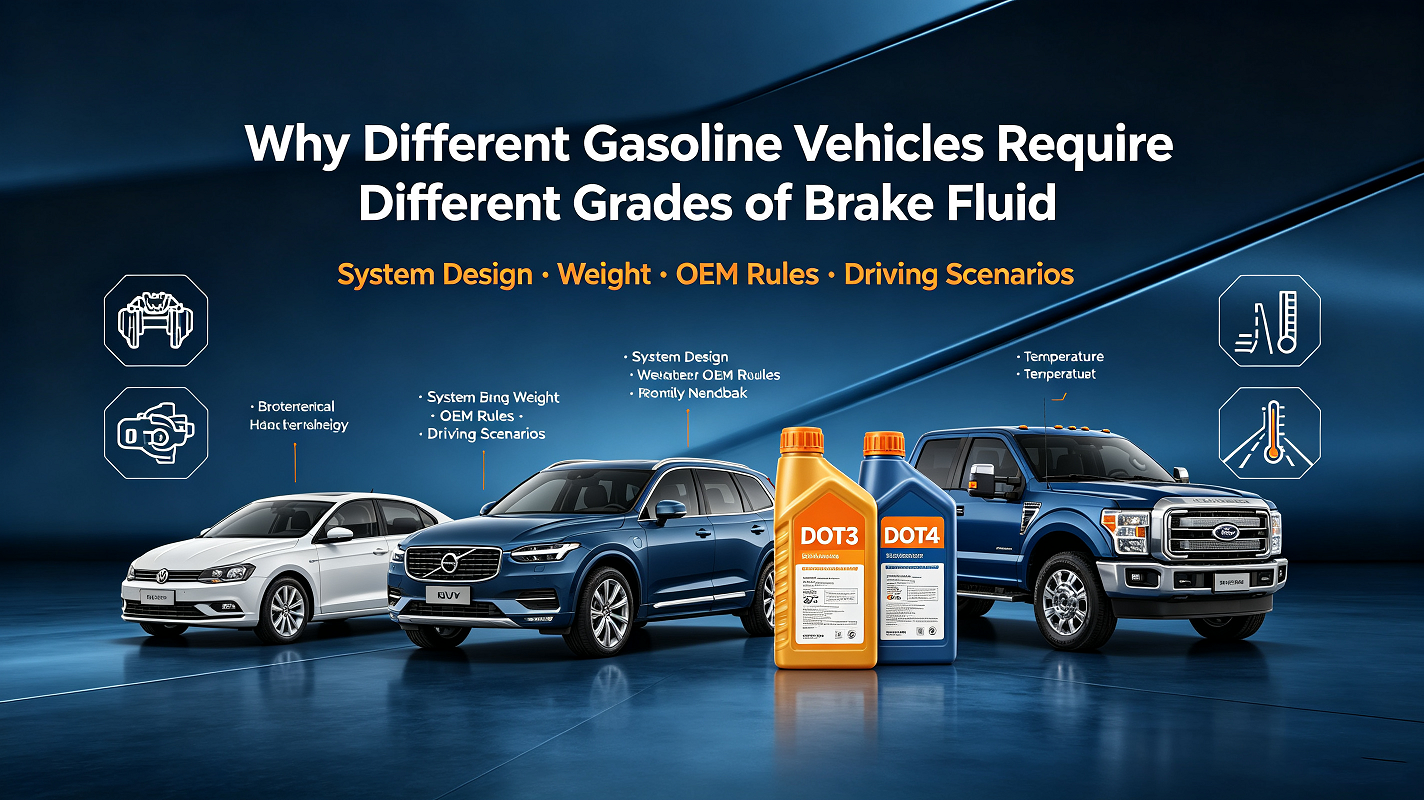
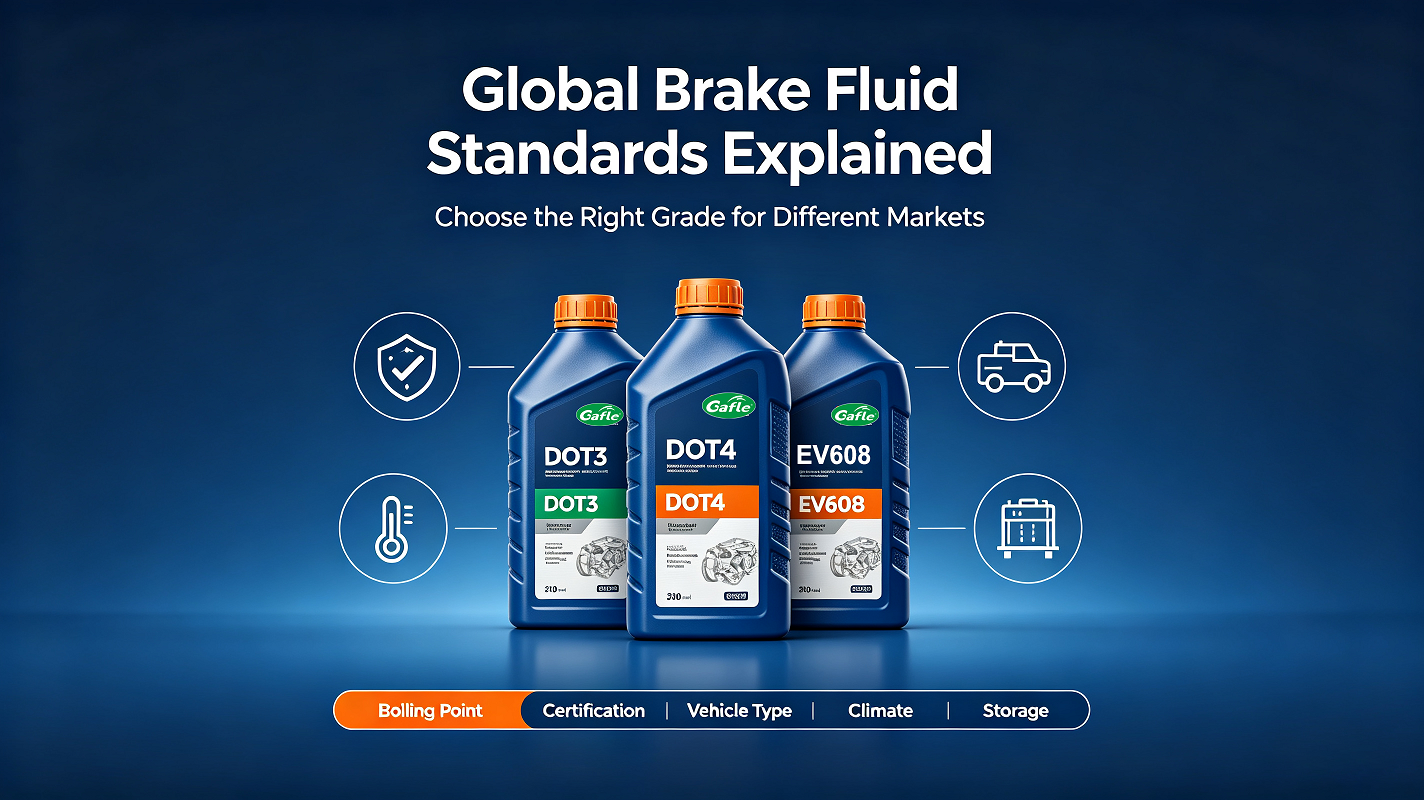
- North America & Global mainstream markets: Follow US FMVSS 116 DOT standard (DOT3, DOT4, DOT4 EV608, DOT5.1). Most passenger cars require DOT4 as the baseline standard, and EVs mandate special EV brake fluid.
- European Union: Enforce ECE R40 certification. EU high-performance cars, heavy vans and electric vehicles ban low-boiling DOT3 fluid; only DOT4 or higher is permitted for road registration.
- Africa (Kenya, South Africa): Comply with SANS local standards. Long-distance mountain driving and high ambient temperatures raise the minimum boiling point threshold, so DOT3 is barely used in formal auto shops.
- Southeast Asia: Countries like Vietnam, Thailand allow DOT3 for old low-displacement motorcycles, but new gasoline passenger cars must use DOT4 per updated national transport laws.
Regulators adjust standards to reduce brake failure accidents caused by overheating, creating obvious regional specification gaps.
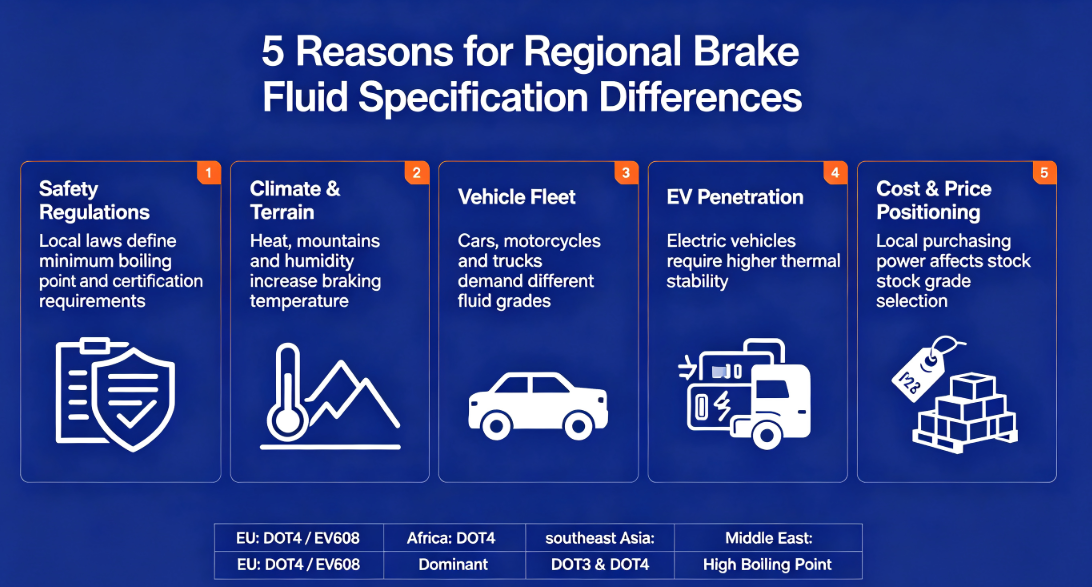
2. Local climate & road conditions change brake fluid performance requirements
Ambient temperature, terrain and driving habits decide how much heat brake systems generate, which sets different demands for brake fluid boiling points.
- Hot, high-temperature regions (Middle East, East Africa): Year-round extreme heat plus mountain slopes lead to frequent heavy braking. Low-spec DOT3 boils easily and forms air bubbles, so DOT4 or EV608 high-boiling fluid becomes the mainstream choice.
- Cold northern regions: Low humidity requires anti-freezing brake fluid additives, while they still maintain DOT4 as the minimum grade to handle highway high-speed braking heat.
- Flat low-temperature Southeast Asian towns: Light daily commuting creates less brake heat, so low-cost DOT3 remains acceptable for old motorcycles and entry-level cars.
Regions with harsh driving environments always adopt stricter, higher-spec brake fluid standards.
3. Diverse local vehicle fleets fuel different specification demands
The mix of vehicles running on local roads directly shapes market demand for brake fluid grades.
- Markets dominated by fuel passenger cars & EVs (EU, USA, China): Modern cars use multi-piston calipers and regenerative braking on EVs. These systems generate sustained high heat, requiring high-performance DOT4 and dedicated DOT4 EV608 brake fluid.
- Motorcycle-dominated markets (Vietnam, Indonesia, Nigeria): Millions of small-displacement motorbikes with simple brake systems only need cost-effective DOT3 fluid for daily short trips.
- Heavy commercial vehicle markets (South Africa, Saudi Arabia): Trucks, buses and trailers bear heavy loads; local laws forbid DOT3, and DOT4 full-synthetic brake fluid is mandatory for all commercial fleets.
If one region’s vehicle stock is mostly old light vehicles, low-spec brake fluid will occupy most of the local market.
4. The rapid rise of electric vehicles creates brand-new regional specification divides
EV penetration rate varies wildly across the world, which opens a new gap in brake fluid standards between regions.
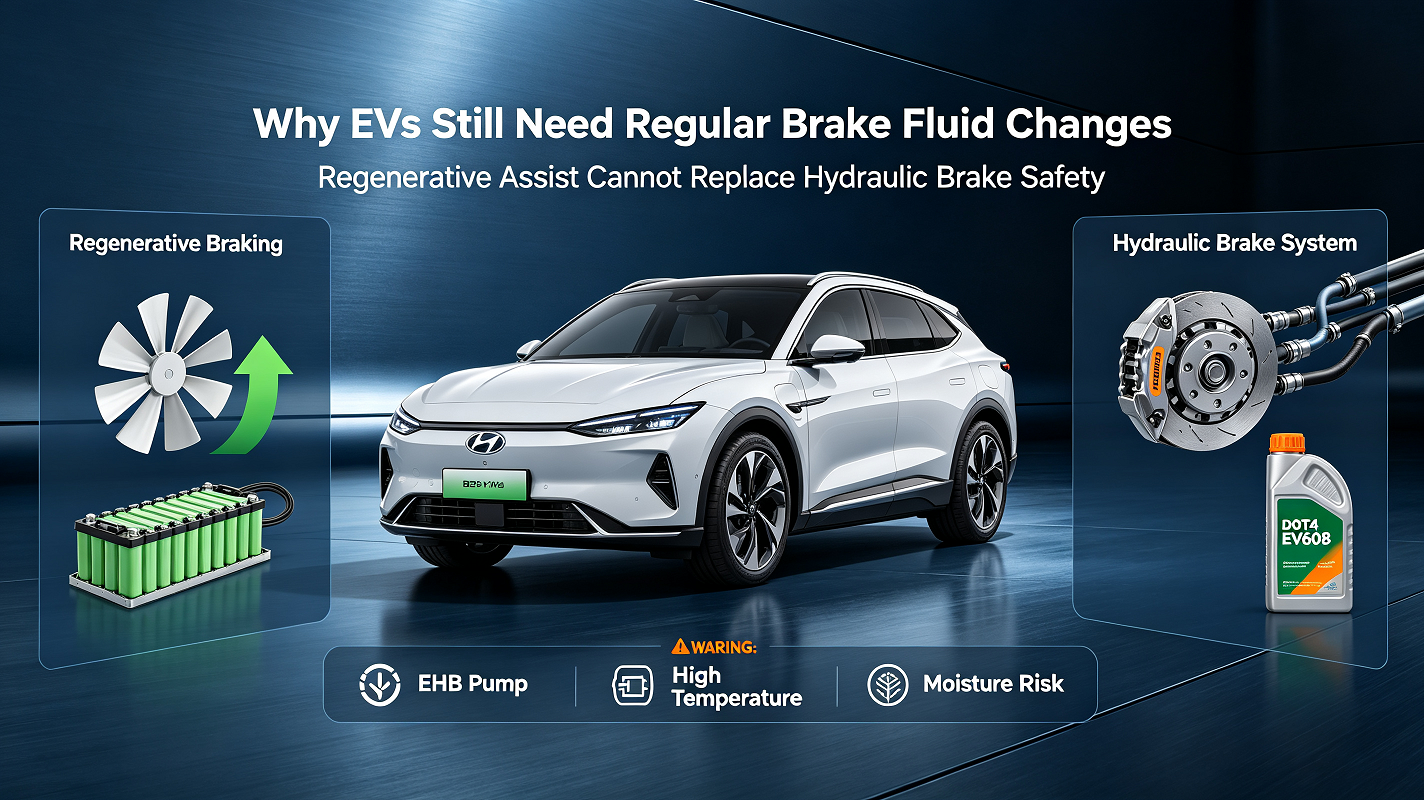
- High-EV-adoption zones (Europe, North America): Most new energy cars use electro-hydraulic brake systems with frequent regenerative braking. Traditional DOT4 cannot resist long-cycle high temperatures, so special EV brake fluid (DOT4 EV608) is officially recommended by local automakers and garages.
- Low-EV markets (most African & Southeast Asian nations): Local roads are still full of fuel cars and motorcycles. Demand for EV-specific brake fluid stays tiny, and wholesalers only stock conventional DOT3/DOT4.
Countries pushing carbon neutrality update vehicle brake fluid standards faster to match EV technical upgrades.
5. Import cost & local market price positioning affect distributor stock choices
Even if national laws permit high-spec brake fluid, local importers and auto shops select specifications based on local consumer purchasing power.
- Low-income emerging markets: Consumers prioritize low maintenance costs. Distributors import large volumes of cheap DOT3 to fit local budget demand, even though DOT4 is technically safer.
- High-income mature markets: Car owners prioritize driving safety over minor cost differences. Repair shops only stock premium DOT4 and EV brake fluid, as customers refuse low-grade DOT3 products.
Wholesalers balance regulatory rules and local spending power to decide which brake fluid specifications to import in bulk.
Final Conclusion
No single universal brake fluid standard fits all global markets. Regional gaps stem from 5 key factors: safety regulations, climate & terrain, local vehicle types, EV popularity, and local consumption budgets.
For global auto chemical importers, GAFLE provides full-series brake fluid matching every regional standard: DOT3, universal DOT4, and exclusive DOT4 EV608 fluid for electric vehicles. We also support custom packaging and certification documents for each target market to help you meet local regulatory and retail demands.
Contact our sales team to get market-matched brake fluid solutions for your country.
Welcome to contact GAFLE for more information & cooperation!
peter
ZHEJIANG GAFLE AUTO CHEMICL CO.,LTD
Tel:86-579-8222 1665
Fax:86-579-8246 4690
Cel/Wechart:86-13335993986
E-mail:peter@gafle.net
Web:www.gafle.net
peter
ZHEJIANG GAFLE AUTO CHEMICL CO.,LTD
Tel:86-579-8222 1665
Fax:86-579-8246 4690
Cel/Wechart:86-13335993986
E-mail:peter@gafle.net
Web:www.gafle.net