
For global auto aftermarket wholesalers and brand owners, receiving leaking brake fluid after weeks of ocean transit is one of the most costly headaches. Spilled fluid stains entire pallets, ruins printed packaging labels, triggers consumer complaints, creates customs clearance delays, and causes direct inventory loss.
Many chemical suppliers only focus on product performance while ignoring packaging and transit protection, leading to frequent leakage claims. At GAFLE, we build a complete multi-stage leak-proof packaging system, with strict quality control running through filling, capping, cartoning, pallet wrapping and container loading. Our full-chain protection ensures zero leakage damage no matter how rough the sea voyage is.
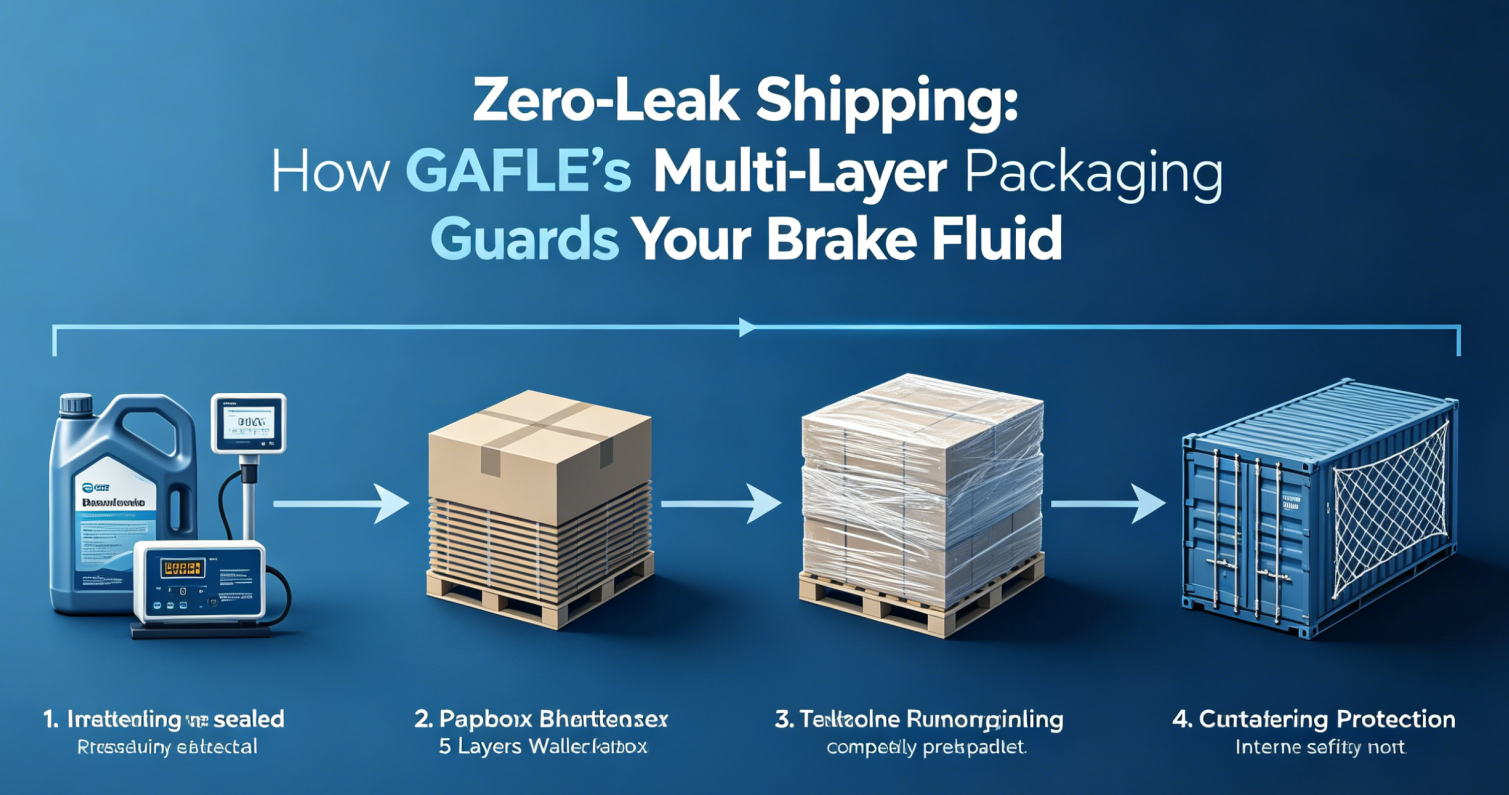
1. Dual Sealing & 100% Pressure Leak Test at Filling Workshop
All leakage risks originate from the filling and capping stage, so we set up dual anti-seep barriers and full inspection for every single can before packaging:
- Double-layer sealing structure for all metal cans: Each cap is equipped with a built-in thick silicone anti-leak gasket plus precision locking screw threads. Even under temperature fluctuation and stacking extrusion inside containers, the dual seal completely blocks liquid seepage.
- Automatic vacuum air pressure leak testing line: Every filled can goes through machine pressure inspection. Any tiny gap on bottle bodies or loose caps will trigger automatic rejection to eliminate hidden leakage risks.
- Secondary manual spot check: QC staff randomly squeeze finished cans to recheck cap tightness. Products with loose lids are picked out and re-sealed before entering cartons.
This primary inspection barrier eliminates over 90% of potential leakage risks at the source. No defective sealed cans flow into later packaging links.
2. Reinforced 5-Layer Export Cartons with Internal Separation
Ordinary thin cartons deform easily under pallet stacking weight, squeezing metal cans and causing breakage. Our export cartons are customized exclusively for long-distance overseas shipping:
- Thickened 5-layer high-compression corrugated cardboard, capable of bearing heavy stacking pressure inside 40HQ containers without bending or collapsing.
- Custom molded inner divider cards separate each brake fluid can individually, preventing collision and friction between metal tins during bumpy land transport and vessel rocking at sea.
- Waterproof coated carton surface blocks humid sea air and rainwater, avoiding box softening and structural damage during port handling.
Every outer carton is sealed with cross-shaped reinforced packing tape to stop box splitting under rough forklift operation.
3. Full Pallet Stretch Film Wrapping & Corner Anti-Collision Protection
Single carton protection is insufficient. We add pallet-level fixation as the second major anti-leak layer:
- Each full pallet of cartons is tightly wrapped with high-toughness transparent stretch film for 6–8 complete layers, fully covering top, bottom and four vertical sides. All cartons are locked into one rigid integrated block to avoid sliding, tilting or tipping inside the container.
- Hard plastic corner protectors are attached to four vertical edges of every pallet, buffering impact from container inner walls or adjacent cargo pallets.
This pallet wrapping solution prevents extrusion deformation caused by cargo shifting during braking trucks and swaying ocean vessels.
4. Standardized Container Loading & Anti-Shift Transit Measures
Our protection process does not end after pallet wrapping. We implement strict container loading rules to eliminate cross-pallet extrusion risks:
- Pallets are arranged with uniform safe gaps between each unit, avoiding tight squeezing that crushes carton edges.
- Heavy-duty cargo safety netting is fixed on the front face of stacked pallets to hold the whole cargo block firmly in place, preventing large-scale sliding during long sea transport.
- Dry desiccant bags are placed inside container empty gaps to absorb humid maritime air, stopping carton dampness and reduced compression strength.
Professional loading supervisors supervise the whole process to confirm all anti-shift and moisture-proof measures are fully completed before container locking.
5. Closed-Loop QC Runs Through Every Packaging Stage
Stable leak-proof performance relies on quality checks covering every single link, instead of one-time final inspection before shipment:
- Filling stage: Automatic sealing pressure test + manual cap tightness re-inspection
- Cartoning stage: Visual screening for cracked cans, broken cartons and incomplete tape sealing
- Palletizing stage: Inspection of wrapping tightness and corner protector installation status
- Pre-shipment stage: Random unpacking of sample pallets to recheck internal can sealing and liquid status
This full-link quality control blocks potential leakage risks at the earliest possible stage, forming a complete closed-loop management system from production to delivery.
Core Benefits Of Our Multi-Layer Anti-Leak System For Global Partners
Most low-cost auto chemical manufacturers only adopt basic single-layer packaging without systematic leak testing and transit protection, resulting in frequent after-sales leakage compensation for overseas buyers. GAFLE’s integrated packaging protection brings three irreplaceable advantages to your business:
- Zero leakage inventory loss: Multi-layer sealing and transit protection guarantee intact products arriving at your overseas warehouse, cutting compensation and waste costs completely.
- Brand image protection: Undamaged printed OEM labels and complete cartons maintain tidy retail shelf display without stained, messy goods.
- Smooth customs clearance: No spilled liquid inside containers avoids customs inspection delays or environmental hazard fines caused by leaked chemicals.
As a national brake fluid standard drafting manufacturer with decades of export experience, we treat packaging details as important as brake fluid core performance. Every layer of sealing, wrapping and loading protection reflects our commitment to reliable long-term cooperation with global distributors.
If you are tired of receiving damaged, leaking brake fluid shipments from other suppliers, contact our export team to learn more about our standardized leak-proof packaging and full-chain quality control system.
Welcome to contact GAFLE for more information & cooperation!
peter
ZHEJIANG GAFLE AUTO CHEMICL CO.,LTD
Tel:86-579-8222 1665
Fax:86-579-8246 4690
Cel/Wechart:86-13335993986
E-mail:peter@gafle.net
Web:www.gafle.net
peter
ZHEJIANG GAFLE AUTO CHEMICL CO.,LTD
Tel:86-579-8222 1665
Fax:86-579-8246 4690
Cel/Wechart:86-13335993986
E-mail:peter@gafle.net
Web:www.gafle.net