Choosing the best racing brake fluid for track day drifting rally hill climb
If you spend any time pushing a car hard on circuit, in a drift session, or on a long rally stage, brake fluid stops being a background consumable and becomes a performance part. The search for the best racing brake fluid for track day drifting rally hill climb is really a search for consistency: a pedal that stays firm, brakes that resist fade, and a fluid that can handle heat without turning spongy when the session gets serious.
That matters because brake heat builds fast in motorsport. Track days punish repeated stops. Drifting creates frequent heat spikes and lots of left-foot work. Rally and hill climb events can combine rough surfaces, long descents, and sustained braking in ways that reveal a weak fluid very quickly. The wrong choice may not fail dramatically at first; it often just degrades gradually, which is exactly why drivers sometimes miss the warning signs until the pedal changes feel mid-run.
What buyers really mean when they ask for the best fluid
Most engineers and grassroots racers are not looking for a magic bottle. They want a fluid that balances three things: boiling resistance, pedal feel, and service interval. In practical terms, that means a motorsport brake fluid should cope with high temperature while still remaining compatible with the braking system and easy to bleed. A higher boiling point is useful, but it is not the only number that matters.
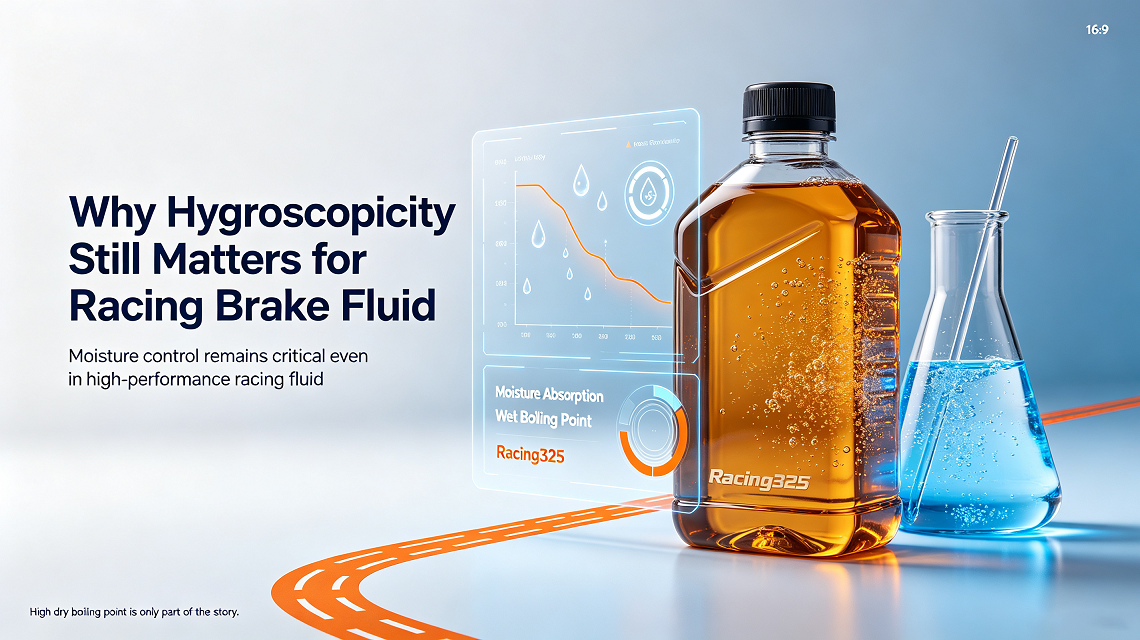
For mixed-use cars, there is always a trade-off. A fluid with excellent high-temperature performance may be more hygroscopic, which means it can absorb moisture over time and lose margin if left in service too long. That is why even good products need regular replacement. The right answer depends on whether the car is a weekend track tool, a dedicated drift car, or a hill climb machine that sees occasional road miles between events.
Key properties to compare before you buy
Boiling behavior
Dry and wet boiling points are the headline figures, and they are worth comparing, but only if you understand what they represent. Dry boiling point is the fresh-fluid benchmark. Wet boiling point reflects the fluid after it has absorbed moisture in service. For buyers, the gap between those two numbers can be just as important as the top-line figure.
Pedal feel and compressibility
Drivers often describe a fluid as “firm” or “soft,” though the effect usually comes from the whole brake system: hose condition, pad choice, caliper heat, and fluid behavior under load. Still, some fluids feel more consistent during repeated hard stops. For hill climb and rally use, where confidence on the pedal matters, that consistency can be more valuable than an impressive spec sheet.
Service life
Racing brake fluid is a maintenance item, not a fit-and-forget upgrade. If a car sees only occasional track days, the fluid may still need scheduled replacement even when mileage is low. Moisture contamination does not care whether the car was driven 200 miles or 2,000. That is a common mistake among first-time buyers.
How to pick racing brake fluid for different motorsport use cases
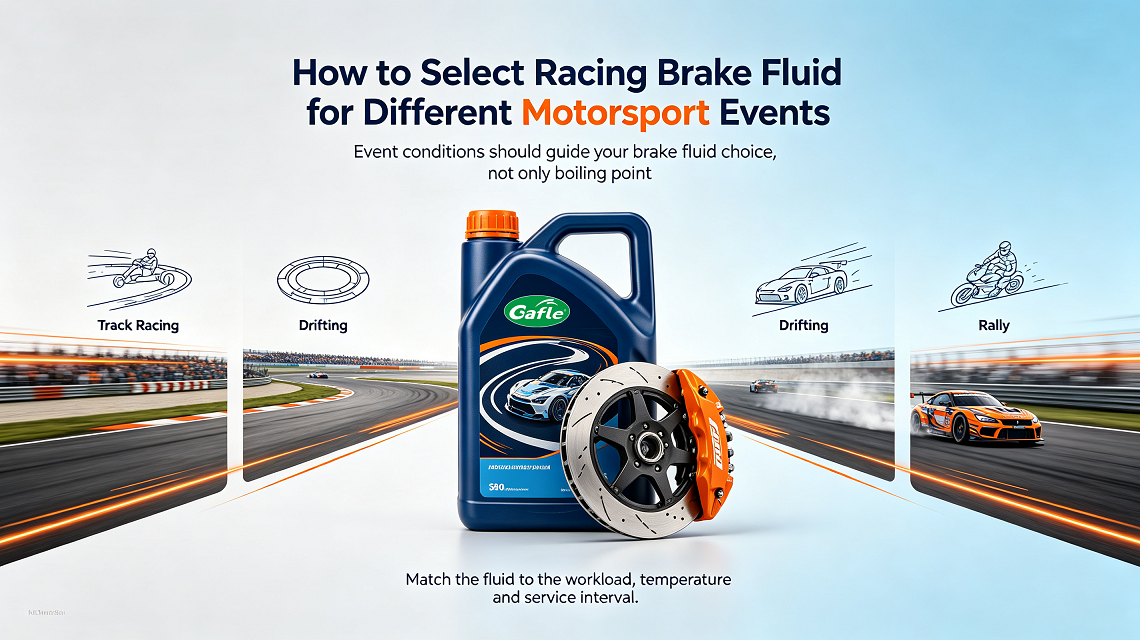
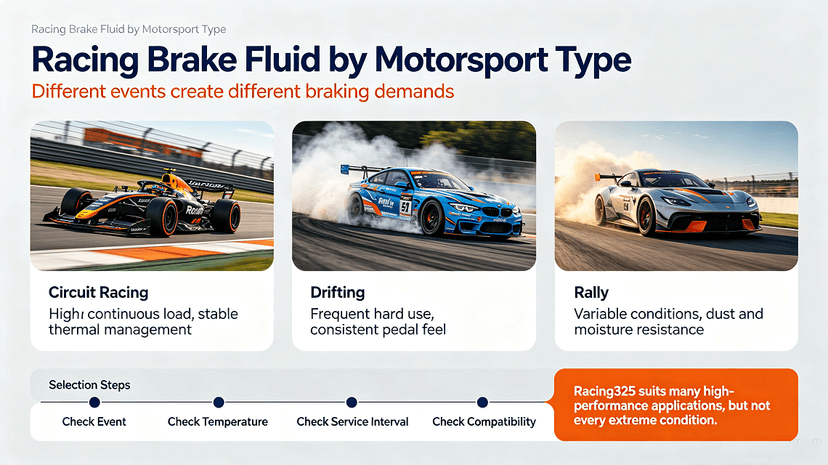
When people ask how to pick racing brake fluid, the best answer usually starts with the event profile.
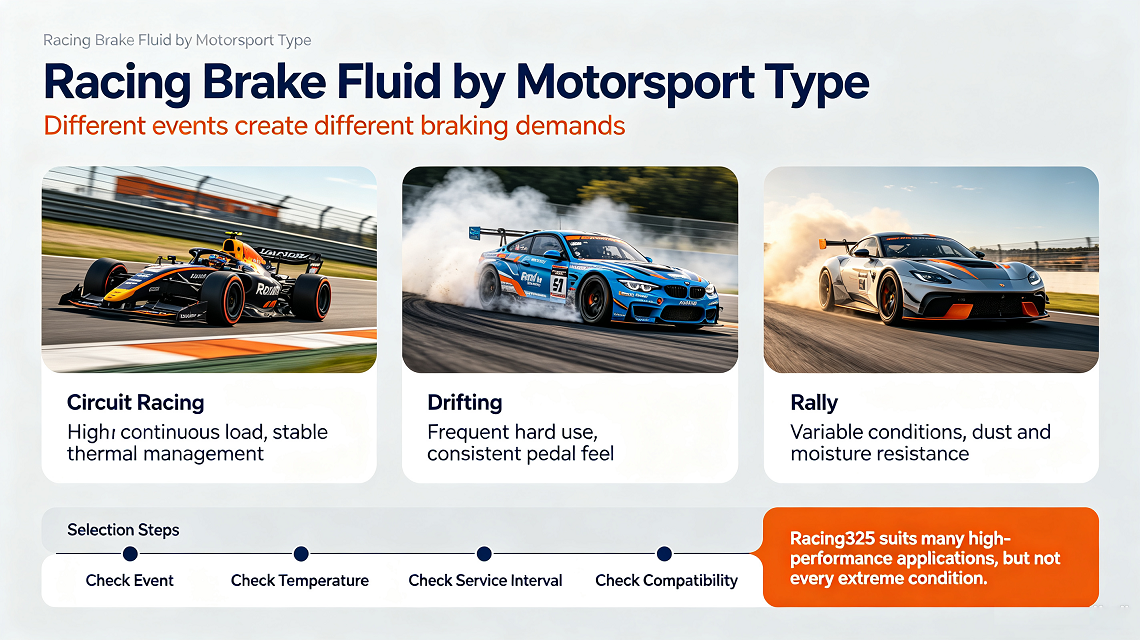
Track day cars benefit from a fluid that delivers a strong higher boiling point and predictable pedal feel through repeated braking zones. Drift cars often need the same heat resistance, but also a fluid that tolerates rapid, repeated handbrake and left-foot inputs without aeration or sudden change in feel. Rally and hill climb applications lean toward thermal stability, especially where braking may be intense but uneven, with surface changes and altitude shifts adding variables the driver does not control.
There is no universal winner. A fluid that is excellent for sprint-style use may not be the best fit for a heavier car on a technical circuit, and a product favored by drift teams may not be the first choice for endurance-oriented time attack. Buyers should match the fluid to the way heat enters the system, not just the badge on the bottle.
Common mistakes that cost performance
The first mistake is choosing only by boiling point and ignoring maintenance habits. The second is mixing old fluid of unknown age with a fresh fill and expecting a clean result. The third is assuming all brake fluids behave the same in every system. Even within the same DOT family, there can be differences in viscosity, compatibility, and service behavior.
Another practical warning: if the brake pedal suddenly feels long after a hard session, do not assume the pads are the whole story. Air in the system, overheated fluid, flexible lines, and even caliper seals can all contribute. Fluid is only one part of the package, but it is one of the easiest parts to overlook.
Practical buyer advice for workshops and teams
For sourcing managers and race-prep workshops, the smartest buying approach is to define the use case first, then shortlist fluids that fit the event temperature profile and service schedule. Keep a record of what was used in each car, when it was changed, and how the pedal behaved after installation. That simple log often reveals more than a spec sheet.
It also helps to stock the same fluid across cars where possible. Standardizing reduces bleed confusion, avoids cross-system uncertainty, and makes it easier to train technicians. If you run mixed programs, you may still need more than one product, but the number should be driven by actual duty cycle, not marketing language.
FAQ: short answers buyers usually want
Is the highest boiling point always best?
Not always. It helps, but service interval, system compatibility, and pedal consistency matter too.
Can one fluid cover track day drifting rally hill climb?
Sometimes, yes, for a crossover car. But dedicated competition use often benefits from a fluid chosen for the specific heat pattern and maintenance plan.
How often should racing brake fluid be changed?
That depends on event intensity, storage conditions, and the fluid itself. For motorsport use, regular replacement is part of normal maintenance rather than an exception.
Final buying note
If you are narrowing down the best racing brake fluid for track day drifting rally hill climb, start with the event, the heat load, and the service routine. The right fluid is the one that gives you predictable pedal feel when the car is hot, not the one with the loudest label. For teams and buyers, that is usually the most useful decision criterion of all.
Welcome to contact GAFLE for more information & cooperation!
peter
ZHEJIANG GAFLE AUTO CHEMICL CO.,LTD
Tel:86-579-8222 1665
Fax:86-579-8246 4690
Cel/Wechart:86-13335993986
E-mail:peter@gafle.net
Web:www.gafle.net