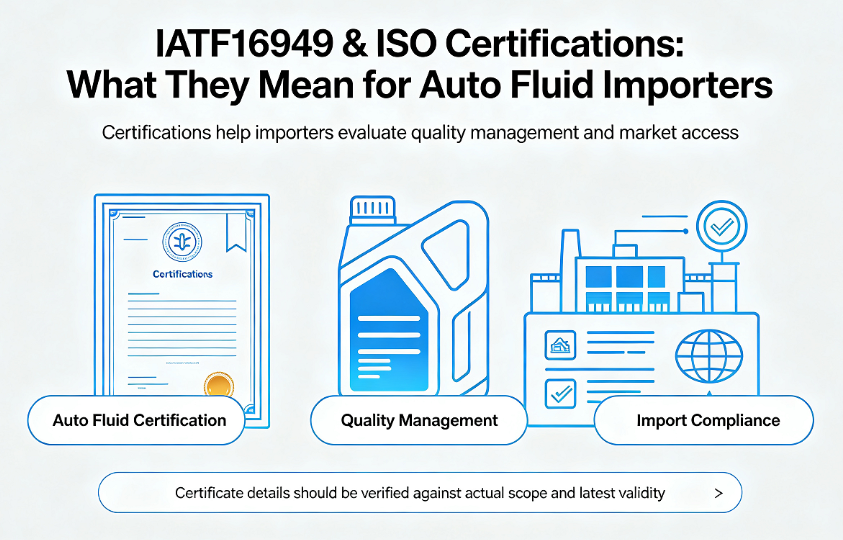
Why IATF16949 matters to automotive fluid buyers
If you are sourcing brake fluids, coolants, or other automotive liquids, IATF16949 is not just another quality acronym to skim past. It is one of the main signals that a supplier’s quality system is built around the discipline the automotive sector expects. For importers, brand owners, and procurement teams, that matters because a fluid can meet a datasheet on paper and still create supply risk if the manufacturing system is weak.
That is the practical question behind what IATF16949 means for automotive fluid importers: does the supplier have a controlled process, traceable production, and a quality culture that can survive volume orders, repeat audits, and customer complaints? Usually, that is the difference between a stable program and a scramble after the first shipment problem.
What the standard tells you, and what it does not
IATF16949 is an automotive quality management standard built on a process approach. In plain terms, it asks a manufacturer to manage variation, document control, nonconforming product handling, corrective action, and continual improvement in a way that fits automotive supply chains. For buyers, the appeal is simple: less guesswork, better traceability, and a supplier that is more likely to respond in a structured way when something goes wrong.
It is worth being careful here. IATF16949 does not automatically prove a specific product is suitable for your application. It does not replace product testing, compatibility review, or the buyer’s own approval process. A plant can be certified and still make the wrong grade of fluid if the specification is not clearly controlled. Certification supports confidence; it does not eliminate the need to verify the product itself.
Why fluid importers care more than they sometimes admit
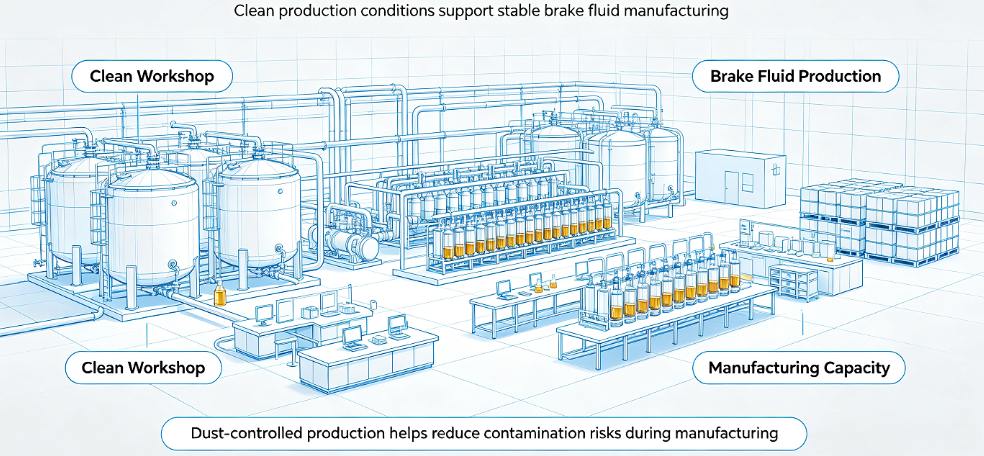
Automotive fluids are sensitive products in a commercial sense. A batch may look identical to another, but small differences in formulation, packaging integrity, moisture control, or contamination can affect performance and shelf life. That is why many buyers look for a certified brake fluid manufacturer rather than a general chemical blender. In this category, the manufacturing system matters almost as much as the chemistry.
For importers, the stakes are also contractual. A weak supplier can turn a routine purchase order into claims handling, replacement freight, and customer dissatisfaction. If the market you sell into expects an ISO automotive certification mindset, then your vendor selection should reflect that reality. In other words, quality certificates are not decoration; they are part of risk management.
Quick reference: how to read a supplier’s quality claim
1. System certification
Ask whether the plant is actually certified to IATF16949, not merely “working toward it.” Request the scope. A certificate that covers one site or one process is useful only within those limits.
2. Product-specific evidence
For brake fluids, coolant concentrates, washer fluids, and similar products, ask for product specifications, batch documentation, and relevant test data. This is where brake fluid certification and internal quality records should support the commercial claim.
3. Change control
A supplier should be able to explain what happens if raw materials, packaging, or process conditions change. This is often where importers uncover hidden weakness. If change control is casual, the risk travels straight to the buyer.
Selection criteria that matter in the real world
When evaluating suppliers, start with consistency, then traceability, then responsiveness. Consistency means the product you receive this quarter should resemble the one you approved last quarter. Traceability means the batch can be followed through production records. Responsiveness means the factory can investigate a complaint without vague answers and delays.
Pricing still matters, of course, but in automotive fluids the cheapest offer can become expensive quickly if it carries quality uncertainty. A mature buyer will usually weigh packaging quality, labeling control, documentation, and export handling alongside the fluid itself. These are not side issues; they are part of the product.
Common mistakes buyers make
One frequent mistake is treating certification as a substitute for supplier qualification. Another is assuming a familiar product name means identical formulation across markets. That is risky, especially when buying across borders. A third mistake is not checking whether the supplier can support the documentation your customers or regulators may ask for later.
There is also a tendency to focus only on the lab report. Useful, yes. Sufficient, no. A fluid program succeeds when the plant, the packaging line, the warehouse, and the document trail all behave with the same level of control.
Buyer’s checklist before you place an order
Before signing off on a new source, confirm the certificate scope, ask for current product specifications, review batch traceability, and understand how nonconforming product is isolated. If you are importing brake fluid specifically, check packaging compatibility, labeling language, and storage guidance as well. Small oversights here can create large downstream problems.
If a supplier is a genuine certified brake fluid manufacturer, they should be able to discuss these items without improvising. If the answers sound vague or heavily outsourced, pause. That pause is usually cheaper than a failed launch.
FAQ: brief answers buyers usually need
Is IATF16949 the same as product approval?
No. It is a quality system standard, not a pass/fail ruling on a specific formulation.
Does every automotive fluid supplier need it?
Not every supplier does, but automotive buyers often prefer it because it reduces supply risk and improves process discipline.
Should importers ask for other documents too?
Yes. Product specs, batch records, test results, and packaging details are still necessary.
What a careful sourcing team should do next
Use IATF16949 as a filter, not the finish line. Start with the certificate, then move into product evidence and commercial fit. If the supplier is solid, the paperwork will reinforce the story rather than trying to create it. That is the sort of supply relationship automotive buyers tend to trust, and for good reason.
For teams comparing multiple sources, build a short vendor scorecard around system certification, documentation quality, responsiveness, and product-specific verification. It is a practical way to separate real manufacturing control from polished sales language.
Welcome to contact GAFLE for more information & cooperation!
peter
ZHEJIANG GAFLE AUTO CHEMICL CO.,LTD
Tel:86-579-8222 1665
Fax:86-579-8246 4690
Cel/Wechart:86-13335993986
E-mail:peter@gafle.net
Web:www.gafle.net