Why brake fluid production deserves more attention than it usually gets
Brake fluid production is one of those manufacturing topics that rarely gets the spotlight until something goes wrong. That is a mistake. Brake fluid sits inside a safety-critical system, and the way it is made has a direct effect on moisture control, chemical stability, contamination risk, and ultimately braking performance. For engineers, sourcing managers, and product teams, the real decision is not whether the fluid looks clear in a drum. It is whether the factory behind it can keep the product consistent from batch to batch, especially when volumes scale up.
This matters because brake fluid is unforgiving. It has to perform under heat, pressure, and long service intervals, while also resisting contamination during production, filling, storage, and transport. A supplier may talk about capacity, but capacity alone does not guarantee a dependable product. The question is how the plant handles cleanliness, process control, and packaging discipline.
What a buyer should look for first
If you are sourcing brake fluid, the first filter is not price. It is the manufacturing environment. A clean workshop, a dust-free workshop, and tightly controlled filling and blending areas can be more important than a glossy catalog. That does not mean every supplier needs the same setup, but the process should clearly reduce exposure to airborne particles, water ingress, and cross-contamination between batches.
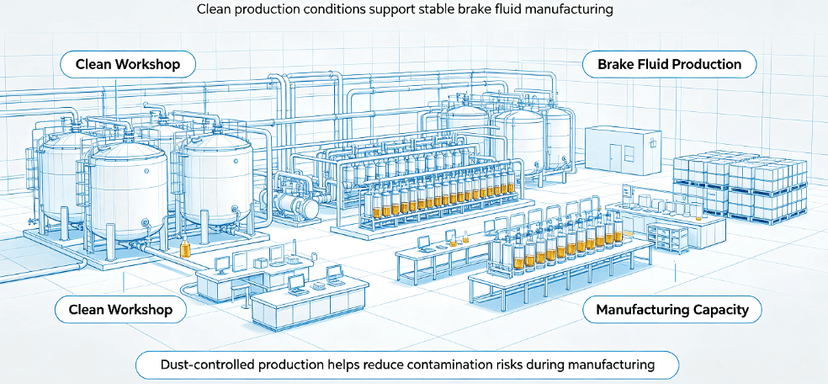
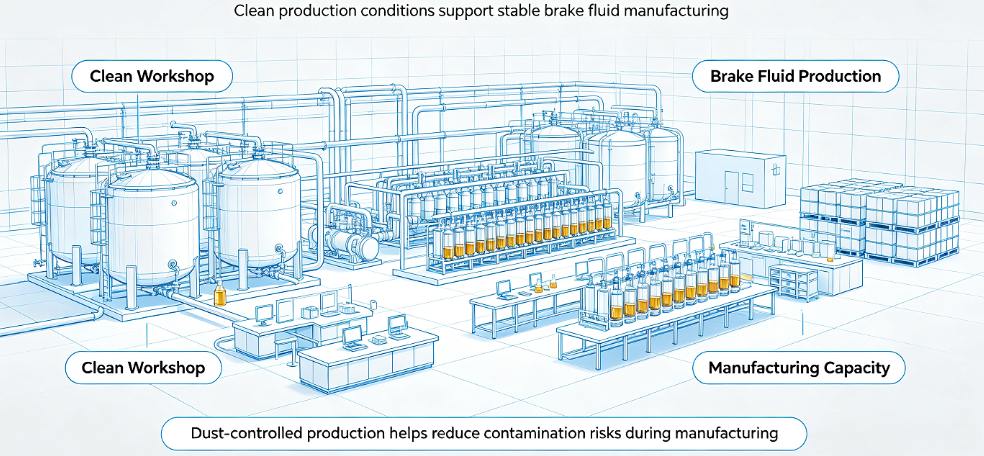
A 10000 ton brake fluid clean production workshop, for example, signals a factory built for scale with controlled conditions in mind. Still, buyers should avoid treating that phrase as proof of quality by itself. Large output can be helpful, but it also creates pressure on raw material handling, filtration discipline, and line cleaning. The bigger the operation, the more important it is to verify that the quality system scales with it.
Quick comparison: what usually separates better suppliers
Not every supplier will publish the same level of detail, but the better ones tend to show a consistent pattern:
Controlled production areas rather than open manufacturing space;
Sealed storage and orderly transfer of base materials;
Clear batch traceability;
Packaging controls that limit moisture pickup;
A mass production factory setup that still maintains discipline at the filling stage.
That last point deserves a note. High-volume plants can be efficient, but efficiency should not come from shortcuts. If a supplier cannot explain how they prevent contamination during transfer, mixing, and final filling, the plant size becomes less impressive.
The manufacturing steps that matter most
Brake fluid production typically starts with selecting the right base components, then blending them under controlled conditions, followed by filtration, filling, and packaging. The exact chemistry depends on the fluid type and application, so buyers should ask whether the supplier is producing for general automotive use, heavy-duty service, or another segment. It is not enough to say “brake fluid” as if all products behave the same.
During blending, moisture control is a practical concern. Many brake fluid formulations are sensitive to water content, and once unwanted moisture enters the system, performance can drift. That is why a clean workshop is more than a cosmetic selling point. It supports more stable handling conditions and reduces avoidable contamination risks. The same logic applies to filtration and storage. A batch can be well prepared and still be compromised by careless transfer or poor container management.
Why clean production is not just marketing language
Some buyers hear “dust-free workshop” and assume it is a branding phrase. It is not, or at least it should not be. In brake fluid production, dust and airborne debris can create quality issues that are hard to detect early. Small particles may not be obvious at the point of filling, but they can become a problem in warehousing, shipping, or end-use performance. For a product tied to vehicle safety, that is too much risk to ignore.
That said, buyers should ask for specifics rather than slogans. What areas are controlled? How are materials staged? Is the filling line isolated? How is air quality managed? The answers matter more than the label.
Common mistakes buyers still make
One common mistake is focusing only on annual output. A supplier may present itself as a mass production factory, which is useful information, but output should be read alongside process control. Another mistake is assuming all suppliers use the same raw materials or the same packaging discipline. They do not. Small differences in handling can lead to noticeable differences in shelf stability and field performance.
A third mistake is skipping the basic question of intended use. Brake fluid is not a generic commodity in the practical sense. Product grades, compatibility, and service expectations vary. If the procurement brief is vague, the factory may quote the wrong formulation or packaging format, and the problem often appears late, when changing suppliers becomes expensive.
Practical advice for sourcing teams
When evaluating a supplier, ask for a plant layout overview, a description of the clean production workflow, and a clear explanation of how contamination is prevented from raw material receiving to final packing. If the supplier claims a 10000 ton brake fluid clean production workshop, request context: what part of the process is covered, how capacity is distributed, and whether different product lines share the same controlled area.
Also pay attention to packaging. Brake fluid can be sensitive to improper sealing and storage conditions, so the container format and closure integrity should match the intended distribution channel. This is one of those practical details that can look minor in a quotation sheet and become major in the warehouse.
What a good buyer-supplier conversation sounds like
The best conversations are not about slogans. They are about process. A capable supplier should be able to discuss workshop cleanliness, batch handling, filtration, filling controls, and how large-scale output is managed without losing consistency. If the answers stay vague, that is a warning sign, even if the factory photos look impressive.
For teams comparing options, the useful decision is straightforward: choose the supplier whose brake fluid production setup shows real control, not just claimed capacity. In this category, safety and consistency are worth more than a low headline price.
Next step for buyers
If you are shortlisting suppliers, start with the manufacturing environment and work outward. Ask for process details, batch traceability, and packaging controls before discussing volume commitments. That approach takes a little more time, but it avoids the expensive mistake of buying a product that looks acceptable on paper and behaves unpredictably in service.
Welcome to contact GAFLE for more information & cooperation!
peter
ZHEJIANG GAFLE AUTO CHEMICL CO.,LTD
Tel:86-579-8222 1665
Fax:86-579-8246 4690
Cel/Wechart:86-13335993986
E-mail:peter@gafle.net
Web:www.gafle.net