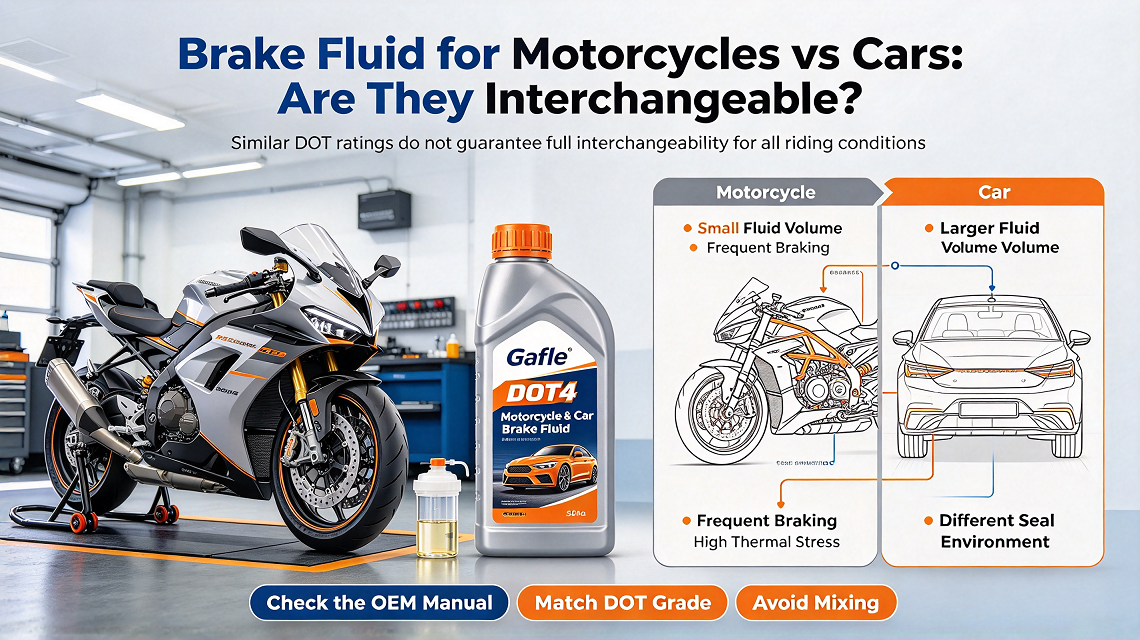
At first glance, motorcycle brake fluid and passenger car brake fluid appear identical. However, their operating environments differ dramatically, and swapping them blindly can create safety risks.
For motorcycle repair shops, two-wheeler parts distributors and riders, brake maintenance is a critical safety task. Many people ask whether standard automotive DOT3 or DOT4 brake fluid can be poured into motorcycle brake systems. Both motorcycle and car brake fluids are usually polyglycol-based DOT-rated products. They share the same classification standards, but this does not mean they are fully interchangeable in every situation. To understand the difference, you need to look at how motorcycle brake systems operate.
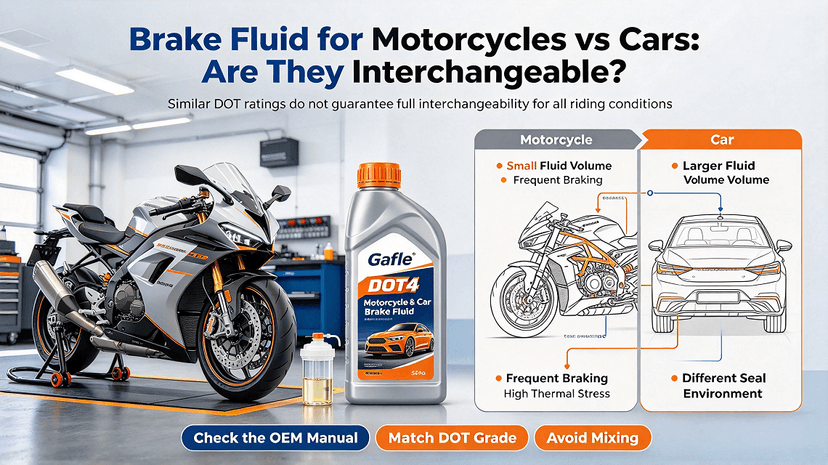
Motorcycle brakes face far more frequent, rapid brake actuation with much smaller fluid volumes.
A passenger car brake hydraulic system holds a relatively large volume of brake fluid. Even under heavy use, temperature changes happen gradually. Motorcycles are a completely different case. A motorcycle brake circuit contains only a tiny amount of brake fluid. Every squeeze of the brake lever pressurizes this small volume of liquid. During city riding, winding mountain roads or track use, riders apply and release brakes constantly. The fluid cycles between high pressure and resting pressure hundreds of times in a short period.
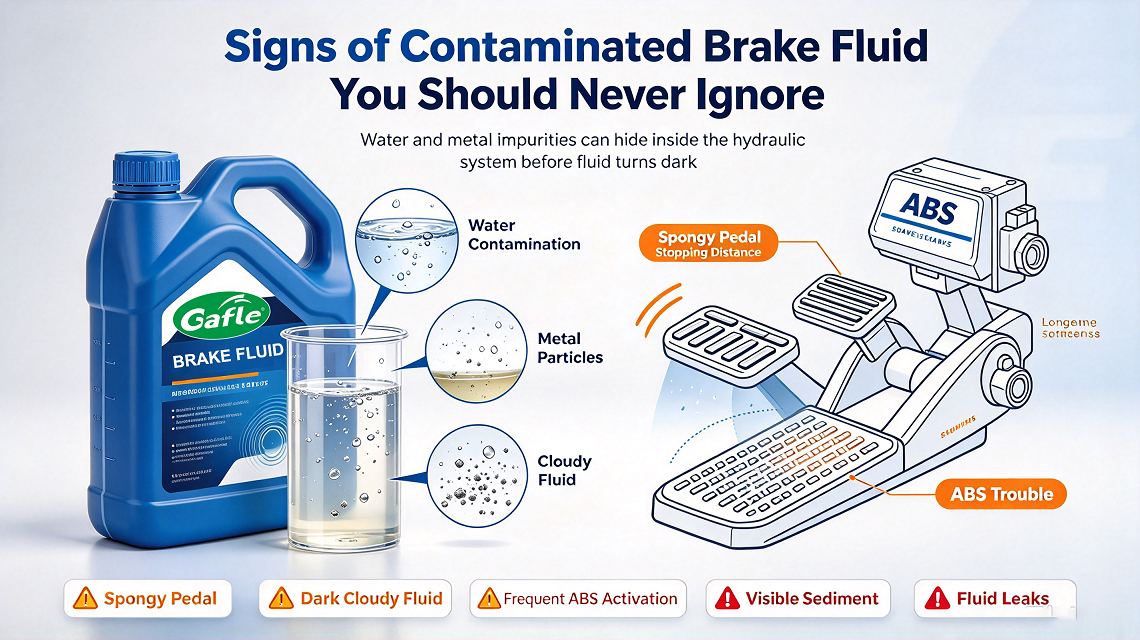
This repeated pressurization heats the brake fluid quickly. The small fluid volume cannot dissipate heat as effectively as a car brake system. Motorcycle brake fluid must maintain stable boiling point under frequent thermal cycling. If the fluid cannot withstand repeated heating, vapor bubbles form inside the brake line. The brake lever will feel spongy, and braking power can fade suddenly. This is extremely dangerous for two-wheeled vehicles, where riders rely on precise brake control to avoid falls.
Motorcycle brake seal and hose materials have unique requirements.
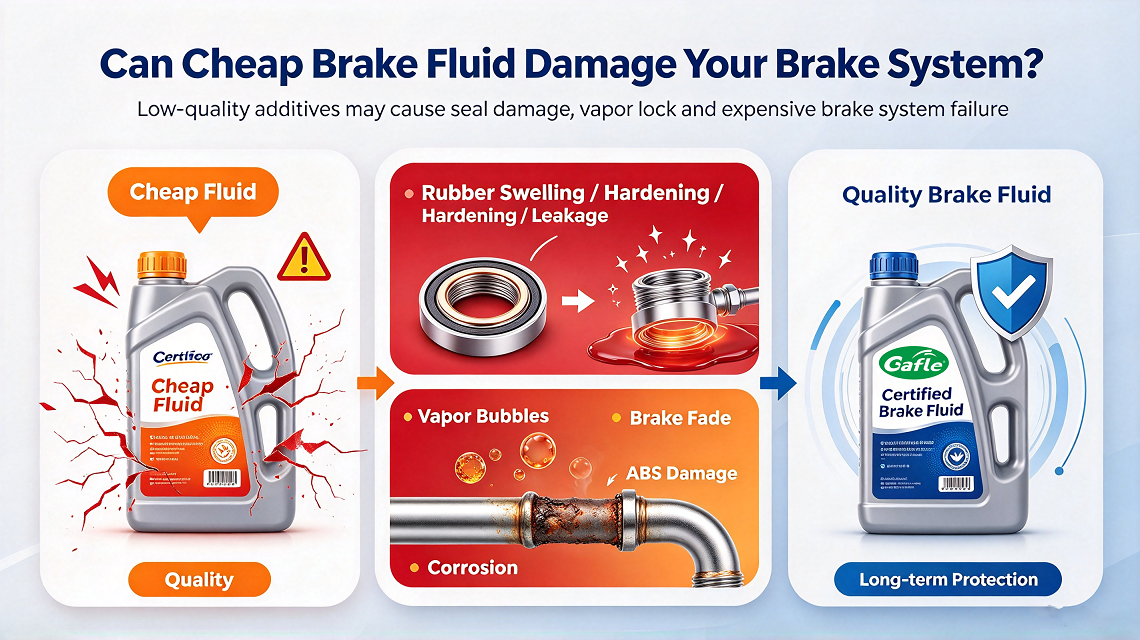
Motorcycle master cylinders, caliper seals and flexible brake hoses are designed for compact packaging and constant vibration. The elastomer materials used in motorcycle brake components are not always identical to automotive rubber parts. Standard automotive brake fluid additives are formulated for car seal compounds. When used long-term in some motorcycle brake systems, it may cause slow seal swelling or accelerated ageing under continuous vibration and pressure cycling.
High-performance motorcycle brake fluid blends contain tailored additive packages that resist thermal degradation and protect motorcycle-specific rubber components. This is especially important for bikes with combined braking systems and ABS, which are now widely fitted on modern motorcycles.
When can you use automotive brake fluid on a motorcycle?
If the motorcycle OEM manual permits a standard DOT4 polyglycol brake fluid, high-quality automotive DOT4 fluid can work for basic street riding. But this is not a universal rule. Some sport bikes, adventure bikes and track motorcycles require brake fluid with higher thermal stability. Using ordinary car brake fluid in these applications will lead to brake fade during aggressive riding.
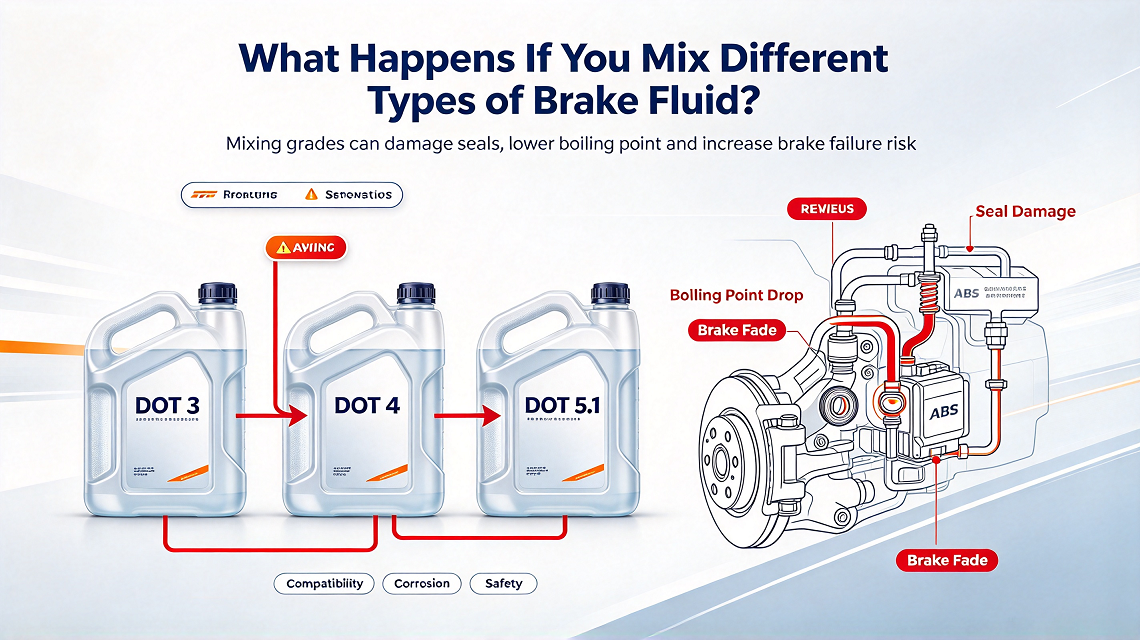
One non-negotiable rule: never use DOT5 silicone brake fluid in motorcycles unless explicitly approved by the bike manufacturer. Silicone-based DOT5 will not mix with polyglycol fluid and will damage most motorcycle brake seals.
Key tips for selecting motorcycle brake fluid
Always follow the motorcycle manufacturer’s recommended DOT grade first. For commuter street bikes, standard high-quality DOT4 is usually sufficient. For sport bikes, off-road and adventure motorcycles that see heavy braking, select brake fluid with enhanced thermal stability. Perform full brake flushes at the recommended interval, not just topping up fluid. Motorcycle brake systems absorb moisture faster due to frequent lever movement and vibration.
Gafle supplies reliable brake fluid for both automotive and motorcycle applications.
Gafle produces a full range of DOT-rated brake fluids suitable for passenger cars and motorcycles. Our standard DOT4 brake fluid delivers stable performance for daily street motorcycles. We also offer high-performance brake fluid options for heavy-use two-wheelers. For motorcycle parts wholesalers and repair shops, Gafle provides consistent batch quality, complete technical documents and OEM packaging support.
Final Takeaway
Car brake fluid and motorcycle brake fluid are not automatically interchangeable. While polyglycol DOT grades share the same base chemistry, the intense high-frequency braking and compact hydraulic circuits of motorcycles place extra stress on brake fluid. Always match the brake fluid specification to the vehicle type and riding conditions to keep two-wheel brake systems safe and reliable.
Welcome to contact GAFLE for more information & cooperation!
peter
ZHEJIANG GAFLE AUTO CHEMICL CO.,LTD
Tel:86-579-8222 1665
Fax:86-579-8246 4690
Cel/Wechart:86-13335993986
E-mail:peter@gafle.net
Web:www.gafle.net
peter
ZHEJIANG GAFLE AUTO CHEMICL CO.,LTD
Tel:86-579-8222 1665
Fax:86-579-8246 4690
Cel/Wechart:86-13335993986
E-mail:peter@gafle.net
Web:www.gafle.net