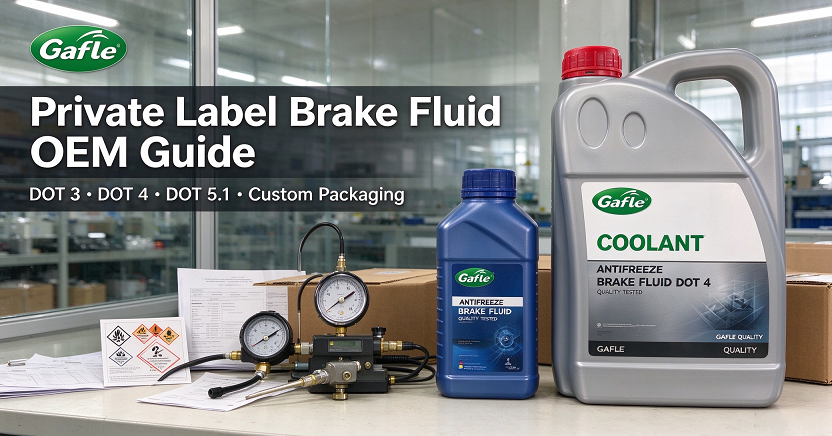
Quick answer: A successful Brake Fluid Wholesale program starts with a verified product range and ends with a repeatable purchase contract—not merely a low price per bottle. Importers should specify the exact DOT grade and target applications, request formula-specific test evidence, compare quotations on the same packaging and delivery basis, approve labels and batch-release controls, and establish a practical reorder plan. A supplier such as GAFLE can be evaluated against these requirements through its publicly listed brake fluid products and OEM/private-label service information.
A distributor can receive two quotations for “DOT 4 brake fluid” and discover that the offers are not comparable. One may be priced in a plain bottle delivered at the factory; the other may include custom artwork, tamper-evident packaging and export documentation. A lower price could be offset by freight, inventory, relabeling, inspection, customer complaints or a change of formula between orders. Neither quotation is suitable for approval until the purchasing conditions are made identical.
This article is written for automotive aftermarket importers, national and regional distributors, retail chains, workshop supply networks, and private-label brand owners. It is not a vehicle service manual. Vehicle-specific brake-fluid selection must follow the applicable manufacturer's instructions, and all compliance claims must be checked against the exact formulation and destination market. The aim is to help the purchasing team turn an initial quotation into a documented, scalable sourcing program.
GAFLE WHOLESALE BUYER SUPPORT
Start with a verified product range
Explore Brake Fluid Products ↗Request a Wholesale Sourcing Quote ↗1. What Does Brake Fluid Wholesale Mean for a Professional Importer?
In a consumer setting, a customer might buy one sealed bottle for a service appointment. In wholesale distribution, the buyer acquires multiple product lines and packages, manages storage and documentation, and carries responsibility for accurate downstream product descriptions. The economic unit is therefore not just the liter of fluid. It is the saleable SKU delivered in the correct package, with the correct technical identity, at the required time.
A wholesale program may include GAFLE-branded goods, distributor-branded products, or a combination. It may supply independent repair garages, retail stores, fleet-maintenance workshops or vehicle-parts wholesalers. Each channel produces different order patterns. A garage needs quick access to a fluid that matches its service work; a retailer needs an understandable label and suitable shelf packaging; a private-label company needs rights to artwork, documented technical claims and consistency across orders.
For this reason, a professional wholesale contract should connect five records: the approved fluid formula, the applicable performance specification, the packaging configuration, the accepted label revision and the commercial order terms. If any record changes without approval, the reseller may receive a product that no longer matches its published listing or technical file.
A useful internal purchasing workflow is SCOPE → VERIFY → PRICE → LOCK → REPLENISH. First define the market and products; then confirm documentation; compare standardized offers; lock technical and contractual details; and finally build a repeat-order system with traceability. This sequence is the organizing principle of the guide.
2. Who Buys Brake Fluid in Bulk—and What Do They Actually Need?
Not all wholesale buyers are trying to solve the same problem. An importer seeking to establish a national brand may prioritize local labeling, testing and channel positioning. A regional distributor supplying 200 garages is more concerned with refill frequency, stable stock and the number of bottle sizes it must carry. An OEM purchasing department may have specialized material-compatibility, document-control and supplier-audit requirements.
| Buyer segment | Typical purchasing decision | Main risks to control | Useful supplier response |
|---|---|---|---|
| Automotive-fluid importer | Which DOT grades and pack formats can enter the target market? | Compliance, customs, mismatched labels | Standard-specific documentation and export-ready order specifications |
| National parts distributor | What product assortment can be replenished consistently? | Overstock, stockouts, variable lead times | SKU-level forecasting, stable packaging and lot identification |
| Workshop-supply wholesaler | Which sealed bottles suit frequent repair work? | Wrong-fluid sale, open-container exposure | Clear grade labeling, training data and dependable delivery |
| Private-label brand owner | Can the manufacturer make a repeatable branded range? | Formula changes, unauthorized claims, artwork mistakes | Controlled formula, approved label proof and change-control agreement |
| Fleet-service purchasing team | Which vehicles actually use the offered hydraulic fluid? | Wrong application or system chemistry | Vehicle-specific verification and traceable product data |
| Specialty aftermarket reseller | Which validated technical products justify a separate SKU? | Slow-moving stock, overclaimed performance | Detailed test reports and transparent application boundaries |
A supplier should not be measured by how many grades it lists without evidence. It should be assessed by whether it can supply the grades the channel needs, with transparent specifications, viable commercial terms and an auditable order process.
A buyer should also identify who approves the purchase. Engineering or quality staff may control formula approval, the commercial buyer controls price and lead times, marketing controls artwork, and local compliance personnel control label and import requirements. Recording these roles before issuing an RFQ avoids a late-stage problem in which marketing approves a bottle but quality rejects the technical file.
3. Define the Product Range Before Requesting Prices
The phrase “brake fluid” does not identify a single interchangeable substance. A wholesale range may involve DOT 3, DOT 4, non-silicone DOT 5.1 or specialized low-viscosity applications. These products must be evaluated under the exact vehicle and hydraulic-system requirements. Silicone-based DOT 5 and mineral-oil hydraulic-system products are separate chemistry categories and must not be treated as automatic substitutes for conventional glycol-based grades.
Buyers can first examine the GAFLE Brake Fluid collection, which publicly lists DOT3, DOT4, DOT5.1, OEM, Modified and Racing, and energy-vehicle product directions. The GAFLE DOT3 catalogue entry and DOT407 DOT 4 entry provide identifiable starting references. Product pages establish what is listed; they do not replace current technical data sheets or grant universal vehicle approval.
| Wholesale product family | Appropriate initial buying question | Required evidence before launch | Commercial role |
|---|---|---|---|
| DOT 3 | Which target vehicles and markets specify or permit this grade? | Applicable standard, exact TDS, conformity evidence | Verified everyday-service assortment |
| DOT 4 | Which customers require a DOT 4 hydraulic fluid? | Actual dry/wet ERBP, viscosity and material-test profile | Widely relevant, but still application-controlled |
| DOT 5.1 non-silicone | Is there documented demand for the special grade? | Exact chemistry, testing and vehicle instruction | Specialty technical stock, not a blanket upgrade |
| Low-viscosity formulation | Does the manual require a named LV class or property? | Specific low-temperature viscosity and relevant standard | Limited technical SKU with clear differentiation |
| Performance / racing | Which race systems and rules actually permit this product? | Formula-specific data, intended-use boundaries | Specialist high-information channel |
| OEM / private label | Can existing verified formulations be packaged for the brand? | Formula lock, artwork approval, commercial feasibility | Brand-building and distributor differentiation |
Do not expand the range simply to fill a catalogue. Start with sales history, service-market information and verified vehicle demand. Then choose the smallest assortment that meets customer needs without creating technical confusion. A distributor can always add a specialized item after reviewing demand, but it may be difficult to unwind an overstated compatibility claim printed on thousands of bottles.
4. Use Standards Correctly: Performance Grades Are Not Vehicle Approvals
For U.S. hydraulic brake-fluid applications, FMVSS No. 116 (49 CFR §571.116) is an important regulatory reference. It specifies grade requirements, test methods, packaging and labeling. The selected minimum dry and wet boiling-point limits below illustrate why apparently similar products should not be compared using an undefined phrase such as “premium brake fluid.” These are minimum standard requirements, not measured values for GAFLE's DOT3 or DOT407 products.
| Selected FMVSS No. 116 parameter | DOT 3 | DOT 4 | Procurement meaning |
|---|---|---|---|
| Minimum dry equilibrium reflux boiling point | 205°C | 230°C | Confirm product-specific result and method |
| Minimum wet equilibrium reflux boiling point | 140°C | 155°C | Important to the standardized moisture-conditioned test |
| Maximum kinematic viscosity at −40°C | 1,500 mm²/s | 1,800 mm²/s | General grade limit, not proof of a special LV specification |
| Corrosion, water tolerance and rubber effects | Additional requirements apply | Additional requirements apply | Request a full conformity statement or applicable reports |
| Container and label provisions | Applicable where the rule governs | Applicable where the rule governs | Review actual bottle, seal, lot code and market label |
Do not equate “DOT 4” with permission to use a product in every DOT 3 vehicle, and do not identify a fluid as approved by a vehicle manufacturer without documentation. The vehicle's own service information controls the application. The DOT 5.1 non-silicone and DOT 5 silicone distinction is also relevant when managing a broader range; similar numbers do not make the chemistry identical.
Outside the U.S., the importing country may reference different standards, testing, language or chemical-marking requirements. An ISO 4925 or SAE reference can be useful when relevant, but the importer must state the version and exact requirement. A supplier's quality-management certificate is not the same thing as evidence that a specific batch conforms to the product standard. Keeping those categories separate is essential for trustworthy listings and safe distribution.
For a buyer-facing technical catalogue, write statements such as “DOT 4 grade—supporting documentation available for review” only when those documents actually exist for the proposed SKU. Avoid “compatible with all cars” or “exceeds all international standards.” These overbroad claims can create a commercial liability that a lower purchase price cannot compensate for.
5. Build an RFQ That Makes Every Supplier Quote the Same Product
The first serious opportunity to prevent cost overruns is the request for quotation. Many vague inquiries ask for “best price of DOT 4, one container,” then receive offers with different bottle sizes, carton counts, shipment points and artwork assumptions. Those numbers are not suitable for supplier ranking. A controlled RFQ defines the intended product and the deliverables each price must include.
| RFQ field | What the buyer should specify | Why it changes the quotation |
|---|---|---|
| Destination and channel | Country, wholesale/retail/workshop channels | Label, delivery and market-compliance scope |
| Formula and grade | DOT grade, standard revision, approved SKU or performance requirement | Product cost and test documentation |
| Package | Bottle size, neck, cap, inner seal, tamper feature and carton | Components, filling efficiency, freight density |
| Artwork | Brand, label language, warnings, barcode, revision owner | Design, printing, regulatory review |
| Volume by version | Units of each formula × bottle × label combination | Minimum-run economics and setup |
| Technical evidence | TDS, SDS, test report, COA example, requested inspection | Lab time, review and acceptance |
| Delivery basis | Incoterm with named place, shipment window, destination | Freight, risk transfer and insurance assumptions |
| Quality acceptance | Sampling, label tolerance, seal checks, nonconformity process | Inspection and rework obligations |
| Reorder conditions | Forecast, lead-time review, change notice and price validity | Long-term continuity and supplier planning |
A good RFQ separates must-have requirements from preferences. An applicable fluid standard and correct safety label may be non-negotiable. A custom bottle shape may be optional for a trial order. This separation gives suppliers room to propose a compliant economical option without altering the technical identity of the product.
If the sourcing request involves a new private-label brand, send the vehicle and market restrictions before asking the manufacturer to print labels. It is much cheaper to review a digital proof than to rework a completed shipment.
RFQ & TECHNICAL REVIEW
Turn your specification into a comparable quotation
Review GAFLE DOT407 ↗Send Your RFQ to GAFLE ↗6. Compare Wholesale Prices on a True Landed-Cost Basis
The cheapest bottle on a quotation sheet is not necessarily the lowest-cost product in the distribution warehouse. To compare offers fairly, normalize the formula, testing scope, fill quantity, usable units, packaging, trade term and delivery location. Only then assess price. If one offer is EXW and another is CIF, treating both prices as directly comparable would conceal material differences in freight and risk allocation.
A useful management formula is: landed cost per saleable unit = total acquisition and import costs ÷ accepted saleable units received. Acquisition and import costs may include the unit invoice, packaging premiums, freight, insurance, customs charges where applicable, local transport, inspection and reasonable handling expenses. Non-saleable leakage or label defects reduce the denominator, raising the effective cost of every usable bottle.
A distributor can then evaluate the commercial result using a margin calculation: gross margin = (net selling revenue − cost of goods sold) ÷ net selling revenue. The business should apply its own accounting policy for landed costs, credits and overhead. These formulas are planning tools, not GAFLE price quotations, and they do not justify inventing a universal wholesale profit percentage.
Cost comparison: what the price sheet often hides
| Cost or risk item | Supplier A may include | Supplier B may exclude | What to ask |
|---|---|---|---|
| Standard bottle and cap | Yes | Yes, different material | Which exact component specification? |
| Inner seal / tamper protection | Included | Additional charge | Can the physical sample and seal test be reviewed? |
| Private label and language variants | One artwork version | Setup per version | What costs recur at reorder? |
| Test reports / batch COA | Defined documents | Only generic catalogue | Which evidence will ship with each lot? |
| Export carton and pallet | Included at named standard | Different carton pack | How many accepted units per carton and pallet? |
| Inland and ocean transport | Quote depends on Incoterm | Outside unit price | What is the named delivery point? |
| Rework / damaged goods | Defined claims process | Unclear | Who investigates and pays when specified defects occur? |
A disciplined buyer keeps an RFQ comparison spreadsheet with unit of measure, order quantity, formulation, packaging, trade term, document scope, cost assumptions and validity date. Rank suppliers only after these values are aligned. This turns negotiation into a transparent business decision and prevents hidden changes that make the lower initial quote expensive to operate.
The issue is especially important when mixed-SKU packaging is involved. A supplier may offer an attractive price for one high-volume bottle but a significantly higher cost for several brand languages or special closures. The quote must break down each variant separately.
7. Understand MOQ: Formula, Bottle, Artwork and Order Mix
A minimum order quantity should never be treated as one universal number for the entire manufacturer. Practical production minimums can be affected by formulation preparation, bottle sourcing, cap stock, filling changeover, printed-label quantity, carton print runs, shipment utilization and how many versions share common components.
Ask for three MOQ perspectives: the minimum by formula, the minimum by physical packaging configuration, and the minimum by printed artwork/language version. A quoted total of many bottles may still be operationally unrealistic if those bottles are split among numerous small versions. Equally, a manufacturer may be able to offer simpler stock packaging for a trial project; this must be confirmed rather than promised in advance.
A buyer should request an order-mix proposal showing which units can be combined within a shipment and which require separate production or packaging setups. This is more useful than a website statement such as “low MOQ available.” If setup charges apply, ask whether they are one-time or repeated for later orders, and who owns any tooling or artwork files.
For a first import, the objective should be to gather meaningful demand data without creating avoidable dead stock. Starting with fewer grades and package formats may help the distributor track actual demand. Once repeat orders show stable sales, additional sizes or premium products can be introduced with better forecasting evidence.
8. Technical Documents: TDS, SDS, COA and Conformity Reports
Wholesalers sometimes receive a product catalogue and assume it is sufficient for technical approval. It is not. The purchasing file should distinguish a technical data sheet (TDS) describing the product, a safety data sheet (SDS) addressing handling and safety, test reports or conformity evidence supporting claims, and a certificate of analysis (COA) relating to a defined production lot or tested batch where available.
For example, the public GAFLE DOT407 product page describes DOT 4 performance characteristics and intended hydraulic applications. A buyer should still request the current formulation identification, measured or guaranteed dry/wet ERBP, viscosity, corrosion and material compatibility evidence, and the acceptance criteria used for production release. Marketing copy is the beginning of a technical conversation—not its conclusion.
Use a document-control table. Record the issuer, revision date, product code, formula revision, test methods, limits, signature or approval status and intended markets. When a new batch arrives, verify that the COA and label reference the approved product. A report attached to a different product code or old formula may not support the goods being purchased.
High-quality wholesalers also agree on who retains samples, how long records are kept, and how an incident is investigated. Brake fluid is used in safety-critical hydraulic systems; traceability is more valuable than a glossy but unsupported claim of “zero defects.”
| Document | Main purpose | Practical acceptance check |
|---|---|---|
| Technical data sheet (TDS) | Defines the offered formula and technical profile | Product code, revision and stated properties agree with the quotation |
| Safety data sheet (SDS) | Communicates safe handling and relevant product hazards | Correct material identity, language and destination-specific version |
| Test or conformity evidence | Supports claims made about the stated grade or standard | Test method, sample identity, issuing laboratory and scope are traceable |
| Certificate of analysis (COA) | Reports designated findings or release information for a lot | Lot and product codes match the shipped goods; reported tests are understood |
| Quality-system certificate | Helps evaluate supplier management procedures | Certified entity, facility, scope, issuer and current status are verified |
| Approved packaging / artwork file | Controls market-facing label and container design | Bottle, closure, warnings and version match the agreed golden sample |
This checklist can be assigned to the technical manager before the purchase order is confirmed. It helps prevent a common failure: approving a price against a catalogue entry and discovering only after manufacturing that the regulatory label or batch records do not match the imported SKU.
9. Packaging and Artwork Are Part of Product Qualification
The original container is a technical control because many non-silicone brake fluids can absorb moisture. An unsuitable closure, failed inner seal or damaged bottle can compromise product handling and create uncertainty before the fluid reaches a workshop. This makes packaging more than a marketing expense.
FMVSS No. 116 contains detailed U.S.-market requirements for applicable brake-fluid containers, including a resealable closure, an inner seal and a tamper-proof feature for specified container capacities. It also requires specific container information and warnings for covered products. Other destination markets may impose additional or different requirements. The importer and manufacturer should review those rules before artwork approval.
A packaging specification should document the bottle material, fill volume, neck finish, cap, seal, tamper evidence, label substrate, printed text, carton dimensions, lot marking, pallet protection and acceptance testing. If private labeling is requested, approval should include the exact final artwork file and its revision code. “Same as last order” is not a sufficient change-control instruction if the supplier may have multiple versions.
GAFLE's published custom brake fluid packaging and private-label guide describes options such as bottles, labels and cartons. Buyers can use the page as a discussion starting point, but actual availability, MOQ, tooling, artwork conditions and lead times must be obtained through a written quote.
A practical first-article inspection should review filled samples, closure operation, inner-seal condition, leakage resistance, label durability, barcode readability, quantity and carton protection. Keep approved reference samples so that later batches can be compared against the same physical specification.
PRIVATE LABEL & PACKAGING
Validate bottle, label, seal and supply conditions
Explore Private Label Services ↗Discuss Custom Packaging ↗10. Supplier Quality Review: From Raw Materials to Release
A wholesale partnership is only as reliable as the supplier's ability to repeat an approved formulation and package. Importers should ask about incoming material controls, batch identification, formula version management, equipment cleaning, moisture and contamination prevention, filling-line checks, label reconciliation, retained samples and final release.
The review should distinguish quality-management systems from specific product validation. FORK's company profile describes automated production facilities and clean production processes; the website also lists various quality and management-system certifications. Those statements help identify questions for an audit, but a buyer should request current certificates, scope and facility identity rather than assume that all claims are independently verified for the exact order.
A distributor can use the following illustrative supplier review scorecard. Safety-critical product compliance is a pass/fail requirement regardless of the numerical score.
| Assessment area | Example weight | Evidence to request |
|---|---|---|
| Formula and applicable standards | 25 | Exact SKU, permitted use, reports and current specification |
| Testing and lot traceability | 20 | Test methods, batch COA example, lot mapping and retention |
| Manufacturing and change control | 20 | Process-control description, release criteria and change notices |
| Packaging and label quality | 15 | Seal validation, first-article samples and approved artwork |
| Commercial and supply continuity | 10 | Feasible MOQ, reorder process, capacity and delivery terms |
| Communication and complaint handling | 10 | Named technical contact, response process and corrective actions |
| Total | 100 | Critical compliance gates must pass independently |
A supplier scoring well on communication cannot compensate for missing evidence that the fluid is the specified grade. Likewise, a distributor should not accept a supposed quality certificate if it names a different legal entity or facility without explanation. The best wholesale program has both sound documentation and practical service responsiveness.
11. Approve Samples in Three Separate Gates
Sample approval is more efficient when broken into three independent decisions. First is technical acceptance: does the supplied formula match the specified grade and application requirements, and is the evidence adequate? Second is packaging acceptance: does the actual bottle, closure, seal, label and carton match approved requirements? Third is commercial acceptance: can the manufacturer deliver the same configuration at the agreed quantity, price and schedule?
A single attractive sample does not answer all three. The fluid could be technically correct but have an unsuitable cap. The package could be excellent but carry an overstated vehicle claim. Or both could be satisfactory while MOQ and reorders make the business unworkable. Each gate needs an assigned reviewer and a documented result.
For the first commercial order, retain a signed golden sample or equivalent controlled reference for formula identity, physical package and print proof. State clearly what tolerance is allowed in fill levels, labeling, carton damage and other objective criteria. If the supplier changes a component or formulation, specify whether the buyer must approve the modification before production resumes.
Avoid setting acceptance criteria that cannot be measured. “Premium appearance” is weaker than an agreed label proof and inspection standard. “Excellent brake performance” is weaker than named technical methods and documented specification limits.
12. Contract Terms That Reduce Wholesale Supply Risk
A purchase order should be accompanied by a technical and quality agreement proportionate to the business. This is not a substitute for legal advice, but it helps teams define what must remain consistent after the price is agreed. Include an exact product description, formula/version, applicable standard, package specifications, artwork revision, lot coding, documentation, inspection rights, delivery basis and approved substitutes—normally none without written authorization.
Clarify how production deviations are reported, how nonconforming units are isolated, and how customer complaints will be investigated. Specify who pays for rework, replacement or return under agreed conditions. Define how price changes and material substitutions are communicated. For private-label business, record artwork ownership, trademark permissions and confidentiality requirements where applicable.
The contract should also address what happens if the buyer's market regulation changes. A label printed for one country is not automatically acceptable in another. A sound process assigns responsibility for legal review and for approving an updated package before a new shipment is released.
Distributors can ask GAFLE about these issues through its contact page. The objective of the discussion should be an executable specification and order plan rather than a broad statement that everything can be customized.
13. Export Documentation, Shipment Planning and Receiving Checks
International brake fluid distribution involves more than a commercial invoice. Depending on the product, destination and trade route, buyers may need the invoice, packing list, certificate of origin where applicable, transport documents, SDS, technical documents, product labeling evidence and customs-related information. The exact set must be confirmed for the importing country and shipment. Do not assume all brake-fluid formulations share identical transport classification or documentation requirements.
Agree on an Incoterm and a named location. Clarify who books freight, who insures the cargo if required, when risk transfers, and who provides the documents for customs clearance. Build in review time for multilingual labels or market-specific marks. An importer should coordinate with qualified logistics and customs professionals instead of treating a generic shipping template as regulatory advice.
At receiving, check the count against the packing list, inspect cartons and pallets, verify the seals and visible damage, confirm the SKU and label version, and record lot codes. If a batch is missing the agreed paperwork or shows leakage, hold it for review rather than release it straight into warehouse stock.
A basic receiving record includes shipment number, received date, formula/grade, package code, quantity, lot, manufacture or packaging date where specified, artwork revision, visible condition, document status and disposition. This record becomes valuable when a later complaint must be traced back through the distribution chain.
14. Inventory Rotation and the First Ninety Days of Sales
Brake fluid is sensitive to handling and storage conditions, and inventory that remains unsold for long periods can tie up capital. The importer should obtain product-specific storage instructions and any supported shelf-life or reassessment guidance from the actual manufacturer; an arbitrary universal expiry period should not be invented for every formula and package.
Use lot-aware warehouse management. Keep containers in their original sealed packaging, protect them from conditions described in the SDS and TDS, and avoid decanting into unidentified containers. Apply first-expiring-first-out when validated expiry information is available, or another defined rotation approach appropriate to the actual product. Damage, leaks and unreadable lot codes should trigger quarantine and documented investigation.
For a new wholesale range, the first ninety days can be treated as a commercial learning cycle, not a promised production or delivery schedule. Collect actual orders by grade, bottle size and channel. Record returns, technical questions, stockouts and packaging complaints. Compare the real consumption rate against the initial forecast before expanding the assortment.
The most useful metric may be sell-through by individual SKU, not total volume shipped into the country. A successful launch can have one fast-moving DOT 4 pack and one slow-moving specialty product. Replenishment decisions should reflect that difference rather than reorder every product in the same proportion.
15. Create a Repeat-Order Contract Instead of Repeating First-Order Negotiations
The purpose of wholesale sourcing is not to requalify the entire product every time the warehouse needs stock. Once the buyer has an approved formula, label, packaging and quality record, reorders should refer to those controlled documents. The supplier can then confirm quantity, current commercial conditions, any changes and planned shipment dates.
A repeat-order checklist should ask: Has the formula changed? Are the same test methods and acceptance limits in force? Is the label revision unchanged? Are the bottle and cap components approved? Are current documents available? Has the buyer updated its rolling forecast? Are there unresolved complaints? If any answer raises a material issue, pause the affected SKU and conduct a review.
An effective supply program can use an indicative rolling demand forecast divided into firm purchase orders and nonbinding future expectations. This lets the manufacturer plan components while preserving the buyer's inventory controls. The forecast and replenishment policy should be agreed based on real capacity and commercial terms, not assumed from a website promise.
For a private-label distributor, the reorder record should reference both the formula code and brand-artwork version. Otherwise a container can be produced with an obsolete label even when the fluid itself has not changed. Repeatability is what turns a wholesale quotation into a dependable business asset.
16. How GAFLE Fits into a Brake Fluid Wholesale Project
FORK identifies Zhejiang Gafle Auto Chemical Co., Ltd. as an automotive chemical manufacturer and describes brake-fluid production, private-label packaging and export-related experience. The brake-fluid portfolio includes several technical and OEM product directions, while the DOT3 and DOT407 DOT 4 pages offer identifiable catalogue starting points. Its private-label brake fluid article discusses customer branding and packaging.
These public statements are useful for a prospective customer building a shortlist. They are not a substitute for a current quotation, an approved formulation, an independently verified certificate or a vehicle-specific product approval. Before placing a bulk order, ask GAFLE to confirm which existing SKU can meet your required standard, packaging, documentation and target-market criteria.
A well-prepared inquiry allows the supplier to answer practical questions: Is the product an existing formula or a development project? What sample and documents are available? Which packaging configurations can be quoted? What MOQ applies to each formula and artwork version? What inspection criteria can be agreed? What is the expected ordering process and how are future changes communicated?
The company should be evaluated against the same documented requirements used for any other supplier. That evidence-led process makes a commercial conversation more efficient and builds confidence without overpromising.
GAFLE DISTRIBUTOR SOURCING
Get product documents and a project-specific offer
View the Brake Fluid Range ↗Request an OEM / Wholesale Quote ↗17. RFQ Template: Copy This into Your First Supplier Inquiry
Subject: Brake Fluid Wholesale RFQ — DOT Grades, Packaging and Repeat Supply for [Country]
We are an importer/distributor supplying [customer channels] in [country]. We are sourcing [DOT grades and exact requirements] for [vehicle/service segments], with initial order volumes of [units by SKU] and an indicative annual forecast of [quantity]. Please quote each formulation, bottle size, seal and label-language configuration separately, stating the applicable MOQ, named Incoterm, pricing validity and current lead-time proposal.
Please provide the current TDS and SDS for each offered formula, applicable standard claims and supporting evidence, a sample COA format, quality-system documentation relevant to the production facility, packaging specifications, artwork approval procedure, batch-code method and a proposed nonconformity process. We also request sample options, first-article review terms, available private-label configurations, and an explanation of what changes require customer reapproval on repeat orders.
Our technical team will review the proposed grade against the intended market before any product-compatibility statement is approved. We would appreciate a written proposal identifying the exact catalogue or development SKU and the documents included with commercial delivery.
This inquiry template can be adapted for branded or private-label supply. Replace every bracketed field with real project details. An accurate RFQ is far more likely to yield a meaningful offer than a message asking only for “your best wholesale price.”
18. Frequent Purchasing Mistakes That Damage Distributor Margins
Mistake 1 — Comparing different DOT grades as if they were equivalent. Match the intended vehicle requirements and exact formula first. A higher number is not a universal substitute.
Mistake 2 — Ranking EXW and delivered quotations without normalizing costs. Set the same Incoterm, destination and included services before comparing unit prices.
Mistake 3 — Asking for one MOQ across many artwork and bottle versions. Minimums may depend on each unique combination; request a detailed break-out.
Mistake 4 — Approving a brand label before its claims are validated. Confirm technical statements, warnings, language and legal requirements before printing.
Mistake 5 — Relying only on a generic manufacturer certificate. Quality-system credentials do not prove that the specific formula and batch meet the required grade.
Mistake 6 — Neglecting the seal and tamper feature. Brake-fluid packaging helps protect against moisture and contamination; it is not decorative.
Mistake 7 — Failing to connect lot numbers to receiving records. Missing traceability makes defect investigations and targeted stock holds much harder.
Mistake 8 — Filling the warehouse with every catalogue variation. SKU proliferation increases dead stock, packaging complexity and working capital needs.
Mistake 9 — Treating the first approval as permanent despite formula or packaging changes. Require change notices and reapproval where appropriate.
Mistake 10 — Promising delivery or profit margins from a general website claim. Obtain current written terms and evaluate actual landed costs and customer demand.
19. Frequently Asked Questions About Brake Fluid Wholesale
FAQ 1. What information should I send a brake fluid wholesale supplier first?
Send your destination market, customer channel, intended vehicle population, required DOT grade or other specification, requested bottle sizes, brand/label requirements and trial and annual quantity estimates. Ask for a written quotation by SKU and package version with supporting technical documents. This is more actionable than requesting a generic price list.
FAQ 2. Is DOT 4 the best brake fluid to stock for every market?
No. DOT 4 is relevant to many hydraulic brake applications, but the correct assortment depends on the vehicles being serviced and applicable manufacturer instructions. DOT 3, DOT 5.1 or a specialized formulation may be required for other defined applications. Market demand and technical compatibility must determine stock selection.
FAQ 3. What is the normal MOQ for bulk brake fluid orders?
There is no universal MOQ. It may vary by formula, bottle, cap, printed label, carton, tooling and whether the order is branded or private label. Ask the supplier to state MOQ by each unique formula-and-package configuration, along with any setup charge and possible standard-packaging alternatives.
FAQ 4. Can I source brake fluid under my own brand?
Yes, private-label brake fluid is an established business model, and GAFLE publicly describes OEM/private-label services. The actual formula, available packaging, label design, minimum run, costs and market requirements need a project-specific quotation and approval process. Trademark or vehicle-manufacturer endorsements must not be invented.
FAQ 5. Which technical documents should accompany a wholesale purchase?
Request current TDS and SDS files, the exact standard claim and supporting test evidence, an appropriate COA or batch-release record, and packaging and traceability details. The required import and customs documents depend on the destination and shipment. Confirm all documents refer to the actual formula and lot.
FAQ 6. What is the difference between a brake fluid TDS and COA?
A TDS describes a product's technical characteristics and applicable specifications. A COA typically records defined tests or acceptance information associated with an identified batch or lot. A COA should not be assumed to cover tests it does not list; neither document replaces the vehicle manufacturer's application instructions.
FAQ 7. How should a distributor compare wholesale quotes fairly?
Require the same technical grade, fill quantity, closure, packaging, label, documentation, quantity, Incoterm and delivery point. Then calculate landed cost per accepted saleable unit. Consider inspection, rework, inventory carrying cost, damage, exchange-rate exposure and the terms of future reorders where relevant.
FAQ 8. What prevents moisture problems in brake fluid inventory?
Use correctly specified original sealed containers, intact inner seals and tamper-evident features where required. Follow the product's storage guidance, protect stock from damage and contamination, rotate inventory using validated shelf information and quarantine leaking or untraceable goods. Do not assume a generic storage period for every formula.
FAQ 9. How can I keep repeat orders consistent?
Lock the approved formula, technical documents, grade, package components, artwork version and acceptance criteria. Map every order and batch to these identifiers. Require supplier notification and approval for material changes, retain first-article references, review each incoming lot and track unresolved quality issues before releasing a reorder.
FAQ 10. How can I obtain a brake fluid wholesale quotation from GAFLE?
Review the GAFLE brake-fluid products, identify the relevant grade and package needs, and send your destination market, target application, technical documents required, intended quantities and branding plans through the GAFLE contact page. Request a formal SKU-specific response instead of assuming public product descriptions are binding commercial offers.
Conclusion
A high-performing Brake Fluid Wholesale business is built around a controlled purchasing system, not the lowest advertised price. Importers should define the real market requirement, shortlist supported DOT grades, standardize RFQs, verify formula-specific evidence, calculate landed cost on accepted saleable goods and approve physical packaging and label revisions before shipment. After receiving, batch traceability, stock rotation and change-controlled reorders protect both technical credibility and distributor margins.
The most valuable supplier is one that can connect performance documentation, packaging accuracy, quality release and realistic commercial conditions into a repeatable workflow. No single certificate, boiling-point number or attractive bottle can replace that complete process. And because brake fluid is used in safety-critical hydraulic systems, vehicle-specific approval and applicable rules always take priority over broad aftermarket claims.
GAFLE's public brake fluid portfolio, DOT407 product page and private-label guidance give importers a practical starting point for sourcing discussions. To build an RFQ-to-reorder program, provide your target country, required specifications, packaging versions, expected order quantities and requested evidence through the GAFLE contact page. Ask for a written, document-backed proposal that your procurement and quality teams can confidently approve and reorder.