logo

Why Is My Engine Overheating After Changing Coolant?

logo

Published

Oct 30 2026

  • News
  • Antifreeze / Coolant
  • Buying Guide

Follow us

why-is-my-engine-overheating-after-changing-coolant

why engine overheating after changing coolant

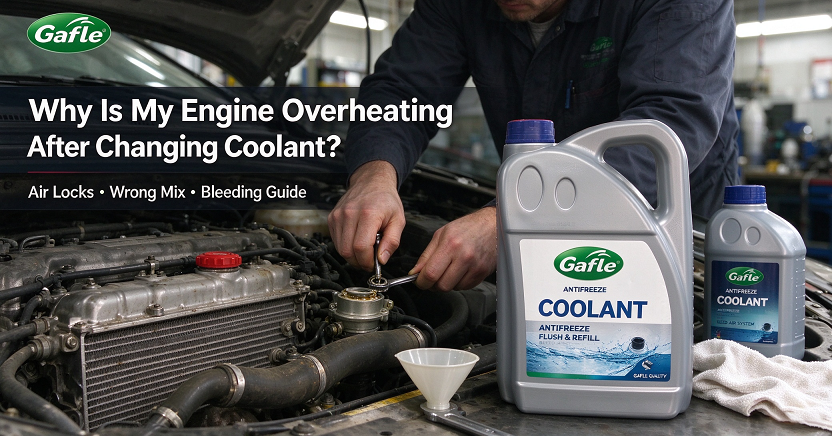
Engine overheating after a coolant replacement is a troublesome complaint for auto repair shops. Technicians finish a coolant flush, return the car to the customer, and the temperature warning light comes on during the first drive. Many people immediately suspect a faulty radiator or water pump, but in most cases, the root cause comes from errors during the refill operation. This article covers all typical mistakes that trigger post-service overheating and teaches the correct bleeding and filling process for different vehicles.

Air pockets trapped inside the cooling circuit are the top reason for engine overheating immediately after coolant replacement. When you drain all coolant, air fills every passage of the cooling system. If you simply pour new coolant in and close the cap without proper bleeding, air bubbles get stuck at high points of the circuit. Air cannot transfer heat and blocks liquid circulation. The coolant sensor reads high temperature quickly even though the fluid volume looks normal in the expansion tank. This issue happens most often on vehicles with complex routing, horizontal radiators or remote heater cores.

Mixing incompatible coolant chemistries such as IAT, OAT and HOAT creates sludge and clogs cooling passages. Many workshops keep multiple coolant colors and types in stock. If the technician adds OAT coolant into a system originally filled with conventional silicate-based IAT antifreeze, chemical reactions occur. The incompatible additives react and form thick jelly-like sediment. These gels stick inside radiator fins, narrow engine water jackets and block flow. This clogging problem may not show up right away; overheating appears after a short driving period as deposits build up.

Incorrect mixing ratio, either too diluted or too concentrated, breaks thermal stability and heat transfer performance. After a flush, some technicians add too much distilled water to the concentrated antifreeze, lowering the boiling point. Other technicians skip dilution and pour neat glycol directly. Both wrong ratios hurt cooling performance. Over-diluted coolant boils easily under load, while over-concentrated coolant turns thick and flows slowly. Either situation causes the operating temperature to rise above the safe range.

Flushing coolant can loosen old scale and sediment, which may clog the radiator core or jam the thermostat. Old coolant carries dissolved rust and mineral scale. When you flush the system with flowing liquid, these hard deposits break loose. Some sediment flows into the thin radiator tubes and gets stuck. Other particles lodge inside the thermostat valve. Partially blocked radiators lose heat dissipation capacity, and a jammed thermostat limits coolant circulation. This kind of fault is common on high-mileage vehicles with neglected cooling systems.

Thermostats can stick closed after debris flows through, preventing coolant from entering the large cooling cycle. The thermostat is a temperature-controlled valve. It stays closed when cold to speed up engine warm-up and opens when the set temperature is reached. If dirt and scale particles wedge between the valve and seat during coolant replacement, the thermostat fails to open. The coolant only runs in the small bypass loop and never passes through the radiator. The engine heats up rapidly within minutes.

Bleeding procedures differ between vehicle models; many cars require dedicated bleed screws to remove trapped air fully. Some vehicle designs have air bleed screws located on the thermostat housing, radiator upper tank or heater pipe. The correct workflow is to fill coolant slowly, open bleed screws until steady liquid flows out without bubbles, then tighten the screws. Other vehicles use a vacuum coolant filler tool to evacuate air before refilling. Skipping model-specific bleeding steps almost guarantees air lock and overheating.

FAQ

Q1: How can I tell if overheating after coolant change is caused by an air lock?

A1: Common signs are fluctuating temperature gauge, heat blowing cold from the heater, and bubbling inside the expansion tank.

Q2: Can I mix red OAT coolant with green traditional IAT coolant?

A2: It is not recommended. The different additive packages react and form sludge that blocks the cooling system.

Q3: What is the best way to bleed air from a cooling system?

A3: Follow the OEM procedure. Use bleed screws if equipped, or use a vacuum coolant filling tool for difficult models.

Q4: Will a stuck thermostat open by itself after driving?

A4: Usually no. Once debris jams the valve closed, the thermostat remains stuck and must be replaced.

Q5: How long should I run the engine after coolant refill to check temperature?

A5: Run the engine with heater on hot, watch temperature for 10–15 minutes, and recheck the reservoir level after cooling down.

Q6: Does every coolant flush require a full system bleed?

A6: Yes. Any time you drain the cooling system completely, air enters and bleeding is mandatory.

Welcome to contact GAFLE for more information & cooperation!
peter
ZHEJIANG GAFLE AUTO CHEMICL CO.,LTD
Tel:86-579-8222 1665
Fax:86-579-8246 4690
Cel/Wechart:86-13335993986
E-mail:peter@gafle.net
Web:www.gafle.net
Featured Blogs
Can You Manufacture Brake Fluid Under My Brand?

Can You Manufacture Brake Fluid Under My Brand?

1. Private label brake fluid OEM lets aftermarket brand owners sell branded brake fluid without operating their own chemical blending factory. 2. Glycol-based DOT 3, DOT 4 and DOT 5.1 are the mainstream brake fluid grades for passenger cars, commercial vehicles and motorcycles. 3. Full custom packaging includes bottle sizes, custom labels, brand logos, hazard warnings and printed outer cartons. 4. All OEM brake fluid follows FMVSS 116 specification; each batch comes with COA test reports and MSDS safety documents. 5. The OEM process covers requirement discussion, sample validation, artwork approval, mass production, quality inspection and delivery. 6. Flexible minimum order quantities support both small test orders and large container shipments for global importers. 7. Brake fluid is classified as a chemical good; we provide labeling guidance and documents to meet GHS and overseas import regulations.

Can you manufacture coolant under my brand?

Can you manufacture coolant under my brand?

1. Private label coolant OEM service enables distributors and workshop chains to launch their own antifreeze brand without building chemical production lines. 2. Multiple coolant chemistries are available for OEM, including IAT, OAT and HOAT formulas for passenger cars, trucks and EV thermal systems. 3. Full packaging customization covers bottle shapes, volumes, custom labels, liquid color and carton printing. 4. All private label coolant can be produced to meet ASTM standards, with complete test reports and MSDS documents for export. 5. The standard OEM cooperation workflow includes requirement confirmation, sample approval, artwork finalization, production, inspection and delivery. 6. Flexible MOQ and lead time options are available to support small startup brands and large bulk importers. 7. The manufacturer can provide supporting export documents and guidance to meet destination country chemical labeling regulations.

Why Is My Engine Overheating After Changing Coolant?

Why Is My Engine Overheating After Changing Coolant?

1. Air pockets trapped inside the cooling circuit are the top reason for engine overheating immediately after coolant replacement. 2. Mixing incompatible coolant chemistries such as IAT, OAT and HOAT creates sludge and clogs cooling passages. 3. Incorrect mixing ratio, either too diluted or too concentrated, breaks thermal stability and heat transfer performance. 4. Flushing coolant can loosen old scale and sediment, which may clog the radiator core or jam the thermostat. 5. Thermostats can stick closed after debris flows through, preventing coolant from entering the large cooling cycle. 6. Bleeding procedures differ between vehicle models; many cars require dedicated bleed screws to remove trapped air fully.

Why Does Coolant Level Keep Dropping?

Why Does Coolant Level Keep Dropping?

1. Visible external leaks from hoses, radiators, heater cores and water pump seals account for most easy-to-detect coolant loss cases. 2. Internal leaks caused by blown head gaskets let coolant enter combustion chambers or oil galleries without obvious dripping marks. 3. A faulty radiator pressure cap fails to maintain system pressure, allowing coolant to escape as vapor at operating temperature. 4. Coolant has natural vapor loss, but improper mixing and aged fluid will greatly accelerate evaporation consumption. 5. Micro-leaks on EV battery cooling plates and thermal management joints are hard to spot during routine visual inspection. 6. Technicians should follow a step-by-step diagnostic workflow and use cooling system pressure testers to locate hidden leaks efficiently.

What Happens If Coolant Is Too Concentrated?

What Happens If Coolant Is Too Concentrated?

1. High-concentration coolant has higher viscosity and weaker fluidity, reducing circulation flow and lowering engine heat dissipation efficiency. 2. Freeze protection of glycol coolant peaks at around 60% concentration; further increasing glycol content will not improve freezing resistance. 3. Thick concentrated coolant increases the load on the water pump, accelerating wear of pump bearings and seals and leading to leakage. 4. Excess glycol may form gummy deposits, blocking narrow passages inside radiators and cooling pipelines. 5. The recommended coolant mixing ratio varies according to local climate and vehicle types, including ICE and new energy vehicles. 6. Specific testing and dilution steps are required to safely adjust over-concentrated coolant back to the factory-specified range.

What Happens If Coolant Is Too Diluted?

What Happens If Coolant Is Too Diluted?

1. Over-diluted coolant has a higher freezing point, which makes it easy to freeze in cold weather and crack engine water jackets or radiators. 2. Excess water reduces the boiling point of coolant, leading to boil-over and engine overheating under heavy load. 3. Low additive concentration weakens corrosion inhibition, triggering pitting and rust on aluminum, cast iron and copper components inside the cooling circuit. 4. Minerals from hard water form limescale deposits, gradually blocking radiator tubes and heater cores and hurting heat exchange. 5. A refractometer is the reliable tool to tell whether coolant is within the recommended concentration range. 6. You can either partially replace the fluid or fully flush the cooling system to fix severely over-diluted coolant.