Choosing a Bulk Antifreeze Supplier Starts With Application Fit, Not Price
A reliable bulk antifreeze supplier should do more than provide a competitive price per liter. For importers, automotive chemical distributors, fleet suppliers, repair-shop wholesalers, and private-label brands, the real purchasing question is whether the coolant specification fits the target vehicles, climate, maintenance system, packaging channel, and applicable performance requirements.
Two antifreeze products that look similar may be intended for very different service conditions. A passenger-car coolant, a heavy-duty diesel coolant, a prediluted fleet product, and a concentrate for local blending should therefore not be treated as interchangeable purchasing items.
For B2B buyers, the safer sourcing sequence is:
application → required specification → coolant type → concentration → testing → packaging → quantity → supplier capability → landed cost
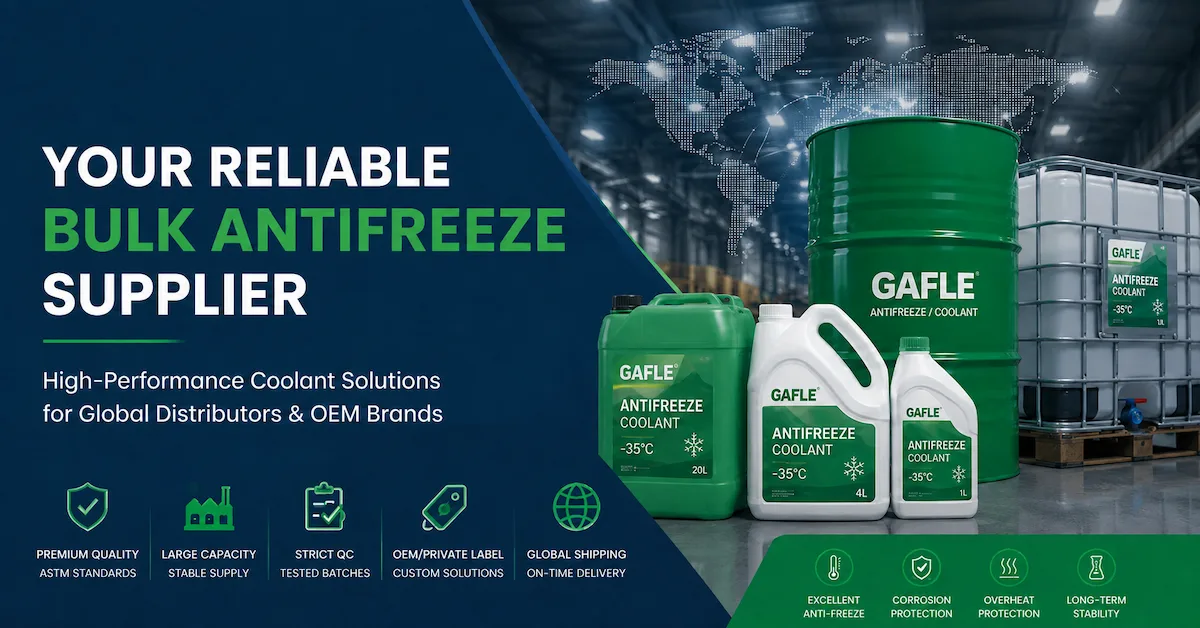
GAFLE's current Antifreeze/Coolant product category covers conventional coolant as well as specialized thermal-management products, while its current coolant content also references IAT, OAT, HOAT and EV grades for different market requirements.
Who Needs a Bulk Antifreeze Supplier?
Bulk sourcing is primarily a B2B decision rather than a consumer purchasing model.
Typical buyers include:
- Automotive chemical importers
- Regional antifreeze distributors
- Auto-parts wholesalers
- Private-label automotive brands
- Lubricant brands expanding into coolant
- Fleet maintenance suppliers
- Truck and heavy-equipment distributors
- Repair-shop supply companies
- Automotive aftermarket chains
- OEM and contract-packaging buyers
These customers usually need more than the liquid itself. They may also require technical documents, different pack sizes, custom labels, carton design, local-language packaging, batch consistency, samples, and export support.
A business buying only a few retail containers does not normally need a dedicated bulk antifreeze program. Likewise, companies sourcing specialized battery immersion fluids or other non-conventional thermal-management fluids should define those requirements separately rather than assuming conventional engine antifreeze is suitable.
Match the Antifreeze to the Vehicle and Operating Environment
One of the biggest sourcing risks is selecting a product first and checking the application later.
A professional bulk antifreeze supplier should ask where the product will be sold, which vehicles or engines it will serve, what winter and summer conditions are expected, whether the buyer needs concentrate or ready-to-use coolant, and which OEM or industry requirements apply.
Light-Duty Passenger Vehicles
For passenger cars and light-duty applications, ASTM D3306 is an important reference in markets where ASTM specifications are used. ASTM states that D3306 covers glycol-based engine coolants for automobiles and other light-duty cooling systems, including concentrate and prediluted product categories.
A distributor sourcing for this segment should specify:
- Target vehicle market
- Glycol base where relevant
- Concentrate or prediluted format
- Required freezing-point performance
- Applicable OEM or market standard
- Corrosion protection requirements
- Required packaging
- Label language
The buyer should request confirmation for the specific SKU rather than assume that every coolant offered by a manufacturer meets every standard.
Heavy-Duty Trucks and Equipment
Heavy-duty engines have different operating demands.
The current ASTM D6210 specification covers fully formulated glycol-based coolants for heavy-duty engines and addresses protection against corrosion, cavitation, freezing and boiling. ASTM also distinguishes D6210 heavy-duty applications from light-duty coolant specifications.
This matters for:
- Commercial trucks
- Buses
- Construction machinery
- Mining equipment
- Agricultural equipment
- High-output stationary engines
- Other demanding diesel applications
If your customers operate wet-liner diesel engines, for example, cavitation protection and the engine manufacturer's coolant-maintenance requirements become especially important.
Cold, Temperate and Hot Markets
Climate is another purchasing variable.
In cold regions, freezing-point performance is an obvious concern. In hot climates, buyers should not assume antifreeze is unnecessary: the coolant still performs important heat-management and corrosion-control functions inside the cooling system.
For international distributors, this means a single formula may not be the best commercial choice for every country. Climate, local vehicle mix, maintenance habits and applicable standards should all be reviewed before the order specification is finalized.
Concentrate or Ready-to-Use Antifreeze?
This decision affects product cost, logistics and downstream quality control.
| Product Form | Main Advantage | Buyer Responsibility | Typical Buyer |
|---|---|---|---|
| Concentrated coolant | More formulation flexibility and potentially more efficient fluid-volume shipping | Correct dilution and suitable water quality | Distributors, local blenders, professional workshops |
| Prediluted coolant | Ready for direct application with controlled factory dilution | Correct vehicle/application selection | Retail channels, workshops, fleet suppliers |
| OEM/private-label coolant | Market-specific branding and packaging | Accurate specification and label approval | Brand owners, importers, wholesalers |
| Heavy-duty coolant | Designed around demanding engine applications | Confirm engine/OEM requirements | Truck, fleet and equipment channels |
ASTM D3306 and D6210 both distinguish coolant concentrates from prediluted products, and D6210 specifically refers to using suitable-quality water with concentrate. That makes dilution control an important part of the procurement discussion when buying concentrated coolant.
For buyers without controlled local blending procedures, a factory-prediluted product may simplify consistency. For experienced distributors with suitable blending capability, concentrate may offer more flexibility.
Technical Specifications to Put in Your RFQ
Sending a message that says only “Please quote antifreeze” gives the supplier too little information.
A stronger RFQ helps both parties identify the correct product faster.
Recommended Antifreeze RFQ Checklist
| RFQ Item | What the Buyer Should Specify |
|---|---|
| Application | Passenger car, truck, bus, construction equipment, fleet, etc. |
| Target market | Country or region |
| Required standard | ASTM, OEM specification or other market requirement |
| Product type | Concentrate or ready-to-use |
| Coolant chemistry | Required technology if already defined |
| Glycol base | Specify where required |
| Freeze protection | Based on target climate and product specification |
| Packaging | Retail bottle, workshop pack, drum or bulk format |
| Branding | GAFLE brand, OEM or private label |
| Label language | Market-specific requirements |
| Documents | TDS, SDS/MSDS, COA or other required files |
| Quantity | Trial order and expected annual volume |
| Destination | Port/country for logistics planning |
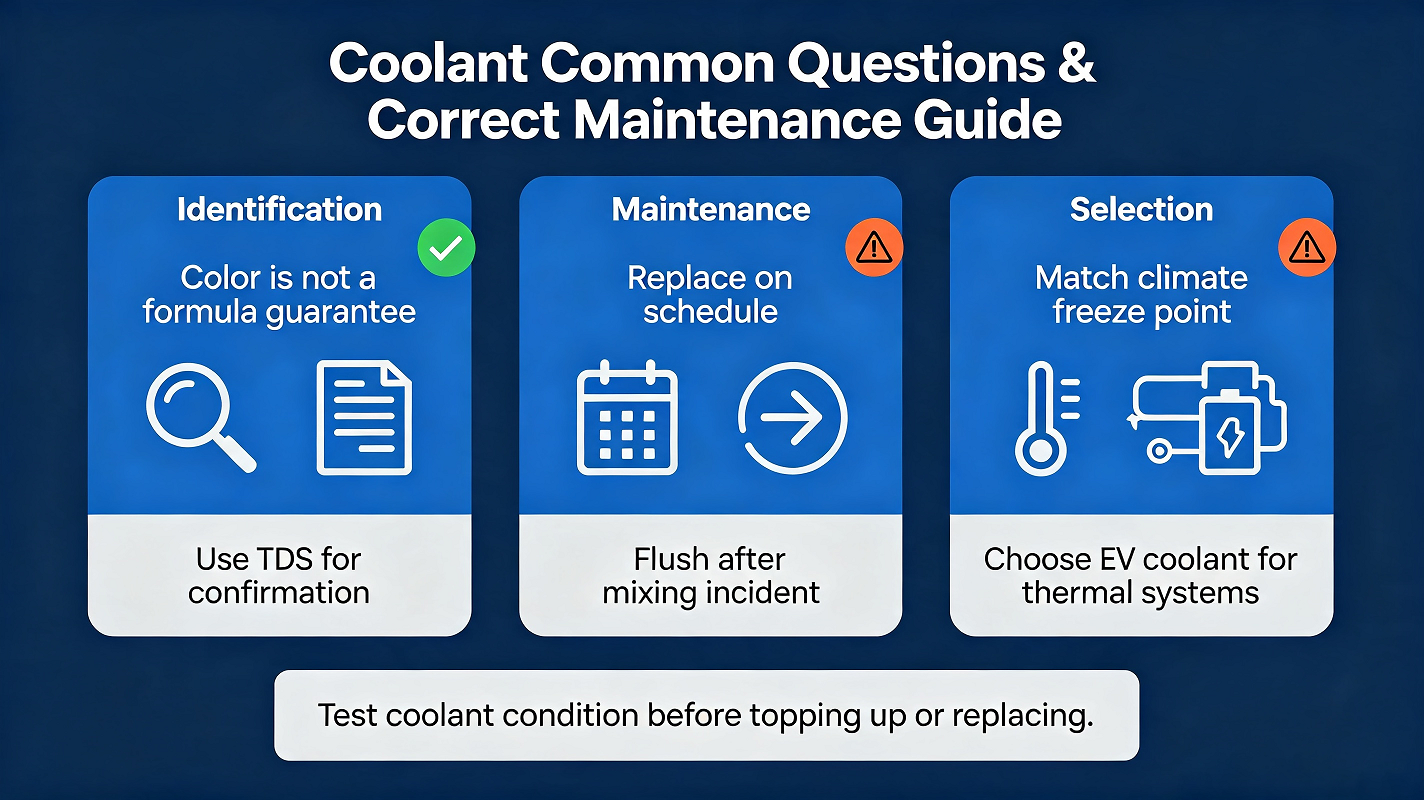
Do not choose bulk engine coolant based only on color. Color can support product identification and branding, but the purchasing decision should be based on the required chemistry, performance specification, vehicle application and manufacturer's recommendations.
What Quality Control Should a Bulk Antifreeze Supplier Provide?
Price differences between suppliers are easier to compare than quality-system differences, but the second issue often carries greater long-term risk.
Before approving a bulk order, buyers should investigate the supplier's control over:
Raw Materials
Ask how raw materials are qualified, received and controlled.
Changing raw-material quality can affect downstream batch consistency, so a professional procurement process should look beyond a single finished sample.
Formulation and Production Control
The supplier should be able to explain how formulations are prepared, mixed, monitored and transferred into filling operations.
According to GAFLE's current company information, production is conducted in an airtight environment using advanced facilities and fully automated production lines, with manufacturing processes monitored under its quality-management system.
Finished-Product Testing
Depending on the product specification, buyers may need verification of properties such as:
- Freezing point
- Boiling-related performance
- pH
- Corrosion protection
- Foaming
- Relative density
- Water content
- Chemical composition
- Cavitation performance for applicable heavy-duty products
For example, ASTM's heavy-duty coolant specifications include physical, chemical and performance requirements rather than treating “antifreeze” as one generic product category.
Batch Documents
For serious wholesale antifreeze projects, request documentation appropriate to the product and market.
GAFLE's current antifreeze sourcing content recommends that buyers request technical data sheets, safety documents, product specifications, sample test information and packaging details.
A practical document package may therefore include, where applicable:
- TDS
- SDS/MSDS
- COA
- Product specification sheet
- Batch identification
- Packaging specification
- Sample test results
- Relevant certificates
The exact document requirement should be agreed before the purchase order rather than after goods are ready for shipment.
OEM and Private Label Antifreeze for Distributors
For many buyers, bulk sourcing is part of a brand-building strategy.
An OEM antifreeze manufacturer can help an importer or distributor convert a generic procurement requirement into a market-specific product line.
Possible customization areas include:
- Product specification
- Coolant color where technically appropriate
- Bottle format
- Label
- Carton
- Brand identity
- Product wording
- Local language
- Market information
- Shipping configuration
GAFLE's current antifreeze content states that its OEM/private-label programs can support customized formula, color, packaging, labels, cartons and export-related support.
Buyers considering a private-label antifreeze program should approve both the product specification and packaging artwork before mass production.
Why Packaging Matters in Bulk Purchasing
Packaging is not merely a design issue.
It affects:
- Distributor positioning
- Workshop handling
- Shelf presentation
- Container utilization
- Leakage risk
- Label compliance
- Retail price architecture
- Warehouse efficiency
A distributor selling through automotive stores may require smaller consumer packs, while a fleet or workshop supplier may need larger service formats.
GAFLE's current wholesale content lists multiple retail and bulk package formats and notes that MOQ depends on packaging, customization and production arrangements.
That is why buyers should not request “your minimum MOQ” without first defining the package and customization level.
How to Compare Bulk Antifreeze Prices Correctly
The lowest factory quotation is not always the lowest procurement cost.
A more useful comparison is:
Product cost + packaging + customization + testing/documentation + freight + duties + inventory risk + quality-failure risk
Several variables can change the quotation:
- Concentrate vs premix
- Raw-material system
- Required performance standard
- Packaging size
- Bottle and carton design
- Label quantity
- Customized formula requirements
- Order volume
- Export destination
- Documentation requirements
This is why price should be compared only after competing suppliers quote against the same RFQ specification.
If Supplier A quotes a generic premix and Supplier B quotes a specified OEM/private-label product with testing and customized packaging, their prices are not directly comparable.
Common Procurement Risks and How to Reduce Them
Risk 1: Buying by Color Instead of Specification
Solution: Define the vehicle application, standard, chemistry and OEM requirements first.
Risk 2: Approving Only One Sample
A sample proves what was submitted, not necessarily how future production batches will be controlled.
Solution: Ask about batch testing, records and traceability.
Risk 3: Choosing a Light-Duty Product for Heavy-Duty Service
ASTM maintains separate specifications for light-duty and heavy-duty engine coolant applications.
Solution: Put the equipment type and required performance specification directly on the RFQ.
Risk 4: Ignoring Local Dilution Quality
This is particularly relevant when importing concentrate.
Solution: Define the intended dilution ratio and water-quality control before selecting concentrate instead of factory predilution.
Risk 5: Finalizing Packaging Too Late
Bottle, label, carton and language changes can affect project preparation and MOQ.
Solution: Approve product and packaging specifications together.
Risk 6: Comparing Quotes Without Documents
Solution: Include the required TDS, SDS/MSDS, COA and other market-specific documentation in the quotation request.
How Different Buyers Should Choose a Supplier
| Buyer Type | Main Purchasing Priority | Recommended Focus |
|---|---|---|
| Importer | Compliance and consistent supply | Documentation, specification, packaging, export support |
| Distributor | Margin and market differentiation | Private label, package range, repeat-order consistency |
| Automotive brand | Brand control | Formula, packaging, label approval, QC |
| Fleet supplier | Maintenance reliability | Correct application, bulk format, consistent batches |
| Repair-shop wholesaler | Practical workshop demand | Ready-to-use formats, technical support, packaging |
| Heavy-duty distributor | Demanding engine service | Heavy-duty specification, cavitation/corrosion performance |
| New private-label brand | Controlled market entry | Samples, packaging development, MOQ planning |
| Large wholesaler | Supply continuity | Capacity, QC system, repeat-order stability |
This segmentation matters because the “best” bulk antifreeze supplier for a startup private-label project may not be evaluated in exactly the same way as a supplier for a commercial truck fleet.
Why Manufacturing Capacity and Quality Systems Matter
Large-volume buyers need to know whether a supplier can reproduce the required product consistently, not simply whether it can produce one successful sample.
According to GAFLE's current corporate information, Zhejiang Gafle Auto Chemical Co., Ltd. reports annual production capacity exceeding 80,000 tons across all product lines and OEM service for more than 90 international brands. The same corporate information lists IATF 16949, ISO 9001, ISO 14001 and ISO 45001 certifications.
For buyers evaluating GAFLE specifically, additional company and manufacturing information is available on the GAFLE About Us page, while technical resources can be reviewed through the Download Center.
These company credentials should still be evaluated together with the actual product specification, sample, documentation and commercial terms for the coolant being purchased.
A Better Supplier Qualification Process
A professional bulk antifreeze sourcing project can follow eight steps.
Step 1: Define the Market
Identify country, vehicle population, climate, customer channel and application.
Step 2: Define the Technical Requirement
Specify coolant format, relevant standard, vehicle/OEM requirements and target performance.
Step 3: Request Supplier Documentation
Ask for product specifications, safety information, certificates and sample documentation.
Step 4: Evaluate Samples
Check the product against the agreed requirement instead of comparing appearance alone.
Step 5: Confirm OEM Packaging
Approve bottle, cap, label, carton, language and branding details.
Step 6: Confirm Commercial Conditions
Finalize MOQ, production arrangement, payment terms, shipment terms and destination.
Step 7: Define Batch Acceptance
Agree what documentation or tests will accompany production orders.
Step 8: Build a Repeat-Order Plan
For distributors and fleets, continuity matters. Discuss expected annual volume and replenishment frequency instead of treating each purchase as an isolated transaction.
Following this process makes supplier comparison much easier because technical and commercial variables are defined before price negotiation.
What to Send GAFLE for a Faster Bulk Antifreeze Quote
When contacting a manufacturer, provide enough information for the supplier to recommend the correct solution.
A useful inquiry can include:
- Destination country
- Passenger-car or heavy-duty application
- Required coolant standard
- Concentrate or premix
- Required freezing-point range
- Preferred chemistry if known
- Packaging size
- Estimated quantity
- OEM/private-label requirements
- Label language
- Required certificates or documents
- Target delivery schedule
You can review GAFLE's broader automotive product portfolio before sending the project requirements, then use the GAFLE contact page to discuss antifreeze specifications, samples, packaging and bulk-order requirements.
FAQ About Bulk Antifreeze Suppliers
1. What is a bulk antifreeze supplier?
A bulk antifreeze supplier provides coolant in commercial quantities for distributors, importers, fleets, workshops, automotive brands and other professional buyers. Supply can include standard branded products, bulk formats, OEM production or private-label programs.
2. What should I ask before buying antifreeze in bulk?
Start with the target vehicle application, country, climate, required standard, concentrate or premix format, packaging, quantity and documentation. This allows suppliers to quote comparable products instead of generic coolant.
3. What is the difference between ASTM D3306 and ASTM D6210?
ASTM D3306 applies to glycol-based engine coolant for automobile and light-duty service, while ASTM D6210 covers fully formulated glycol-based coolant for heavy-duty engines. Buyers should confirm which specification is relevant to their vehicle or equipment application.
4. Is concentrate better than premixed antifreeze?
Neither is universally better. Concentrate provides dilution flexibility but requires controlled mixing and suitable water quality, while prediluted coolant can simplify use and consistency for workshops, retailers and fleets.
5. Can a bulk antifreeze supplier provide private-label products?
Yes, depending on the manufacturer. GAFLE currently supports OEM/private-label antifreeze projects with customization involving product formulation, color, packaging, label and carton requirements.
6. What is the MOQ for bulk antifreeze?
There is no universal MOQ. It can vary according to product specification, packaging, label customization, bottle requirements and production arrangement; GAFLE's current wholesale guidance likewise states that MOQ depends on packaging and customization requirements.
7. What documents should I request from an antifreeze supplier?
Depending on your market and product, request appropriate technical specifications, TDS, SDS/MSDS, COA, test information, batch details, certifications and packaging documentation. Requirements should be confirmed before ordering.
8. Can antifreeze color be customized?
Private-label manufacturers may support color customization, but color alone should not be used to determine vehicle compatibility. Product chemistry, technical specification and vehicle/OEM requirements are more important selection criteria.
9. Can one bulk antifreeze product be used for every vehicle?
Buyers should not assume so. Light-duty, heavy-duty and specialized thermal-management applications can have different technical requirements, so the correct specification should be confirmed for the intended vehicles or equipment.
10. How do I get an accurate bulk antifreeze quotation?
Send the supplier your destination market, application, standard, coolant format, packaging, quantity and private-label requirements. The more precise the RFQ, the easier it is to compare product specifications and total sourcing costs between suppliers.
Conclusion
Selecting a bulk antifreeze supplier is ultimately a technical and supply-chain decision, not simply a price comparison. Distributors and OEM buyers should verify application fit, coolant specification, concentrate or premix format, relevant standards, quality-control procedures, documentation, packaging, customization capability and repeat-order reliability before approving volume production.
For passenger-car distributors, heavy-duty aftermarket companies, fleet suppliers and private-label automotive brands, a well-defined RFQ reduces specification mistakes and makes supplier quotations much easier to compare.
GAFLE supplies antifreeze and coolant solutions as part of its automotive chemical portfolio and supports OEM/private-label projects for international B2B buyers. To evaluate a specific bulk engine coolant project, contact GAFLE with your target market, application, required specification, packaging and estimated order volume.