logo

Can you provide performance test reports?

logo

Published

Nov 03 2026

  • News
  • Buying Guide
  • Manufacturing & Quality Control

Follow us

can-you-provide-performance-test-reports

coolant brake fluid performance test report guide

When you buy OEM coolant or brake fluid from a manufacturer, you will receive test documents such as COA and lab performance reports. These papers are required for customs inspection, distributor audit and product marketing. However, many brand owners are not familiar with these professional indicators and cannot judge whether the product meets the promised standard. GAFLE factory, as an automotive fluid manufacturer, breaks down the test report content for you in plain language.

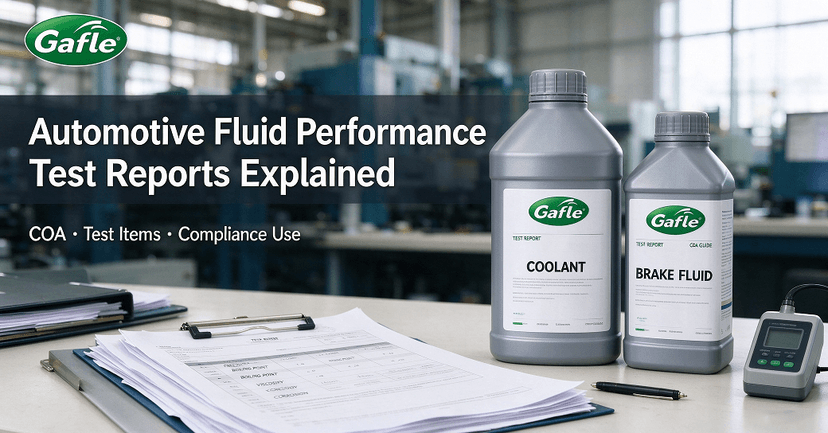
Two main types of performance test reports The first one is COA, Certificate of Analysis. This is the batch release report issued by our factory internal QC lab for every production batch. It records key test data of that specific batch of finished goods. COA is free for every OEM order. The second type is third-party independent lab report. It is issued by an outside accredited testing institute. Third-party reports are usually required for strict market access, tender projects or large retail chain audits, and this service needs extra testing cost and lead time. COA proves batch consistency, while third-party reports serve as independent verification of the formula.

Key indicators on coolant test reports For antifreeze coolant, the most watched index is freezing point, which tells you the lowest temperature the fluid can resist freezing. Boiling point shows its high-temperature protection ability for the engine. Reserve alkalinity reflects the service life and acid neutralization capacity of the coolant. Corrosion test result shows whether the formula can protect aluminum, cast iron and copper engine parts from rust and corrosion. The report also includes pH value, appearance and compatibility notes. If the measured freezing point is higher than your requirement, the coolant cannot work safely in cold regions.

Key indicators on brake fluid test reports Brake fluid is a safety fluid, so boiling point data is the core. Dry boiling point is the boiling temperature of new fresh brake fluid, while wet boiling point means the boiling point after absorbing water. When brake fluid absorbs moisture, wet boiling point drops and causes brake fade risk. Kinematic viscosity controls the fluid flow speed under low temperature, critical for ABS and ESP braking systems. Rubber compatibility test result shows whether the brake fluid will damage rubber hoses and seals over time. All these indicators follow FMVSS 116 and ISO 4925 standards for DOT grades.

Tips for OEM buyers to use test reports Every new production batch has its unique batch number and matching COA. Our manufacturer will send the COA before shipment. You should keep the report together with the batch record for 3–5 years for customs audit. Third-party reports are usually valid for the fixed formula; if you change the formula, you need to re-apply for a new third-party test. Never modify the data on the test report, forged test documents will cause customs detention and legal risk.

FAQ

Q1: Can I get a COA for every OEM coolant or brake fluid batch from your factory?

A1: Yes, our manufacturer issues a unique COA for every finished production batch, and it is provided free of charge.

Q2: What is the difference between COA and third-party lab test report?

A2: COA is internal batch test from our factory QC. Third-party report is issued by an independent accredited lab for official verification.

Q3: How often do I need to renew the third-party test report for my OEM formula?

A3: If the formula stays unchanged, most third-party reports are valid for 1–2 years. When you adjust the formula, a new test is required.

Q4: Does the test report show the exact chemical ingredient percentage?

A4: Standard COA and performance reports show performance indicators, not full confidential ingredient proportion of the formula.

Q5: Can I use your test report directly for customs clearance in my country?

A5: COA is widely accepted for general customs clearance. Some countries require local language documents or special accredited lab reports, you need to confirm local import rules in advance.

Q6: What if one index on the COA is slightly out of the target range?

A6: Our factory will not ship out-of-spec goods. If any indicator fails internal testing, the batch will be reworked and re-tested before release.

Welcome to contact GAFLE for more information & cooperation!
peter
ZHEJIANG GAFLE AUTO CHEMICL CO.,LTD
Tel:86-579-8222 1665
Fax:86-579-8246 4690
Cel/Wechart:86-13335993986
E-mail:peter@gafle.net
Web:www.gafle.net
Featured Blogs
Can you provide multilingual SDS and technical documents?

Can you provide multilingual SDS and technical documents?

1. SDS, or Safety Data Sheet, is a mandatory compliance document for cross-border trade of coolant and brake fluid, and many countries require SDS in local official language. 2. A standard SDS covers 16 sections of safety information for chemical products, used for customs clearance, warehouse storage and logistics transportation. 3. Our manufacturer can provide multilingual SDS versions for different target markets, with language adaptation and region-specific hazard statements. 4. Besides SDS, there is a full set of supporting technical documents for global automotive fluid import, including TDS, COA and certificate of origin. 5. Buyers need to understand the rules of document revision, batch update and proper usage to avoid compliance risks.

Can you provide performance test reports?

Can you provide performance test reports?

1. Performance test reports and COA documents are essential for importing, customs clearance and sales of coolant and brake fluid, but many buyers struggle to understand the technical indicators. 2. There are two main types of test reports from our manufacturer: internal Certificate of Analysis (COA) and independent third-party lab reports. 3. Coolant test reports focus on freezing point, boiling point, reserve alkalinity and corrosion protection performance. 4. Brake fluid test reports mainly track dry boiling point, wet boiling point, kinematic viscosity and rubber seal compatibility. 5. OEM buyers need to know how to get test reports, update batch data and use these documents correctly for import and sales.

Can you provide technical support for product development?

Can you provide technical support for product development?

1. Many brand owners do not have in-house chemical technical teams and need professional technical support from their automotive fluid manufacturer during OEM development. 2. Our factory provides pre-production technical consultation to help buyers select suitable coolant or brake fluid specifications for their target market and vehicle types. 3. We offer lab testing support including seal compatibility test, stability test and performance verification for OEM projects. 4. Technical support continues after products launch, helping buyers handle end-user questions and product-related troubleshooting. 5. GAFLE manufacturer has fixed communication channels and response rules for technical support requests from OEM buyers.

Can you match our existing product specification?

Can you match our existing product specification?

1. Many brand owners want a manufacturer to replicate their existing coolant or brake fluid product, but they do not understand the formula matching workflow and limitations. 2. Buyers need to send physical samples and supply basic background information of the target fluid to our factory for matching work. 3. Our lab team runs a series of physical and chemical tests on the sample to capture its core performance specifications. 4. After the initial formula adjustment, the manufacturer produces trial samples for buyers to test and confirm. 5. Formula matching service has clear boundaries related to intellectual property and special patented raw materials.

What information is needed to start an OEM project?

What information is needed to start an OEM project?

1. Unclear specifications and incomplete files often cause back-and-forth communication and delay when buyers start an OEM automotive fluid project with a manufacturer. 2. You need to define clear product specifications, formula requirements and regional performance standards before sending inquiry to the factory. 3. Complete packaging and label design files are essential for the manufacturer to start artwork review and pre-production sampling. 4. Buyers should confirm order quantity, trade terms, shipment plan and required certificates for their OEM project. 5. Different countries have different chemical compliance rules, so buyers need to prepare relevant regulatory requirements for label and document creation.

How long does an OEM coolant order take?

How long does an OEM coolant order take?

1. Many importers underestimate the full lead time of OEM coolant orders and face stock shortages due to missed scheduling steps. 2. The pre-production phase covers PI confirmation, artwork review, pre-production sample approval and production schedule reservation at our factory. 3. Once all pre-work is approved, the manufacturer starts raw material blending, filling, labeling and quality inspection of finished coolant. 4. After production is finished, we arrange inspection, export document preparation and container loading for your coolant shipment. 5. Multiple factors will extend the lead time of OEM coolant orders, and buyers can take simple steps to avoid delays.