logo

What information is needed to start an OEM project?

logo

Published

Nov 03 2026

  • News
  • Buying Guide

Follow us

what-information-is-needed-to-start-an-oem-project

what info to prepare for OEM antifreeze brake fluid

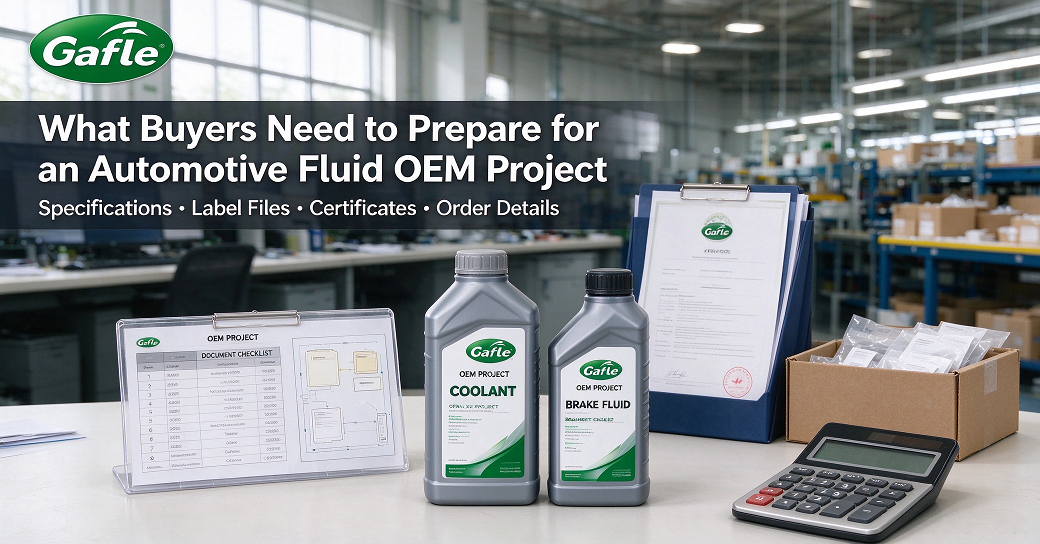
Starting an OEM coolant or brake fluid project is exciting for brand owners, but many new buyers do not know what materials they need to hand over to the manufacturer. Vague requirement descriptions, low-resolution label pictures or missing specification data lead to repeated confirmation, sample rework and longer lead time. As an experienced automotive fluid manufacturer, GAFLE factory summarizes the full checklist of materials you need to prepare before launching your OEM project, to streamline the whole cooperation process.

Product specification and performance requirements First, you need to confirm the product category: coolant or brake fluid. For coolant, define freezing point, boiling point, formula type (IAT / OAT / HOAT / EV thermal fluid) and target vehicle type (passenger car, heavy truck, EV). For brake fluid, confirm DOT grade, required dry and wet boiling point, viscosity standard. You also need to tell our manufacturer which industry standard your product needs to meet, such as ASTM for coolant, FMVSS 116 for brake fluid. If you only need our ready standard formula, just specify the model you select; if you need custom formula, you should provide your target performance indicators clearly.

Packaging, bottle and label design files Second, prepare packaging related information. Confirm bottle style and capacity: our factory has standard grey jug bottles for coolant and tamper-proof bottles for brake fluid. Provide vector artwork files for labels, AI or PDF format is preferred. The artwork should contain your brand name, product name COOLANT or BRAKE FLUID, specification, hazard warning area. If you also want custom printing on outer export cartons, supply carton design files and mark the print position. If you do not have a designer, our team can give you label template suggestions.

Commercial order and shipment requirements Third, sort out your commercial needs. Confirm your estimated order quantity, which directly decides MOQ, unit price and production schedule. Clarify trade terms such as FOB, CIF or EXW, destination port, and preferred shipping method (sea or air). List all the certificates and test reports you require, including COA, SDS, ISO certificate, reach declaration or third-party lab test documents. Also tell us if you need pallet packing or special export packing.

Regional chemical compliance requirements Automotive fluids are classified as chemical goods, and every country has unique import and labeling rules. You need to inform our manufacturer of your selling market and local regulatory requirements, such as GHS hazard class, mandatory warning statements, language requirement on labels. For example, some European markets require local language safety statements, while some Middle East markets have specific label size rules. Providing this information in advance helps our factory avoid non-compliant labels that will be detained by customs.

FAQ

Q1: What file format should I send for label artwork to the OEM factory?

A1: Vector PDF or AI file is the best choice for high-quality printing. High resolution PNG is acceptable for simple designs, but it may become blurry after scaling.

Q2: Do I need to provide my own formula if I choose ready-formula OEM service?

A2: No. If you select our existing standard formula, you only need to confirm the specification. Our manufacturer will keep the stable formula and provide test data for you.

Q3: Can I change the bottle size after the OEM project starts?

A3: It depends on the progress. If production has not started, bottle change is possible, but it may affect MOQ and quotation. If filling has begun, bottle replacement cannot be supported.

Q4: What certificates are commonly requested for coolant and brake fluid OEM orders?

A4: Most buyers ask for COA, SDS, ISO certificate and packing list. Extra third-party certification can be arranged with additional testing cost.

Q5: Do I need to prepare GHS hazard information by myself?

A5: You can tell our manufacturer your target market, and we will provide standard GHS hazard content that fits coolant or brake fluid for you to add into your label design.

Q6: Can I order mixed specifications, such as DOT4 brake fluid and -37℃ coolant in one OEM order?

A6: Yes, our factory supports mixed SKUs in one container, each item needs to meet its own MOQ requirement.

Q7: What if I do not have a finished label design yet?

A7: Our sales team can send blank label templates for coolant and brake fluid. You can modify the template with your brand logo and information.

Welcome to contact GAFLE for more information & cooperation!
peter
ZHEJIANG GAFLE AUTO CHEMICL CO.,LTD
Tel:86-579-8222 1665
Fax:86-579-8246 4690
Cel/Wechart:86-13335993986
E-mail:peter@gafle.net
Web:www.gafle.net
Featured Blogs
Can you provide multilingual SDS and technical documents?

Can you provide multilingual SDS and technical documents?

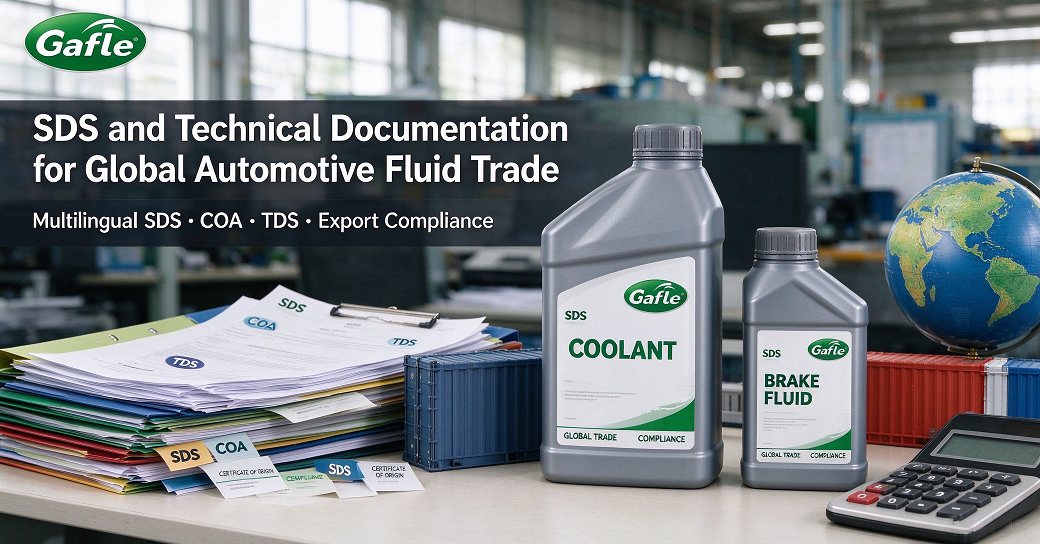
1. SDS, or Safety Data Sheet, is a mandatory compliance document for cross-border trade of coolant and brake fluid, and many countries require SDS in local official language. 2. A standard SDS covers 16 sections of safety information for chemical products, used for customs clearance, warehouse storage and logistics transportation. 3. Our manufacturer can provide multilingual SDS versions for different target markets, with language adaptation and region-specific hazard statements. 4. Besides SDS, there is a full set of supporting technical documents for global automotive fluid import, including TDS, COA and certificate of origin. 5. Buyers need to understand the rules of document revision, batch update and proper usage to avoid compliance risks.

Can you provide performance test reports?

Can you provide performance test reports?

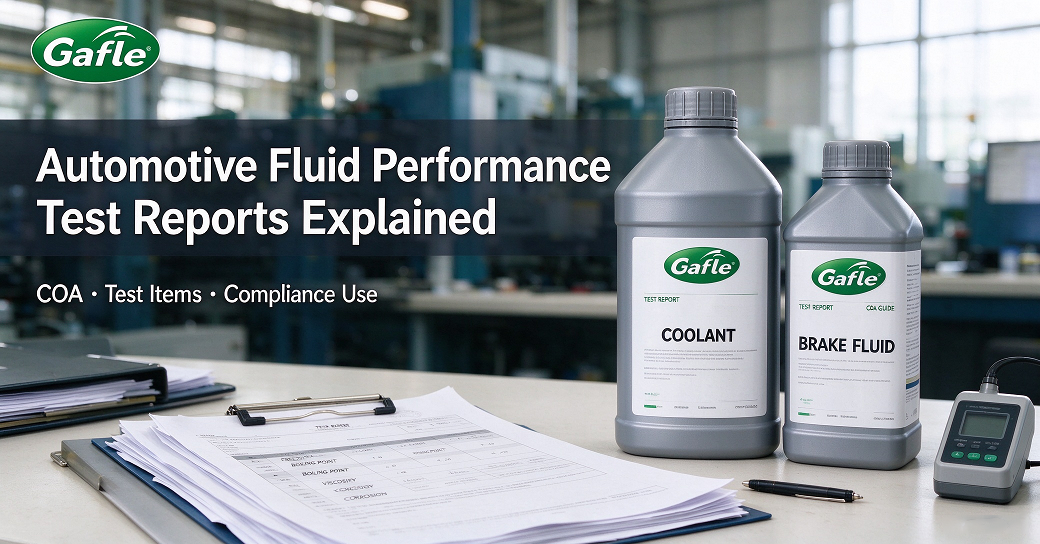
1. Performance test reports and COA documents are essential for importing, customs clearance and sales of coolant and brake fluid, but many buyers struggle to understand the technical indicators. 2. There are two main types of test reports from our manufacturer: internal Certificate of Analysis (COA) and independent third-party lab reports. 3. Coolant test reports focus on freezing point, boiling point, reserve alkalinity and corrosion protection performance. 4. Brake fluid test reports mainly track dry boiling point, wet boiling point, kinematic viscosity and rubber seal compatibility. 5. OEM buyers need to know how to get test reports, update batch data and use these documents correctly for import and sales.

Can you provide technical support for product development?

Can you provide technical support for product development?

1. Many brand owners do not have in-house chemical technical teams and need professional technical support from their automotive fluid manufacturer during OEM development. 2. Our factory provides pre-production technical consultation to help buyers select suitable coolant or brake fluid specifications for their target market and vehicle types. 3. We offer lab testing support including seal compatibility test, stability test and performance verification for OEM projects. 4. Technical support continues after products launch, helping buyers handle end-user questions and product-related troubleshooting. 5. GAFLE manufacturer has fixed communication channels and response rules for technical support requests from OEM buyers.

Can you match our existing product specification?

Can you match our existing product specification?

1. Many brand owners want a manufacturer to replicate their existing coolant or brake fluid product, but they do not understand the formula matching workflow and limitations. 2. Buyers need to send physical samples and supply basic background information of the target fluid to our factory for matching work. 3. Our lab team runs a series of physical and chemical tests on the sample to capture its core performance specifications. 4. After the initial formula adjustment, the manufacturer produces trial samples for buyers to test and confirm. 5. Formula matching service has clear boundaries related to intellectual property and special patented raw materials.

What information is needed to start an OEM project?

What information is needed to start an OEM project?

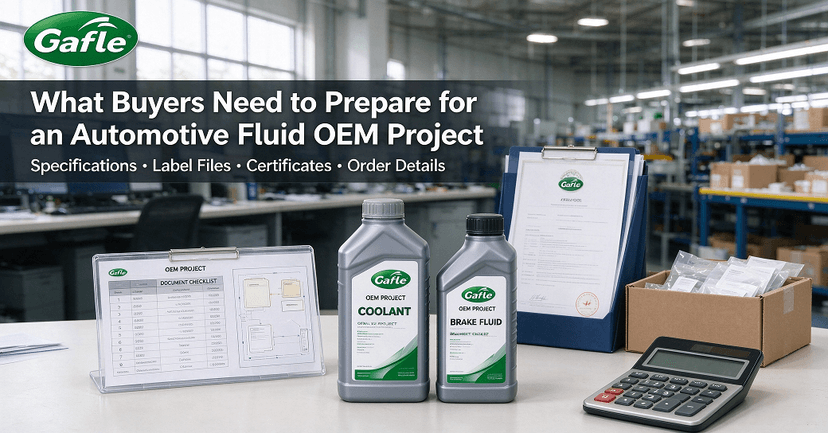
1. Unclear specifications and incomplete files often cause back-and-forth communication and delay when buyers start an OEM automotive fluid project with a manufacturer. 2. You need to define clear product specifications, formula requirements and regional performance standards before sending inquiry to the factory. 3. Complete packaging and label design files are essential for the manufacturer to start artwork review and pre-production sampling. 4. Buyers should confirm order quantity, trade terms, shipment plan and required certificates for their OEM project. 5. Different countries have different chemical compliance rules, so buyers need to prepare relevant regulatory requirements for label and document creation.

How long does an OEM coolant order take?

How long does an OEM coolant order take?

1. Many importers underestimate the full lead time of OEM coolant orders and face stock shortages due to missed scheduling steps. 2. The pre-production phase covers PI confirmation, artwork review, pre-production sample approval and production schedule reservation at our factory. 3. Once all pre-work is approved, the manufacturer starts raw material blending, filling, labeling and quality inspection of finished coolant. 4. After production is finished, we arrange inspection, export document preparation and container loading for your coolant shipment. 5. Multiple factors will extend the lead time of OEM coolant orders, and buyers can take simple steps to avoid delays.