Why Brake Fluid Batch Consistency Matters to Brake System Longevity
When evaluating hydraulic braking performance, sourcing teams and validation engineers often spend months qualifying a specific formulation against FMVSS 116 or ISO 4925 standards. Yet, the real challenge rarely lies in formulating an initial lab-scale blend that passes compliance. The genuine operational risk is maintaining brake fluid batch consistency across months or years of high-volume blending. If one production run drifts slightly in moisture absorption rates, cold-temperature viscosity, or reserve alkalinity, the consequences surface downstream as warranty claims, ABS valve sticking in cold climates, or accelerated seal degradation.
Brake fluids—predominantly glycol ether and borate ester formulations for DOT 3, DOT 4, and DOT 5.1 specifications—are chemically sensitive mixtures. A minor deviation during intermediate compounding or packaging directly impacts performance parameters. Achieving stable brake fluid quality requires tight process constraints that start well before the fluid enters the final blending vessel.
The Chemistry Behind the Drift: Raw Material Control
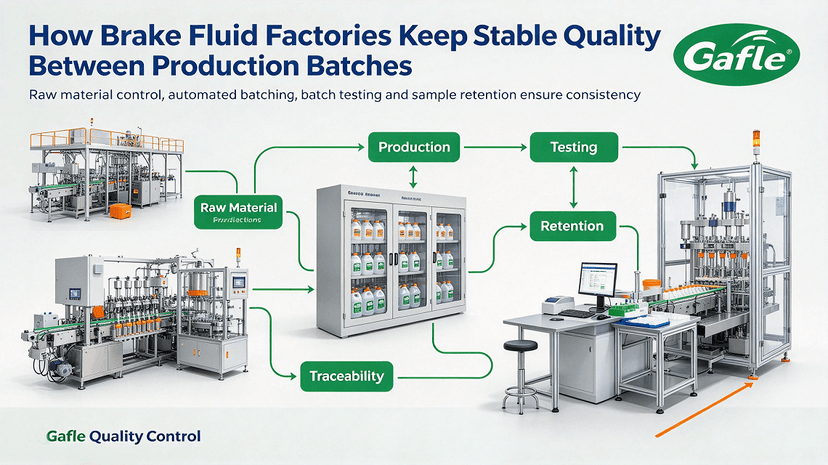
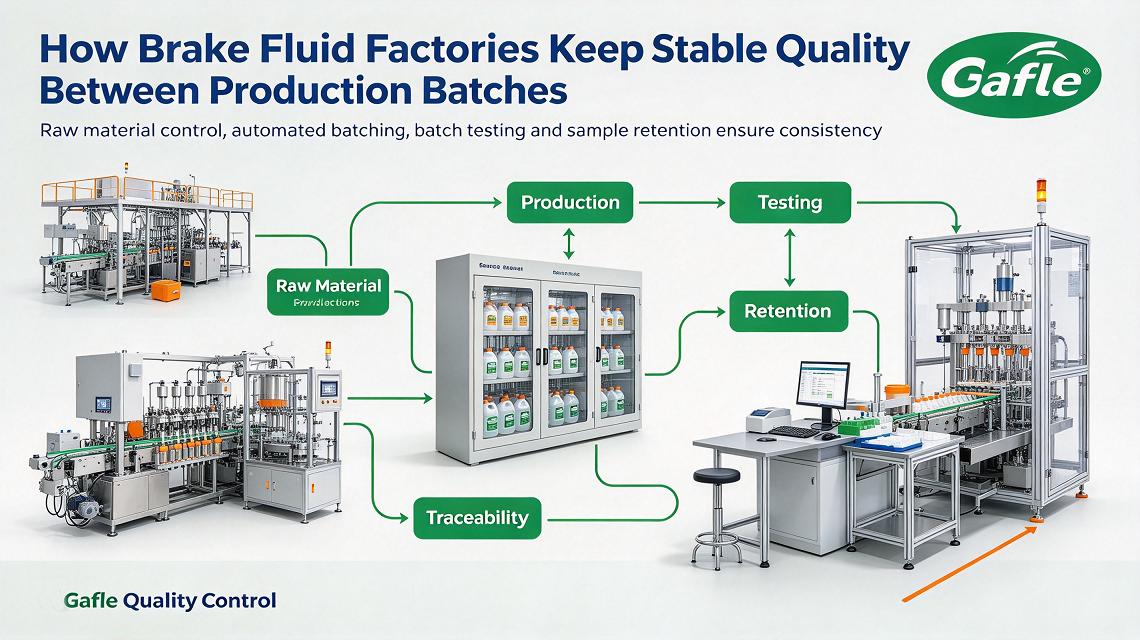
Most brake fluid batch variability does not originate from human error at the blending panel; it originates upstream in feedstock variances. A standard DOT 4 fluid relies on an intricate balance of glycol ethers (which provide the solvent base), borate esters (which scavenge moisture and maintain high dry and wet boiling points), and an additive package comprising corrosion inhibitors, antioxidants, and pH stabilizers.
Rigorous raw material control is the foundation of preventing chemical drift. Polyglycols and glycol ethers are inherently hygroscopic. If raw materials sit in storage tanks without dry nitrogen blanketing or desiccated breathers, ambient humidity will contaminate the feedstock before batching even starts. A feedstock that arrives with 0.15% baseline water content instead of the expected 0.05% forces the blender to either over-compensate with moisture scavengers or deliver a batch with a depressed dry Equilibrium Reflux Boiling Point (ERBP).
Similarly, inhibitor packages must dissolve completely and evenly. Inhibitors like triazoles and amines protect yellow metals and ferrous components in calipers and master cylinders. If raw material purity varies between chemical lots, these additives can suffer from solubility limits, leading to haze, sediment, or localized fluid stratification inside bulk IBCs or consumer bottles.
Essential Protocols for Brake Fluid Batch Testing
A Certificate of Analysis (CoA) that simply states 'passed' against nominal specification ranges is rarely sufficient for high-reliability tier suppliers. Systematic brake fluid batch testing must verify physical and chemical benchmarks at multiple stages: during blending, immediately prior to packaging, and after bottling.
Key laboratory evaluations should include:
Kinematic Viscosity at -40°C: Vital for modern Electronic Stability Control (ESC) and Anti-lock Braking Systems (ABS). Excessive cold-temperature thickening can slow valve response times by crucial milliseconds. Slight variations in the molecular weight distribution of polyglycols can cause a batch to fail cold-flow limits even if its room-temperature viscosity appears normal.
- Dry and Wet ERBP: Dry ERBP gauges the fluid's baseline thermal ceiling, while wet ERBP simulates real-world performance after humidification. Consistent borate ester concentrations are crucial here; an uncalibrated metering pump can leave an entire batch deficient in moisture-binding capacity.
- Karl Fischer Titration: Direct measurement of water content. A production batch should typically leave the packaging line with water content strictly minimized, often below 0.10% to 0.20%, depending on the target grade.
- pH and Reserve Alkalinity: Monitoring the fluid’s ability to neutralize acidic degradation products over its operational lifespan. An inconsistent inhibitor ratio destabilizes pH, accelerating internal corrosion of brake line alloys.
- Elastomer Compatibility: Testing with standard SBR and EPDM reference rubbers ensures the batch will not induce excessive volumetric swelling, shrinkage, or hardening in master cylinder cups and caliper piston seals.
Where Quality Control Often Breaks Down
Even when the blending chemistry is dialed in, plant-level quality control can fail during the packaging phase. Brake fluids are aggressive solvents and extremely thirsty for moisture. Bottling equipment that has not been thoroughly purged between runs can introduce cross-contamination from wash water or previous product grades.
Furthermore, packaging integrity is an overlooked driver of batch stability. If an automated foil-induction sealer fluctuates in temperature or pressure, micro-leaks in the bottle seal allow moisture ingress during sea freight or warehouse storage. A batch that left the blending plant with a pristine 265°C dry boiling point may arrive at an assembly plant degraded simply because the container seals lacked batch-level validation.
Sourcing managers should also pay attention to pigging systems and transfer line purges. In facilities that blend both standard DOT 3 and high-performance DOT 5.1, residual lines must be completely cleared. Even fractional contamination of a low-boiling-point fluid into a high-spec run will compromise the batch's technical rating.
Buyer's Guide: Auditing a Fluid Formulator
When evaluating a manufacturing partner for contract blending or private-label fluid programs, look beyond sales claims and inspect their operational discipline:
- In-Line Analytical Monitoring: Does the plant utilize real-time automated sampling (such as refractive index or near-infrared spectroscopy) during circulation, or do they rely solely on a single grab sample taken at the end of the shift?
- Feedstock Acceptance Criteria: Insist on seeing incoming inspection logs for raw glycols. A reputable toll blender should reject incoming tanker trucks if moisture, color, or acidity fall outside tightly defined acceptance windows.
- Retained Sample Retention: Standard practice should mandate retained samples for every distinct batch, kept in sealed glass containers for a minimum of 24 to 36 months to support root-cause investigations if field anomalies occur.
- Nitrogen Management: Confirm that all storage tanks, intermediate buffer vessels, and filling heads utilize active nitrogen blanketing to prevent moisture ingestion from ambient air.
Frequently Asked Questions
Why does cold-temperature viscosity vary between batches of the same fluid?
Cold-temperature viscosity is highly sensitive to the exact distribution of polymer chain lengths in the polyglycol ether base. If raw material suppliers deliver a feedstock with slightly higher average molecular weights or unreacted intermediates, the fluid will thicken significantly at -40°C, even if room-temperature viscosity remains within the nominal specification.
Can packaging materials affect brake fluid batch consistency after shipment?
Yes. High-density polyethylene (HDPE) bottles without adequate moisture-barrier layers allow atmospheric moisture permeation over time. Additionally, defective foil seals allow vapor exchange, which gradually depresses the fluid's wet and dry boiling points before the container is ever opened by a technician.
What is the difference between wet ERBP and dry ERBP in quality control?
Dry ERBP measures the boiling point of fresh, unadulterated fluid straight from the container. Wet ERBP measures the boiling point after the fluid has been conditioned to absorb approximately 3.7% water under standardized atmospheric humidity. Wet ERBP testing checks whether the fluid's chemical buffer and moisture-scavenging components perform reliably under real-world degradation conditions.
Next Steps for Engineering and Procurement
To ensure your supply chain maintains dependable fluids that meet OEM-tier expectations, review your current purchasing specifications. Replace broad reference standards with defined tolerance bands for cold viscosity, raw material moisture limits, and batch retention protocols. For assistance reviewing blend specifications or establishing quality-assurance criteria for high-performance fluid applications, contact our technical fluids team.
Welcome to contact GAFLE for more information & cooperation!
peter
ZHEJIANG GAFLE AUTO CHEMICL CO.,LTD
Tel:86-579-8222 1665
Fax:86-579-8246 4690
Cel/Wechart:86-13335993986
E-mail:peter@gafle.net
Web:www.gafle.net