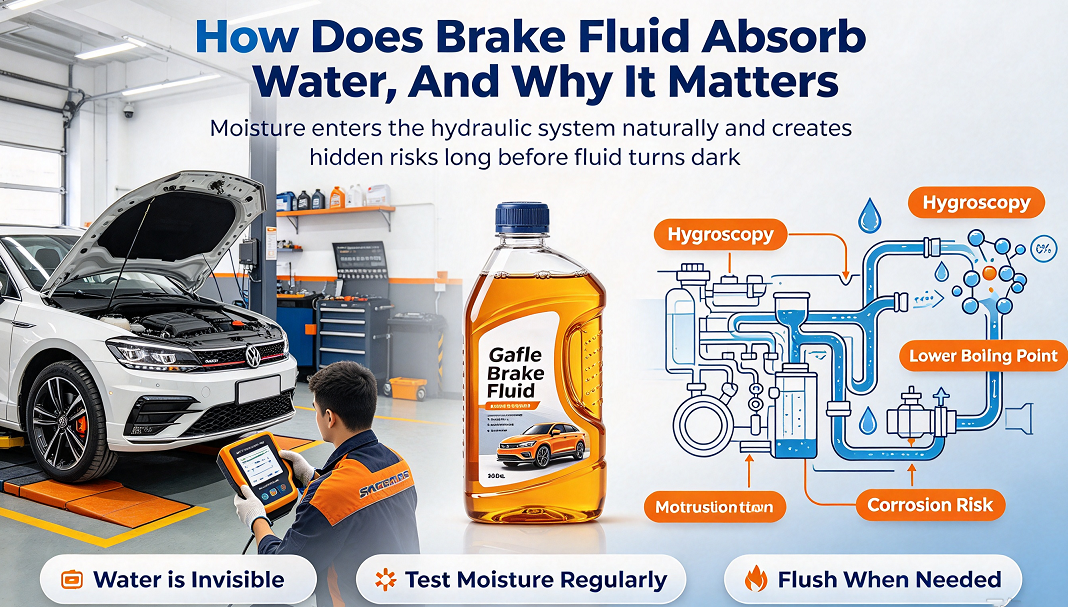
Most technicians know brake fluid can absorb water, but many do not fully understand the underlying hygroscopic mechanism and its hidden impact on brake safety.
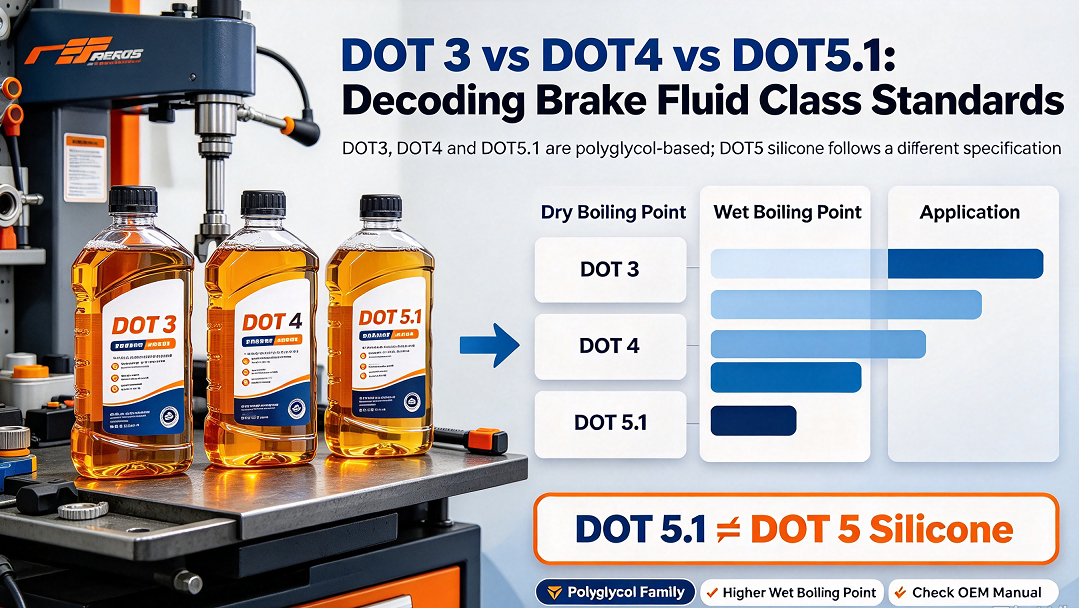
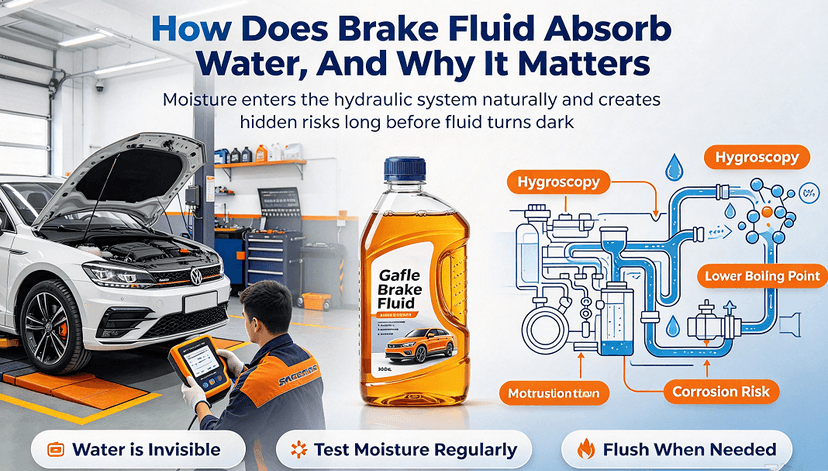
Brake fluid is the core medium that transfers force within a vehicle’s hydraulic brake system. Poly-glycol based DOT3, DOT4 and DOT5.1 brake fluids all share one critical chemical property: they are hygroscopic. This means the fluid actively attracts and absorbs water molecules from the surrounding environment. This is not a manufacturing defect, but an inherent chemical characteristic built into the formula. Many people mistakenly believe brake fluid only gets contaminated by water if there is a leak in the brake system. In reality, moisture can slowly penetrate the brake circuit even when all seals, hoses and reservoir caps are intact.
How moisture enters and dissolves inside brake fluid
Water vapor from ambient air can pass through tiny pores in rubber brake hoses, and slowly seep past the imperfect seal of the brake fluid reservoir cap. Once water vapor comes into contact with polyglycol brake fluid, it mixes uniformly into the liquid at a molecular level. Water does not sink to the bottom or float on top. It forms a homogeneous mixture, so you cannot visually separate water from brake fluid just by looking at the reservoir.
This absorption process happens continuously from the moment the brake fluid container is opened. Even sealed bottles of brake fluid will slowly take in moisture over long storage periods. Once installed inside the vehicle, the fluid will keep absorbing water year after year. The rate of water intake depends on climate. Vehicles operated in humid coastal regions absorb moisture much faster than cars in dry inland areas.
The biggest risk: water drastically lowers brake fluid boiling point
The most dangerous consequence of water contamination is the drop in wet boiling point. Pure new brake fluid has a high dry boiling point, allowing it to stay in liquid form under heavy braking heat. Water boils at 100°C, far lower than the working temperature of brake calipers during repeated hard stops. When brake fluid absorbs water, the boiling point of the entire mixture decreases steadily.
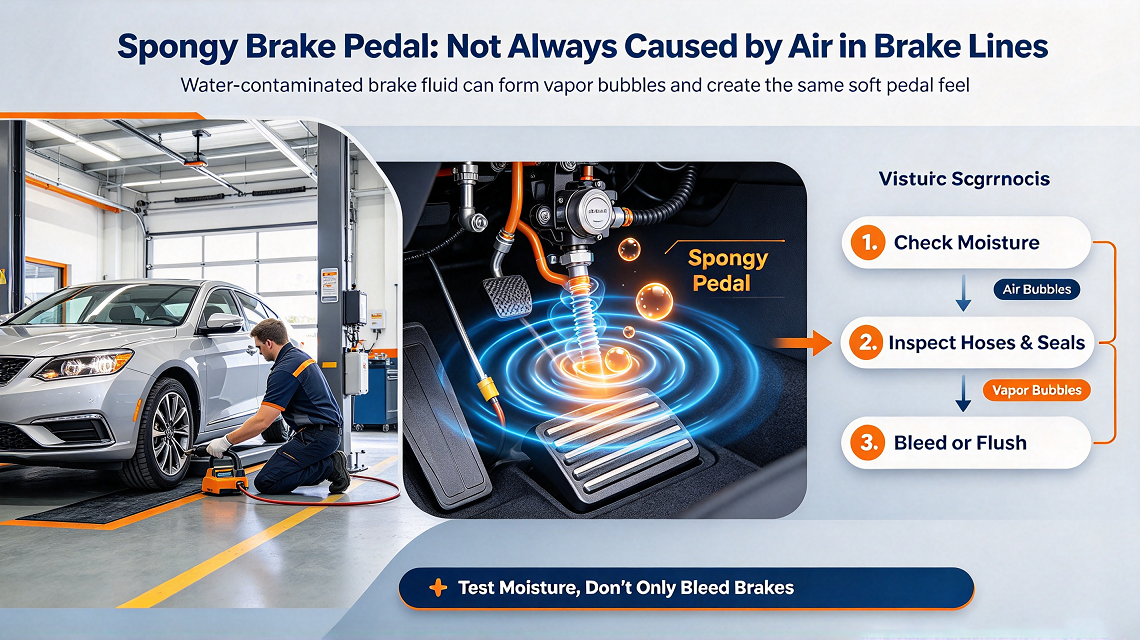
When the fluid reaches boiling temperature, water turns into compressible vapor bubbles. Liquid brake fluid transfers pressure instantly, but gas bubbles compress when you press the brake pedal. This creates a spongy brake feel, longer stopping distance, and sudden brake fade. This hazard can appear unexpectedly during mountain descents, heavy load towing or emergency braking. Even a small percentage of water inside brake fluid can cut the boiling point significantly, creating a hidden safety hazard that cannot be detected by visual inspection.
Secondary damage: moisture triggers corrosion inside brake hydraulic parts
Dissolved water inside brake fluid also initiates electrochemical corrosion on all metal components of the brake system. Master cylinder bores, steel brake lines, caliper pistons and ABS valve bodies will gradually develop rust. Tiny rust particles circulate through the whole hydraulic circuit, scratching polished metal surfaces, wearing rubber seals and clogging the micro passages inside ABS modules.
Corrosion damage develops slowly. Vehicle owners and technicians may not notice symptoms until seals start to leak or ABS faults appear. At this stage, the damage to brake parts is often irreversible. Repairing corroded brake components costs far more than a routine brake fluid flush.
How to monitor and prevent excessive water absorption
Visual inspection cannot tell you the water content of brake fluid. The only reliable way is to use a professional brake fluid tester that measures moisture percentage. Industry standard practice recommends brake fluid replacement once water content reaches 3%.
Many service shops replace brake fluid only based on fixed mileage. This approach has limitations. A vehicle parked in humid climate with low annual mileage can still absorb dangerous levels of moisture, even if the odometer reading is low. Routine testing is more accurate than mileage-based replacement alone. Always keep brake fluid bottles tightly sealed. Never leave the reservoir cap off longer than necessary during maintenance, to avoid exposing fresh brake fluid to humid air.
Gafle brake fluid stable formula and maintenance guidance
Zhejiang Gafle Environmental Technology produces a full range of DOT-rated polyglycol brake fluids. Our brake fluid is formulated with high-quality base materials and balanced anti-corrosion additives. While all polyglycol brake fluid is hygroscopic, Gafle brake fluid maintains stable performance and strong corrosion protection before moisture reaches the warning threshold. We provide full technical datasheets and MSDS documents for all products, helping auto parts distributors and repair shops deliver professional brake maintenance advice to end customers.
Final Takeaway
Brake fluid absorbs water through its natural hygroscopic property. Moisture does not just discolor the fluid; it reduces boiling point and triggers internal brake system corrosion. Visual checks are not enough. Regular water testing and scheduled brake fluid flushes are essential to avoid sudden brake fade and expensive brake component damage.
Welcome to contact GAFLE for more information & cooperation!
peter
ZHEJIANG GAFLE AUTO CHEMICL CO.,LTD
Tel:86-579-8222 1665
Fax:86-579-8246 4690
Cel/Wechart:86-13335993986
E-mail:peter@gafle.net
Web:www.gafle.net
peter
ZHEJIANG GAFLE AUTO CHEMICL CO.,LTD
Tel:86-579-8222 1665
Fax:86-579-8246 4690
Cel/Wechart:86-13335993986
E-mail:peter@gafle.net
Web:www.gafle.net