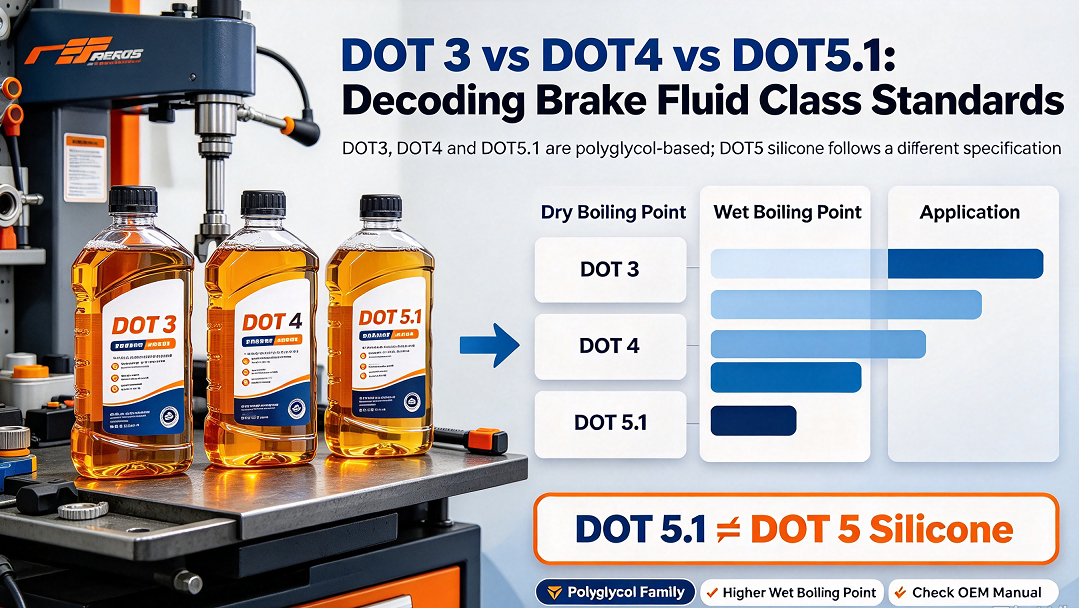
Brake fluid DOT grades are widely referenced in vehicle maintenance, yet many mechanics and parts buyers still mix up DOT3, DOT4, DOT5.1, and mistakenly confuse DOT5.1 with silicone DOT5 brake fluid.
The US Department of Transportation (DOT) sets performance specifications for hydraulic brake fluid used in road vehicles. Each DOT grade defines minimum requirements for dry boiling point, wet boiling point, viscosity, rubber compatibility and corrosion resistance. These grades are not arbitrary brand marketing labels. They are standardized performance benchmarks. However, widespread misunderstanding about these grades leads to wrong fluid selection, improper mixing and premature brake system damage. It is critical to understand the differences between DOT3, DOT4 and DOT5.1, and distinguish polyglycol DOT5.1 from silicone-based DOT5.
Core performance comparison of DOT3, DOT4 and DOT5.1
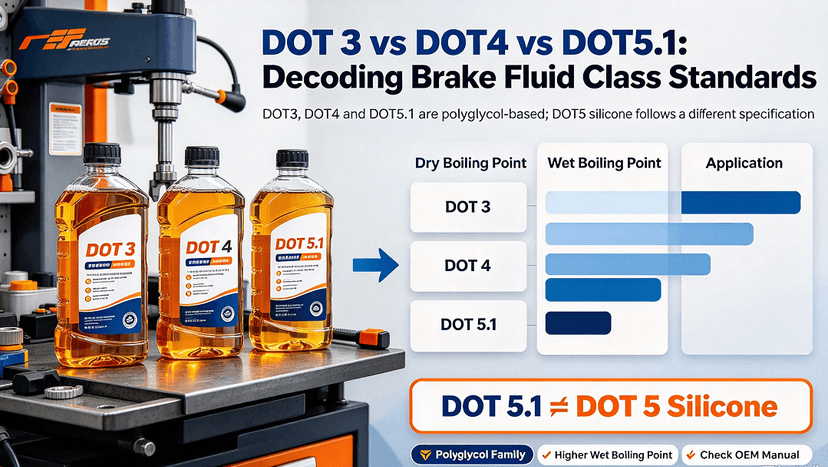
All three grades — DOT3, DOT4 and DOT5.1 — are polyglycol-based brake fluids. They are hygroscopic, miscible with each other, and compatible with standard brake rubber seals. The primary difference lies in boiling point thresholds.
DOT3 is the entry-level specification. It meets the minimum standard for light vehicle brake systems. Its dry boiling point and wet boiling point are the lowest among these three grades. DOT3 works well for older passenger cars with relatively low brake thermal load. But under heavy braking, mountain driving or towing, DOT3 is more likely to suffer boiling point degradation after absorbing water.
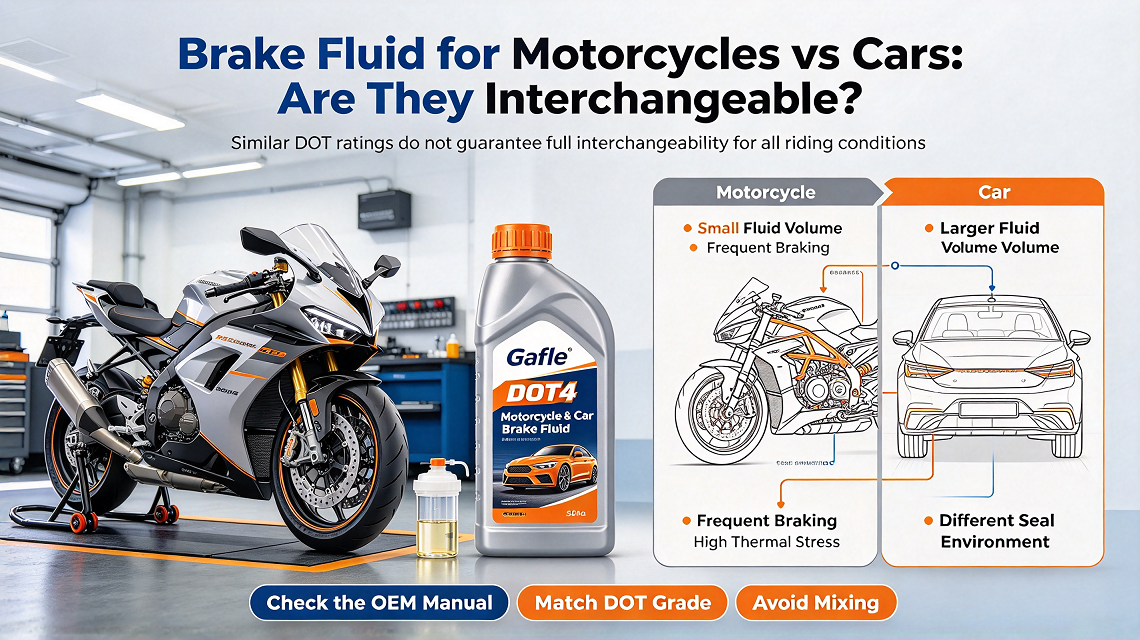
DOT4 is the most widely used grade in modern passenger cars, motorcycles and light commercial vehicles. It has higher dry and wet boiling points than DOT3. The upgraded formula provides a larger safety margin when brake fluid absorbs moisture over time. Most OEM factory recommendations for modern vehicles specify DOT4 brake fluid. It balances performance and cost, making it the mainstream choice for global auto parts markets.
DOT5.1 is the highest-performance polyglycol brake fluid in this group. It delivers a significantly higher wet boiling point. DOT5.1 is designed for high-performance vehicles, race vehicles, heavy-load applications and vehicles that see frequent hard braking. It maintains stable performance even after absorbing a certain amount of water. A very common misunderstanding is assuming DOT5.1 is the same as DOT5. This is not true.
Critical distinction: DOT5.1 ≠ DOT5 silicone brake fluid
This is one of the most pervasive myths in brake fluid selection. DOT5.1 is polyglycol based, same base chemistry as DOT3 and DOT4. It can mix safely with DOT3 and DOT4. DOT5 is silicone-based brake fluid. Silicone DOT5 is not hygroscopic, but it cannot mix with polyglycol brake fluid. If DOT5 silicone fluid enters a brake system previously filled with DOT3/DOT4/DOT5.1, the two liquids will separate, trap air bubbles and damage rubber seals. Repairing this contamination requires complete disassembly and cleaning of the whole brake circuit.
DOT5 silicone fluid is rarely recommended for standard road vehicles. DOT5.1, on the other hand, can be used as an upgrade replacement for DOT3 and DOT4 systems, as long as the service procedure includes a full brake fluid flush.
How to select the right DOT grade for different vehicles
Always follow the vehicle OEM manual as the first priority. The manufacturer selects the brake fluid grade based on brake system design, expected thermal load and seal material. Do not downgrade from the recommended grade. For example, if the manual requires DOT4, using DOT3 will reduce safety margin.
Upgrading to a higher grade is possible with a full system flush. If a car originally uses DOT4, you can switch to DOT5.1 after completely flushing all old fluid out of the brake circuit. But partial top-up mixing is not recommended. For ordinary daily commuter vehicles, high-quality DOT4 is usually sufficient. For performance cars, fleet vehicles and vehicles used for frequent mountain driving, DOT5.1 offers better high-temperature protection.
Gafle full range of DOT standard brake fluid
Zhejiang Gafle Environmental Technology manufactures DOT3, DOT4 and DOT5.1 polyglycol brake fluids that meet DOT performance standards. Every batch undergoes strict laboratory testing for boiling point, viscosity and corrosion protection. We provide complete technical documentation for auto parts importers, wholesalers and repair shops. Gafle brake fluid supports OEM private label packaging for global B2B partners.
Final Takeaway
DOT3, DOT4 and DOT5.1 are all polyglycol brake fluids with increasing boiling point performance. Never confuse polyglycol DOT5.1 with silicone DOT5 brake fluid. Always refer to the vehicle manual for the required grade. When upgrading brake fluid grades, perform a full brake flush instead of simple topping up to avoid mixing old and new fluid.
Welcome to contact GAFLE for more information & cooperation!
peter
ZHEJIANG GAFLE AUTO CHEMICL CO.,LTD
Tel:86-579-8222 1665
Fax:86-579-8246 4690
Cel/Wechart:86-13335993986
E-mail:peter@gafle.net
Web:www.gafle.net
peter
ZHEJIANG GAFLE AUTO CHEMICL CO.,LTD
Tel:86-579-8222 1665
Fax:86-579-8246 4690
Cel/Wechart:86-13335993986
E-mail:peter@gafle.net
Web:www.gafle.net