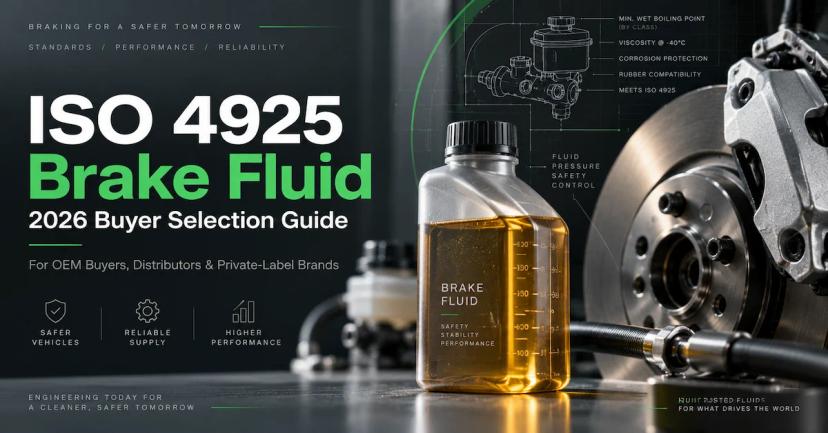
What ISO 4925 Brake Fluid Means for Buyers in 2026
When a brake fluid RFQ says only “ISO 4925,” the specification is incomplete.
A professional buyer needs at least two more pieces of information: which edition of ISO 4925 applies and which performance class is required. Those details affect boiling-point limits, low-temperature viscosity, testing expectations, application suitability, and the evidence that should accompany supplier approval.
That distinction matters more in 2026 because ISO 4925:2020 has been replaced by ISO 4925:2026, the fourth edition of the international standard for non-petroleum-based brake and clutch fluids used in compatible road-vehicle hydraulic systems. ISO lists the 2020 edition as withdrawn and the 2026 edition as the current published version. ISO
For distributors and private-label brands, this creates a practical sourcing issue. A supplier may have historical test data against an older edition, while a new customer specification or tender may explicitly require the current edition. Those documents should not automatically be treated as interchangeable.
A useful RFQ therefore does not ask:
“Can you supply ISO 4925 Brake Fluid?”
It asks:
“Please quote brake fluid for ISO 4925:2026 Class 6, subject to our required test documentation, packaging specification, target market, and batch acceptance criteria.”
That one sentence removes a large amount of ambiguity before price negotiation even begins.
GAFLE's current brake fluid portfolio includes DOT 3, DOT 4, DOT 5.1, OEM and application-oriented brake fluids. For a buyer, however, catalogue positioning should be the start of technical qualification—not the final evidence used to release an order. Gafledp
Why the ISO 4925 Class Matters More Than the Standard Name Alone
ISO 4925 does not define a single universal fluid.
It contains different performance classes intended to address different combinations of thermal performance and fluidity. A product described simply as “ISO 4925 compliant” therefore leaves an important question unanswered: compliant with which class?
This is particularly relevant for modern braking systems.
Older procurement practices often focused heavily on dry boiling point. That remains important, but it is only one part of hydraulic performance. A fluid used in a cold climate or in a vehicle with electronically controlled brake functions may also need significantly better low-temperature flow characteristics.
A buyer comparing two fluids can therefore make the wrong decision if the comparison looks only like this:
| Supplier | Claimed Dry Boiling Point | Price |
|---|---|---|
| Supplier A | 255°C | Lower |
| Supplier B | 250°C | Higher |
That table says almost nothing about wet boiling point, viscosity at −40°C, corrosion, elastomer compatibility, water tolerance, stability, batch consistency, test edition, packaging, or traceability.
A stronger purchasing comparison begins with the required performance class and then asks whether the full product evidence matches it.
This is why ISO 4925 Brake Fluid should be treated as a specification-controlled product rather than a commodity selected by one headline value.
ISO 4925 Classes at a Glance
The following values are useful screening references for procurement. They do not replace the complete purchased ISO standard, because ISO 4925 includes additional requirements and prescribed test procedures beyond the three headline parameters shown here.
| ISO 4925 Class | Minimum Dry ERBP | Minimum ERBP Act | Maximum Viscosity at −40°C | Typical Procurement Context |
|---|---|---|---|---|
| Class 3 | 205°C | 140°C | 1,500 mm²/s | Conventional hydraulic brake applications where the specified performance level is appropriate |
| Class 4 | 230°C | 155°C | 1,500 mm²/s | Higher thermal requirement than Class 3 |
| Class 5-1 | 260°C | 180°C | 900 mm²/s | Higher boiling reserve with improved cold-fluidity requirement |
| Class 6 | 250°C | 165°C | 750 mm²/s | Low-viscosity applications, often important for electronically controlled braking systems |
| Class 7 | 260°C | 180°C | 750 mm²/s | High boiling reserve combined with low-temperature viscosity performance |
Published technical references consistently show Class 6 at ≥250°C dry ERBP, ≥165°C wet ERBP and ≤750 mm²/s at −40°C, while Class 7 combines ≥260°C, ≥180°C and ≤750 mm²/s. BASF Fuel & Lubes Class 3, Class 4 and Class 5-1 are commonly summarized with the corresponding 205/140/1500, 230/155/1500 and 260/180/900 thresholds. ManualWiki
These values are minimum or maximum class limits, not typical values for every product.
That difference is critical.
If a technical data sheet says:
Dry ERBP: 270°C typical
and the standard says:
Dry ERBP: ≥260°C
those statements do not mean the same thing. One is a typical formulation or test result; the other is a minimum class requirement.
For supplier approval, buyers should determine whether every published value is:
- a standard threshold;
- an internal product specification;
- a guaranteed release limit;
- a typical formulation value;
- or an actual batch result.
Mixing those categories produces misleading comparisons.
ISO 4925 vs DOT Brake Fluid: Similar Reference Points, Different Specifications
International buyers regularly use ISO classes and DOT grades in the same conversation, but they should not be treated as identical naming systems.
FMVSS No. 116 defines U.S. motor-vehicle brake-fluid requirements, including DOT 3, DOT 4 and DOT 5/DOT 5.1-related requirements, while ISO 4925 uses its own class structure. FMVSS No. 116, for example, specifies DOT 3 minimum dry and wet ERBP values of 205°C and 140°C and DOT 4 values of 230°C and 155°C. Legal Information Research Institute
A practical comparison looks like this:
| ISO Class | Familiar DOT Reference | Important Qualification |
|---|---|---|
| ISO Class 3 | Often associated with DOT 3 performance | Confirm both standards separately if both are required |
| ISO Class 4 | Often associated with DOT 4 | Do not assume every DOT 4 claim automatically proves every ISO requirement |
| ISO Class 5-1 | Commonly associated with DOT 5.1 non-silicone fluid | Do not confuse DOT 5.1 with silicone-based DOT 5 |
| ISO Class 6 | Commonly associated with low-viscosity DOT 4 / ESP-type applications | Class 6 has a 750 mm²/s low-temperature viscosity ceiling |
| ISO Class 7 | Higher-performance low-viscosity class | Requires both high boiling performance and low-temperature fluidity |
For a buyer, the safest rule is simple:
Do not convert an OEM requirement into another standard by assumption.
If the vehicle manufacturer specifies DOT 4, source against that requirement.
If the tender specifies ISO 4925:2026 Class 6, put that exact requirement into the RFQ.
If both ISO and FMVSS requirements apply, ask the supplier for evidence covering both.
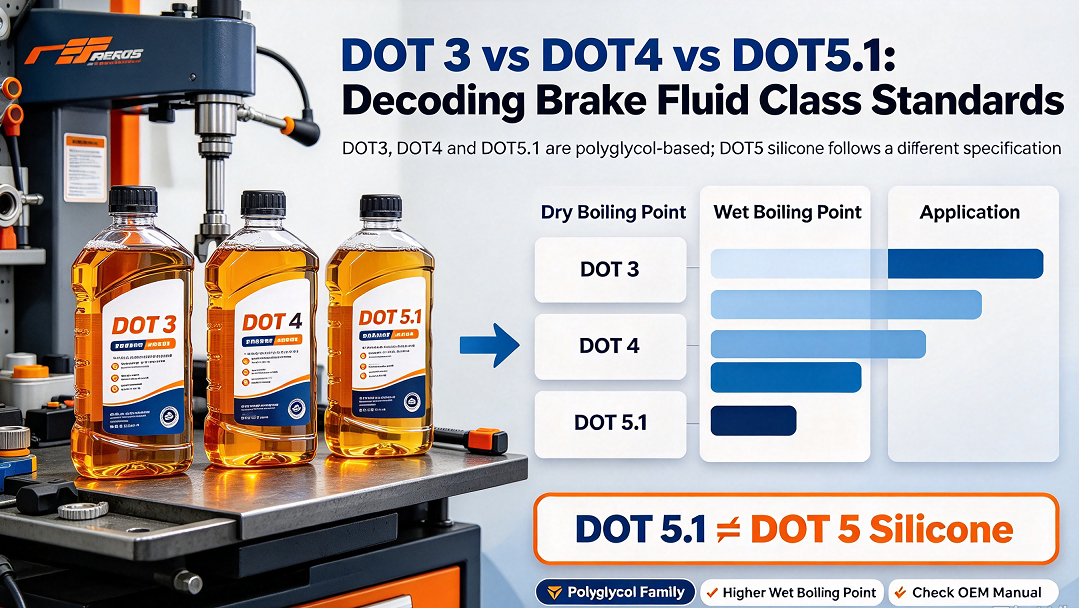
FORK's DOT 3 vs DOT 4 vs DOT 5.1 guide provides additional background for buyers comparing the familiar DOT categories.
Why Dry Boiling Point Is Important—but Not Enough
Brake systems generate heat.
Under repeated braking, downhill operation, towing, commercial duty, performance driving, or other demanding conditions, that thermal load can become significant. Brake fluid must remain capable of transmitting hydraulic pressure without forming vapor under the conditions for which the system and fluid were designed.
Dry ERBP is therefore a useful property because it evaluates the boiling performance of relatively fresh fluid under the defined test.
But a high dry number should never be used alone to declare one fluid “better.”
Consider two hypothetical products:
Fluid A
- Dry ERBP: 275°C
- ERBP Act: 160°C
Fluid B
- Dry ERBP: 265°C
- ERBP Act: 180°C
A marketing department might immediately promote Fluid A because 275 is greater than 265.
A technical buyer should not make that leap.
The two fluids may be designed for different classes, and Fluid B may retain substantially more boiling margin after prescribed moisture conditioning. Other parameters may differ as well.
The correct purchasing question is not:
Which number is highest?
It is:
Which product satisfies the complete required specification with repeatable production control?
That distinction separates product marketing from engineering procurement.
Why Wet ERBP Deserves More Attention in Supplier Qualification
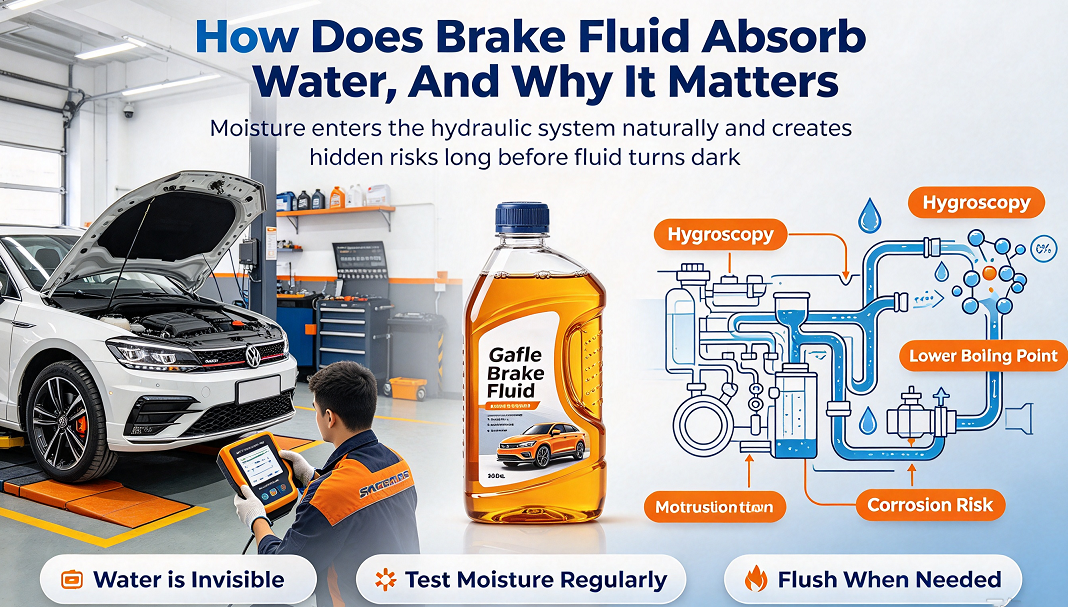
Glycol-based brake fluids are hygroscopic. Moisture exposure therefore matters over the service life of the fluid.
Wet ERBP is designed to provide a standardized way to evaluate boiling performance after prescribed moisture conditioning. It gives buyers a more useful view of retained thermal capability than a fresh-fluid number alone.
This is particularly relevant for:
- humid markets;
- vehicles kept in service for long periods;
- commercial fleets;
- workshops servicing mixed vehicle populations;
- products stored and distributed through long supply chains;
- private-label brands whose reputation depends on consistent field performance.
A procurement team should ask suppliers to identify the test method and whether a value represents:
standard minimum → product specification → typical result → batch result.
If those four are not separated, an apparently impressive comparison chart may have no technical meaning.
GAFLE's own brake fluid testing guide identifies dry boiling point and wet boiling point as key elements in brake-fluid quality verification. Gafledp
Low-Temperature Viscosity Is a Major Difference Between ISO Classes
Low-temperature viscosity is one of the most commercially important parts of ISO 4925 class selection, yet it receives less attention than boiling point in many buyer inquiries.
At low temperature, brake fluid becomes more viscous. If fluidity is insufficient for the application, hydraulic response through narrow passages and electronically controlled components can be affected.
This is why the jump from a 1,500 mm²/s ceiling to 750 mm²/s at −40°C is significant.
Class 6 and Class 7 are not simply “higher-numbered brake fluids.” Their low-temperature viscosity requirement is a defining part of the class.
This matters in vehicles using sophisticated brake control technologies such as:
- ABS;
- electronic stability control;
- automated brake interventions;
- traction-related hydraulic control;
- other systems where fast pressure modulation may be required.
It also matters in markets where vehicles operate during severe winter conditions.
A distributor supplying Northern Europe, northern North America, high-altitude regions, or other cold markets should therefore avoid selecting a product from boiling point alone.
Ask:
- What ISO class does the vehicle or project require?
- What is the specified viscosity limit at −40°C?
- What is the supplier's release specification?
- What result appears on the test report?
- Is that result tied to the exact supplied formulation?
- How is batch variation controlled?
Those questions create a far stronger technical purchase than “Please quote high boiling point brake fluid.”
ISO Class 3: Where It Fits
ISO 4925 Class 3 provides a conventional performance reference with minimum dry ERBP of 205°C, minimum wet ERBP of 140°C and maximum viscosity at −40°C of 1,500 mm²/s.
For a buyer, Class 3 should not be dismissed simply because higher classes exist.
The correct fluid is the one specified for the vehicle and market.
Class 3 may remain relevant for vehicle populations, aftermarket channels, workshops and regions where the applicable manufacturer requirement calls for this performance category.
GAFLE's current DOT3 product page describes its DOT 3 product as a glycol-based brake fluid for hydraulic brake and clutch systems, positioned for stable response, thermal resistance and corrosion protection in everyday driving conditions. Gafledp
However, that public page should not be treated as a substitute for a full project-specific TDS or certificate.
For an import order, request the exact product specification, test evidence and batch documentation that your market requires.
ISO Class 4: A Common Higher-Thermal-Performance Reference
Class 4 raises the headline boiling requirements to 230°C dry ERBP and 155°C wet ERBP while maintaining a defined low-temperature viscosity requirement.
This makes it an important reference across large parts of the global vehicle aftermarket.
But the phrase “Class 4 brake fluid” still leaves important purchasing questions unanswered.
A buyer needs to know:
- intended vehicles;
- climate;
- target market;
- whether FMVSS DOT 4 is also required;
- whether the vehicle OEM has additional specifications;
- actual formulation release limits;
- corrosion and compatibility performance;
- packaging;
- required test documents;
- batch traceability.
Another important point is that ISO Class 4 and FMVSS DOT 4 should not be collapsed into one line item without checking their full requirements. They overlap in familiar headline boiling values, but the standards are separate and should be controlled as separate contractual requirements when necessary.
ISO Class 5-1: Higher Boiling Reserve Without the DOT 5 Confusion
Class 5-1 uses headline values associated with higher thermal performance: 260°C minimum dry ERBP and 180°C minimum wet ERBP, with a lower maximum viscosity at −40°C than the more conventional classes.
The naming causes one of the most common brake-fluid misunderstandings.
DOT 5.1 is not the same as silicone-based DOT 5.
A purchasing specification should therefore never shorten “DOT 5.1” to “DOT 5.”
That missing decimal can completely change what the buyer appears to be ordering.
When a product or tender refers to ISO Class 5-1, DOT 5.1 or another related requirement, confirm the exact chemistry, standard, vehicle recommendation and compatibility rather than relying on the number alone.
ISO Class 6: Why Low-Viscosity Brake Fluid Matters
ISO 4925 Class 6 is especially important when a project needs strong thermal performance together with significantly lower cold viscosity.
Its familiar headline limits are:
- dry ERBP ≥250°C;
- ERBP law ≥165°C;
- viscosity at −40°C ≤750 mm²/s. BASF Fuel & Lubes
This combination is one reason Class 6 frequently appears in discussions around modern electronically controlled braking systems.
A common commercial mistake is to source a generic DOT 4 product and assume it automatically satisfies a low-viscosity requirement.
It may not.
If the OEM requirement calls for a low-viscosity formulation, the buyer needs evidence for that requirement.
This is particularly important for private-label programs. A front label that says “DOT 4” may be commercially familiar, but the underlying technical project may also require a low-viscosity standard or OEM-specific specification.
The artwork should never promise a technical capability that has not been approved against the actual fluid.
ISO Class 7: High Boiling Performance Plus Low-Temperature Fluidity
Class 7 combines:
- dry ERBP ≥260°C;
- ERBP law ≥180°C;
- viscosity at −40°C ≤750 mm²/s. BASF Fuel & Lubes
For sourcing teams, Class 7 illustrates why a “higher grade” should not be interpreted as simply “a higher boiling point.”
The class combines thermal and low-temperature requirements.
That makes it useful as a reminder that modern brake-fluid performance is multidimensional.
If a customer requests Class 7, ask for documentation covering the complete class requirements, not just a certificate containing one impressive boiling-point result.
The current 2026 edition is also relevant here. GAFLE's recent high-performance brake fluid buyer guide notes that ISO 4925:2026 retains Classes 3, 4, 5-1, 6 and 7 and introduces additional lubrication-related pass/fail work connected with friction, noise and wear considerations. Gafledp
For a new approval program, this is another reason an old report should not automatically be represented as evidence against a revised edition.
ISO 4925 Covers More Than Three Numbers
Boiling point and viscosity are easy to place on a sales sheet.
The less visible tests often reveal more about a supplier's technical discipline.
Depending on the applicable class and edition, a complete standard-based evaluation addresses areas such as:
- fluid stability;
- corrosion behavior;
- fluidity;
- water tolerance;
- compatibility;
- resistance to oxidation;
- behavior toward elastomeric components;
- evaporation-related performance;
- hydraulic-system performance under prescribed testing;
- other requirements defined by the normative edition.
The lesson for buyers is straightforward:
Do not qualify ISO 4925 Brake Fluid from a three-line specification table alone.
A fluid may clear the headline boiling threshold yet still require evidence across a much wider test program.
This becomes particularly important when the product will be sold under your own trademark. Once your logo is on the bottle, a quality complaint is no longer only the factory's problem. It becomes your distributor relationship, your warranty discussion and your brand reputation.
Rubber and Elastomer Compatibility Cannot Be an Afterthought
ISO 4925 applies to non-petroleum-based fluids used in road-vehicle hydraulic brake and clutch systems designed for compatible elastomer components including SBR and EPDM materials. ISO
For buyers, this has two implications.
First, material compatibility is part of brake-fluid performance. The fluid does not work in isolation; it contacts seals, cups, hoses, metal surfaces and hydraulic components.
Second, a buyer must not assume every hydraulic fluid belongs in every braking system.
If a vehicle requires a mineral-oil-based hydraulic fluid, a conventional glycol brake fluid should not be substituted simply because both products transfer hydraulic pressure.
Likewise, silicone DOT 5 should not be confused with glycol-based DOT 5.1.
The safest instruction for aftermarket content and packaging remains:
follow the vehicle manufacturer's specification.
That sentence is not legal decoration. It prevents a general product category from overriding a vehicle-specific engineering requirement.
Corrosion Testing Is Part of Long-Term System Protection
A brake system contains different metals.
A fluid therefore has to do more than remain liquid and resist boiling. Its formulation and inhibitor system must control corrosion under defined test conditions.
This is relevant to:
- master cylinders;
- wheel cylinders;
- calipers;
- ABS hydraulic units;
- valves;
- lines;
- other metal components exposed to the fluid.
Corrosion performance becomes even more important because conventional glycol-based brake fluid can absorb moisture during its service life.
When evaluating a supplier, ask whether the technical documentation clearly identifies:
- applicable corrosion test method;
- tested fluid identity;
- test date;
- acceptance criteria;
- result;
- laboratory or internal QC source;
- connection between the tested sample and the commercial formulation.
A generic statement such as “excellent anti-corrosion” is marketing language.
A documented result against a defined test is technical evidence.
How to Read a Brake Fluid TDS Without Being Misled
A Technical Data Sheet can be useful, but buyers often compare TDS documents incorrectly.
Use this sequence.
1. Identify the exact product
Confirm product code, formulation or SKU.
“DOT 4 Brake Fluid” may represent more than one formula within a factory.
2. Identify the referenced standards
Look for the complete requirement:
- ISO 4925 edition and class;
- FMVSS grade;
- SAE requirement;
- OEM specification where applicable;
- local market standards if relevant.
3. Separate specification limits from typical values
A TDS may show a typical dry ERBP of 265°C while the production release specification uses another minimum.
Ask which value controls the shipment.
4. Review test methods and units
Do not compare values if the test method or unit is unclear.
5. Check revision date
A document written for ISO 4925:2020 is not automatically evidence for ISO 4925:2026.
6. Ask what document will accompany production
Possible project documents can include:
- TDS;
- SDS;
- batch COA;
- inspection record;
- third-party test report;
- certificate copies;
- packing list;
- traceability information.
Not every project needs every document, but the requirement should be agreed before purchase.
A COA Should Be Connected to the Batch You Actually Buy
A certificate of analysis is most useful when it answers a simple question:
What do these results prove about this shipment?
For repeat OEM business, the COA structure should be discussed during supplier qualification rather than after production.
Useful fields can include:
- product identity;
- lot or batch number;
- production date;
- test date;
- defined test properties;
- actual results where applicable;
- specification limits;
- approval or release status.
A beautifully formatted report from an unrelated sample does little to control your commercial order.
This is also why batch coding matters.
If a customer later reports a problem, the manufacturer should be able to connect the packaged goods to production and quality records.
FORK's batch consistency guide describes clean production conditions, documented operating procedures and laboratory verification of each production batch as parts of its consistency approach. Gafledp
What Good Brake Fluid Quality Control Looks Like
For B2B sourcing, quality control should start before final inspection.
A sensible process has several layers.
Incoming Raw Material Control
Incoming materials should be checked against defined requirements before use.
A formulation can only be as consistent as the materials entering it.
Formula and Batch Control
Approved formulas should be controlled.
For an OEM customer, unapproved formulation changes create obvious technical and commercial risk.
Controlled Mixing and Manufacturing
Production conditions affect repeatability and contamination risk.
GAFLE discusses the role of a clean manufacturing environment in its brake fluid manufacturing guide. Gafledp
In-Process Monitoring
Key process parameters should be monitored rather than relying entirely on final inspection.
Laboratory Testing
GAFLE states that its brake-fluid QC program includes evaluation of dry boiling point, wet boiling point, viscosity, corrosion resistance and chemical stability, with other technical checks discussed in its manufacturing content. Gafledp
Filling and Packaging Inspection
Packaging is especially important for hygroscopic fluid.
Cap, liner, seal, bottle, filling control and storage protection affect the condition of the fluid delivered to the customer.
Final Release and Traceability
Only approved product should move to finished-goods release, with traceability connecting the packaged lot to manufacturing records.
That system is more valuable to a buyer than a one-time laboratory sample with no repeat-order control.
Why Packaging Is Part of the Technical Product
Private-label buyers sometimes separate “fluid approval” from “packaging design.”
That is risky.
Brake fluid packaging performs technical functions as well as marketing functions.
The pack must help protect the fluid from:
- moisture exposure;
- contamination;
- leakage;
- incorrect identification;
- damage during transport and storage.
For an OEM or private-label program, approve:
- bottle capacity;
- bottle material;
- closure;
- seal;
- label material;
- printed technical claims;
- warnings;
- batch-code area;
- carton;
- palletization;
- local-language requirements.
If the bottle, cap or seal changes after sample approval, decide whether the change requires revalidation.
Artwork also needs technical control.
A marketing team may want to print:
“Exceeds ISO 4925 Class 7”
but that claim should not be approved unless the exact formula and evidence support it.
Technical documentation and packaging artwork should tell the same story.
A Note About GAFLE's Current Public ISO 4925 Reference
Transparency matters in technical content.
GAFLE's current public brake fluid category page states that GAFLE brake-fluid performance exceeds ISO 4925:2020. Gafledp
At the time of this guide, ISO 4925:2026 is the current published edition and ISO 4925:2020 is withdrawn. ISO
That does not mean a current GAFLE product fails the new edition.
It means a professional buyer whose contract specifically requires ISO 4925:2026 should ask GAFLE for product-specific confirmation and the appropriate supporting evidence rather than interpreting an older public-page statement as automatic certification to the revised edition.
This is the correct way to manage any supplier—not only GAFLE.
Standards, formulations, technical pages and test reports can have different revision dates. Procurement should reconcile them before approval.
Who Should Use an ISO 4925-Based Sourcing Process?
This approach is particularly useful for:
Automotive Importers
Importers need to control technical specifications and local market requirements before placing container-volume orders.
Distributors and Wholesalers
A distributor supplying multiple vehicle segments may need several brake-fluid classes rather than one universal SKU.
Private-Label Automotive Brands
Private-label customers carry the commercial reputation of the finished product and therefore need stronger control of specifications, artwork and repeat-order consistency.
Workshop Chains
Workshop networks need clear product selection and service guidance across a mixed vehicle population.
Fleet Operators
Fleet buyers are often more concerned with operational reliability and maintenance consistency than retail shelf positioning.
Automotive OEM and Tier Programs
These projects can involve additional manufacturer-specific specifications, documentation, change-control procedures and approval requirements.
Cold-Climate Markets
Low-temperature viscosity can become a primary selection factor.
Performance and Demanding-Duty Applications
Higher thermal requirements may make wet and dry boiling performance especially important, although the vehicle specification must still control product selection.
Who Should Not Choose a Brake Fluid by ISO Class Alone?
ISO class alone is not enough where:
- the vehicle manufacturer names a specific proprietary specification;
- a regulatory market has additional mandatory requirements;
- an OEM approval is required;
- the system uses mineral-oil hydraulic fluid;
- the application requires silicone DOT 5;
- the vehicle manual prohibits the proposed fluid;
- compatibility has not been established;
- a racing or special-duty application has additional performance requirements.
In these cases, ISO 4925 can be one part of the specification, but it should not replace the actual vehicle or project requirement.
How B2B Buyers Should Qualify an ISO 4925 Brake Fluid Supplier
A strong supplier qualification process can be completed in ten steps.
Step 1: Define the Application
State the vehicle population and operating environment.
Do not begin with price.
Step 2: Define the Standard and Edition
For a current new project, specify whether ISO 4925:2026 applies.
If your customer still calls for ISO 4925:2020, do not silently change the contract. Ask whether the specification should be updated.
Step 3: Define the Class
Class 3, 4, 5-1, 6 and 7 have different performance requirements.
Step 4: Add Other Required Standards
Include FMVSS, SAE, OEM or local requirements where applicable.
Step 5: Request the Product TDS and SDS
Verify product identity and document revisions.
Step 6: Review Testing Evidence
Check methods, limits, results and sample identity.
Step 7: Audit Quality and Batch Controls
Ask how the factory controls raw materials, formulation, process, testing, filling and traceability.
Step 8: Approve Packaging
Technical product and packaging should be approved together.
Step 9: Define Shipment Documentation
Do not wait until the container is ready to discover that your customer expects a COA or another document.
Step 10: Define Change Control
Specify which changes require notification or customer approval.
That last step is often overlooked.
A repeat-order product should not quietly change formula, packaging or technical claims without an agreed process.
ISO 4925 Brake Fluid Supplier Qualification Checklist
Use this checklist when comparing factories.
| Requirement | What to Ask | Why It Matters |
|---|---|---|
| Standard | Which ISO 4925 edition? | Prevents obsolete/ambiguous references |
| Class | 3, 4, 5-1, 6 or 7? | Defines the required performance level |
| Vehicle application | Which vehicles/systems? | Prevents grade-only selection |
| Dry ERBP | Limit and actual product data | Evaluates fresh-fluid thermal requirement |
| ERBP Act | Limit and actual product data | Evaluates retained boiling performance |
| −40°C viscosity | Limit and result | Important for cold hydraulic response |
| Corrosion | Applicable test evidence | Protects system metals |
| Elastomer compatibility | Required test evidence | Supports seal/cup compatibility |
| Stability | Relevant results | Supports consistent performance |
| Batch QC | Which properties are released? | Controls repeat production |
| Traceability | Batch coding and records | Supports complaint investigation |
| TDS/SDS | Revision-controlled documents | Supports technical approval |
| COA | Batch-specific or generic? | Links evidence to delivered goods |
| Packaging | Bottle, cap, seal, label, carton | Protects fluid and brand |
| OEM/private label | Customization scope | Defines commercial program |
| Change control | Notification requirements | Protects approved specification |
If a supplier answers only:
“Yes, we meet ISO”
the qualification is not finished.
OEM and Private-Label ISO 4925 Brake Fluid Projects
Private-label procurement adds another layer of work because the buyer is sourcing both a chemical product and a market-ready branded SKU.
A structured project normally moves through the following stages.
1. Technical Requirement Definition
Define:
- ISO edition;
- class;
- additional standards;
- destination country;
- vehicle applications;
- required technical documents.
2. Product Selection or Development
Choose an existing qualified formulation or discuss a project-specific solution where appropriate.
Do not assume customization is necessary if a proven standard formula already fits the application.
3. Sample and Technical Review
Review product data and, where required, samples and test evidence.
4. Packaging Development
Confirm bottle, cap, seal, label, carton, barcode, language and shipping marks.
5. Artwork Approval
Technical claims must match the approved product.
6. Production
Manufacture to the approved specification and production controls.
7. Testing and Release
Complete agreed inspection and documentation.
8. Packaging and Traceability
Apply approved artwork and batch identification.
9. Export Preparation
Confirm cartons, pallets, shipping documents and destination requirements.
10. Repeat-Order Control
Use approved product and packaging references to reduce variation across future orders.
GAFLE describes OEM and ODM support for automotive fluids in its OEM/ODM solutions overview, including product specification, packaging, filling, testing and bulk-order production support. Gafledp
What Affects the Cost of ISO 4925 Brake Fluid?
There is no technically responsible universal answer to “What does ISO 4925 brake fluid cost?”
The quotation depends on more than the standard name.
Commercial variables can include:
- performance class;
- formulation;
- test/document requirements;
- bottle size;
- bottle and cap type;
- label printing;
- carton specification;
- packaging quantity;
- order volume;
- number of SKUs;
- artwork setup;
- destination;
- pallet requirement;
- shipping terms;
- OEM or private-label scope;
- additional customer-specific testing.
A 500 mL stock-pack product and a customized 1 L private-label Class 6 project are not the same commercial item.
The lowest price can also become the most expensive option when it causes:
- rejected labels;
- repeated testing;
- delayed shipment;
- customer complaints;
- batch inconsistency;
- rework;
- product withdrawal;
- distributor disputes.
A useful quotation comparison therefore normalizes the specification first and compares price second.
Five Expensive Mistakes Buyers Make
Mistake 1: Writing Only “ISO 4925” on the RFQ
Without edition and class, suppliers may quote different products against the same inquiry.
Mistake 2: Comparing Only Dry Boiling Point
This ignores wet performance, low-temperature viscosity and the wider standard.
Mistake 3: Treating DOT and ISO as Automatically Identical
They are separate specifications.
Mistake 4: Approving Marketing Artwork Before Technical Approval
This can place unsupported claims on thousands of bottles.
Mistake 5: Using One Historical Test Report Forever
A report has a date, sample identity and normative basis.
If formulation, standard edition or relevant process changes, determine whether new evidence is required.
Why Manufacturing Consistency Matters as Much as Initial Compliance
A sample can pass.
A business needs future batches to remain controlled.
That is why supplier evaluation should go beyond:
“Can you make a compliant sample?”
and ask:
“How do you keep production within the approved specification over repeated orders?”
Useful evidence includes:
- raw-material controls;
- approved supplier management;
- formula control;
- operating procedures;
- process monitoring;
- laboratory capability;
- retained records;
- batch testing;
- equipment maintenance;
- calibration;
- nonconformance handling;
- traceability;
- corrective action;
- change management.
GAFLE's published manufacturing material describes quality control from incoming materials through production monitoring, laboratory testing and final product inspection. Its current corporate information also lists IATF 16949, ISO 9001, ISO 14001 and ISO 45001 management-system certifications. Gafledp
These supplier-level credentials are useful.
They still do not replace product-specific approval.
That distinction should remain clear in every serious B2B procurement program.
Why Buyers Consider GAFLE for Brake Fluid Sourcing
Zhejiang Gafle Auto Chemical Co., Ltd. focuses on automotive chemicals and maintains a dedicated brake-fluid product portfolio.
Its current corporate information reports annual production capacity exceeding 80,000 tons across all product lines and OEM service to more than 90 international brands. The same page lists IATF 16949, ISO 9001, ISO 14001 and ISO 45001 certifications. Gafledp
For an ISO-focused sourcing project, GAFLE's useful capabilities include:
- multiple brake-fluid categories;
- OEM/private-label support;
- controlled production processes;
- internal laboratory testing;
- dry and wet boiling-point evaluation;
- viscosity testing;
- corrosion and stability testing;
- packaging customization;
- batch-control practices;
- export-oriented B2B support.
Buyers can review GAFLE's company background, brake fluid range, and brake fluid quality-control content before opening a project discussion.
The important point is not to assume that one public company credential proves every possible product requirement.
A professional inquiry should identify exactly what you need.
What to Send GAFLE for a Faster and More Accurate Quote
Instead of sending:
“Please send your best price for ISO 4925 Brake Fluid.”
send a structured RFQ.
Include:
- Destination country
- ISO 4925 edition required
- ISO class
- DOT/SAE/OEM standards also required
- Target vehicle population
- Operating climate
- Required bottle size
- GAFLE brand or private label
- Estimated first-order quantity
- Estimated annual demand
- Number of SKUs
- Label language
- Artwork status
- Required TDS/SDS
- Required test report or COA
- Pallet requirement
- Target delivery date
- Any customer-specific acceptance criteria
If you do not know the correct ISO class, send the vehicle or customer specification rather than guessing.
GAFLE's team can then review the project against the actual requirement. Buyers ready to discuss specifications, packaging and order quantities can use the GAFLE contact page.
Frequently Asked Questions About ISO 4925 Brake Fluid
What is ISO 4925 Brake Fluid?
ISO 4925 is an international specification covering non-petroleum-based fluids for compatible road-vehicle hydraulic brake and clutch systems. The standard includes performance requirements and defined test methods rather than simply identifying a chemical product. Buyers should specify both the relevant edition and class. As of 2026, ISO 4925:2026 is the current published edition. ISO
Is ISO 4925:2020 still the current version?
No. ISO identifies ISO 4925:2020 as withdrawn and ISO 4925:2026 as the current fourth edition. If a legacy vehicle specification, tender or customer document still references the 2020 edition, do not silently change the contractual requirement. Confirm which edition the customer expects and obtain evidence against that basis. ISO
What is the difference between ISO 4925 Class 4 and Class 6?
Class 6 has a much tighter low-temperature viscosity requirement and higher headline boiling-point thresholds than Class 4. Class 6 uses ≥250°C dry ERBP, ≥165°C wet ERBP and ≤750 mm²/s at −40°C. It is therefore particularly relevant when low-temperature hydraulic fluidity is important. The vehicle or OEM specification should still determine selection. BASF Fuel & Lubes
Is ISO 4925 Class 6 the same as DOT 4 LV?
They are closely associated in many technical discussions because low-viscosity DOT 4 products may be designed to meet ISO Class 6 and related SAE requirements. However, “DOT 4” and “ISO Class 6” remain references to separate specifications. If an RFQ requires both, list both requirements and ask for evidence against both rather than treating one label as automatic proof of the other.
Is ISO Class 5-1 the same as silicone DOT 5?
No. This is an important distinction. DOT 5.1-type fluids are non-silicone fluids commonly based on glycol/glycol-ether chemistry, while DOT 5 is a silicone-based category. Do not shorten DOT 5.1 to DOT 5 in purchasing documents, labels or workshop instructions.
What test values should an importer request?
At minimum, start with the values relevant to the required class, such as dry ERBP, wet ERBP and low-temperature viscosity, then review the additional testing required by the standard and your project. Ask whether each number is a standard threshold, guaranteed product specification, typical value or actual batch result. Where required, request TDS, SDS, test reports and batch documentation.
Does a higher dry boiling point always mean better brake fluid?
No. It is one performance property. Wet boiling point, low-temperature viscosity, corrosion behavior, material compatibility, stability and application requirements also matter. A fluid with a very high dry boiling point can still be the wrong choice if it does not satisfy the complete vehicle or project specification.
Can a private-label buyer print “ISO 4925 compliant” on the bottle?
Only after the exact technical claim has been verified for the selected formulation, class and applicable edition, and after any market-specific regulatory review required for the destination. The label should not make a broader claim than the evidence supports. Technical approval should therefore occur before final artwork approval.
What is the best ISO 4925 class for modern vehicles?
There is no universal “best” class. Modern electronically controlled brake systems may require low-viscosity fluids, making Class 6 or Class 7 relevant in some applications, but vehicle manufacturers can specify different requirements. The vehicle manual or OEM technical specification should always be the first selection reference.
How do I request an ISO 4925 Brake Fluid quotation from GAFLE?
Provide the destination market, ISO edition and class, any DOT/SAE/OEM requirements, vehicle application, bottle size, quantity, annual volume, private-label requirement, artwork status and required documents. If the specification is unclear, send the original vehicle or customer requirement so the technical discussion can begin from the correct basis. You can submit the project through the GAFLE contact page.
Conclusion
ISO 4925 Brake Fluid should not be purchased as a generic product defined by a standard number on a label. For OEM buyers, importers, distributors and private-label automotive brands, the real specification includes the ISO edition, performance class, vehicle application, dry and wet boiling requirements, low-temperature viscosity, corrosion and compatibility performance, testing evidence, batch control, packaging and documentation.
The 2026 revision makes edition control especially important. ISO 4925:2020 is now a withdrawn edition, while ISO 4925:2026 is current. A buyer reviewing historical certificates or public product pages should therefore ask a precise question: what evidence supports the exact product against the exact edition and class required by this order?
That approach also produces better commercial results. Once the technical requirement is fixed, suppliers can quote comparable products, packaging teams can prepare accurate artwork, quality teams can define release criteria, and repeat orders can be controlled against an approved reference instead of relying on vague descriptions such as “high-performance brake fluid.”
For buyers evaluating GAFLE, the next step is to define the project rather than simply request a price. Review the GAFLE brake fluid portfolio, identify your target market and ISO class, prepare the required packaging and documentation list, and then contact GAFLE with a structured RFQ. A clear specification at the beginning is one of the most effective ways to reduce sourcing risk, shorten technical discussions and build a repeatable OEM or private-label brake-fluid program.