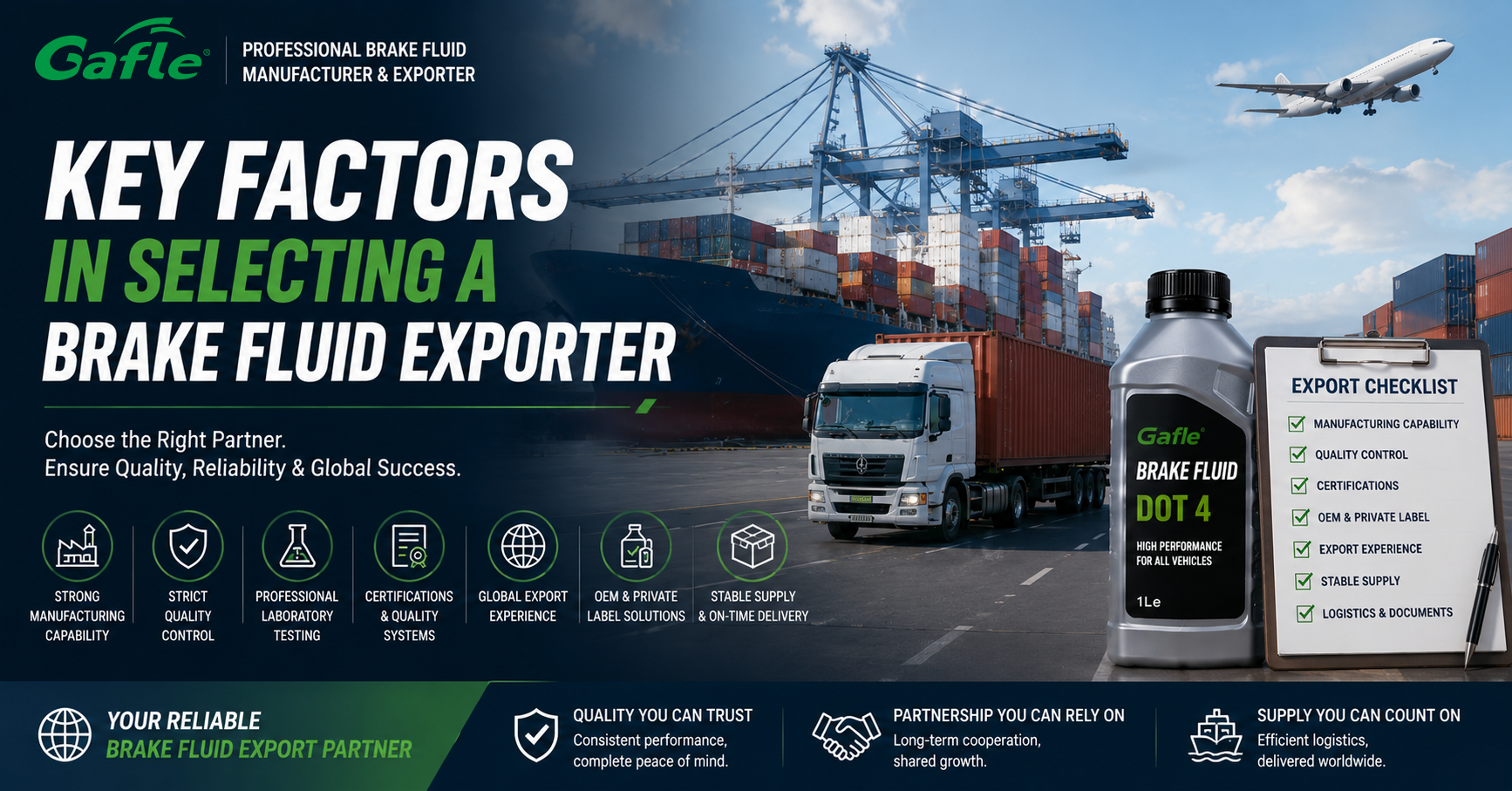
Key Factors in Selecting a Brake Fluid Exporter
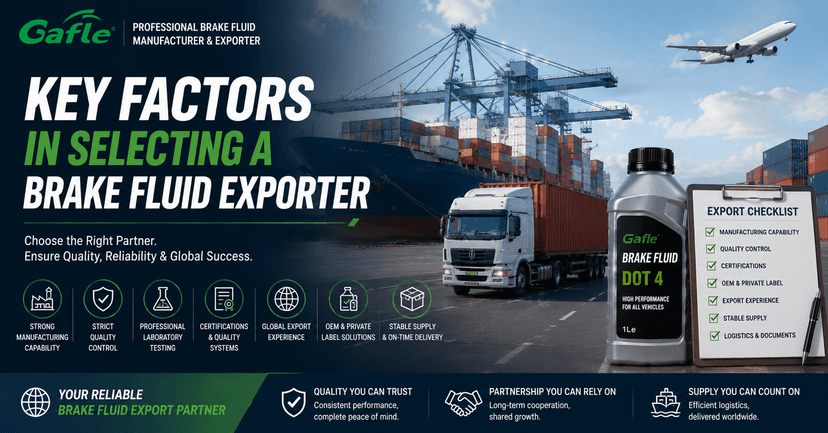
Choosing the right brake fluid exporter is an important decision for automotive importers, distributors, wholesalers, and private label brands. A reliable export partner needs more than the ability to offer competitive prices—it should combine professional manufacturing, consistent quality, international trade experience, technical support, and dependable supply.
For brake fluid, these capabilities are particularly important because product specifications, quality requirements, packaging, documentation, and market regulations may vary between countries.
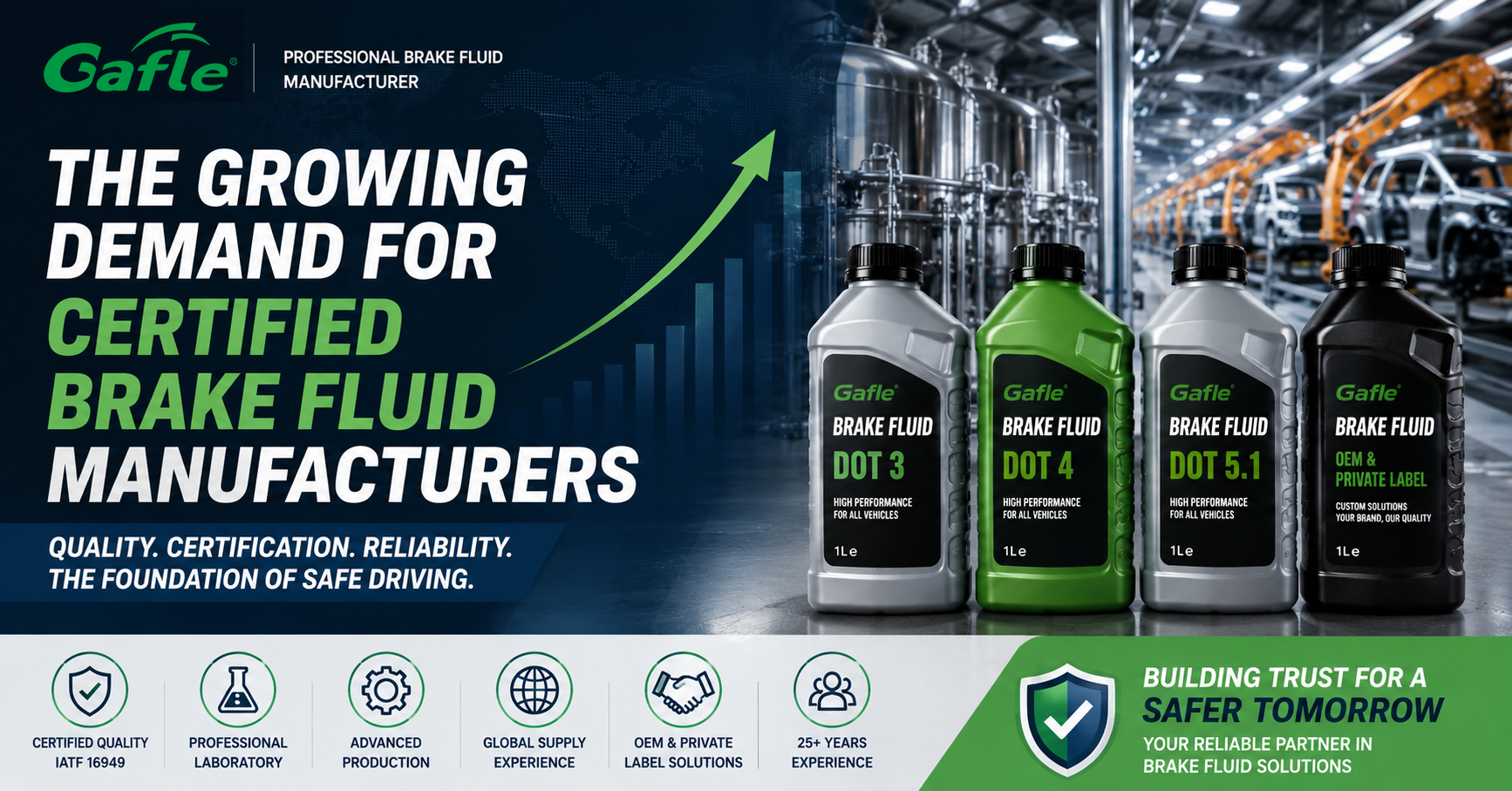
Gafle is a professional brake fluid manufacturer and exporter with more than 25 years of manufacturing experience. We provide DOT 3, DOT 4, OEM, and private label brake fluid solutions for customers in global automotive markets.
In this article, we examine the key factors international buyers should consider before selecting a long-term brake fluid export partner.
1. Manufacturing Capability Should Come First
When choosing a brake fluid exporter, one of the first questions to ask is:
Does the exporter actually manufacture brake fluid?
Some exporters specialize mainly in trading, while others operate their own production facilities. For buyers seeking OEM development, technical customization, and stable long-term supply, working directly with an experienced brake fluid manufacturer can offer important advantages.
Buyers should evaluate:
- Years of brake fluid manufacturing experience
- Production facilities and equipment
- Technical team
- Product range
- Production capacity
- Quality control processes
- Laboratory capabilities
A professional manufacturer should be able to clearly explain how brake fluid moves from raw material inspection through production, testing, filling, packaging, and final inspection.
Direct manufacturing capability can also make communication more efficient when customers need customized specifications or packaging.
2. Evaluate Brake Fluid Quality Control
Quality should be one of the most important criteria when selecting an exporter.
Brake fluid operates within a vehicle's hydraulic braking system, making product consistency particularly important.
Professional quality control should cover the complete manufacturing process rather than relying only on final inspection.
Raw Material Control
Raw materials should be sourced and managed according to established quality procedures.
Incoming materials should be appropriately identified, inspected, and stored before production.
Production Process Control
Manufacturing formulas, equipment, production parameters, and operating procedures should be controlled to help maintain batch consistency.
Finished Product Testing
Finished brake fluid should be tested according to the applicable product specifications and internal quality requirements.
Batch Traceability
Appropriate production and quality records should allow manufacturers to trace relevant batches when necessary.
For overseas buyers, these systems can provide greater confidence in repeat-order consistency.
3. Check the Manufacturer's Laboratory Capabilities
A professional laboratory is another important factor when evaluating a brake fluid supplier.
Brake fluid quality cannot be determined simply by looking at the liquid or its packaging.
Depending on the relevant specification, professional testing may evaluate characteristics such as:
- Dry boiling point
- Wet boiling point
- Low-temperature viscosity
- Chemical stability
- Corrosion performance
- Fluidity and appearance
- Material compatibility
Laboratory capability is particularly valuable for international OEM customers because different markets and product programs may require different specifications.
At Gafle, professional laboratory testing is integrated into product development, production, and quality control.
4. Review Certifications and Quality Management Systems
International buyers should also evaluate the manufacturer's quality management systems.
Working with a certified brake fluid manufacturer can provide additional evidence that structured procedures are in place for managing production and quality.
For automotive manufacturing, IATF 16949 is an important quality management system standard.
It emphasizes areas such as:
- Process control
- Risk management
- Defect prevention
- Traceability
- Supplier management
- Continuous improvement
However, buyers should distinguish between management-system certification and product compliance.
IATF 16949 is a quality management system certification; it is not a product certification for an individual brake fluid.
Specific brake fluid products should still be evaluated according to applicable technical specifications and destination-market requirements.
5. International Export Experience Matters
A good manufacturer is not automatically a good exporter.
This is one of the most important differences international buyers should understand.
A professional brake fluid exporter should have experience handling the commercial and logistical requirements associated with international orders.
This may include:
- Export documentation
- International shipping coordination
- Packaging requirements
- Product documentation
- Customer communication
- Container loading arrangements
- Destination-market requirements
Export experience can help reduce avoidable problems during international transactions.
For example, packaging suitable for one domestic market may not necessarily be appropriate for a long international shipment. Documentation requirements can also differ depending on the destination and mode of transport.
An experienced exporter should identify these issues before the goods leave the factory.
6. Understand Destination-Market Requirements
Brake fluid is sold in many markets worldwide, but buyers should not assume that the same product, label, or documentation is automatically suitable everywhere.
Different countries may apply different requirements concerning:
- Product standards
- Chemical regulations
- Labels
- Language
- Packaging
- Safety information
- Import documentation
Before placing an order, importers should confirm the applicable requirements in their destination market.
A professional export partner should be willing to cooperate with the buyer in reviewing relevant product and packaging requirements.
However, importers remain responsible for confirming the specific regulatory requirements applicable to their own market.
This is why experienced international cooperation is so valuable.
7. Evaluate OEM Brake Fluid Manufacturing Capability
For customers developing their own automotive brands, choosing an experienced OEM brake fluid manufacturer is especially important.
OEM projects often involve much more than applying a different label to an existing bottle.
Depending on the project, customers may require support with:
- Product specifications
- DOT 3 or DOT 4 options
- Bottle capacities
- Bottle styles
- Labels
- Outer cartons
- Brand identity
- Technical information
- Market-specific packaging
An experienced OEM factory should have a structured process for confirming these requirements before mass production.
This can reduce misunderstandings and help ensure that the final product matches the customer's expectations.
8. Check Private Label Brake Fluid Experience
Demand for private label brake fluid continues to create opportunities for automotive aftermarket businesses.
Importers and distributors that already sell products such as engine oils, coolants, filters, spare parts, or automotive chemicals may use private label brake fluid to expand their product portfolios.
Instead of building their own production facilities, they can work with an established manufacturer and sell brake fluid under their own brands.
A strong private label partner should support:
Product Selection
Choosing appropriate brake fluid specifications for the target market.
Branding
Applying the customer's brand identity to bottles, labels, and cartons.
Packaging
Developing suitable packaging sizes and configurations.
Mass Production
Maintaining consistent quality across repeat orders.
Export Support
Coordinating production and international shipment requirements.
Gafle provides OEM and private label brake fluid solutions for international automotive customers.
9. Consider Wholesale Supply Capability
For distributors and large importers, production scale matters.
A professional wholesale brake fluid supplier should be able to support both initial orders and long-term growth.
Before selecting an exporter, buyers should discuss:
- Production capacity
- MOQ
- Lead time
- Packaging capacity
- Repeat-order capability
- Raw material planning
- Container-order support
The lowest price is of limited value if a supplier cannot deliver consistently when demand increases.
Importers should therefore evaluate whether the manufacturer has enough capacity and operational stability to support their future business.
10. Check Delivery Reliability
International supply chains involve longer distances and more coordination than domestic orders.
A reliable exporter should provide realistic production and delivery schedules.
Buyers should evaluate whether the supplier has systems for:
- Production planning
- Packaging preparation
- Order tracking
- Container loading
- Export coordination
- Shipment documentation
Reliable delivery is particularly important for distributors because stock shortages can affect retailers, workshops, and downstream customers.
A strong export partner should understand that stable supply is part of product quality.
11. Evaluate Communication and Technical Support
Communication is sometimes overlooked during supplier selection, but it can have a major impact on international cooperation.
A professional exporter should respond clearly to questions concerning:
- Product specifications
- Test information
- Packaging
- Labels
- Production schedules
- Quality requirements
- Export documentation
This becomes even more important when working across different languages and time zones.
Technical communication is also valuable when developing OEM products.
If a buyer requests a particular performance characteristic, the manufacturer's technical team should be able to evaluate whether the requirement is technically appropriate and how it relates to the product specification.
Good communication reduces mistakes before production begins.
12. Look Beyond the Lowest Price
Price is always an important part of international sourcing, but choosing a brake fluid exporter based only on price can create additional risks.
A lower quotation may not reflect differences in:
- Raw materials
- Quality control
- Laboratory testing
- Manufacturing experience
- Packaging quality
- Export support
- Delivery reliability
- Technical service
For private label customers, supplier problems can directly affect the reputation of their own brand.
A better approach is to evaluate the total value of the partnership.
The right supplier should provide competitive pricing together with consistent quality and dependable long-term service.
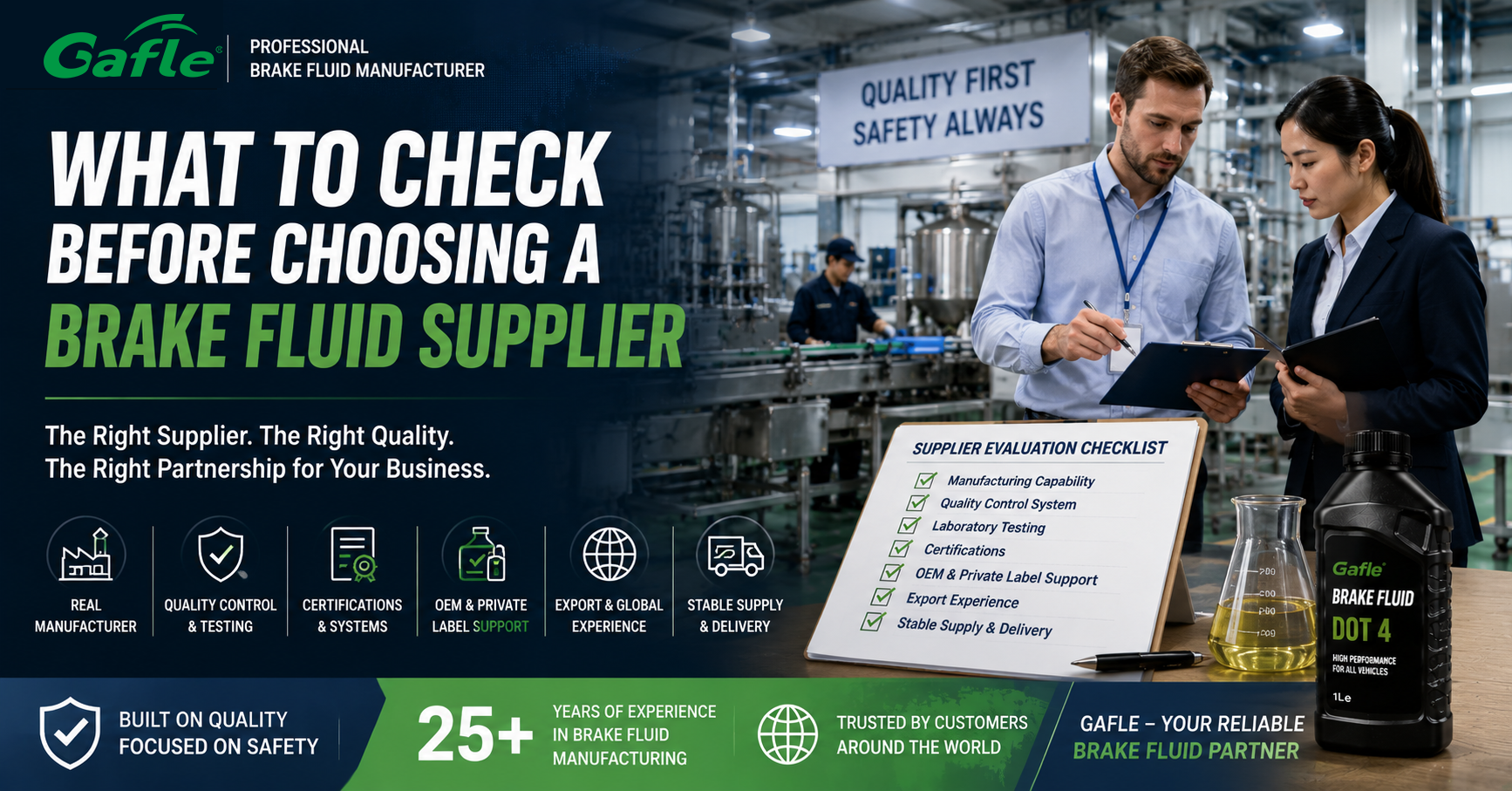
Brake Fluid Exporter Evaluation Checklist
Before making a final decision, international buyers can use this checklist:
| Key Factor | What Buyers Should Check |
|---|---|
| Manufacturing | Does the exporter operate a real brake fluid factory? |
| Experience | How long has the company manufactured brake fluid? |
| Quality Control | How are raw materials, production, and finished products controlled? |
| Laboratory | Can the factory test key brake fluid characteristics? |
| Quality System | Does the manufacturer have relevant quality management systems? |
| Export Experience | Has it supplied international customers successfully? |
| Market Support | Can it cooperate on destination-market requirements? |
| OEM | Can it support customized products and packaging? |
| Private Label | Can it manufacture brake fluid under your brand? |
| Capacity | Can it support wholesale and repeat orders? |
| Delivery | Are production and shipment schedules reliable? |
| Communication | Is technical and commercial communication professional? |
Why Choose Gafle as Your Brake Fluid Export Partner?
Gafle is a professional brake fluid manufacturer and exporter serving customers in international automotive markets.
With more than 25 years of brake fluid manufacturing experience, Gafle combines manufacturing expertise, laboratory testing, quality management, OEM customization, and global export capabilities.
Our key capabilities include:
- 25+ years of brake fluid manufacturing experience
- Professional brake fluid production facilities
- Professional laboratory and testing capabilities
- IATF 16949 quality management system
- Strict production and quality control
- DOT 3 and DOT 4 brake fluid manufacturing
- OEM brake fluid solutions
- Private label brake fluid services
- Customized bottles, labels, and cartons
- International export experience
- Stable production and supply capabilities
- Participation in drafting China's national brake fluid standards
For importers, distributors, wholesalers, and automotive brands, Gafle can support projects from product selection and packaging development through manufacturing, quality control, and export coordination.
From Brake Fluid Exporter to Long-Term Global Partner
The best exporter is not simply a company that can ship a container overseas.
A valuable long-term partner should understand manufacturing, quality, technical requirements, customization, international trade, and supply-chain reliability.
As an automotive business grows, its requirements may also change.
A distributor may begin with one DOT 4 brake fluid product and later require additional specifications, packaging sizes, private label products, or new destination markets.
Working with an experienced manufacturer and exporter can make this expansion easier.
For this reason, international buyers should evaluate suppliers based not only on today's order but also on their ability to support future growth.
Conclusion
Selecting the right brake fluid exporter requires a comprehensive evaluation of both manufacturing and international supply capabilities.
Buyers should examine the manufacturer's production experience, quality control, laboratory testing, quality management systems, export experience, OEM capabilities, private label support, production capacity, delivery reliability, and communication.
A supplier that combines these capabilities is more likely to provide stable value over the long term.
With more than 25 years of manufacturing experience, Gafle provides DOT 3 and DOT 4 brake fluid manufacturing, professional laboratory testing, OEM and private label solutions, strict quality control, and international export support.
If you are looking for a reliable brake fluid manufacturer, exporter, or wholesale supplier, contact Gafle to discuss your OEM and private label brake fluid requirements.