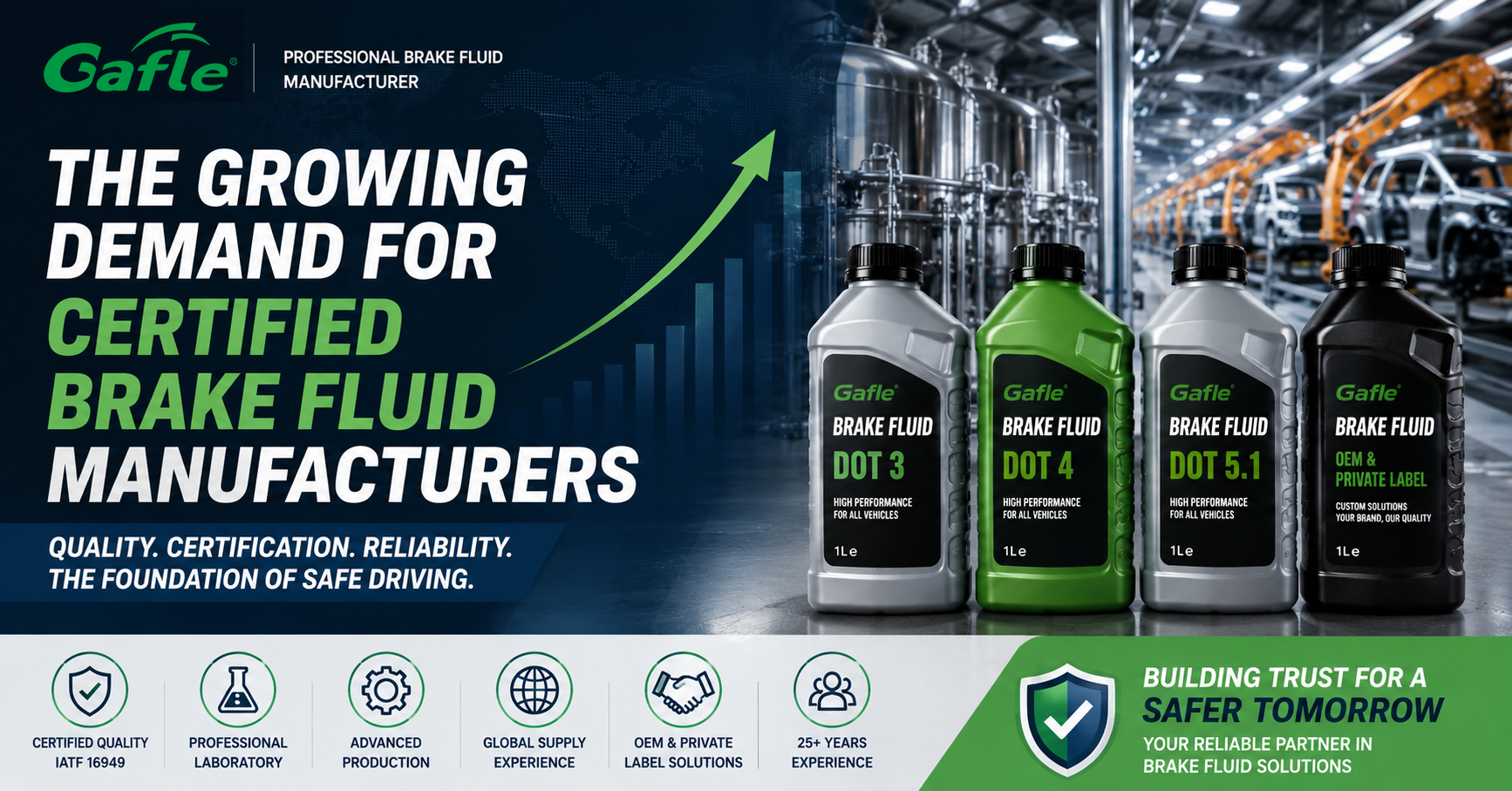
The Growing Demand for Certified Brake Fluid Manufacturers
The global automotive aftermarket continues to evolve, and buyers are becoming more selective about the manufacturers behind the products they sell. For brake fluid in particular, price and basic supply capability are no longer the only considerations. Importers, distributors, automotive brands, and private label companies increasingly look for manufacturers with established quality management systems, professional testing capabilities, stable production, and international market experience.
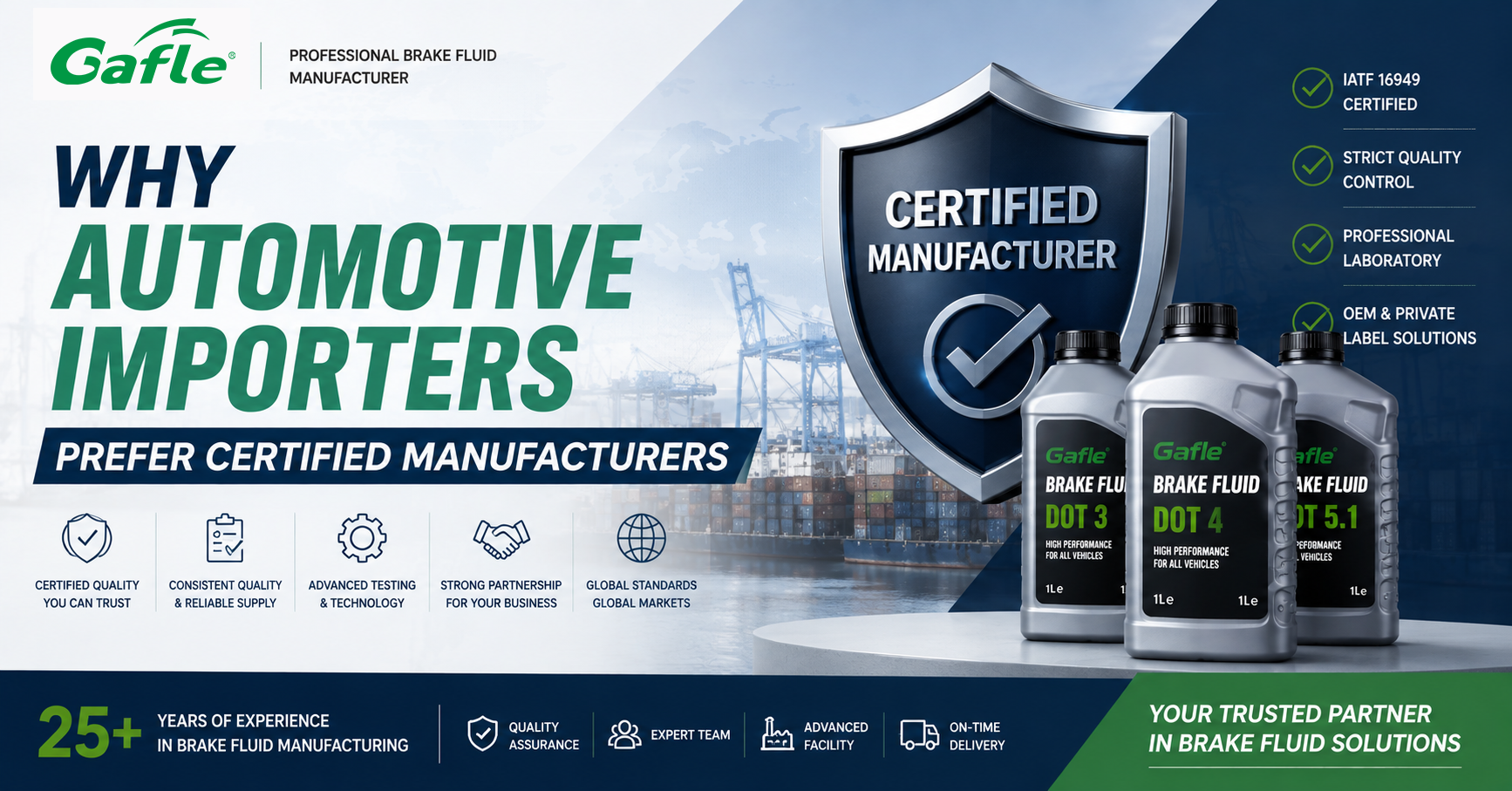
As a result, demand for a certified brake fluid manufacturer is becoming increasingly important in global automotive supply chains.
For buyers, certification is not simply about displaying a certificate. It provides evidence that a manufacturer has established processes for quality management, production control, traceability, risk management, and continuous improvement.
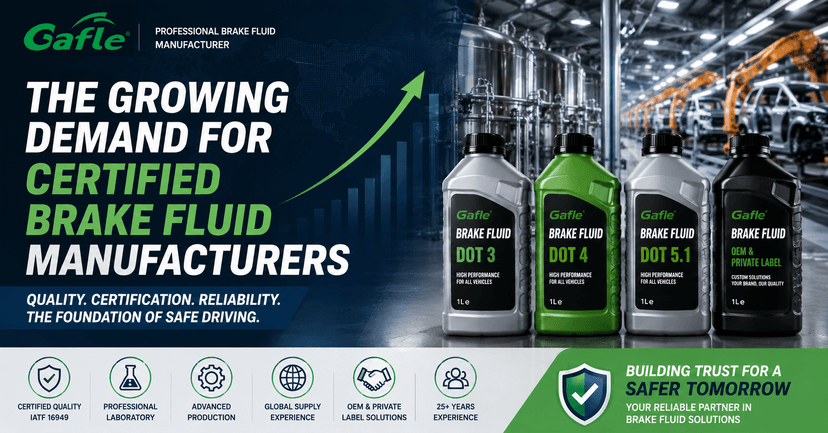
Gafle, a professional brake fluid manufacturer with more than 25 years of manufacturing experience, provides DOT 3, DOT 4, OEM, and private label brake fluid solutions for customers in international markets.
This article explores what is driving demand for professional brake fluid manufacturers and why certification, manufacturing expertise, and quality control are becoming increasingly important for global automotive businesses.
Why Is Demand for Professional Brake Fluid Manufacturers Growing?
Brake fluid is an essential service fluid in hydraulic braking systems. As vehicles remain in service, brake fluid requires inspection and replacement according to vehicle manufacturer recommendations.
This creates ongoing demand throughout the automotive aftermarket, including repair workshops, service centers, parts distributors, wholesalers, retailers, and automotive brands.
At the same time, buyers are becoming more professional in the way they evaluate suppliers.
Instead of simply asking:
“What is your price?”
More buyers now ask:
“How do you control quality?”
“What testing capabilities does your factory have?”
“Can you provide consistent quality across different production batches?”
“Can you support our OEM or private label project?”
“What quality management certifications does your factory hold?”
This shift is increasing demand for experienced and professionally managed brake fluid factories.
Why Certification Matters in Brake Fluid Manufacturing
For international buyers, certification can be an important part of supplier qualification.
A certified brake fluid manufacturer typically operates under documented quality management procedures covering multiple stages of production.
These may include:
- Raw material inspection
- Supplier management
- Production process control
- Equipment management
- Product testing
- Batch traceability
- Nonconformance management
- Corrective and preventive actions
- Continuous improvement
Certification does not replace product testing, nor does it automatically mean that every product meets the regulatory requirements of every country.
However, it can demonstrate that the manufacturer has established a structured system for managing manufacturing quality.
For buyers developing long-term supply relationships, this is an important consideration.
Why Automotive Buyers Pay Attention to IATF 16949
One of the quality management standards frequently considered within the automotive industry is IATF 16949.
IATF 16949 focuses specifically on automotive quality management and places strong emphasis on areas such as process control, defect prevention, risk management, traceability, and continuous improvement.
For buyers evaluating an IATF 16949 brake fluid manufacturer, the value is not simply the certificate itself.
What matters is how the quality management system is applied throughout the factory.
For example, buyers may evaluate whether the manufacturer has clearly defined procedures for incoming materials, production processes, laboratory testing, finished-product inspection, and batch records.
It is also important to distinguish between management-system certification and product compliance.
IATF 16949 is a quality management system standard; it is not a product certification for a specific brake fluid.
Individual brake fluid products should still be evaluated according to their applicable specifications, test requirements, and destination-market regulations.
Higher Quality Expectations Are Changing the Brake Fluid Market
Another factor driving demand for professional manufacturers is the increasing emphasis on product consistency.
Automotive distributors and brands cannot afford large variations between different production batches.
For brake fluid, important performance characteristics may include:
- Dry boiling point
- Wet boiling point
- Low-temperature viscosity
- Chemical stability
- Corrosion performance
- Fluidity and appearance
- Compatibility with relevant braking-system materials
Professional manufacturing therefore requires more than simply blending raw materials and filling bottles.
It requires controlled formulas, standardized processes, appropriate testing equipment, trained personnel, and documented quality procedures.
This is one reason buyers increasingly prefer to work directly with an established brake fluid factory rather than sourcing only on the basis of the lowest price.
Professional Laboratory Testing Is Becoming More Important
As international buyers become more quality-conscious, laboratory capability is becoming an important factor when choosing a brake fluid supplier.
A professional laboratory allows manufacturers to evaluate raw materials, monitor production, inspect finished products, and verify key performance characteristics.
This becomes particularly important when a manufacturer produces multiple brake fluid specifications or develops customized products for OEM customers.
Laboratory capability can also improve communication between manufacturers and international customers.
When a buyer has specific technical requirements, an experienced technical team can evaluate those requirements and determine how they relate to formulation, manufacturing, and testing.
At Gafle, professional laboratory testing is an important part of brake fluid manufacturing and quality control.
Global Buyers Want More Than a Brake Fluid Supplier
The relationship between automotive buyers and manufacturers is also changing.
Traditionally, some buyers viewed suppliers simply as sources of finished products.
Today, many international customers want a long-term manufacturing partner capable of supporting multiple stages of their business.
A professional brake fluid supplier may be expected to provide support with:
- Product selection
- Technical specifications
- OEM production
- Packaging customization
- Label development
- Quality documentation
- Export requirements
- Production planning
- Stable repeat supply
This is particularly important for importers and distributors building their own automotive brands.
The manufacturer is no longer simply filling an order—it becomes part of the customer's supply chain.
Why OEM Brake Fluid Demand Is Increasing
Another important trend is the growth of OEM manufacturing.
Many automotive aftermarket businesses want to expand their product portfolios without investing in their own brake fluid production facilities.
Working with an experienced OEM brake fluid manufacturer allows these companies to develop products under their own brands while relying on an established factory for manufacturing and quality control.
This model can be attractive to:
- Automotive parts distributors
- Lubricant brands
- Automotive chemical brands
- Wholesalers
- Importers
- Retail chains
- Workshop networks
Instead of building a new factory, customers can focus their resources on branding, distribution, marketing, and customer development.
The manufacturer handles the specialized production process.
Private Label Brake Fluid Is Creating New Opportunities
The growth of private label automotive products is another reason professional manufacturers are receiving more attention.
A private label brake fluid manufacturer can help customers create products carrying their own brand identity.
Depending on the project and applicable requirements, customization may include:
- Product specifications
- DOT 3 or DOT 4 options
- Bottle capacities
- Bottle design
- Labels
- Outer cartons
- Brand identity
- Market-specific packaging
For distributors that already sell engine oils, coolants, filters, or other automotive products, adding private label brake fluid can help create a more complete product portfolio.
This means manufacturers need more than production capacity.
They also need OEM experience, packaging resources, quality systems, technical communication, and reliable delivery.
Why Stable Supply Matters to International Buyers
Product quality is essential, but supply stability is equally important for international customers.
Once an importer establishes a product in its local market, unexpected supply interruptions can affect distributors, retailers, workshops, and end customers.
A professional manufacturer therefore needs to balance quality with production planning and reliable delivery.
Buyers often evaluate:
- Production capacity
- Raw material management
- Lead times
- Batch consistency
- Export experience
- Packaging capacity
- Communication efficiency
A low quotation provides little value if the supplier cannot consistently deliver the required product.
For this reason, established buyers increasingly evaluate the manufacturer's overall capability rather than focusing only on unit price.
How to Evaluate a Professional Brake Fluid Factory
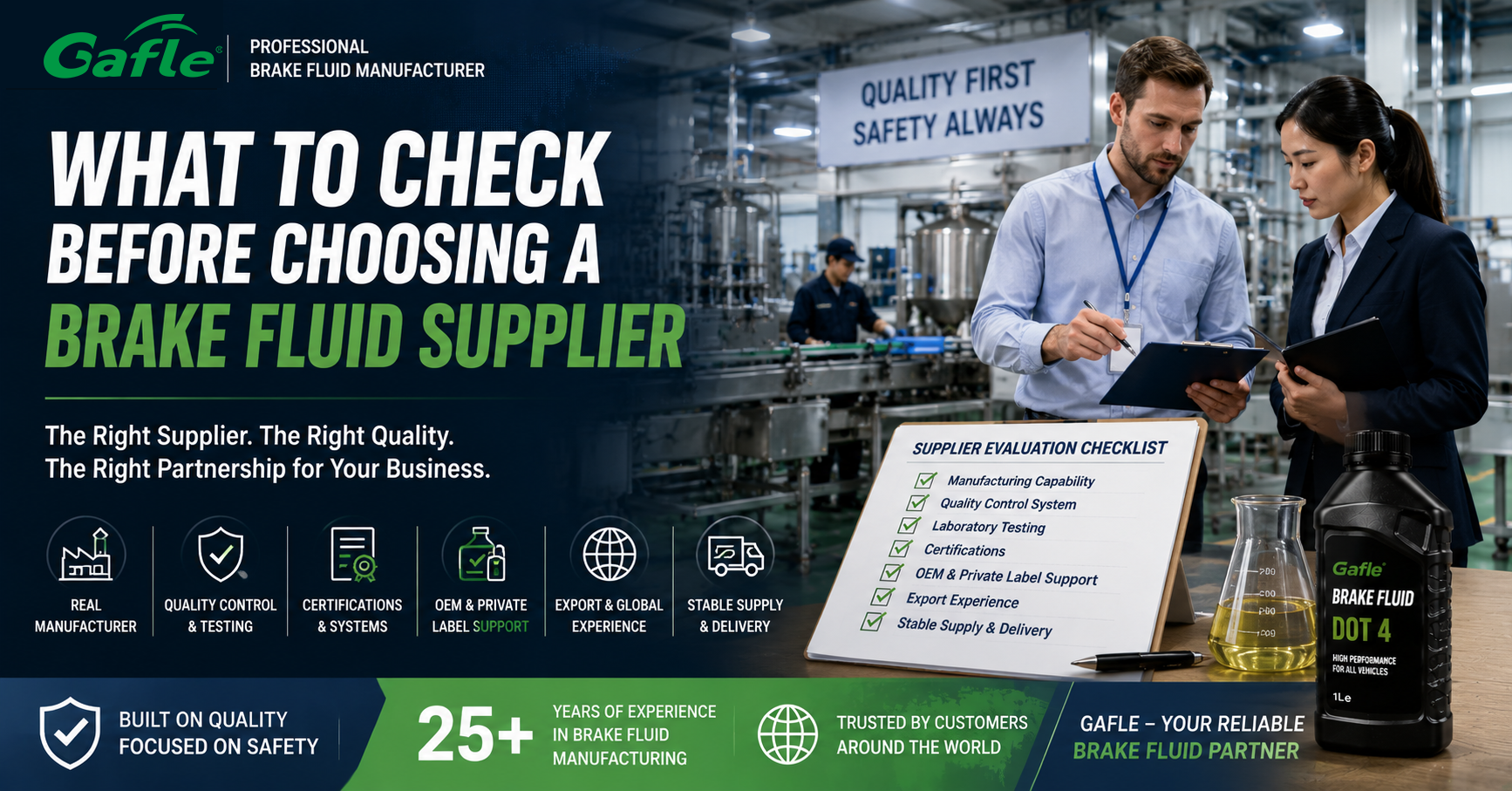
When choosing a brake fluid factory, international buyers should conduct a comprehensive supplier evaluation.
Important areas include:
Manufacturing Experience
Brake fluid is a specialized automotive product. Long-term industry experience can indicate deeper knowledge of formulations, production processes, quality control, and different market requirements.
Quality Management System
Buyers should understand how the manufacturer manages raw materials, production, inspection, traceability, and quality improvement.
Laboratory Capability
A professional factory should have appropriate equipment and technical personnel to evaluate key brake fluid characteristics.
Production Capacity
The manufacturer should be able to support both current orders and future business growth.
OEM Experience
For private label customers, experience with customized products, packaging, labels, and export projects is especially important.
International Market Experience
Manufacturers serving global customers should understand export documentation, shipping requirements, communication, and differences between destination markets.
Why Direct Factory Cooperation Is Becoming More Attractive
As global sourcing becomes more transparent, many professional buyers prefer to communicate directly with manufacturers.
Direct factory cooperation can provide greater visibility into:
- Product formulation
- Manufacturing processes
- Testing
- Quality control
- Production schedules
- Packaging customization
It can also make product development more efficient.
If a distributor wants to launch a new DOT 4 brake fluid, change its packaging, or expand into another market, direct communication with the manufacturer can make technical and commercial discussions easier.
For serious OEM and private label projects, this direct relationship can create long-term value.
Why Choose Gafle as Your Brake Fluid Manufacturing Partner?
Gafle is a professional brake fluid manufacturer focused on brake fluid manufacturing and OEM solutions for international automotive markets.
With more than 25 years of manufacturing experience, Gafle combines production expertise, quality management, laboratory testing, and customization capabilities to support global customers.
Gafle's key capabilities include:
- 25+ years of brake fluid manufacturing experience
- IATF 16949 quality management system
- Professional brake fluid laboratory
- Strict production and quality control procedures
- DOT 3 and DOT 4 brake fluid manufacturing
- OEM brake fluid manufacturing
- Private label brake fluid solutions
- Customized bottles, labels, and cartons
- International export experience
- Participation in drafting China's national brake fluid standards
For importers, distributors, wholesalers, and automotive brands, Gafle provides more than finished brake fluid products.
Our goal is to support customers with stable manufacturing, professional quality control, customization, and long-term cooperation.
From Product Supplier to Strategic Manufacturing Partner
The global automotive aftermarket is becoming increasingly competitive.
For buyers, finding a product is easy. Finding a manufacturer capable of supporting long-term brand development is more difficult.
This is why the role of the brake fluid manufacturer is changing.
Professional buyers increasingly expect manufacturers to provide technical expertise, quality assurance, flexible OEM solutions, reliable production, and international supply capabilities.
Certification supports this transition by providing a structured foundation for quality management, while manufacturing experience and laboratory capability help turn those systems into consistent products.
Together, these factors explain why demand for professional and certified manufacturers continues to grow.
Conclusion
The growing demand for a certified brake fluid manufacturer reflects a broader change in the global automotive supply chain.
Importers and automotive brands are looking beyond price and evaluating quality systems, manufacturing expertise, laboratory testing, traceability, OEM capabilities, and supply reliability.
At the same time, growing demand for OEM brake fluid manufacturers and private label brake fluid manufacturers is creating new opportunities for factories capable of supporting customized automotive brands.
With more than 25 years of brake fluid manufacturing experience, Gafle provides professional DOT 3 and DOT 4 brake fluid manufacturing, OEM and private label solutions, laboratory testing, quality management, and international supply support.
If you are looking for a reliable brake fluid manufacturer for your market, contact Gafle to discuss your OEM, private label, or wholesale brake fluid requirements.