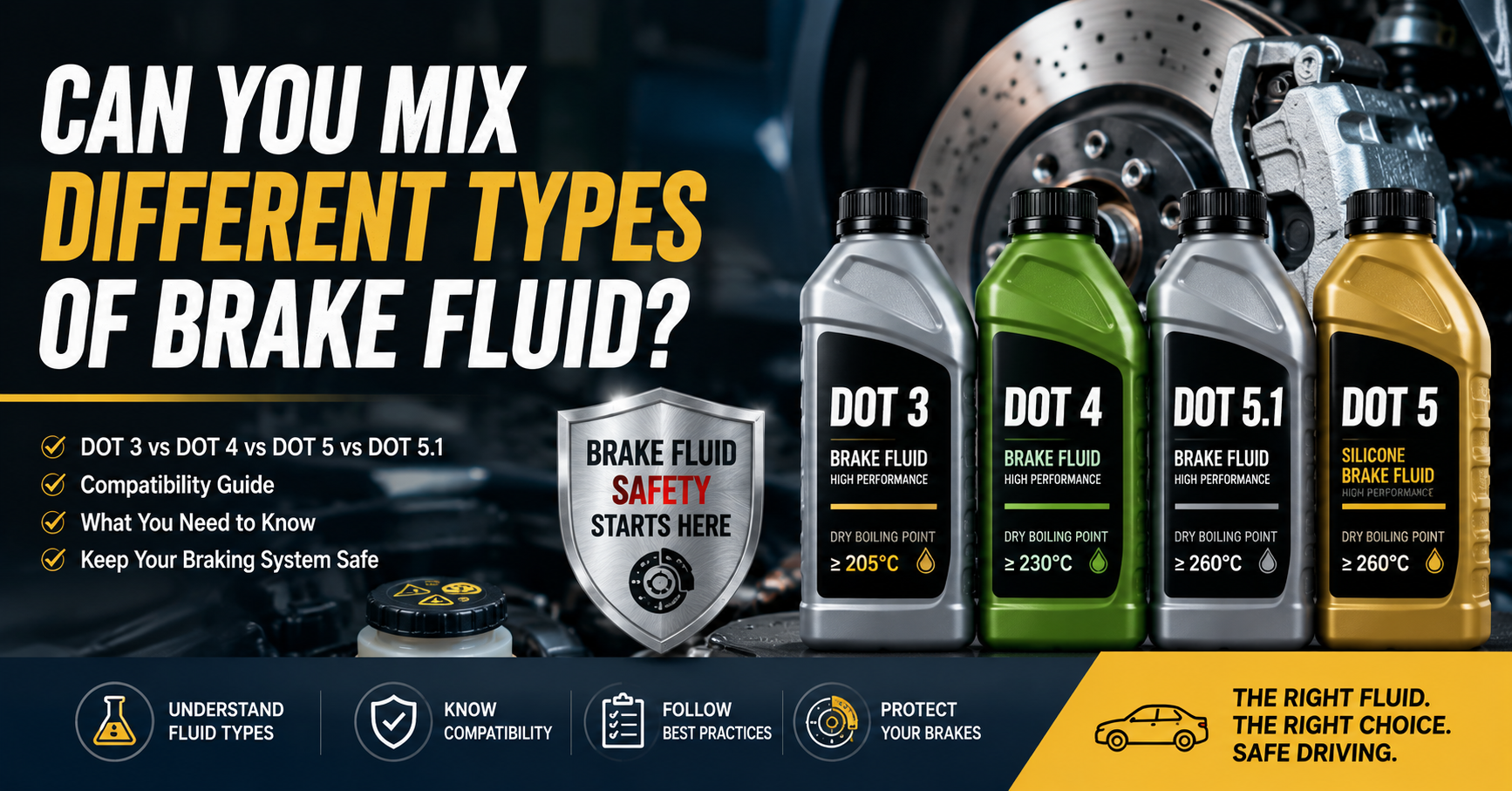
Can You Mix Different Types of Brake Fluid?
Brake fluid is essential to the safe and reliable operation of a vehicle's hydraulic braking system. However, with several types available—including DOT 3, DOT 4, DOT 5, and DOT 5.1—many drivers and automotive professionals ask the same question: Can you mix different types of brake fluid?
The short answer is: some brake fluids are chemically compatible, while others should never be mixed. Even when two types are generally compatible, mixing them does not necessarily mean it is the best choice for your vehicle.
Understanding brake fluid compatibility is therefore important for vehicle owners, repair shops, distributors, and automotive aftermarket businesses.
As a professional brake fluid manufacturer with more than 25 years of manufacturing experience, Gafle produces brake fluid solutions for global automotive markets. In this article, we explain the differences between common brake fluid types and what you should know before mixing them.
Understanding the Different Types of Brake Fluid
Before discussing whether brake fluids can be mixed, it is important to understand the main types of brake fluid.
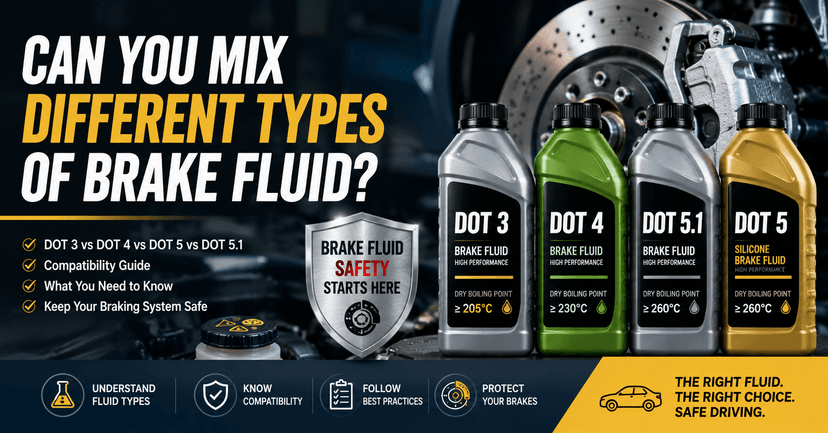
The most common classifications include DOT 3, DOT 4, DOT 5, and DOT 5.1.
DOT 3 Brake Fluid
DOT 3 is commonly used in many passenger vehicles and conventional braking systems. Most DOT 3 fluids are glycol-ether-based and are hygroscopic, meaning they absorb moisture over time.
DOT 3 provides reliable performance for vehicles designed to use this specification.
DOT 4 Brake Fluid
DOT 4 brake fluid is also generally glycol-ether-based but has higher minimum boiling-point requirements than DOT 3.
It is widely used in modern passenger vehicles and braking systems where higher thermal performance is required.
Different DOT 4 formulations can also be designed for specific viscosity or high-performance requirements.
DOT 5 Brake Fluid
DOT 5 is fundamentally different from DOT 3 and DOT 4 because DOT 5 is silicone-based.
This difference is extremely important.
DOT 5 should not be mixed with glycol-based DOT 3, DOT 4, or DOT 5.1 brake fluids.
Mixing incompatible fluid chemistries may negatively affect braking-system performance and material compatibility.
DOT 5.1 Brake Fluid
Despite the similar name, DOT 5.1 is not the same as DOT 5.
DOT 5.1 is generally glycol-ether-based and belongs to the same broad chemical family as DOT 3 and DOT 4.
This naming similarity is one of the most common causes of confusion when discussing brake fluid compatibility.
Can You Mix DOT 3 and DOT 4 Brake Fluid?
One of the most frequently asked questions is:
Can you mix DOT 3 and DOT 4 brake fluid?
In general, conventional glycol-based DOT 3 and DOT 4 brake fluids are chemically compatible. However, that does not mean mixing them should automatically become standard practice.
The most important rule is always to use the brake fluid specification recommended by the vehicle manufacturer.
If a vehicle requires DOT 4, adding a lower-specification fluid can change the performance characteristics of the overall fluid mixture.
Therefore, compatibility should not be confused with interchangeability.
Even when two fluids can physically mix, the resulting mixture may not provide the same performance as the higher-specification fluid by itself.
DOT 3 vs DOT 4 Brake Fluid: What Is the Difference?
Understanding DOT 3 vs DOT 4 brake fluid helps explain why casually mixing different specifications is not recommended.
Both are generally glycol-based, but their performance requirements differ.
DOT 4 has higher minimum dry and wet boiling-point requirements than DOT 3 under FMVSS 116.
This makes DOT 4 suitable for braking systems requiring higher thermal performance.
The choice between DOT 3 and DOT 4 should therefore be based on:
- Vehicle manufacturer requirements
- Brake system design
- Required boiling-point performance
- Applicable product specifications
- Driving and operating conditions
If your vehicle specifies DOT 4, using the correct DOT 4 product is preferable to deliberately creating a mixture of DOT 3 and DOT 4.
What Happens When You Mix DOT 3 and DOT 4?
Because conventional DOT 3 and DOT 4 fluids are generally chemically compatible, mixing them does not automatically create an immediate chemical reaction.
However, the performance of the resulting mixture can differ from that of the original fluids.
For example, adding DOT 3 to a system requiring DOT 4 may reduce the overall boiling-point performance compared with using the correct DOT 4 fluid alone.
This is particularly important because brake fluid operates under high temperatures generated during braking.
The safest approach is simple:
Follow the vehicle manufacturer's specified brake fluid requirement rather than intentionally mixing different grades.
Can You Mix DOT 4 and DOT 5.1 Brake Fluid?
DOT 4 and DOT 5.1 are generally glycol-based fluids, so they are chemically compatible in many conventional applications.
However, once again, chemical compatibility does not mean they should be mixed without considering the vehicle manufacturer's requirements.
DOT 5.1 has different performance requirements, including viscosity and boiling-point characteristics.
If a braking system is designed for a particular fluid specification, using the recommended fluid helps ensure that the system operates as intended.
When replacing brake fluid, it is better to use the correct specification rather than relying on mixing as a routine practice.
Why You Should Never Confuse DOT 5 and DOT 5.1
This is one of the most important points when discussing types of brake fluid.
DOT 5 and DOT 5.1 sound almost identical, but their chemistry is fundamentally different.
DOT 5: Silicone-based
DOT 5.1: Glycol-based
DOT 5 should not be mixed with DOT 3, DOT 4, or DOT 5.1.
Using an incompatible brake fluid can affect braking-system operation and compatibility with components designed for a different fluid chemistry.
Whenever there is uncertainty, check the vehicle owner's manual or consult a qualified automotive technician before adding brake fluid.
Why Brake Fluid Boiling Point Matters
One reason different brake fluid grades should not be treated as interchangeable is their boiling-point performance.
Braking generates significant heat. Brake fluid must maintain its hydraulic properties under these elevated temperatures.
Brake fluid specifications typically include requirements for both dry and wet boiling points.
The dry boiling point represents fresh fluid, while the wet boiling point reflects performance after the fluid has absorbed a specified amount of moisture under standardized test conditions.
Because glycol-based brake fluids are hygroscopic, their moisture content can increase during service, which can reduce boiling-point performance over time.
This is why selecting the correct brake fluid—and replacing it according to the vehicle manufacturer's maintenance recommendations—is important.
How to Choose the Correct Brake Fluid for Your Vehicle
Instead of asking only, "Can you mix brake fluid?", a better question is:
Which brake fluid does my vehicle actually require?
There are several places to check:
1. Owner's Manual
The vehicle owner's manual is the most reliable starting point for identifying the required brake fluid specification.
2. Brake Fluid Reservoir Cap
Many vehicles indicate the recommended DOT specification on or near the brake fluid reservoir.
3. Vehicle Manufacturer Specifications
Some vehicles may have additional requirements beyond the basic DOT classification.
4. Qualified Automotive Technician
If the required specification is unclear, a professional technician can identify the correct product for the braking system.
Never select brake fluid based only on price, packaging, or the assumption that a higher DOT number is automatically better.
Can You Top Up Brake Fluid With a Different Brand?
Brand alone is not the most important consideration.
More important factors include fluid chemistry, specification, performance requirements, and vehicle manufacturer recommendations.
Two products from different manufacturers may meet the same DOT classification, but formulations can still differ.
When topping up or replacing brake fluid, use a fresh, properly stored product that meets the vehicle manufacturer's required specification.
Because brake fluid readily absorbs moisture, containers should also be kept tightly sealed and contaminated fluid should never be introduced into the braking system.
Why Brake Fluid Quality Matters
Whether you are a vehicle owner, repair shop, distributor, or automotive brand, brake fluid quality should never be overlooked.
A professional brake fluid should be manufactured and tested for important characteristics such as:
- Dry boiling point
- Wet boiling point
- Low-temperature viscosity
- Chemical stability
- Corrosion performance
- Material compatibility
- Fluid appearance and condition
Consistent manufacturing and strict quality control help ensure that every production batch meets the intended product specification.
This is why choosing a reliable brake fluid manufacturer is especially important for automotive distributors and private label brands.
Why Choose Gafle as Your Brake Fluid Manufacturer?
Gafle is a professional brake fluid manufacturer with more than 25 years of experience in brake fluid production.
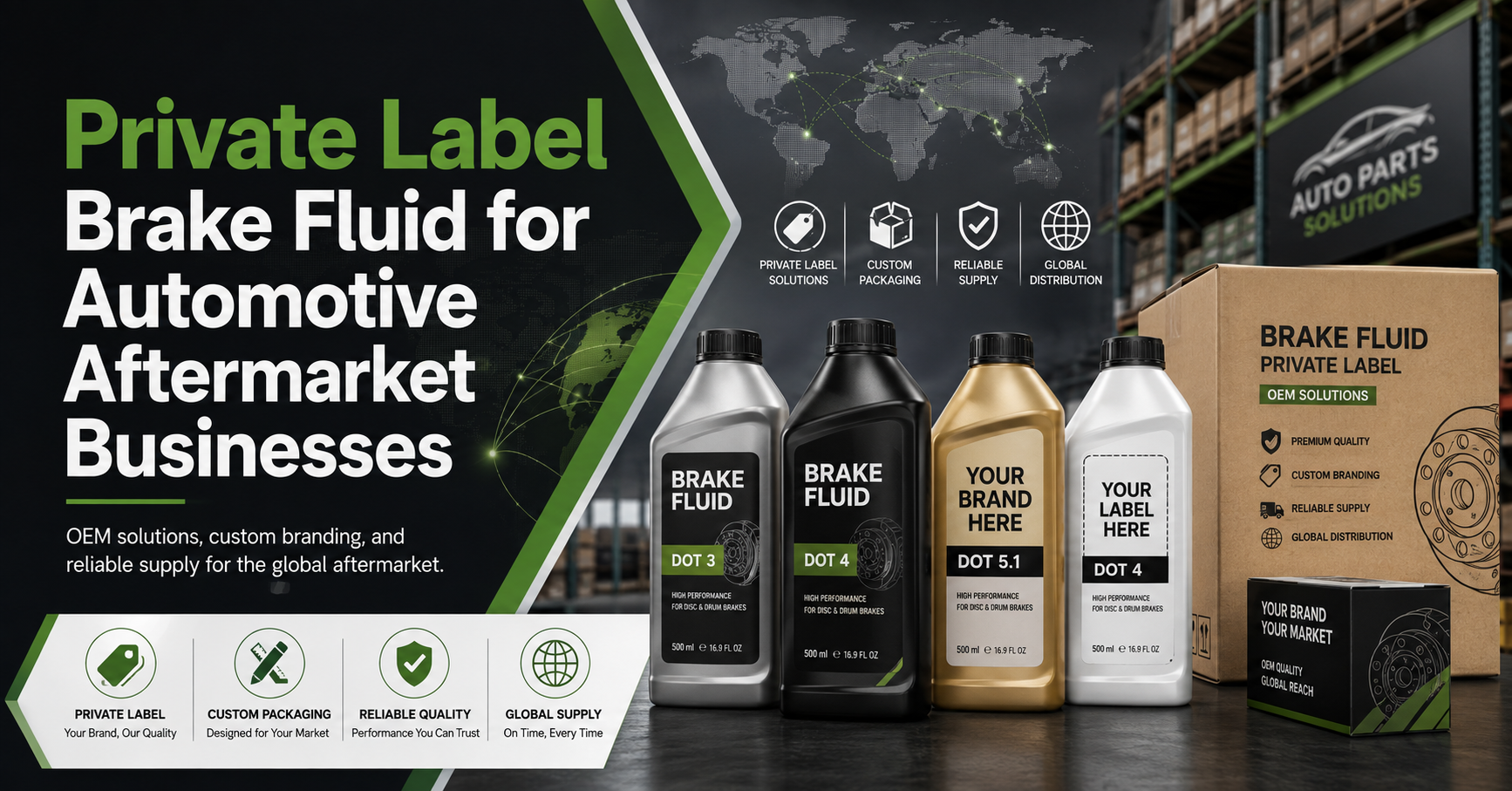
We provide brake fluid manufacturing solutions for automotive customers in international markets, including OEM and private label projects.
Gafle's manufacturing capabilities include:
- More than 25 years of brake fluid manufacturing experience
- DOT 3 and DOT 4 brake fluid solutions
- Professional brake fluid laboratory and testing capabilities
- IATF 16949 quality management system
- Strict production and quality control
- OEM and private label services
- Customized packaging solutions
- Global export experience
- Participation in drafting China's national brake fluid standards
For distributors, importers, wholesalers, and automotive brands, Gafle provides professional manufacturing support from product selection through production and packaging.
Frequently Asked Questions
Can DOT 3 and DOT 4 brake fluid be mixed?
Conventional glycol-based DOT 3 and DOT 4 fluids are generally chemically compatible. However, you should use the specification recommended by the vehicle manufacturer, especially because mixing may alter overall performance.
Can DOT 4 and DOT 5 be mixed?
No. DOT 5 is silicone-based and should not be mixed with glycol-based DOT 4 fluid.
Is DOT 5.1 the same as DOT 5?
No. DOT 5.1 is generally glycol-based, while DOT 5 is silicone-based. Despite their similar names, they are different types of brake fluid.
Can I use DOT 4 instead of DOT 3?
Some applications may permit this because DOT 4 meets higher minimum boiling-point requirements, but the correct choice depends on the vehicle manufacturer's specification. Always check the owner's manual before changing fluid specifications.
Is it better to mix brake fluid or replace it?
If the fluid is old, contaminated, or the wrong specification has been added, professional inspection and appropriate servicing are preferable to simply adding more fluid.
Conclusion
So, can you mix different types of brake fluid?
Some glycol-based brake fluids, such as conventional DOT 3, DOT 4, and DOT 5.1, are generally chemically compatible. However, compatibility does not mean that different specifications should be mixed without considering the vehicle manufacturer's requirements.
DOT 5 is different because it is silicone-based and should not be mixed with glycol-based DOT 3, DOT 4, or DOT 5.1 fluids.
The safest approach is always to use the brake fluid specification recommended by the vehicle manufacturer.
For automotive businesses looking for a professional brake fluid manufacturer, Gafle provides reliable DOT 3 and DOT 4 brake fluid manufacturing, OEM and private label solutions, professional testing, and global supply support.
Contact Gafle to discuss your brake fluid OEM or private label requirements.