Why Fluid Specification Matters Beyond the Spec Sheet
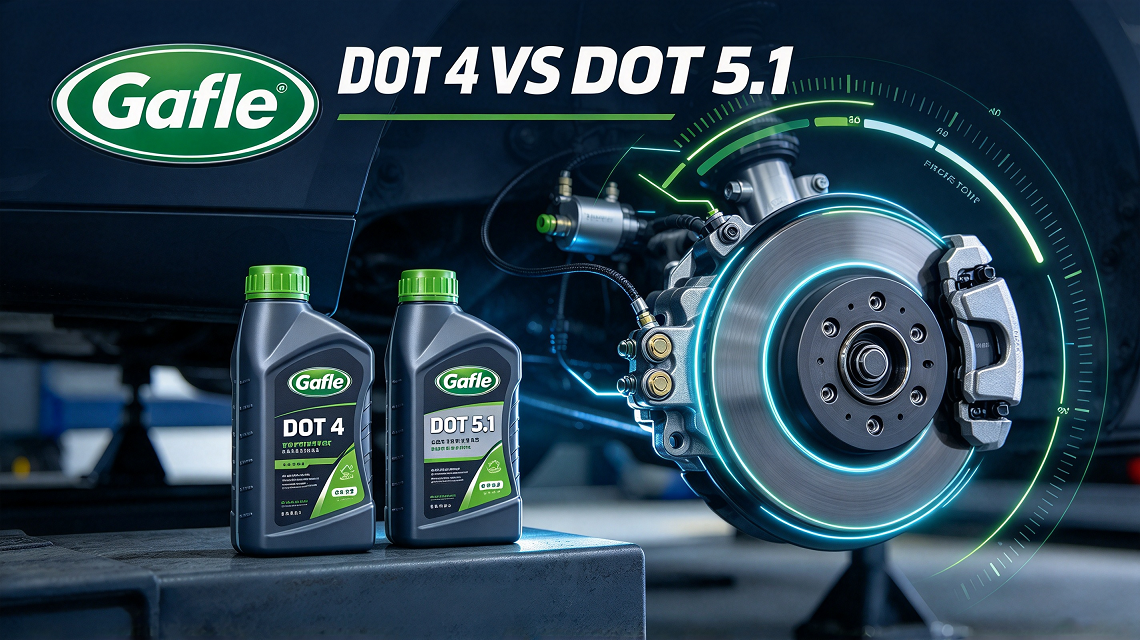
Choosing between glycol-ether formulations often turns into an internal debate over whether the added unit cost translates into tangible field reliability. In any systematic DOT 4 and DOT 5.1 brake fluid comparison, the immediate focus typically lands on boiling points. While thermal thresholds matter under severe duty cycles, modern hydraulic control units—specifically electro-hydraulic stability control (ESC) and anti-lock braking systems (ABS)—introduce dynamic constraints that change the equation entirely. For fleet operators, tier-one suppliers, and equipment engineers, specifying the right hydraulic medium is less about arbitrary margin and more about fluid transit times through micro-valves during rapid cycling.
The Naming Trap: Clearing Up the Chemistry
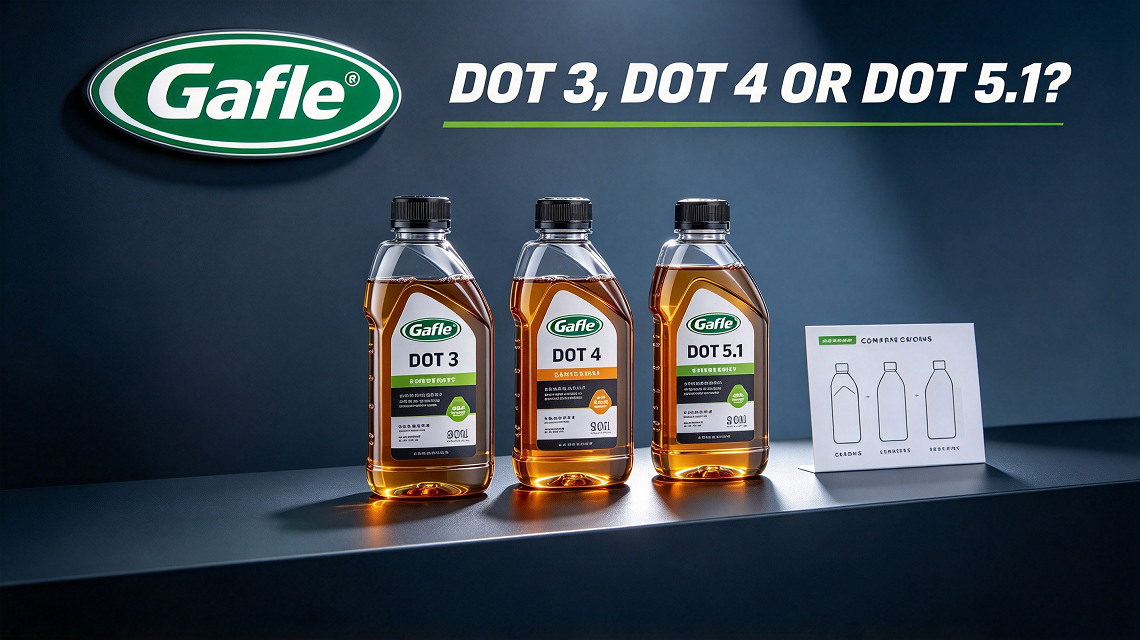
A persistent procurement mistake in heavy-duty maintenance is assuming numerical hierarchy implies identical base chemistry. DOT 5 is a silicone-based fluid (polydimethylsiloxane) and is fundamentally incompatible with glycol systems; mixing them causes immediate phase separation and seal swelling. DOT 5.1, despite its designation, is a borate ester/glycol-ether formulation. Chemically, DOT4 and DOT5.1 are siblings, which means they are fully miscible. You will not destroy an ethylene-propylene-diene monomer (EPDM) seal simply by introducing DOT 5.1 into a system built around DOT 4, though diluting a higher-grade fluid naturally degrades its minimum performance thresholds.
Thermal Performance: Dry vs. Wet Boiling Points
Brake fluids are hygroscopic by nature, steadily drawing ambient moisture through flexible rubber hoses and reservoir vent ports. Over a typical 12-to-24-month service window, fluid moisture content regularly climbs to 3% or 4%. This reality makes the wet boiling point—the temperature at which fluid vaporizes once saturated with roughly 3.7% water—far more telling than the dry rating printed boldly on the drum.
Under FMVSS No. 116 and SAE J1704 standards, standard DOT 4 requires a minimum dry boiling point of 230°C and a wet boiling point of 155°C. By contrast, DOT 5.1 pushes those minimums to 260°C dry and 180°C wet. That 25°C uplift in wet boiling resistance gives an essential safety buffer in continuous descent scenarios, heavy vehicle towing, or severe stop-and-go transit, preventing the phase change that leads to sudden vapor lock and pedal travel loss.
Low Temperature Viscosity: The Critical ABS/ESC Factor
While boiling points grab attention in brake rotor sizing, low temperature viscosity is often the deciding factor in modern chassis dynamics. Modern active safety systems rely on high-frequency pressure modulation, pulsing ABS and traction valves dozens of times per second. If the fluid is too thick, pump recovery slows, pressure rises sluggishly, and reaction times stretch out.
Standard DOT 4 fluid allows a maximum kinematic viscosity of 1,800 mm²/s (cSt) at -40°C. Under the standard DOT 5.1 specification, that limit is cut in half to a maximum of 900 mm²/s at -40°C. This makes DOT 5.1 an inherently superior candidate for cold climate deployment. In sub-zero environments, standard formulations can become sluggish enough to delay valve closure in micro-machined ABS blocks, producing uneven wheel braking or sluggish electronic brake-force distribution.
There is a caveat worth noting: the industry also produces dedicated low-viscosity variations of DOT 4 (often designated as DOT 4 LV or ISO 4925 Class 6), which match or beat the 750–900 mm²/s cold-flow threshold. However, standard, off-the-shelf DOT 4 rarely achieves this level of fluidity in deep freezes.
Key Technical Parameter Differences
To evaluate the functional difference between these grades quickly during component sourcing or fleet standardization, consider how the baseline standards diverge:
Dry Boiling Point (Minimum): DOT 4 requires 230°C, while DOT 5.1 mandates 260°C.
Wet Boiling Point (Minimum): DOT 4 requires 155°C, compared to 180°C for DOT 5.1.
Kinematic Viscosity at -40°C: DOT 4 permits up to 1,800 mm²/s; DOT 5.1 restricts this to 900 mm²/s.
Kinematic Viscosity at 100°C: Both fluids share an identical minimum standard of 1.5 mm²/s to guarantee film strength under high-heat operation.
Base Chemistry: Both use polyalkylene glycol ethers with borate esters, keeping seal compatibility profiles identical across standard automotive elastomer packs.
Selection Criteria: When Should You Upgrade?
For standard utility vehicles operating in temperate zones with conventional vacuum-assisted hydraulic circuits, standard DOT 4 remains an economical, perfectly serviceable choice. It offers ample boiling margin for normal highway payloads and predictable service cycles.
Upgrading to DOT 5.1 becomes a practical engineering necessity under three specific operating realities:
1. Severe Winter Operation: If your vehicles operate in northern territories where ambient temperatures drop below -20°C, the cold-flow advantages of DOT 5.1 protect active safety response times. Specifying it for cold climate operations keeps ABS modulation sharp without requiring a non-standard fluid specification.
2. High-Duty Thermal Cycling: Fleets handling severe gross vehicle weight (GVW) ratings, steep alpine delivery routes, or vocational hauling benefit from the extra thermal headroom provided by the higher wet boiling point, especially toward the end of an extended maintenance interval.
3. Standardizing Mixed High-Performance Fleets: For operations supporting both modern ESC-equipped light trucks and higher-performance units, adopting DOT 5.1 as a universal shop stock removes the risk of a technician pouring slow-flowing standard fluid into an ESC-critical vehicle.
Frequently Asked Questions
Can I top off a DOT 4 reservoir with DOT 5.1?
Yes. Because both use a compatible glycol-ether base, they mix without causing chemical fallout or compromising internal seals. However, mixing them will lower the overall boiling point and alter the low-temperature viscosity proportional to the remaining volume of standard fluid.
Does DOT 5.1 absorb water faster than DOT 4?
In real-world conditions, higher-grade borate-ester fluids can absorb atmospheric moisture slightly faster than lower-spec fluids due to their chemical affinity for water. Because of this, switching to a higher-performing fluid is not an excuse to stretch service intervals. Flushing schedules should remain at 12 to 24 months, depending on field exposure and reservoir integrity.
Why not just use DOT 5 instead?
DOT 5 is silicone-based, does not mix with moisture (allowing water to pool and boil at just 100°C), and tends to aerate under the high-frequency vibration common to modern ABS modulators. It should strictly be reserved for vintage systems, military assets, or non-ABS machinery engineered specifically around silicone fluids.
Practical Recommendations for Engineering and Fleet Teams
Before changing purchasing specifications, verify the vehicle manufacturer's minimum recommended ISO 4925 class. If a system specifies Class 6 for rapid valving response, standard DOT 4 will compromise performance in the winter, whereas DOT 5.1 (or a certified DOT 4 Class 6) fulfills that requirement cleanly. Audit your maintenance bays to ensure DOT 5 silicone is stored far from your glycol drums to eliminate cross-contamination, and establish fluid-testing intervals focused on moisture percentage rather than visual clarity alone.