Choosing
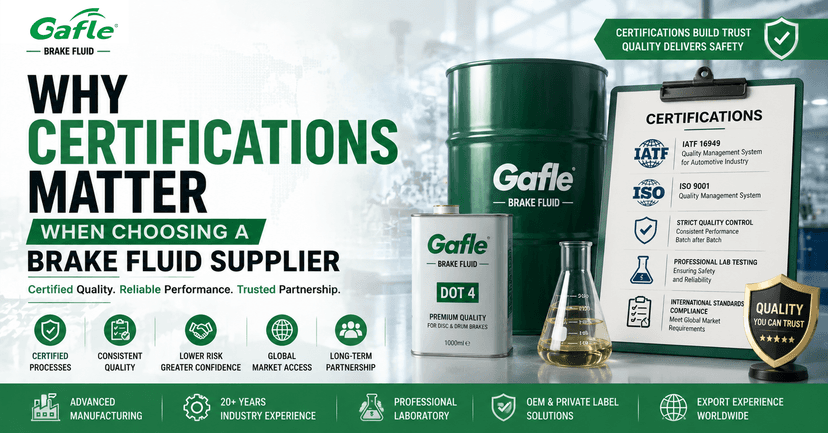
Why Certifications Matter When Choosing a Brake Fluid Supplier
Choosing the right Brake Fluid Supplier is one of the most important decisions for importers, distributors, OEM brands, and automotive businesses. While product pricing and delivery times are important, certifications often provide a deeper insight into a manufacturer's commitment to quality, consistency, and continuous improvement.
A certified manufacturer demonstrates that its production processes, quality management systems, and operational standards meet recognized industry requirements. This helps reduce purchasing risks and builds confidence in long-term cooperation.
As a professional Brake Fluid Manufacturer, Gafle has more than 20 years of dedicated manufacturing experience, supplying premium brake fluid products to customers worldwide. In this article, we'll explain why Brake Fluid Certifications matter, what buyers should look for, and how certifications support consistent product quality.
Why Are Certifications Important?
Brake fluid is a critical safety product that directly affects vehicle braking performance.
Unlike ordinary automotive chemicals, brake fluid requires strict manufacturing processes, reliable raw materials, and comprehensive quality management to ensure consistent performance.
Professional certifications help demonstrate that a manufacturer follows internationally recognized standards throughout production.
For buyers, certifications help provide confidence in:
- Product consistency
- Manufacturing quality
- Process control
- Supply reliability
- Long-term partnership capability
While certifications alone do not guarantee perfect products, they are a strong indicator that a manufacturer has established structured quality management practices.
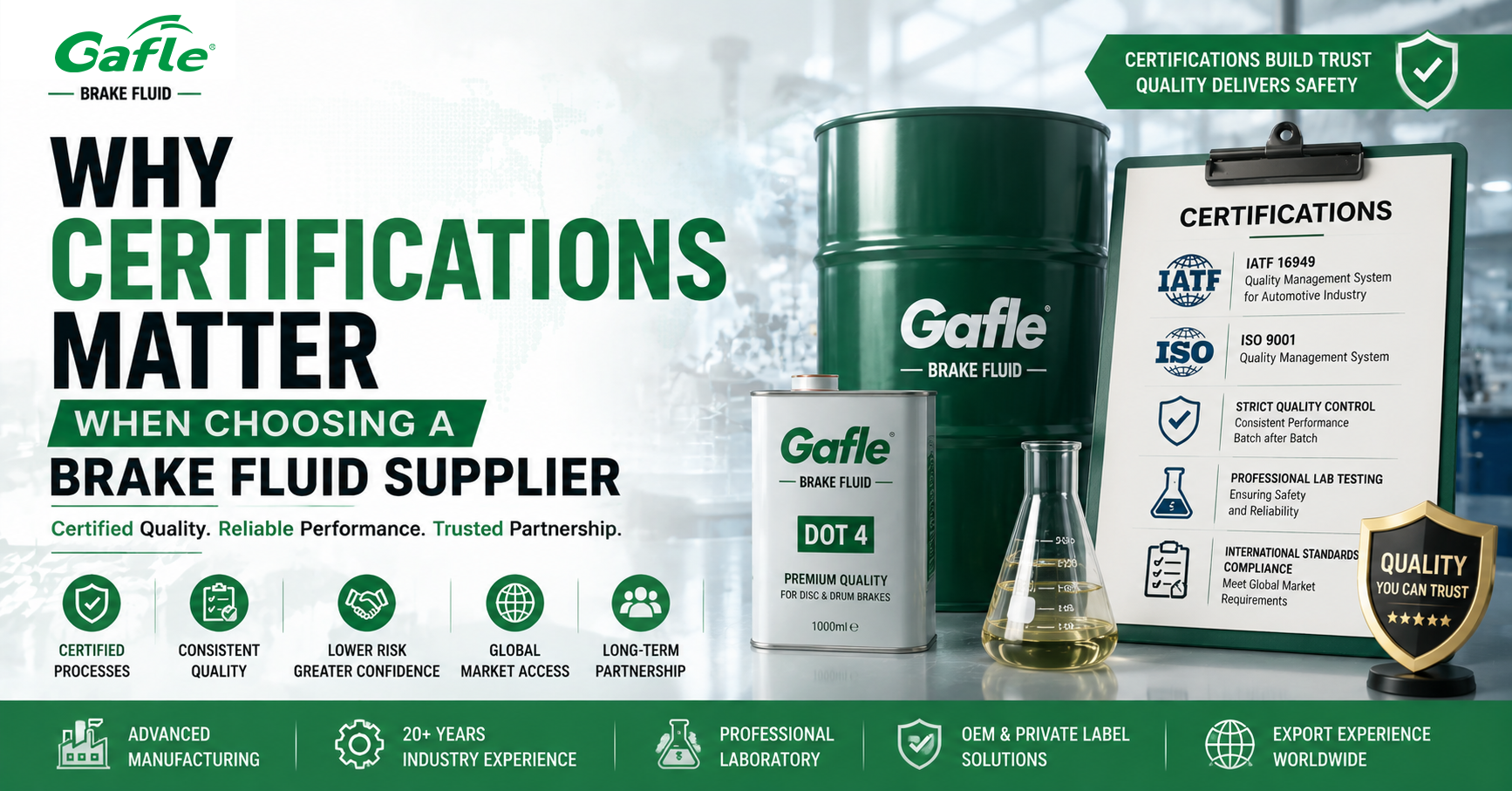 Key Brake Fluid Certifications to Look For
When evaluating a Brake Fluid Supplier, buyers should pay attention to the manufacturer's quality systems and technical capabilities.
IATF 16949 Quality Management System
IATF 16949 is one of the most widely recognized quality management standards in the automotive industry.
It emphasizes:
- Standardized manufacturing processes
- Risk management
- Continuous improvement
- Product consistency
- Customer satisfaction
Manufacturers operating under IATF 16949 typically maintain rigorous quality control procedures throughout production.
ISO Quality Management Systems
ISO-certified quality management systems demonstrate that a company follows structured management procedures and continuous improvement practices.
These systems help improve operational efficiency and manufacturing consistency.
Product Testing and Compliance
Professional manufacturers conduct extensive laboratory testing to verify product performance.
Typical tests include:
- Dry boiling point
- Wet boiling point
- Low-temperature viscosity
- Corrosion resistance
- Material compatibility
- Chemical stability
These tests help ensure products meet applicable technical requirements before shipment.
Export Qualifications
Manufacturers serving international markets should also have experience meeting export documentation and regulatory requirements for different countries.
Strong export capability helps improve delivery reliability and customer support.
How Certifications Improve Product Quality
One of the biggest benefits of Brake Fluid Certifications is their contribution to manufacturing consistency.
Certified quality management systems support:
Standardized Production
Clearly defined production procedures help reduce variation between manufacturing batches.
Better Process Control
Monitoring production processes throughout manufacturing improves product stability.
Batch Traceability
Traceability systems make it possible to identify and review production records for each manufacturing batch.
Continuous Improvement
Certified manufacturers regularly evaluate and improve their production systems to enhance efficiency and quality.
Why Certifications Matter for OEM Projects
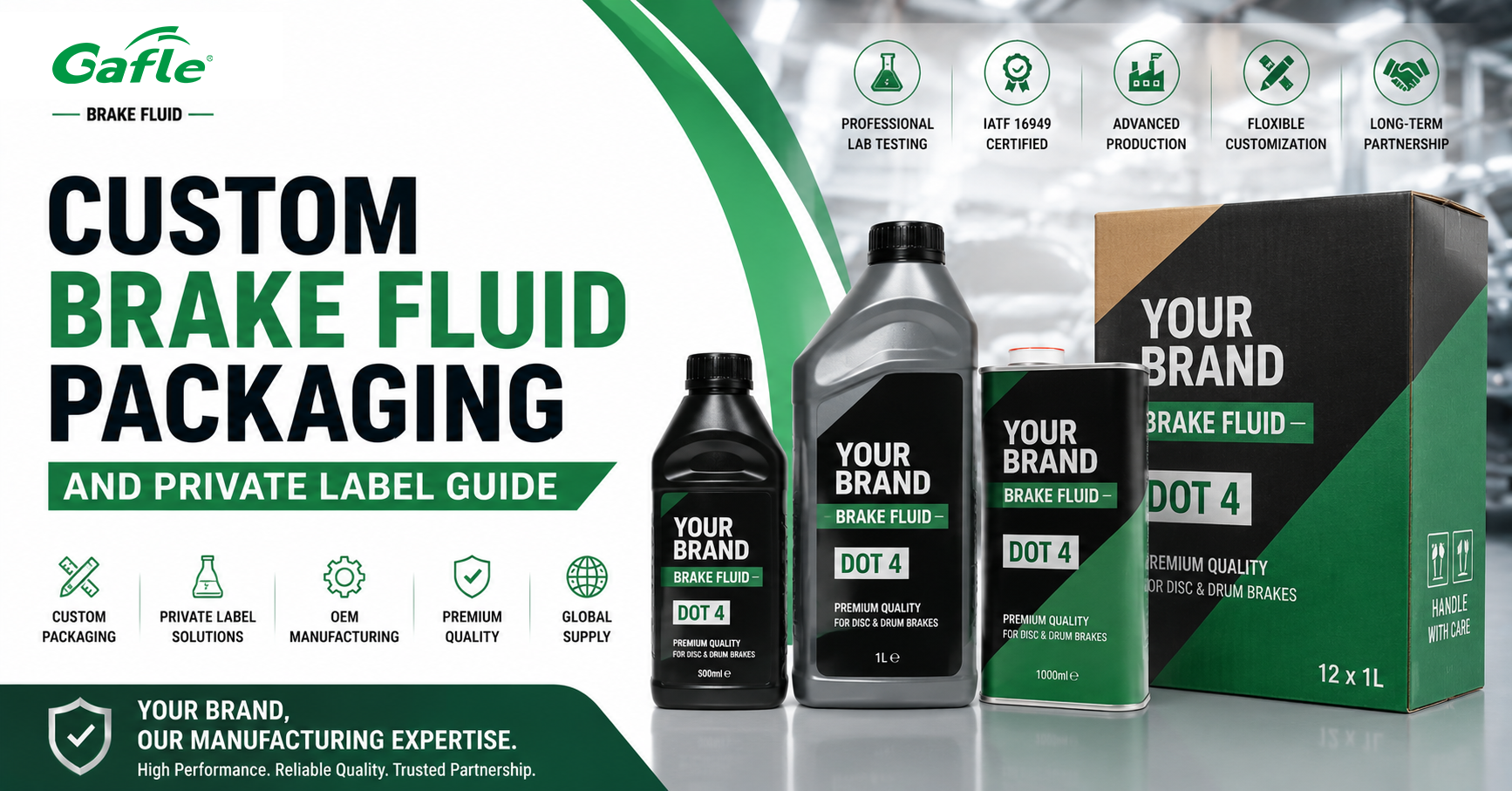
Companies looking for an OEM Brake Fluid Manufacturer often require suppliers with recognized quality certifications.
OEM projects demand:
- Stable product quality
- Consistent manufacturing
- Reliable delivery
- Professional documentation
- Long-term production capability
Certified manufacturers are generally better equipped to support these requirements.
For private label brands, consistent product quality is essential for maintaining customer confidence and protecting brand reputation.
Certifications Are Important—But They're Not Everything
While certifications are valuable, they should not be the only factor when selecting a supplier.
Buyers should also evaluate:
Manufacturing Experience
A manufacturer with many years of experience is more likely to have stable production systems and industry expertise.
Production Facilities
Modern equipment and clean manufacturing environments contribute to consistent product quality.
Professional Laboratory
A well-equipped laboratory supports product testing, research, and quality verification.
Technical Support
Experienced technical teams help customers solve problems and develop customized solutions.
Export Experience
International business experience helps ensure efficient communication, documentation, and logistics.
How to Choose the Best Brake Fluid Manufacturer in China
Many international buyers searching for the Best Brake Fluid Manufacturer in China understand that certifications are only one part of the evaluation process.
Important factors include:
- Manufacturing experience
- Brake Fluid Certifications
- Modern production facilities
- Professional laboratory testing
- Quality management systems
- OEM manufacturing capability
- Private label services
- Stable production capacity
- Export experience
- Long-term technical support
Evaluating all of these areas provides a more complete picture of a manufacturer's capabilities and reliability.
Why Global Customers Choose Gafle
As a trusted Brake Fluid Manufacturer, Gafle combines advanced manufacturing with comprehensive quality management.
Our strengths include:
- 20+ Years of Dedicated Brake Fluid Manufacturing Experience
- IATF 16949 Quality Management System
- Modern Manufacturing Facilities
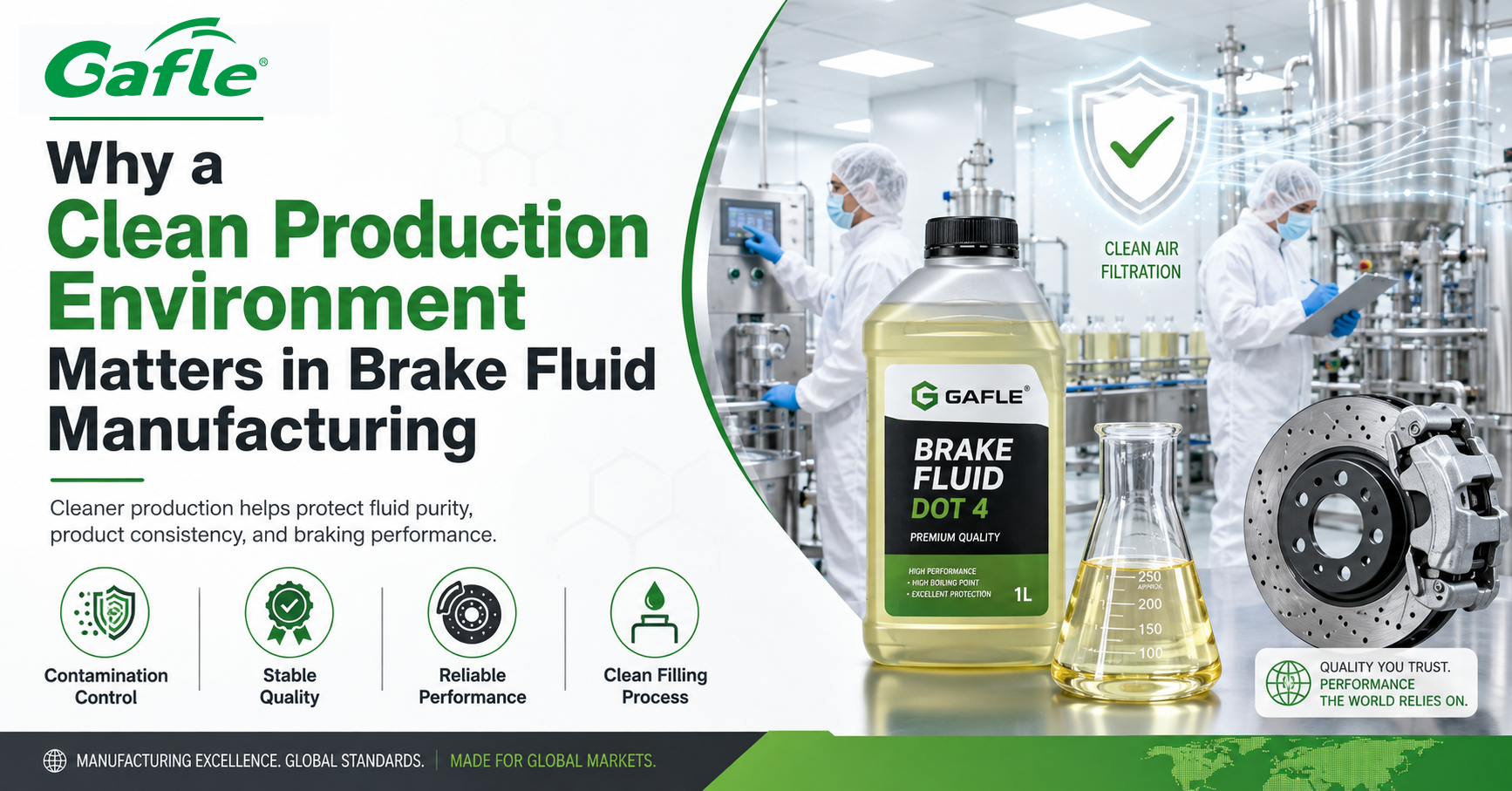
- Clean Production Environment
- Professional Laboratory Testing
- Strict Brake Fluid Quality Control
- DOT 3, DOT 4, and DOT 5.1 Brake Fluid Manufacturing
- OEM Brake Fluid Manufacturing
- Private Label Solutions
- Customized Bottles, Labels, and Cartons
- Stable Large-Scale Production
- Global Export Experience
- Participation in Drafting China's National Brake Fluid Standards
These capabilities enable us to deliver reliable brake fluid products and long-term manufacturing partnerships to customers worldwide.
Frequently Asked Questions
Why are certifications important when choosing a brake fluid supplier?
Certifications demonstrate that a manufacturer follows recognized quality management systems and standardized production processes, helping improve consistency and reliability.
What certifications should a brake fluid manufacturer have?
Many professional manufacturers operate under quality management systems such as IATF 16949 and conduct comprehensive laboratory testing to verify product performance. They should also comply with applicable regulations for their target markets.
Do certifications guarantee product quality?
Certifications are an important indicator of manufacturing capability and quality management, but buyers should also consider production facilities, laboratory capabilities, technical expertise, and manufacturing experience.
Why do OEM customers prefer certified manufacturers?
OEM projects require stable production, consistent quality, reliable documentation, and long-term manufacturing capability—all areas supported by certified quality management systems.
How should buyers choose the Best Brake Fluid Manufacturer in China?
Buyers should evaluate manufacturing experience, Brake Fluid Certifications, laboratory testing, quality management systems, OEM capability, production consistency, export experience, and long-term partnership value rather than focusing only on price.
Conclusion
Choosing a reliable Brake Fluid Supplier involves much more than comparing prices. Brake Fluid Certifications provide valuable evidence that a manufacturer follows structured quality management systems, standardized production processes, and continuous improvement practices.
However, certifications should always be evaluated alongside manufacturing experience, laboratory capabilities, production facilities, OEM expertise, and long-term service commitment.
For companies searching for the Best Brake Fluid Manufacturer in China, selecting a partner with comprehensive certifications, advanced manufacturing technology, professional laboratory testing, and proven industry experience is a smart investment in product quality and business success.
With more than 20 years of dedicated manufacturing experience, Gafle continues to provide premium brake fluid products, reliable OEM solutions, and professional manufacturing services to distributors, importers, and automotive brands around the world.
At Gafle, we believe that certifications are more than certificates on the wall—they represent our commitment to quality, consistency, and earning the trust of every customer we serve.
a Brake Fluid Supplier Is Not Just a Purchasing Task
When an engineering team starts evaluating a Brake Fluid Supplier, the conversation should move quickly past price and packaging. Brake fluid sits in a safety-critical part of the vehicle, which means the wrong sourcing decision can create problems that show up late: inconsistent pedal feel, moisture-related performance loss, compatibility complaints, or an unhappy OEM customer who has already built the fluid into a larger system. That is why buyers, sourcing managers, and product teams need to look at the supplier as a technical partner, not a commodity source.
The practical question is not simply who can fill drums or bottles. It is who can keep formulation consistency, document quality controls, and support the customer through approval, production, and field use. That distinction matters more than many first-time buyers expect.
What Buyers Usually Need to Decide First
Before comparing quotes, clarify the job the fluid must do. Different vehicle platforms, climates, and brake system designs may call for different fluid types and performance profiles. The buyer should know whether the project is replacement aftermarket supply, private label retail, or an OEM program with tighter documentation requirements.
A useful way to frame the decision is to ask four basic questions:
Will the fluid be sold under your own brand or the supplier’s?
Does the project require an OEM Brake Fluid Manufacturer relationship, or is this a straightforward distribution purchase?
What documentation is expected for the vehicle program, customer audit, or export market?
How much variation can the application tolerate before performance, shelf life, or compatibility becomes a concern?
Those questions sound simple, but they separate serious suppliers from sellers who only know how to move product.
Brake Fluid Certifications and Why They Matter
A buyer will often see references to Brake Fluid Certifications, and those documents are more than sales material. In this category, quality evidence is part of the product itself. Certificates, test reports, process controls, and traceability records help show whether a supplier can maintain repeatable production.
It is also worth being careful with terminology. A supplier may advertise broad manufacturing capability, but that does not automatically make it an IATF 16949 Brake Fluid Manufacturer. If that standard is important to your supply chain, ask for current, verifiable evidence rather than relying on website language or a brochure. The same caution applies to any claims about OEM readiness.
For many buyers, the strongest sign of maturity is not the loudest claim. It is a supplier that can answer technical questions clearly, provide the right paperwork without delay, and explain how batches are controlled from raw material to finished shipment.
What an Automotive Brake Fluid Factory Should Be Able to Support
A capable Automotive Brake Fluid Factory should do more than blend and package. Buyers usually want some combination of formulation support, stable production, labeling flexibility, and export documentation. In private-label work, packaging discipline matters because small errors in labeling or filling can create downstream headaches that are expensive to correct.
An experienced Brake Fluid Manufacturer should also be able to discuss compatibility concerns in plain language. For example, a supplier ought to explain why certain fluids are intended for specific braking systems and why mixing or substituting products without checking specifications can be risky. That kind of practical guidance is useful, especially for teams serving mixed fleets or multi-market programs.
How to Compare Suppliers Without Getting Lost in Marketing Claims
When buyers search for the Best Brake Fluid Manufacturer in China, the phrase often pulls in a long list of factories, traders, and private-label vendors. The challenge is not finding names. It is sorting credible producers from polished resellers.
A better comparison method is to evaluate these points:
Technical responsiveness: Do they answer formulation and compliance questions directly?
Documentation discipline: Can they provide current certificates and batch-related records when requested?
Production fit: Are they set up for your package sizes, branding needs, and order volume?
Consistency: Do they describe how they control variation between batches?
Buyer support: Will they help after the first shipment, or disappear once the order is booked?
One practical warning: low quotes can hide weak process control or poor communication. In brake fluid, that is not a bargain. It is a future problem.
Common Mistakes Buyers Make
The most common mistake is treating brake fluid like a simple chemical commodity. It is not. Another is assuming that a supplier who can fill a container can also support OEM or export requirements. Those are different capabilities.
Buyers also sometimes focus only on the product name and ignore the details behind it: packaging format, documentation, compatibility notes, and consistency expectations. For procurement teams, those details are often where the real cost sits.
What a Good Next Step Looks Like
If you are building a sourcing shortlist, ask each candidate supplier for the same set of information: product specification, available documentation, packaging options, and manufacturing capability relevant to your channel. Keep the request practical and specific. A serious supplier will usually respond in kind.
That approach makes it easier to compare a general trader against a true Brake Fluid Manufacturer or an OEM Brake Fluid Manufacturer. It also helps you spot whether the company has the discipline expected from a high-volume supplier or just the language to sound like one.
For engineering teams and sourcing managers, the decision should lean toward the supplier that reduces risk, not the one that only reduces unit cost. In this category, reliability, documentation, and technical clarity usually pay for themselves before the first issue ever reaches the field.