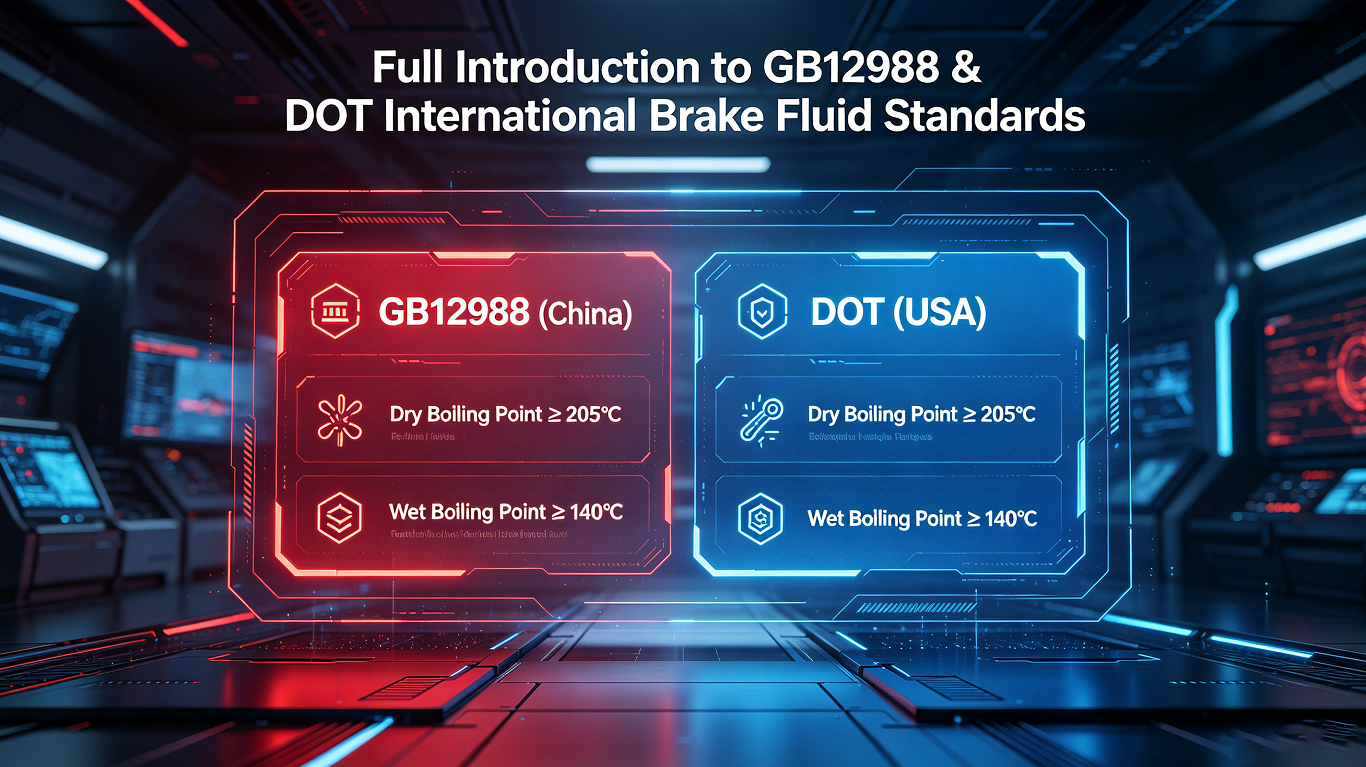
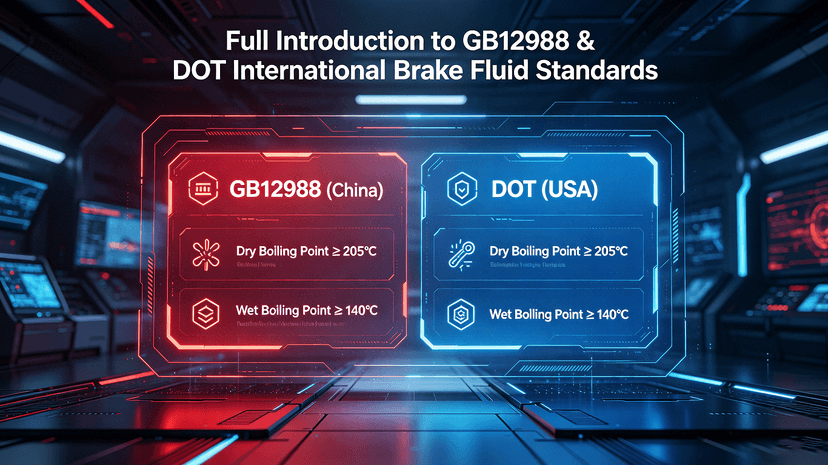
For global auto chemical importers, OEM brand owners and auto repair chains, mastering mainstream brake fluid standards is the core foundation of product procurement and quality control. The two most widely recognized global specifications are China’s GB12988 national standard and the US DOT standard formulated by the Department of Transportation. This article systematically compares their formulation basis, core technical indicators, applicable scenarios and mutual recognition rules.
1. Basic Background of Two Standard Systems
1.1 US DOT Standard
Issued by the U.S. Department of Transportation, it is the most internationally circulated brake fluid standard, covering DOT 3, DOT 4, DOT 5.1 glycol-based fluid and DOT 5 silicone fluid. It is mandatory for all vehicles sold in North America, and most aftermarket distributors in Europe, Southeast Asia, South America and Africa take DOT indicators as the primary purchasing benchmark. The core test methods refer to SAE J1703 / SAE J1704.
1.2 China GB12988 National Standard
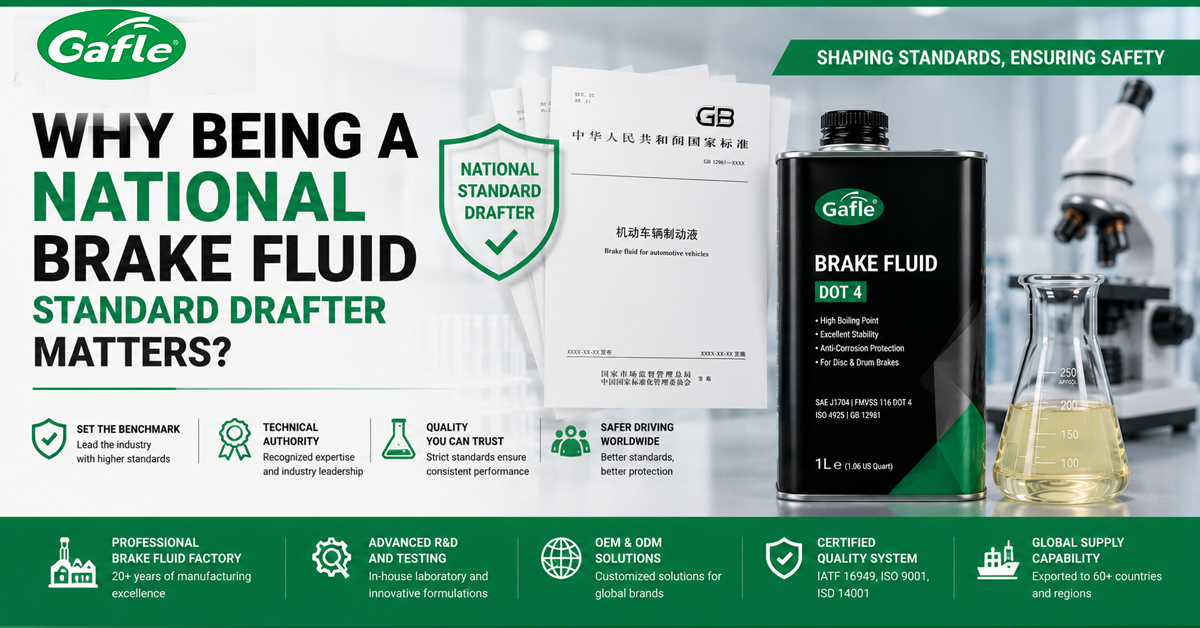
GB12988-2012 Motor Vehicle Brake Fluid is the compulsory national standard for all brake fluid produced and sold in China, drafted by professional auto chemical manufacturers including GAFLE. It fully aligns with the core safety indicators of the DOT system, while adding localized test items adapting to China’s complex road conditions and temperature environments. All Chinese export brake fluid factories must pass GB12988 batch inspection before shipment.
2. Core Technical Parameter Comparison (Glycol DOT3 / DOT4 / DOT5.1)
| Test Item | GB12988 (Grade 3) | DOT3 | GB12988 (Grade 4) | DOT4 | GB12988 (Grade 5) | DOT5.1 |
|---|---|---|---|---|---|---|
| Dry Equilibrium Reflux Boiling Point ≥℃ | 205 | 205 | 230 | 230 | 260 | 260 |
| Wet Equilibrium Reflux Boiling Point ≥℃ | 140 | 140 | 155 | 155 | 180 | 180 |
| Kinematic Viscosity at -40℃ ≤mm²/s | 1500 | 1500 | 1500 | 1500 | 900 | 900 |
| Kinematic Viscosity at 100℃ ≥mm²/s | 1.5 | 1.5 | 1.5 | 1.5 | 1.5 | 1.5 |
| PH Value | 7.0~11.5 | 7.0~11.5 | 7.0~11.5 | 7.0~11.5 | 7.0~11.5 | 7.0~11.5 |
| Max Water Content of Finished Product | ≤0.2% | Unspecified | ≤0.2% | Unspecified | ≤0.2% | Unspecified |
Key difference: GB12988 enforces strict factory water content control below 0.2%, while the DOT standard only restricts the boiling point after absorbing 3.5% water without limiting the initial water index of finished oil. This makes GB12988 products more stable during long-distance ocean shipping.
3. Differences in Test Items & Inspection Rules
- Corrosion Test: GB12988 adds a long-term metal corrosion simulation test for steel, cast iron, aluminum and copper parts, adapting to humid high-salt coastal areas; DOT only requires short-cycle corrosion verification.
- Low-temperature Cycle Test: GB12988 simulates -40℃ to 70℃ alternating cold and heat cycles, targeting northern cold regions and tropical high-temperature markets; DOT low-temperature test is single fixed-point detection.
- Batch Supervision: GB12988 mandates full batch testing before factory delivery with complete original laboratory records retained for 6 months; overseas DOT manufacturers mostly adopt sampling inspection.
4. Mutual Recognition & Global Application Guidance
- Export to North America, Australia, Europe: Products meeting GB12988 Grade 4 / Grade 5 fully satisfy DOT4 / DOT5.1 market access requirements, and test reports can be used for customs clearance auxiliary materials.
- Domestic Chinese market sales: Only brake fluid complying with GB12988 can be legally circulated; pure DOT-certified imported oil without GB inspection records cannot enter China’s aftermarket.
- Cold-region markets (Russia, Northern Europe, Canada): Prioritize GB12988 Grade 5 / DOT5.1 products with -40℃ viscosity ≤900 mm²/s for stable winter braking.
- High-temperature mountainous areas (South America, Southeast Asia): GB12988 Grade4 / DOT4 is the mainstream cost-effective choice for passenger cars and light trucks.
5. GAFLE Standard Compliance Advantage
As a drafting enterprise of GB12988 national standard, all GAFLE brake fluid simultaneously meets GB12988 and corresponding DOT specifications. Each export batch attaches dual-standard inspection reports, supporting third-party SGS, AMECA certification testing. We provide unified parameter certification documents for global wholesale and OEM clients to simplify overseas customs clearance and market registration procedures.
Closing Summary
GB12988 and DOT share consistent core safety boiling point and viscosity thresholds, with GB12988 adding stricter production control and environmental adaptation test items. For cross-border buyers, selecting manufacturers with dual-standard compliance can avoid market access barriers in different countries and regions.
Welcome to contact GAFLE for more information & cooperation!
peter
ZHEJIANG GAFLE AUTO CHEMICL CO.,LTD
Tel:86-579-8222 1665
Fax:86-579-8246 4690
Cel/Wechart:86-13335993986
E-mail:peter@gafle.net
Web:www.gafle.net
peter
ZHEJIANG GAFLE AUTO CHEMICL CO.,LTD
Tel:86-579-8222 1665
Fax:86-579-8246 4690
Cel/Wechart:86-13335993986
E-mail:peter@gafle.net
Web:www.gafle.net