Why Racing Coolant Matters More Than Most Buyers Expect
Choosing racing coolant is not just a small maintenance decision. For teams, builders, and sourcing managers, it is part of the larger question of how a powertrain holds together under load. In motorsport, temperature control affects combustion consistency, oil life, seal durability, hose reliability, and even driver confidence. A cooling system that looks fine on paper can behave very differently once the engine is pushed into repeated high-rpm cycles, long idling periods, or short bursts of extreme heat.
The mistake many buyers make is treating coolant as a commodity. In reality, the fluid is part of the thermal design of the vehicle. That is why racing teams pay attention to formulation, freeze protection, corrosion control, and whether the product fits the rules of the series. The decision is rarely about one single feature. It is about whether the coolant supports stable temperatures when the engine is under the kind of stress that street use never really creates.
Quick Takeaway: What Buyers Are Really Comparing
If you are evaluating racing coolant for a build, you are usually balancing three things: heat transfer, protection, and compliance. Some products are designed to prioritize efficient heat removal. Others are built more as protection fluids with additives that help manage corrosion and cavitation. A few aim to do both reasonably well, though there is almost always a tradeoff.
That is why it helps to ask the right question first: are you looking for maximum race-day thermal control, or a coolant that still offers broad protection for a car that sees mixed use? The answer changes the product choice immediately.
Racing Engine Cooling: What Changes Under Track Conditions
Racing engine cooling works harder than everyday automotive cooling because the operating profile is harsher and less forgiving. In street driving, load changes are gradual and the car gets frequent airflow variation. On track, the engine may sit near peak output for longer periods, while airflow, ambient temperature, and vehicle speed can swing sharply.
That creates a few common challenges. First, heat soak after a session can push temperatures higher even after the car comes off throttle. Second, local hot spots around the cylinder head, combustion chamber, or turbocharger area can stress the fluid. Third, repeated thermal cycling can expose weak points in hoses, gaskets, and the coolant itself.
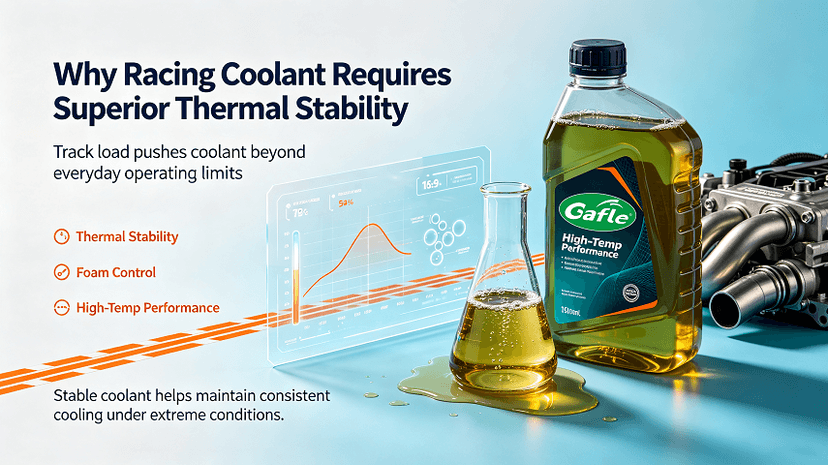
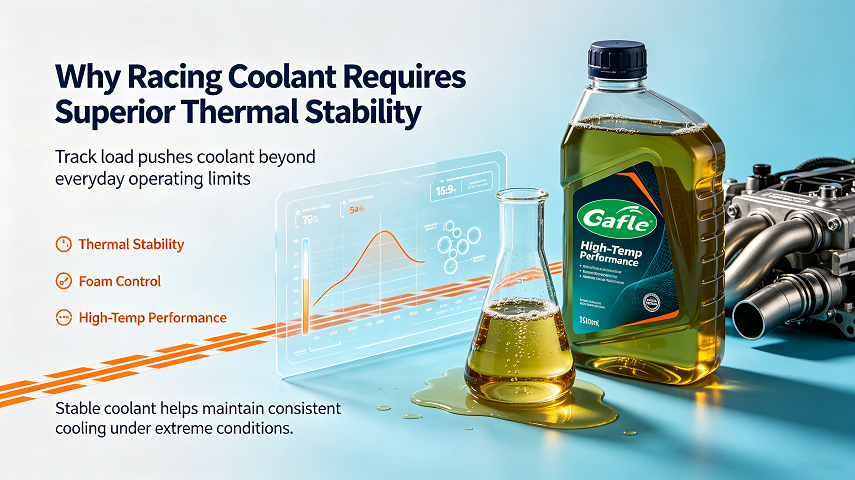
This is where thermal stability coolant becomes a practical concern, not just a technical phrase. A fluid that breaks down, foams, or loses performance under repeated heating and cooling cycles can undermine the whole system. If the engine package runs close to its thermal limit, the margin matters.
Why Racing Coolant Needs High Thermal Stability
The phrase why racing coolant needs high thermal stability sounds academic, but the logic is straightforward. Racing engines do not merely get hot; they cycle through heat loads faster and more aggressively than ordinary road cars. The fluid needs to keep working predictably as temperature rises and falls, rather than changing character in a way that makes the system harder to manage.
High thermal stability helps reduce the risk of performance drift during long sessions. It also supports more consistent engine behavior from one stint to the next, which matters for tuning, data comparison, and driver feedback. If temperature control wanders too much, it becomes difficult to know whether a change in lap time comes from setup, track conditions, or the cooling system itself. That is not a small problem for engineers.
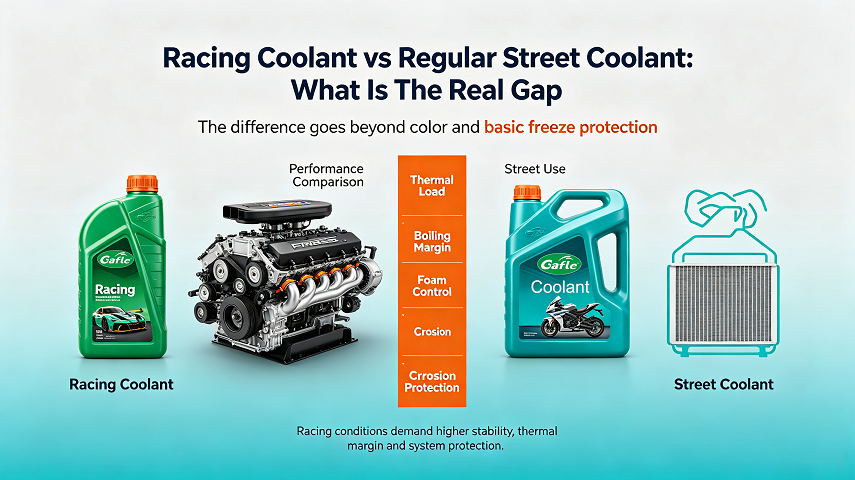
Racing Coolant vs Street Coolant
The comparison between racing coolant vs street coolant is not always clean, because some track cars still need road manners. But the differences are worth spelling out.
Street coolant is generally formulated for broad daily-use protection, including freeze resistance, long drain intervals, and compatibility with mixed materials in passenger vehicles. Racing coolant may be optimized more directly for thermal behavior and track use. In some cases, that means reduced freeze protection or a formulation intended for specific operating environments.
For buyers, the practical warning is simple: do not assume the best street coolant is the best race solution. And do not assume every race coolant is legal or suitable for a car that still sees public roads. Series rules, local climate, and the vehicle’s duty cycle all matter.
Selection Criteria That Actually Help
Check the operating environment first
Start with ambient conditions and track rules. A car running in hot weather with limited airflow faces different cooling demands than one that sees shorter events or cooler climates.
Match the fluid to the material set
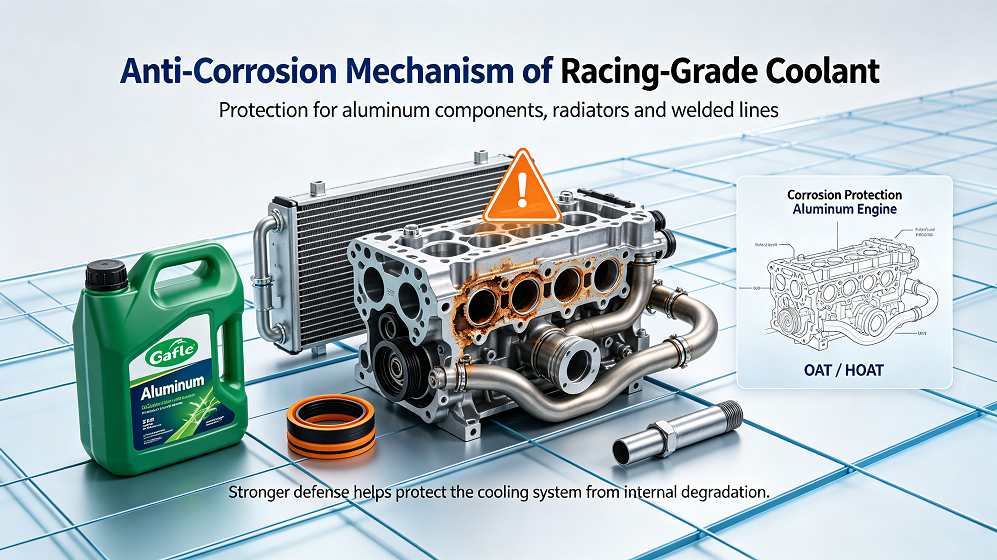
Radiators, water pumps, aluminum heads, gaskets, and hoses all interact with the coolant chemistry. Compatibility matters more than marketing language.
Look beyond the headline claim
Some labels emphasize “high performance” without explaining whether that means heat transfer, corrosion protection, or simply race-day convenience. Read the technical data if it is available. If it is not, that is a caution sign.
Common Buyer Mistakes
One common mistake is overfilling the system with confidence and then discovering the car still runs hot because the real issue is airflow, radiator capacity, or trapped air. Coolant is important, but it cannot fix a weak thermal package on its own.
Another mistake is mixing products without checking compatibility. Even when the chemistry seems similar, mixed formulations can create uncertainty. That may not show up immediately, which is exactly why it causes trouble later.
Finally, some buyers choose a product only because a racer recommended it online. That is understandable, but not enough. A sprint car, endurance prototype, drift car, and street-legal track build do not all need the same fluid behavior.
Practical Buyer Advice for Teams and Sourcing Managers
If you are buying for a shop or team, document the use case first: series requirements, climate, engine layout, and whether the car will be trailered, street-driven, or both. Then compare products on the basis of thermal behavior, corrosion protection, and service compatibility. That sequence is slower than picking the most visible brand, but it saves headaches later.
It also helps to standardize the decision across the fleet where possible. Having one approved fluid family simplifies maintenance, training, and supply control. For mixed programs, keep the exceptions clearly labeled. Small mix-ups happen in real shops, especially when crews are changing fluids between events.
FAQ: Short Answers Buyers Usually Need
Can racing coolant be used in street cars?
Sometimes, but it depends on the formulation, the vehicle, and local requirements. Check whether the product is intended for road use before making that switch.
Does racing coolant automatically run cooler?
Not automatically. It can support better thermal control, but the full cooling system design still determines the result.
Is thermal stability more important than freeze protection?
For many track-only applications, yes. For vehicles used in cold weather, freeze protection may remain essential.
What to Ask Before You Buy
The smartest purchase question is not “Which coolant is best?” It is “Which coolant fits this engine, this series, and this duty cycle?” That framing keeps the conversation grounded in real operating conditions rather than marketing claims. If the technical data is thin, ask for more detail before you commit. In a race program, coolant is not the place to guess.
Welcome to contact GAFLE for more information & cooperation!
peter
ZHEJIANG GAFLE AUTO CHEMICL CO.,LTD
Tel:86-579-8222 1665
Fax:86-579-8246 4690
Cel/Wechart:86-13335993986
E-mail:peter@gafle.net
Web:www.gafle.net