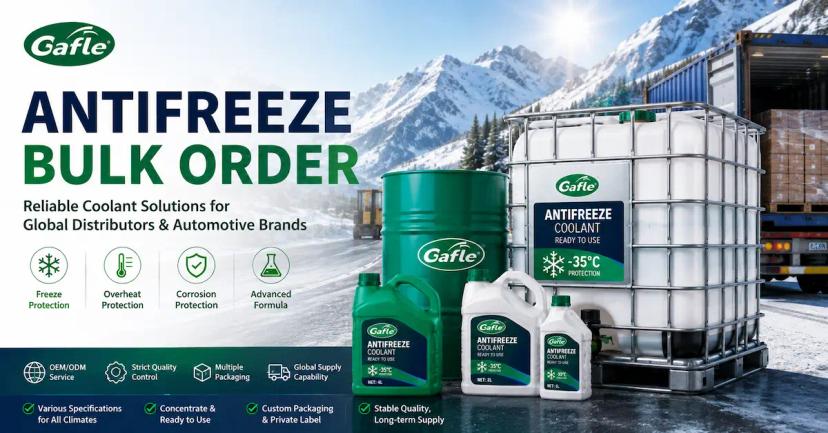
What Should Buyers Confirm Before Placing an Antifreeze Bulk Order?
An antifreeze bulk order should start with the intended application rather than the supplier's lowest quotation.
For distributors, importers, automotive chemical wholesalers, fleet suppliers, and private-label brands, four questions should be answered first:
- Which vehicles or equipment will use the coolant?
- What climate will the product operate in?
- Does the market need concentrate or ready-to-use coolant?
- Which technical specification or vehicle requirement must the product satisfy?
This matters because antifreeze is not simply a colored liquid that prevents freezing. Automotive coolant must also help control operating temperature, protect cooling-system materials from corrosion, and maintain reliable performance across the intended service conditions.
ASTM D3306, for example, covers glycol-base coolants for automobiles and light-duty cooling systems and recognizes both concentrated and prediluted products. Heavy-duty engines are addressed separately under standards such as ASTM D6210, which includes requirements related to freezing, boiling, corrosion, and cavitation protection.
For a commercial buyer, this means the sourcing sequence should be:
market → vehicle application → coolant specification → concentration → packaging → quantity → QC → logistics → price
not:
price → product → application
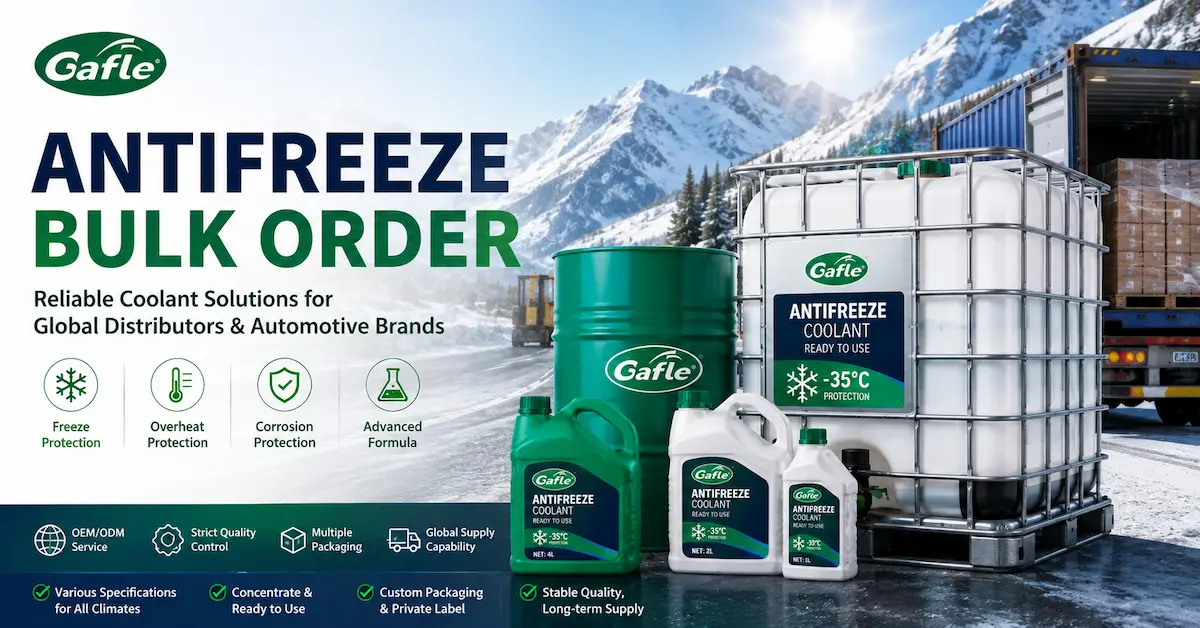
GAFLE currently provides conventional coolant, energy-vehicle coolant, energy-storage battery thermal-management coolant, non-contact liquid-cooling coolant, and OEM solutions within its antifreeze/coolant portfolio.
Who Typically Places Antifreeze Bulk Orders?
Bulk coolant purchasing is mainly a B2B procurement activity.
Automotive Chemical Distributors
Distributors may supply hundreds of workshops, retailers, dealerships, or regional wholesalers.
They usually care about:
- Competitive landed cost
- Multiple packaging formats
- Reliable repeat supply
- Product documentation
- Consistent specifications
- Private-label opportunities
A distributor may also need different coolant SKUs for different customer segments rather than one universal product.
Importers and National Wholesalers
Importers often evaluate additional factors such as:
- Export documentation
- Container planning
- Label language
- Customs-related information
- Product classification
- Packaging durability
- Long-term production capacity
For these buyers, supplier reliability can be as important as the actual coolant formula.
Fleet Maintenance Suppliers
Fleet-focused buyers may supply:
- Logistics companies
- Bus operators
- Truck fleets
- Rental fleets
- Construction companies
- Agricultural equipment operators
They generally prioritize:
- Maintenance reliability
- Bulk packaging
- Application suitability
- Predictable replenishment
- Reduced downtime
Private-Label Automotive Brands
Private-label buyers may use a bulk purchase as the basis for an entire coolant product line.
Their project may involve:
- Formula selection
- Freeze-protection positioning
- Bottle design
- Label artwork
- Carton printing
- Product language
- Brand color
- Multiple package sizes
For this buyer group, OEM antifreeze sourcing should be considered together with the bulk-order strategy.
Match Coolant Selection to Climate Before Ordering Volume
One of the strongest ideas in professional winter coolant selection is that concentration should be matched to operating temperature rather than selected blindly.
A higher glycol percentage does not automatically mean better cooling performance or better freeze protection in every situation. Proper formulation and dilution matter.
ASTM D3306 states that light-duty glycol-base concentrates are generally used within defined concentration ranges, while prediluted coolants can be supplied ready for use.
Moderate Climate Markets
Markets without severe winter temperatures may prioritize:
- Balanced freeze protection
- Heat transfer
- Corrosion protection
- Convenient ready-to-use formats
- Competitive retail pricing
In these markets, an unnecessarily extreme freeze-protection specification may increase procurement cost without delivering meaningful commercial value.
Cold Climate Markets
For cold regions, buyers should confirm:
- Minimum expected ambient temperature
- Coolant concentration
- Vehicle manufacturer requirements
- Product freeze-protection data
- Storage conditions
The target should be based on the actual operating environment rather than average seasonal temperature alone.
Extreme Winter Applications
Applications such as:
- Mountain fleets
- Snow-region commercial vehicles
- Winter recreational vehicles
- Remote industrial equipment
may require more specialized coolant planning.
However, buyers should avoid simply increasing glycol concentration without technical confirmation. The correct ratio should follow the approved formulation, applicable standard, and vehicle requirements.
Concentrated Antifreeze vs Ready-to-Use Coolant for Bulk Orders
This decision has a major impact on purchasing, transportation, warehousing, and downstream handling.
| Factor | Concentrated Antifreeze | Ready-to-Use Coolant |
|---|---|---|
| Dilution | Required before use | Factory prepared |
| Logistics | Less water transported | Higher fluid volume transported |
| Flexibility | Can support different final concentrations | Fixed formulation |
| User error risk | Higher if dilution is uncontrolled | Lower |
| Water quality control | Buyer must manage it | Controlled during manufacturing |
| Typical buyers | Professional distributors, blenders, large workshops | Retail, fleets, workshops |
| Convenience | Lower | Higher |
When Concentrate Makes Sense
Concentrated antifreeze can be attractive for buyers that have:
- Controlled dilution procedures
- Suitable water quality
- Professional downstream users
- High freight sensitivity
- Multiple climate markets
The key advantage is flexibility.
However, the buyer also assumes responsibility for correct dilution.
When Ready-to-Use Coolant Makes Sense
Prediluted coolant can be better for:
- Retail channels
- Workshop networks
- Fleet maintenance
- Markets where mixing errors are a concern
It provides a factory-controlled final mixture and simplifies downstream use.
For a bulk buyer, convenience should be evaluated alongside freight cost and package efficiency.
Ethylene Glycol or Propylene Glycol?
Both ethylene-glycol- and propylene-glycol-based coolants exist in automotive and related thermal-management markets, and ASTM D3306 recognizes both types for light-duty coolant categories.
The right choice depends on the application.
Ethylene Glycol-Based Coolant
Ethylene glycol is widely used in automotive engine cooling applications.
Buyers may consider it for:
- Passenger vehicles
- Light commercial vehicles
- Trucks
- Standard automotive aftermarket applications
Propylene Glycol-Based Coolant
Propylene glycol may be selected for particular applications where lower toxicity or specific operating requirements matter.
However, a bulk buyer should not substitute one glycol system for another without confirming:
- Application
- Additive package
- vehicle requirements
- Material compatibility
- Technical documentation
The glycol base is only one part of a finished coolant. The inhibitor system is equally important.
Why Corrosion Inhibitors Matter in a Bulk Antifreeze Order
Buying glycol alone is not the same as buying a properly formulated automotive coolant.
Cooling systems may contain:
- Aluminum
- Steel
- Cast iron
- Copper
- Brass
- Elastomers
- Plastics
A finished coolant therefore needs an inhibitor package designed for its intended application.
Common coolant technology terms include:
- IAT
- OAT
- HOAT
- Si-OAT
- P-OAT
These describe different approaches to corrosion protection.
Do Not Select Coolant by Color Alone
A frequent procurement mistake is to assume:
green = one chemistry
red = another chemistry
blue = another specification
Color may support product identification and branding, but it does not reliably prove the full formulation or vehicle compatibility.
When placing an antifreeze bulk order, confirm:
- Coolant technology
- Vehicle/OEM requirement
- Technical specification
- Material compatibility
before deciding on final product color.
Bulk Antifreeze Requirements by Vehicle Application
Passenger Cars and Light-Duty Vehicles
Typical purchasing considerations include:
- Suitable light-duty specification
- Vehicle compatibility
- Ready-to-use vs concentrate
- Retail packaging
- Long-term stability
ASTM D3306 is one reference specification commonly used for glycol-base coolants in automobile and light-duty applications.
Heavy-Duty Trucks
Heavy-duty cooling systems can have additional requirements.
ASTM D6210 covers fully formulated glycol-base coolant for heavy-duty engines and includes protection against corrosion, freezing, boiling, and cavitation.
For a heavy-duty bulk order, buyers should specify:
- Truck or equipment type
- Engine requirements
- Service environment
- Applicable standard
- Coolant maintenance strategy
Construction and Agricultural Equipment
These machines may experience:
- Long operating hours
- Dusty conditions
- Heavy loads
- Seasonal temperature changes
A general passenger-car coolant should not automatically be assumed suitable.
Fleet Applications
Fleet buyers typically benefit from standardizing coolant specifications across similar vehicle groups.
This can simplify:
- Warehouse management
- Workshop training
- Replenishment
- Maintenance procedures
- Inventory control
What Packaging Is Best for an Antifreeze Bulk Order?
Bulk purchasing does not necessarily mean one giant tank.
The correct format depends on how the buyer resells or consumes the product.
Retail Bottles
Best suited to:
- Automotive stores
- Dealer networks
- Online sales
- Consumer-facing brands
Buyers should consider:
- Shelf presentation
- Bottle durability
- Label space
- Carton dimensions
Workshop Packs
Suitable for:
- Repair shops
- Service centers
- Fleet workshops
Larger pack sizes can reduce:
- Packaging waste
- Handling time
- Cost per liter
Drum and Bulk Supply
Larger industrial formats may be suitable for:
- High-volume workshops
- Fleet depots
- Repackers
- Professional distributors
The correct choice should consider annual usage, warehouse handling, and local repacking capability.
How Packaging Changes the Real Cost of a Bulk Order
A professional procurement team should compare landed cost, not simply factory unit price.
Consider:
Coolant cost + container cost + carton + pallet + freight + duties + storage + inventory + quality risk
Packaging can influence:
- Container utilization
- Freight per liter
- Breakage/leakage risk
- Warehouse density
- Retail margin
This is especially important for antifreeze exports because ready-to-use coolant contains more transported water than concentrate.
A buyer with controlled local dilution capability may therefore evaluate concentrate differently from a retail distributor that wants a finished, ready-to-use product.
Build an Antifreeze Bulk Order RFQ Before Asking for Price
A message saying:
“Send your best price for one container of antifreeze.”
does not provide enough information.
A professional RFQ should include:
| RFQ Item | Information to Provide |
| Destination market | Country or region |
| Application | Passenger car, truck, fleet, equipment |
| Required specification | ASTM, OEM or market requirement |
| Coolant technology | If already defined |
| Product form | Concentrate or ready-to-use |
| Freeze protection | Required climate performance |
| Package size | Bottle, service pack, drum, bulk |
| Branding | GAFLE brand or private label |
| Label language | Market language |
| Estimated volume | Trial order and annual forecast |
| Documents | TDS, SDS/MSDS, COA, certificates |
| Delivery requirement | Port, Incoterm, timing |
This makes different supplier quotations much easier to compare.
What Quality Control Should Be Verified Before a Bulk Order?
A bulk order increases financial exposure.
A small quality inconsistency can affect thousands of liters rather than a few bottles.
Raw Material Control
The manufacturer should manage:
- Raw material qualification
- Incoming inspection
- Storage
- Traceability
Formula and Mixing Control
Consistency requires control over:
- Ingredient ratios
- Mixing process
- Production records
- Batch identification
Laboratory Testing
Depending on the agreed coolant specification, testing may involve:
- Freezing performance
- pH
- Physical properties
- Corrosion performance
- Foam behavior
- Stability
- Application-specific tests
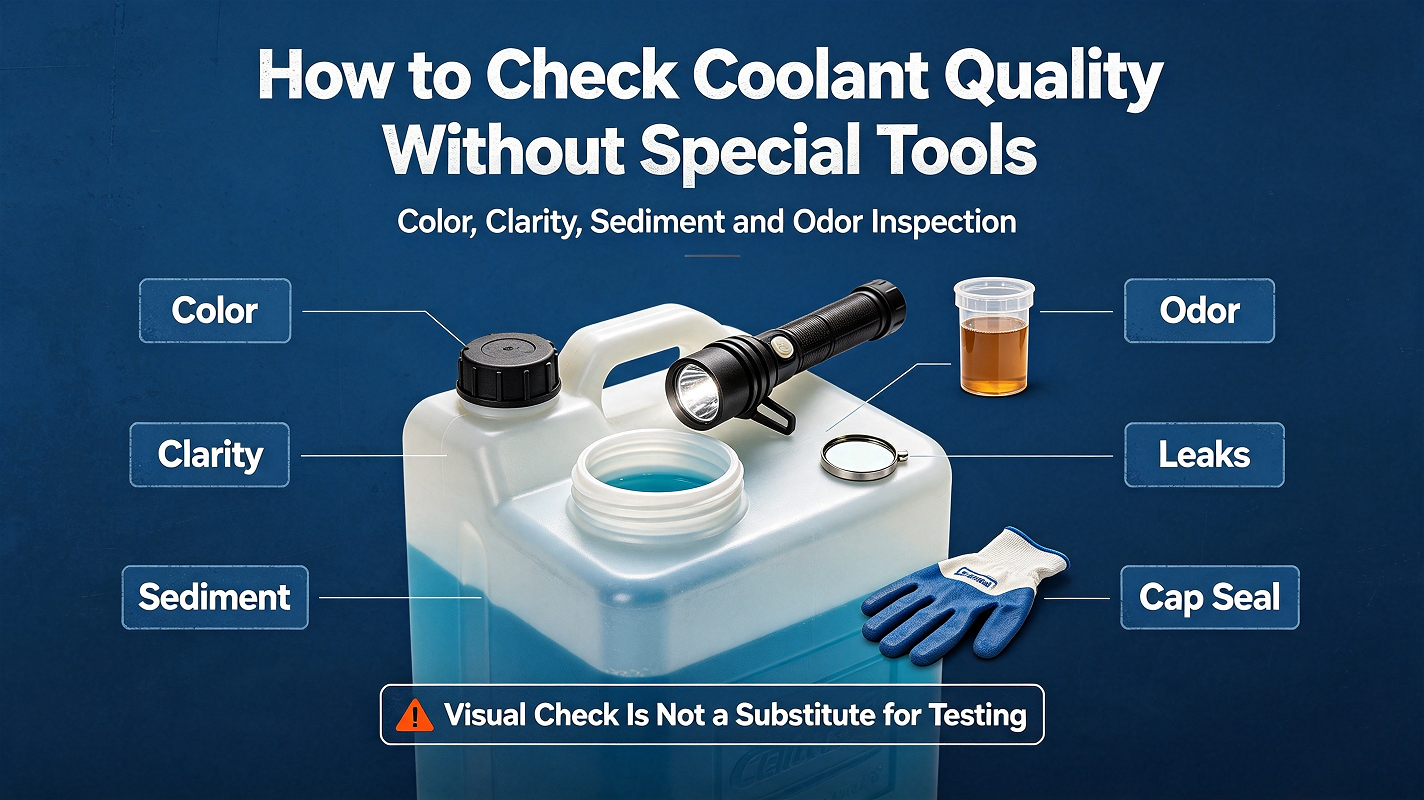
Packaging Inspection
Finished goods also require checks for:
- Cap sealing
- Leakage
- Label placement
- Batch code
- Carton condition
The goal is not simply to produce one passing sample.
The real question is:
Can the approved product be reproduced consistently across future bulk orders?
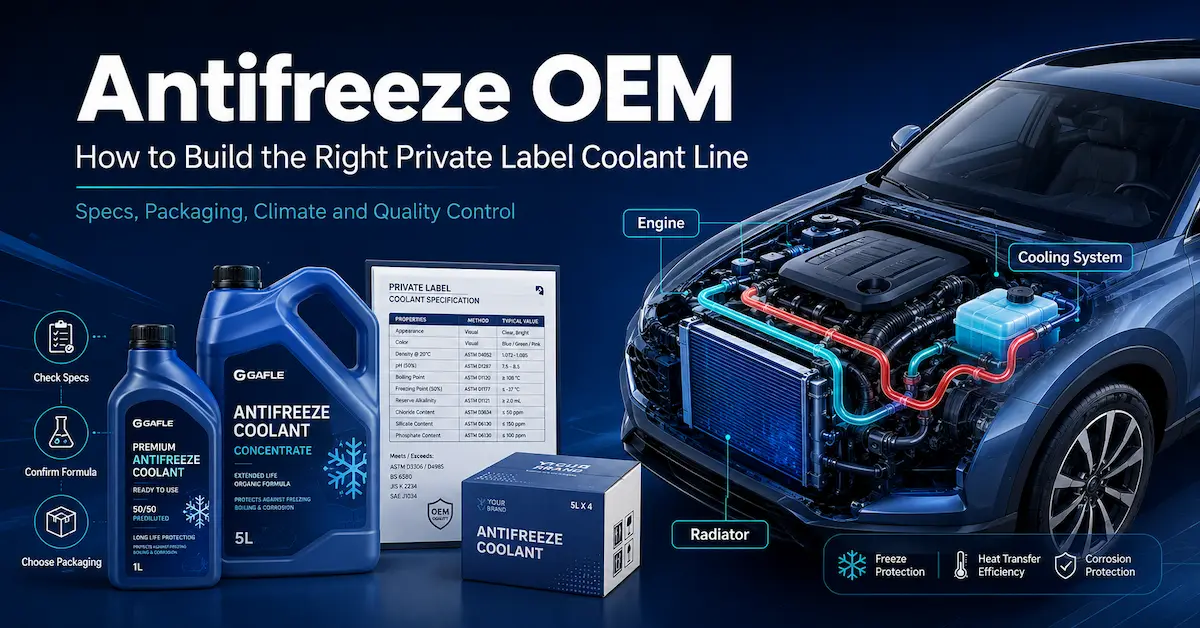
OEM and Private Label Options for Antifreeze Bulk Orders
Large-volume buyers often want their own market identity.
An OEM or private-label project can include:
Product Configuration
Depending on project requirements:
- Coolant specification
- Concentration
- Color
- Application positioning
Packaging
Possible customization includes:
- Bottle
- Cap
- Label
- Carton
- Brand colors
- Multi-language information
Product Line Planning
A distributor may create multiple SKUs such as:
- Standard ready-to-use coolant
- Concentrated antifreeze
- Cold-climate coolant
- Heavy-duty coolant
Instead of launching every SKU at once, buyers can prioritize products according to market demand.
GAFLE lists OEM as part of its current antifreeze/coolant offering. The company states that it began providing OEM services for domestic and overseas brands in 2018.
For more detail on private-label development, buyers can also review GAFLE's Antifreeze OEM guide.
How to Compare Antifreeze Bulk Suppliers
Use a supplier scorecard rather than choosing solely by quotation.
| Evaluation Area | What Buyers Should Check |
| Product fit | Correct coolant for target vehicles |
| Climate fit | Required freeze protection |
| Technical capability | Formula and application knowledge |
| QC system | Raw material, production and batch control |
| Documentation | TDS, SDS/MSDS, COA and specifications |
| OEM capability | Formula and packaging support |
| Capacity | Ability to support repeat orders |
| Export capability | International shipment experience |
| Packaging | Suitable retail, workshop or bulk options |
| Communication | Clear specification confirmation |
The best supplier for a bulk order is the one that can repeatedly deliver the agreed specification—not simply the one offering the lowest first-order price.
Why Manufacturing Capacity Matters for Repeat Orders
Bulk purchasing becomes risky when the buyer grows faster than the supplier can support.
Questions to ask include:
- Can monthly volume increase?
- Can the same formula be reproduced?
- Can packaging inventory support reorders?
- Can seasonal demand peaks be handled?
- Are production records traceable?
According to GAFLE's current corporate information, Zhejiang Gafle Auto Chemical Co., Ltd. reports annual production capacity exceeding 80,000 tons across all product lines and says it serves more than 90 international brands through OEM services.
Its corporate information also lists:
- IATF 16949
- ISO 9001
- ISO 14001
- ISO 45001
These credentials can be part of supplier qualification, but buyers should still verify the exact coolant SKU, specification, test requirements, and commercial conditions for their own project.
How to Reduce Antifreeze Bulk Order Costs Without Creating Quality Risk
Choose the Correct Specification
Avoid buying unnecessary performance simply because it sounds more premium.
Match coolant to:
- Vehicle
- Climate
- Customer
- Standard
Compare Concentrate and Premix Logistics
If your organization can control dilution properly, concentrate may change freight economics.
If not, factory-prepared coolant may reduce downstream risk.
Standardize Packaging Where Possible
Custom bottles can add brand value but may also increase:
- MOQ
- Tooling requirements
- Packaging inventory
- Lead time
A standard bottle with customized labeling may sometimes be commercially more efficient.
Forecast Annual Demand
Give the manufacturer:
- Trial order quantity
- Expected yearly volume
- Seasonal peaks
This helps both parties plan raw materials and packaging more efficiently.
Reduce Unnecessary SKU Complexity
Five similar coolant products may create:
- Higher packaging MOQ
- More inventory
- Slower turnover
A smaller, well-planned product matrix can improve purchasing efficiency.
Common Risks in an Antifreeze Bulk Order
Risk 1: Ordering Before Confirming Application
Result: The product may not match target vehicles.
Better approach: Define application and specification first.
Risk 2: Selecting Only by Freeze Point
Result: Other performance factors such as corrosion protection may be overlooked.
Better approach: Evaluate the complete coolant specification.
Risk 3: Choosing by Color
Result: Buyers may confuse visual identification with chemistry.
Better approach: Confirm formulation and compatibility.
Risk 4: Assuming More Glycol Is Always Better
Result: The final mixture may not provide the intended performance.
Better approach: Follow the approved concentration and technical recommendation.
Risk 5: Comparing Inconsistent Quotes
Result: Two suppliers may be pricing completely different products.
Better approach: Send the same detailed RFQ to every supplier.
Risk 6: Ignoring Repeat-Order Capability
Result: The first shipment works, but supply becomes unstable later.
Better approach: Assess capacity and production consistency before committing.
A Practical Antifreeze Bulk Order Process
Step 1: Define Your Target Market
Identify:
- Country
- Climate
- Vehicle population
- Distribution channel
Step 2: Define the Product Specification
Confirm:
- Application
- Coolant technology
- Concentration
- Relevant standards
Step 3: Select Packaging
Choose:
- Retail bottle
- Workshop pack
- Drum
- Bulk format
Step 4: Request Documents and Samples
Review:
- Technical specification
- TDS
- SDS/MSDS
- Sample
- Relevant test information
Step 5: Approve OEM Details
If required, approve:
- Brand
- Label
- Carton
- Color
- Packaging language
Step 6: Confirm Commercial Terms
Finalize:
- Quantity
- Price
- Payment
- Shipping terms
- Production arrangement
Step 7: Confirm Batch Acceptance Requirements
Agree on the tests and documents required before shipment.
Step 8: Plan Reorders
Provide forecasts where possible to improve supply continuity.
Why Consider GAFLE for an Antifreeze Bulk Order?
GAFLE's automotive chemical product portfolio includes conventional antifreeze/coolant alongside specialized energy-vehicle and thermal-management coolant categories, as well as OEM supply.
The company states that it has exported to markets including Southeast Asia, the Middle East, and Africa since 2012 and began OEM cooperation with domestic and overseas brands in 2018.
For distributors and international buyers, GAFLE can support discussions around:
- Antifreeze/coolant selection
- Bulk purchasing
- OEM/private-label projects
- Packaging requirements
- International supply
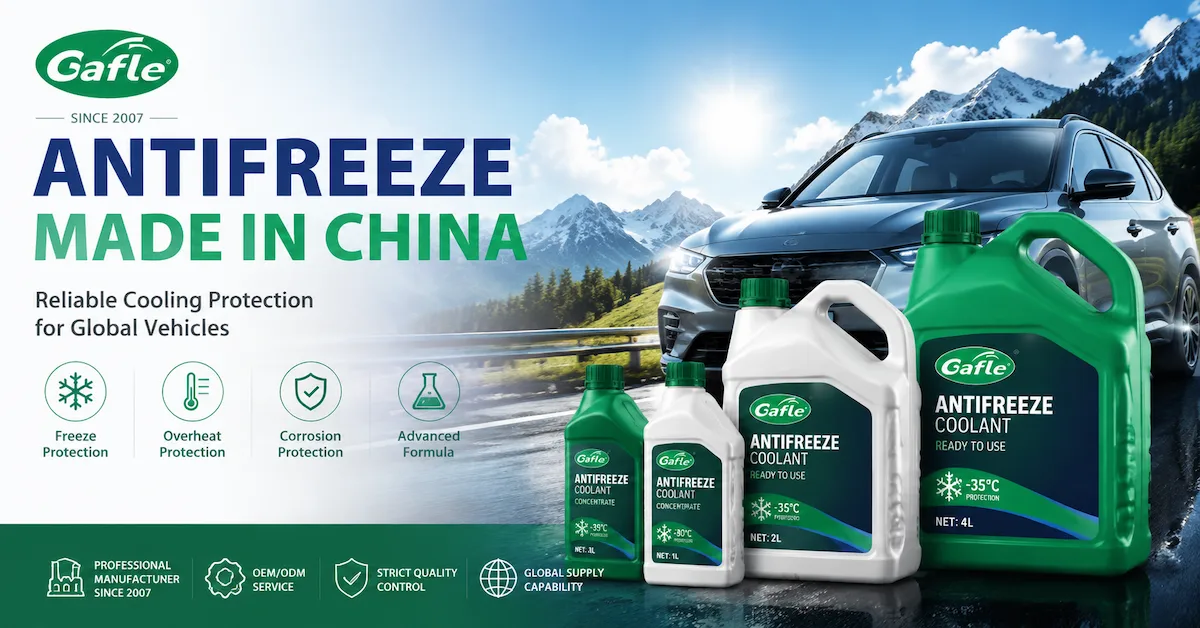
Buyers can explore the GAFLE Antifreeze/Coolant range, review the previous Bulk Antifreeze Supplier guide, or evaluate Antifreeze Made in China sourcing considerations before requesting a quotation.
What Information Should You Send for a Bulk Antifreeze Quote?
For a faster and more accurate quotation, prepare:
- Destination country
- Vehicle application
- Required standard
- Coolant chemistry if specified
- Concentrate or ready-to-use requirement
- Target freeze protection
- Packaging size
- Estimated order quantity
- Annual volume forecast
- OEM/private-label requirement
- Required label language
- Required technical documents
- Target delivery timing
If you do not know the exact coolant specification, start with the target market, vehicle application, and climate.
That gives the supplier enough information to begin product selection.
FAQ About Antifreeze Bulk Orders
1. What is an antifreeze bulk order?
An antifreeze bulk order is a commercial-volume purchase of engine coolant for distributors, importers, fleets, workshops, automotive brands, or other professional buyers. It may involve retail bottles, workshop packaging, drums, or other bulk supply formats.
2. Is concentrate or ready-to-use coolant better for bulk purchasing?
Neither is always better. Concentrate can reduce transported water and provide dilution flexibility, while ready-to-use coolant provides factory-controlled concentration and easier downstream handling. Buyers should compare logistics, application, and operational capability.
3. How should I choose antifreeze concentration for a cold market?
Start with the expected operating temperature, vehicle requirement, and coolant specification. Do not assume that simply increasing glycol concentration will always improve protection; use the approved product recommendation and applicable standard.
4. What documents should I request for a bulk coolant order?
Depending on the market, common documents may include TDS, SDS/MSDS, COA, product specifications, test information, quality certificates, and export documents.
5. Can antifreeze bulk orders be private labeled?
Yes. GAFLE lists OEM within its coolant offering, and private-label projects can be discussed according to product specification, packaging, branding, and order requirements.
6. What affects antifreeze bulk pricing?
Key factors include coolant specification, raw materials, concentrate or prediluted format, packaging, customization, volume, documentation, and destination logistics.
7. Should I select antifreeze by color?
No. Color can help identify a product but does not reliably define its chemistry or vehicle compatibility. Confirm the technical specification and application first.
8. Can one bulk antifreeze product serve passenger cars and heavy-duty trucks?
Buyers should not assume so. Light-duty and heavy-duty cooling systems can have different specification requirements; ASTM maintains separate coolant standards for these service categories.
9. How can distributors reduce bulk coolant sourcing risks?
Use a written RFQ, approve samples and documentation, confirm QC requirements, verify packaging, and evaluate the manufacturer's repeat-order capability before placing high-volume orders.
10. How do I request an antifreeze bulk order from GAFLE?
Provide your destination market, vehicle application, specification, coolant format, packaging, quantity, private-label requirements, and delivery expectations. GAFLE's Contact Us page can be used to discuss project-specific requirements.
Conclusion
A successful antifreeze bulk order requires more than negotiating a low price per liter. The buyer must align climate, vehicle application, coolant chemistry, concentration, corrosion protection, packaging, documentation, logistics, and repeat-order capability before approving volume production.
For importers and distributors, the most effective sourcing strategy is to establish the technical requirement first and optimize cost second.
This approach helps reduce three common risks:
- Buying the wrong coolant for the market
- Paying for unnecessary specifications or packaging
- Choosing a supplier that cannot maintain consistent repeat production
GAFLE combines automotive coolant manufacturing, OEM capability, and international supply experience for B2B buyers. To discuss an upcoming order, explore GAFLE's Antifreeze/Coolant products or contact GAFLE with your target market, specification, packaging, and expected order volume.