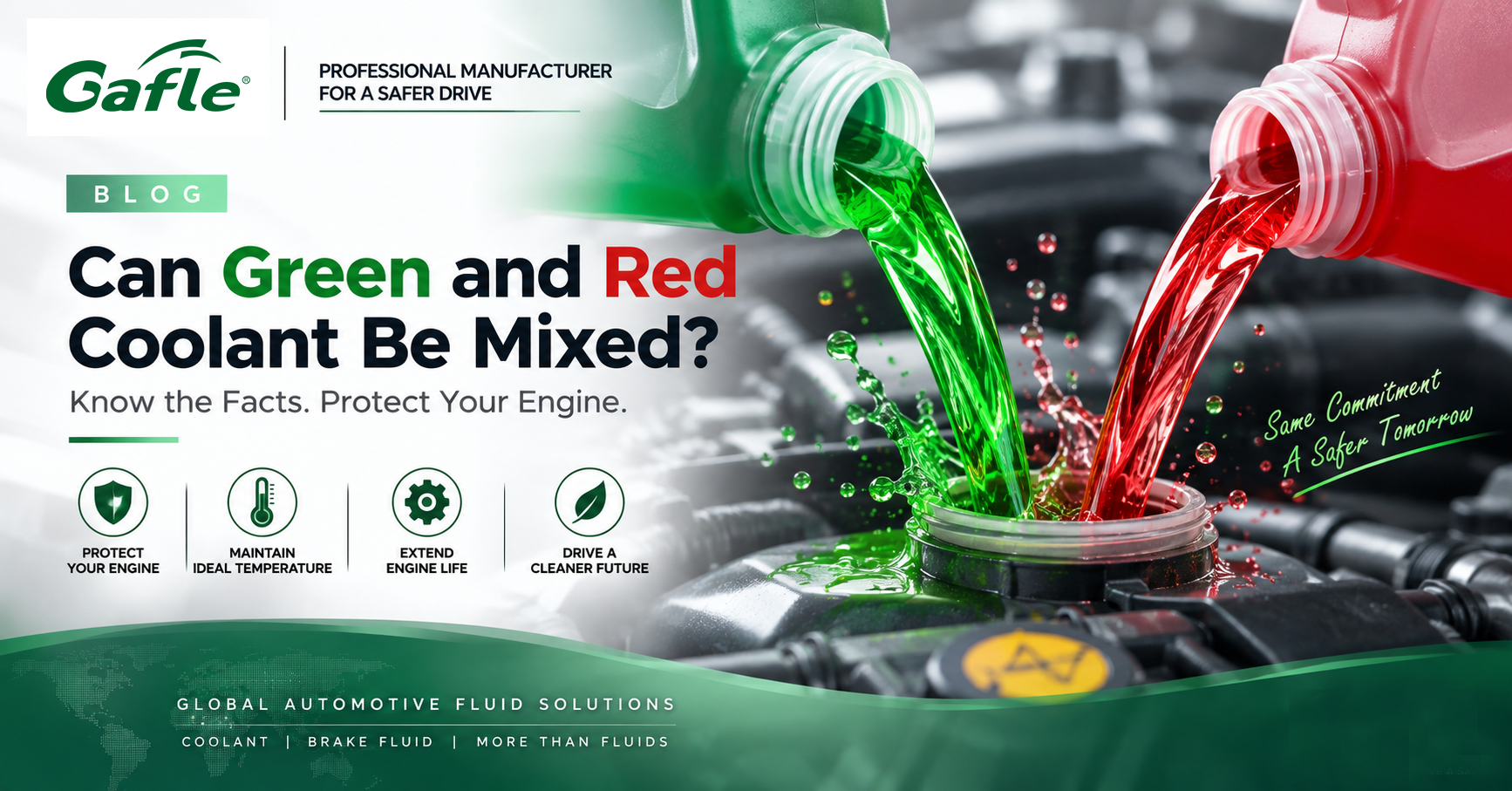
 Can Green and Red Coolant Be Mixed?
Engine coolant plays a vital role in regulating engine temperature, preventing freezing, protecting against corrosion, and extending the life of the cooling system. One of the most frequently asked questions from vehicle owners and distributors is: Can Green and Red Coolant Be Mixed?
The simple answer is: not based on color alone. While coolant colors may appear different, color itself does not determine compatibility. The real factors are the coolant's chemical formulation, additive technology, and the vehicle manufacturer's specification. Two coolants with the same color may use completely different chemistries, while two coolants with different colors may sometimes be compatible if they meet the same specification.
As a professional automotive fluid manufacturer with more than 20 years of manufacturing experience, Gafle supplies high-quality engine coolants and brake fluids to OEM customers, distributors, and automotive brands worldwide. In this article, we'll explain why coolant compatibility matters and how to choose the correct coolant for your vehicle.
Does Coolant Color Really Matter?
Many people believe coolant color determines whether products can be mixed. In reality, coolant color is primarily used as a visual identifier chosen by the manufacturer, not as an industry-wide technical standard.
Different brands may use:
- Green
- Red
- Blue
- Pink
- Orange
- Purple
- Yellow
for products with different additive technologies.
Likewise, two products with the same chemistry may be sold in different colors by different manufacturers. Therefore, color alone should never be used to judge compatibility.
Can Green and Red Coolant Be Mixed?
The safest answer is:
Only if the two coolants are confirmed to be chemically compatible and approved for the same vehicle specification.
Instead of checking the color, you should verify:
- Vehicle manufacturer's recommendation
- Coolant specification
- Additive technology
- Technical Data Sheet (TDS)
- Product label
If compatibility cannot be confirmed, the safest solution is to completely flush the cooling system before changing to another coolant.
Understanding Engine Coolant Compatibility
Proper Engine Coolant Compatibility depends on the coolant's formulation rather than its appearance.
The most common coolant technologies include:
IAT (Inorganic Additive Technology)
A conventional coolant technology commonly used in older vehicles.
OAT (Organic Acid Technology)
Long-life coolant technology offering extended corrosion protection and longer service intervals.
HOAT (Hybrid Organic Acid Technology)
Combines features of IAT and OAT to meet the requirements of many modern vehicle manufacturers.
Long Life Coolant
Many modern vehicles use Long Life Coolant, which provides extended service life while maintaining excellent corrosion protection and cooling performance.
Because different technologies use different additive packages, compatibility should always be confirmed before mixing.
What Happens If You Mix the Wrong Coolants?
Mixing incompatible coolant formulations may reduce the effectiveness of the additive package.
Possible consequences include:
Reduced Corrosion Protection
Different additive systems may not perform as intended when mixed.
Reduced Cooling Efficiency
An incompatible mixture may not provide the same long-term cooling performance as the specified coolant.
Formation of Deposits
In some cases, incompatible additive packages may contribute to sludge or deposits that restrict coolant flow and reduce cooling efficiency.
Shortened Coolant Service Life
Mixing incompatible products may reduce the expected maintenance interval compared with using the correct coolant.
How Gafle Ensures Coolant Quality
At Gafle, coolant quality begins with scientific research and strict manufacturing management.
Professional Formula Development
Our R&D team develops coolant formulations designed to provide:
- Excellent freeze protection
- Reliable boil-over protection
- Long-term corrosion resistance
- Stable heat transfer performance
Premium Raw Materials
Only carefully inspected raw materials are approved for production.
Advanced Laboratory Testing
Each production batch undergoes comprehensive testing, including:
- Freeze protection
- Boiling protection
- Corrosion resistance
- pH stability
- Material compatibility
- Appearance inspection
Strict Quality Control
From raw material inspection to finished product testing, every production stage follows standardized quality procedures.
OEM & Private Label Manufacturing
Gafle provides complete OEM and private label services, including:
- Customized coolant formulations
- Bottle customization
- Label design
- Carton packaging
- Technical documentation
How to Choose a Reliable Coolant Manufacturer
Selecting the right Coolant Manufacturer is just as important as selecting the correct coolant.
A professional supplier should provide:
- Advanced laboratory facilities
- Formula development capability
- Strict quality management
- Stable production capacity
- OEM & ODM services
- Export experience
- Technical support
- Consistent batch quality
Many international buyers searching for the Best Brake Fluid Manufacturer in China also choose manufacturers that provide high-quality engine coolants supported by advanced laboratories, strict quality control, and flexible OEM manufacturing capabilities.
Why Global Customers Choose Gafle
As a trusted automotive fluid manufacturer, Gafle supplies both brake fluid and engine coolant to customers around the world.
Our advantages include:
- 20+ Years of Automotive Fluid Manufacturing Experience
- Professional Research & Development Team
- Advanced Laboratory Testing
- Modern Manufacturing Facilities
- Strict Quality Control
- IATF 16949 Quality Management System
- OEM & Private Label Manufacturing
- Customized Packaging Solutions
- Stable Large-Scale Production
- Global Export Experience
- Participant in Drafting China's National Brake Fluid Standards
These capabilities enable Gafle to provide reliable automotive fluid solutions for distributors, importers, wholesalers, and automotive brands worldwide.
Frequently Asked Questions
Can green and red coolant be mixed?
Not based on color alone. Compatibility depends on the coolant's chemical formulation, additive technology, and the vehicle manufacturer's specification—not the dye color.
Does coolant color determine compatibility?
No. Coolant color is chosen by the manufacturer and is not standardized across the industry. Always check the specification and product documentation instead of relying on color.
What happens if I mix different coolant types?
Mixing incompatible coolant formulations may reduce corrosion protection, shorten coolant life, or contribute to deposits that affect cooling system performance.
How do I know which coolant my car needs?
Always follow the vehicle manufacturer's recommendations and match the coolant specification listed in the owner's manual or service documentation.
How should buyers choose the Best Brake Fluid Manufacturer in China?
Buyers should evaluate manufacturing experience, laboratory capability, quality management systems, OEM services, production consistency, export experience, and technical support rather than focusing only on price.
Conclusion
Understanding Can Green and Red Coolant Be Mixed? is important for protecting your engine and cooling system. While coolant colors may look different, the real factor that determines compatibility is the coolant's chemical formulation and manufacturer specification—not its color. Before topping up or replacing coolant, always verify the recommended specification and avoid relying solely on appearance.
With more than 20 years of manufacturing experience, Gafle continues to provide premium engine coolants and brake fluids through advanced laboratory testing, modern production facilities, and strict quality control.
For businesses searching for the Best Brake Fluid Manufacturer in China, Gafle offers reliable automotive fluid products, flexible OEM and private label solutions, and long-term partnerships built on quality, consistency, and innovation.