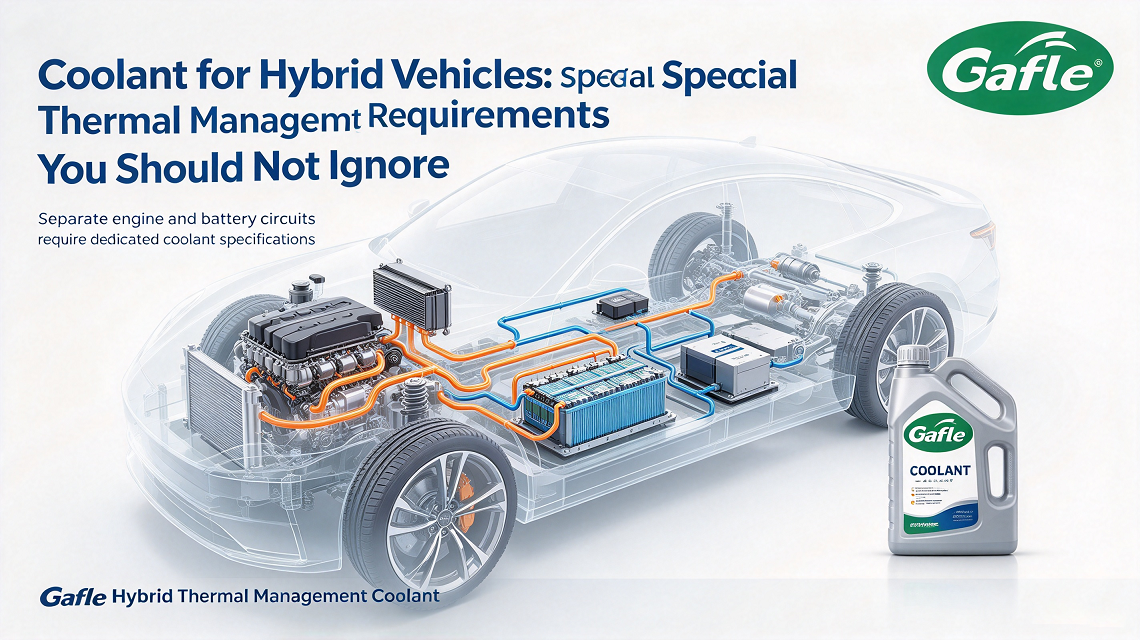
Factory Fill Coolant: What It Is, Why It Matters, and When to Change Course
Factory fill coolant is one of those details most people ignore until a cooling issue shows up. For engineers, sourcing teams, and service planners, though, it sits in a bigger decision chain: what chemistry went into the system at assembly, how that chemistry behaves over time, and whether a change to aftermarket coolant will protect the asset or create avoidable risk.
The question is not just academic. Coolant chemistry affects corrosion control, heat transfer, water pump life, seal compatibility, and service intervals. In mixed fleets and long-life equipment, choosing the wrong replacement fluid can create deposits, gasket problems, or a maintenance pattern that looks acceptable on paper and expensive in practice.
What factory fill coolant actually means
Factory fill coolant is the coolant placed into an engine, vehicle, or thermal system at the point of manufacture. In many cases it is an OEM-specific antifreeze formulation or a closely controlled variant designed to match the metals, elastomers, and operating temperature range of that platform.
That matters because the original fill is usually selected as part of a broader systems package, not as a generic commodity. Aluminum components, mixed-metal assemblies, plastic tanks, seals, and gaskets all influence the chemistry choice. The OEM coolant formula may use a particular inhibitor package, dye, and service-life target that is not interchangeable with every aftermarket product on the shelf.
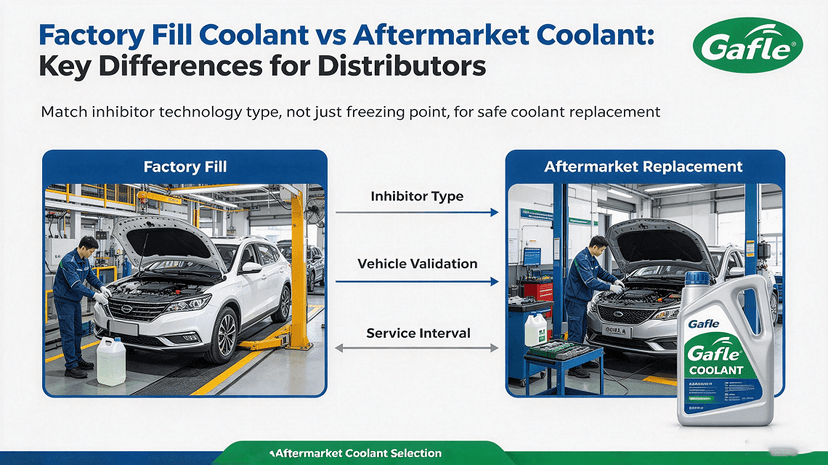
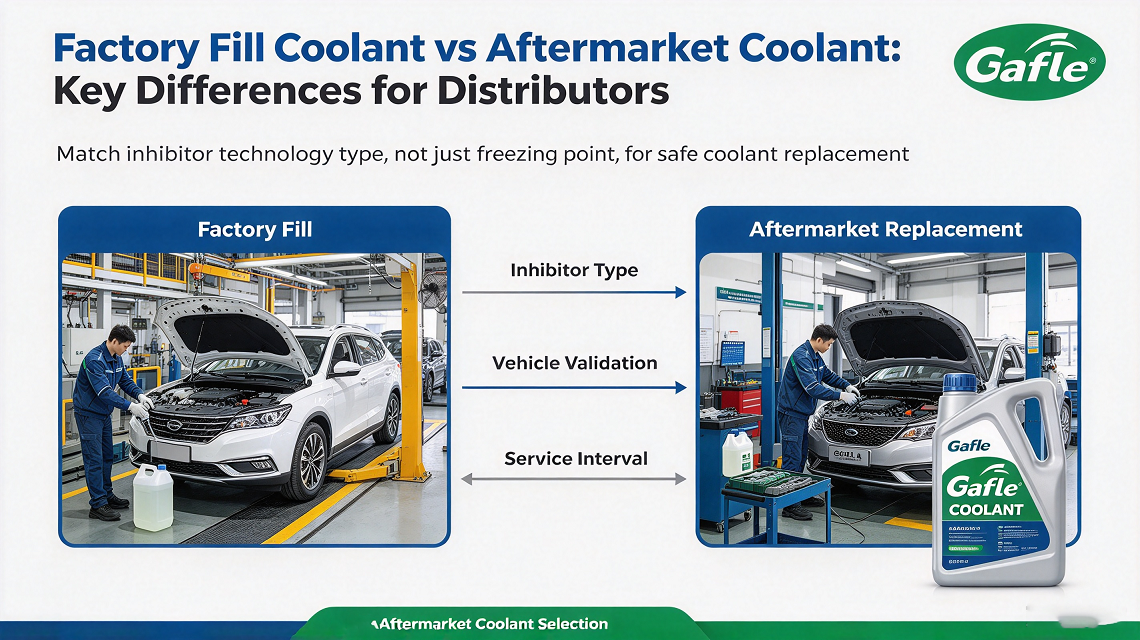
Factory fill coolant vs. aftermarket coolant: the practical difference
The difference between factory fill coolant and aftermarket coolant is often less about color and more about specification discipline. Two bottles may both say “long life” and still behave differently in a real cooling system.
Aftermarket coolant is built to serve a broader range of applications. That can be useful, especially for maintenance simplification. But broad compatibility is not the same as exact matching. Some formulas are designed to meet multiple OEM requirements; others are more general-purpose and rely on the user to confirm fit by specification, not by assumption.
For buyers, the key question is not whether aftermarket coolant is “good” in the abstract. It is whether it meets the platform’s requirements for metallurgy, temperature stability, additive depletion, and service interval. If the answer is unclear, the safer move is to verify the OEM approval language or ask whether the fluid is explicitly compatible with that system.
Can you replace factory coolant with aftermarket fluid?
Can you replace factory coolant with aftermarket fluid? Sometimes yes, but only after checking compatibility carefully. In some service environments, an aftermarket coolant that meets the required specification is a perfectly workable replacement. In others, especially where the OEM uses a particular hybrid or extended-life formula, switching without a flush and compatibility check can be a bad trade.
The main risk is not immediate failure. It is slow mismatch: inhibitor packages that do not align, residual fluid that dilutes the new chemistry, or a maintenance team that assumes all “red,” “pink,” or “yellow” coolants are interchangeable. They are not. Color is a marketing cue, not a specification.
What to look at before making a substitution
1. Base chemistry and inhibitor system
Coolants are built around different chemical families and additive packages. If the replacement fluid does not suit the original system, corrosion protection can weaken over time even if the engine runs normally at first.
2. Material compatibility
Look at the metals and polymers in the cooling circuit. Aluminum, cast iron, copper-containing components, seals, hoses, and plastic tanks all react differently to coolant chemistry. A fluid that works across a broad vehicle pool may still be a poor fit for a specific engine family.
3. Service interval assumptions
Extended-life claims are only useful if they match the actual maintenance plan. If a facility intends to top off frequently or mix suppliers, the expected interval may shrink. That is one of the easiest ways to lose the economic advantage of a premium fluid.
4. Flush strategy
If changing chemistry families, a full flush is often more sensible than a top-off. Mixing incompatible fluids can create sludge, scale, or a shortened inhibitor life. It is a small extra step that can save a much larger repair later.
Common mistakes buyers make
One common mistake is assuming the OEM coolant formula must always be used forever, even when a verified compatible alternative is available. The opposite mistake is just as common: treating all aftermarket coolant as equal because the container says “universal.” Both shortcuts can be costly.
Another frequent problem is service inconsistency. One shop tops off with factory fill coolant equivalent, another uses a general aftermarket coolant, and nobody documents the change. By the time corrosion or deposit issues appear, the root cause is hard to trace.
Buyer-facing advice for sourcing and maintenance teams
If you manage a fleet, production line, or service network, create a short approval list for coolant substitutions. Keep it tied to engine family, equipment model, and acceptable specification language. That is more useful than a broad preference for one brand.
Ask suppliers for compatibility documentation, not just product claims. If a fluid is said to replace factory fill coolant, confirm the exact systems it covers and whether a flush is recommended before use. If the answer is vague, treat that as a warning sign rather than a harmless omission.
Quick takeaway
Factory fill coolant is the original, platform-matched thermal fluid chosen by the manufacturer. Aftermarket coolant can be a valid replacement, but only when it matches the required chemistry and service conditions. The real decision is not brand versus brand; it is whether the fluid protects the system you actually have.
FAQ
Is factory fill coolant always better than aftermarket coolant?
Not always. A well-matched aftermarket coolant can perform well, but only if it meets the system’s specification.
Does coolant color tell me if it is compatible?
No. Color is not a reliable compatibility guide.
Should I mix old and new coolant types?
Only if the products are confirmed compatible. Otherwise, flushing is the safer option.
What is the safest next step if I am unsure?
Check the OEM requirement, review the replacement fluid’s specification sheet, and avoid guessing based on label claims alone.
Welcome to contact GAFLE for more information & cooperation!
peter
ZHEJIANG GAFLE AUTO CHEMICL CO.,LTD
Tel:86-579-8222 1665
Fax:86-579-8246 4690
Cel/Wechart:86-13335993986
E-mail:peter@gafle.net
Web:www.gafle.net