Beyond Hydraulic Pressure: The Chemistry Inside the Line
Automotive hydraulic systems operate under brutal environmental and mechanical stress, yet design conversations often focus heavily on bursting strength and line routing. Less attention is paid to the fluid itself as a protective barrier. Understanding how brake fluid protects metal brake lines requires looking past simple pressure transfer and examining the internal chemical interactions taking place across years of thermal cycling. Without active chemical passivation, standard double-walled steel lines would pit and fail from the inside out long before road salt compromised their zinc or polyvinyl fluoride exterior coatings.
The Internal Environment: Moisture, Heat, and Dissimilar Metals
Modern passenger and commercial vehicle braking systems are galvanic minefields. Mild steel hydraulic lines tie directly into aluminum ABS control modules, cast iron or aluminum brake calipers, and brass flare fittings. When you couple dissimilar metals in the presence of an electrolyte, galvanic corrosion is inevitable unless the fluid medium resists charge transfer.
Compounding this is the chemical nature of conventional DOT 3, DOT 4, and DOT 5.1 fluids. These are polyalkylene glycol ether-based formulations selected specifically for their high boiling points, low volatility, and elastomer compatibility. Unfortunately, glycol ether fluids are intrinsically hygroscopic. They pull water vapor past microscopic imperfections in EPDM caliper seals, reservoir vent caps, and flexible hose interfaces. Once moisture enters the system, plain glycol degrades into acidic byproducts (primarily glycolic and formic acids), drastically accelerating internal brake corrosion unless specific chemical defenses are sustained.
The Brake Fluid Anti-Corrosion Mechanism
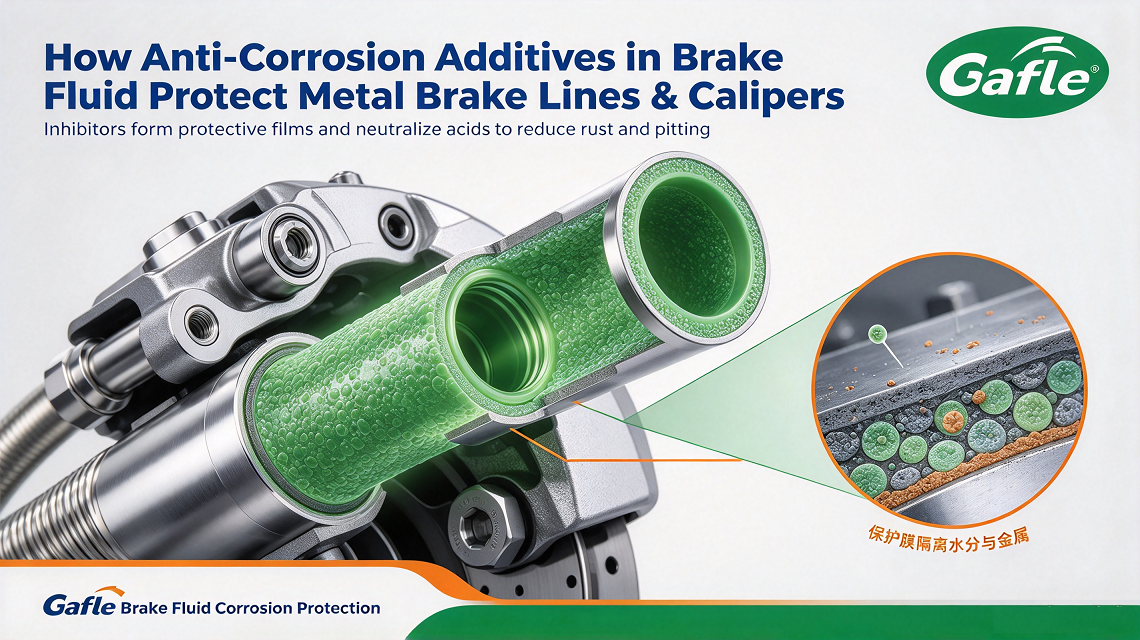
Pure glycol ether does not inherently protect iron, copper, or aluminum. The true heavy lifting falls to a specialized package of brake fluid additives blended into the base stock, typically accounting for 1% to 5% of the total fluid volume. The brake fluid anti-corrosion mechanism functions across three distinct protective vectors:
- pH Buffering (Acid Neutralization): Fresh brake fluid is maintained at an alkaline reserve—typically between pH 7.0 and 11.5. Reserve alkalinity additives, such as aliphatic and cyclic amine compounds, neutralize organic acids formed when glycols break down under high operating temperatures. Keeping the fluid alkaline prevents free hydrogen ions from stripping electrons from ferrous line walls.
- Surface Passivation: Passivators bond chemically to the exposed bare metal surfaces of the tubing. Triazole derivatives (such as tolyltriazole and benzotriazole) form a microscopic chelate layer over yellow metals like copper and brass brazing. This layer arrests copper dissolution, which is critical because dissolved copper acts as an internal catalyst, aggressively corroding iron tubing down the line.
- Vapor-Phase and Liquid-Phase Inhibitors: Specialized carboxylates and organic phosphate salts plate out along the inner walls of steel lines, creating an impermeable monolayer that insulates the base iron from dissolved oxygen and suspended water droplets.
Additive Depletion: Why Age Outweighs Mileage
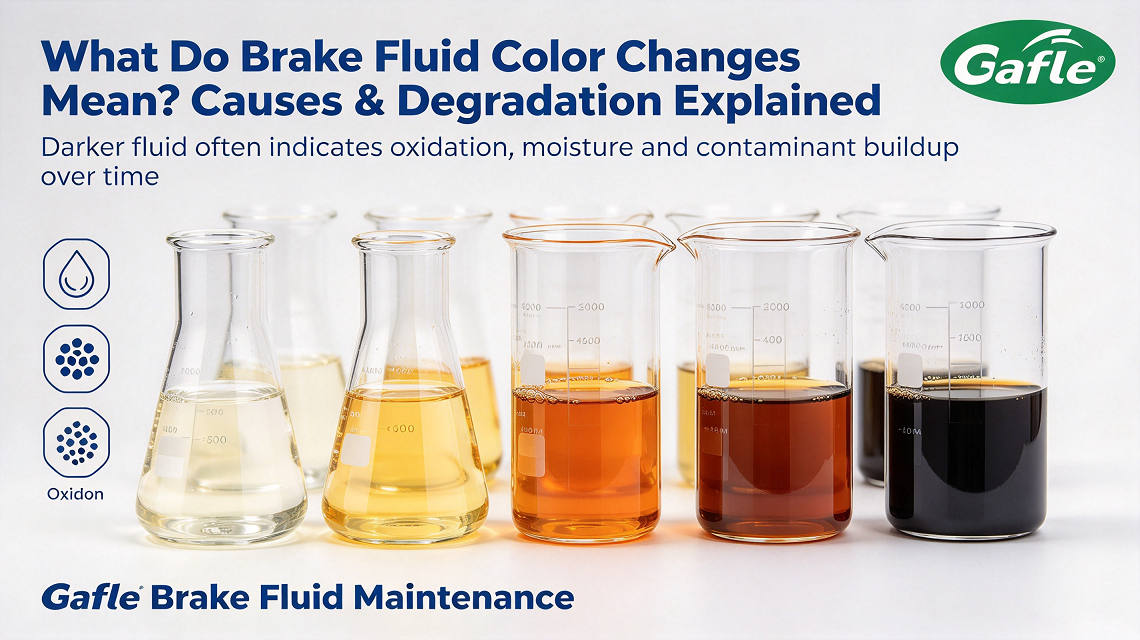
While moisture absorption steadily drops the wet boiling point—a classic safety concern regarding vapor lock during heavy braking—inhibitor depletion is the true engine of component wear. When fluid sits stagnant in low-flow regions of the chassis, such as long runs of hard lines along the underbody or dead-ends near brake calipers, additive molecules expend themselves neutralizing localized acid spikes.
Once the reserve alkalinity is spent, the pH drops. In acidic conditions, the copper alloy used to braze double-walled Bundy tubing begins to migrate into the fluid. The presence of copper ions in concentrations exceeding 200 parts per million serves as an industry-standard indicator that the fluid's protective capacity is exhausted and that pitting corrosion along mild steel lines is imminent.
Internal Degradation vs. Line Metallurgy
Engineers specifying tubing materials must factor fluid chemistry into lifecycle projections:
- Standard Copper-Brazed Steel (Bundy Tube): Cost-effective and fatigue-resistant, but extremely sensitive to fluid pH drops. If internal inhibitors fail, galvanic action between the copper braze and mild steel accelerates pinhole leaks.
- Copper-Nickel (CuNi 90/10): Highly resistant to external salt spray and internal moisture. However, poor fluid maintenance can still strip the natural cuprous oxide film, shedding copper particles that subsequently damage caliper piston bores and sensitive ABS valve seats.
- Stainless Steel Lines: Excellent base chemical resistance, but not immune to crevice corrosion if chloride contamination or severe moisture separation occurs within degraded glycol fluid.
Specification and Maintenance Recommendations
For fleet engineers and maintenance managers, preventing internal line failure is straightforward but frequently mismanaged. Standard moisture pens only measure conductivity, which serves as a rough proxy for water content but tells you nothing about inhibitor reserves. Chemical test strips that evaluate copper levels and reserve alkalinity provide a far more accurate assessment of whether the fluid is still actively passivating internal metals.
Specifying high-quality DOT 4 formulations with robust borate ester packages provides extended moisture resistance by chemically binding water molecules into harmless complexes. Even so, periodic flushing remains the only reliable method to refresh depleted additives and ensure the long-term integrity of critical hydraulic hard lines.
Frequently Asked Questions
Why does internal corrosion matter if external line coatings are intact?
Pinhole leaks frequently originate from the inside out. A line may appear pristine beneath its nylon or epoxy coating, yet harbor localized pitting corrosion caused by stagnant, acid-rich fluid pooled at low points in the chassis.
Does DOT 5 silicone fluid eliminate the need for anti-corrosion additives?
Not entirely. While silicone base fluid does not absorb water, moisture that enters the system cannot be held in solution and pools at low points. Without active chemical protection, these water pockets pool directly against metal line walls and calipers, causing severe localized galvanic pitting.
How does dissolved copper damage brake components?
Dissolved copper acts as an oxidizer. As it plates out onto exposed steel lines and caliper pistons, it pulls electrons from the host iron, sparking aggressive electrochemical pitting and leaving behind abrasive debris that damages micro-machined ABS valves.
Welcome to contact GAFLE for more information & cooperation!
peter
ZHEJIANG GAFLE AUTO CHEMICL CO.,LTD
Tel:86-579-8222 1665
Fax:86-579-8246 4690
Cel/Wechart:86-13335993986
E-mail:peter@gafle.net
Web:www.gafle.net