Thermodynamics at Work: How Pressure Raises Coolant Boiling Point
Internal combustion engines, heavy-duty gensets, and industrial heat exchangers routinely operate at temperatures that would turn plain water into steam under atmospheric conditions. When evaluating thermal performance, mechanical engineers often review how pressure raises coolant boiling point to protect engine blocks from localized overheating and destructive vapor pockets. If a cooling loop operates unpressurized, it sacrifices a massive safety margin, leaving cylinder heads and water jackets vulnerable the moment peak thermal loads spike.
Understanding this mechanic is not just an academic exercise. For sourcing teams and design engineers specifying radiators, surge tanks, and pressure caps, managing operating pressure dictates material wall thicknesses, hose ratings, and component life cycles across the entire cooling system.
The Vapor Pressure Principle in Liquid Loops
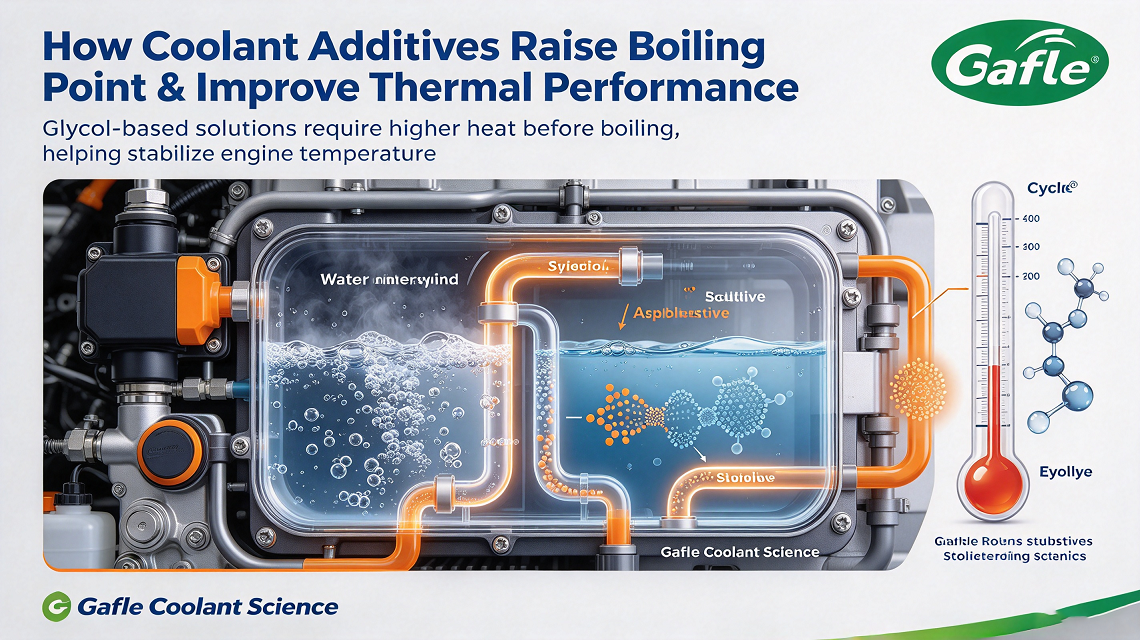
Boiling occurs when the vapor pressure of a liquid equals the external pressure surrounding it. At sea level (roughly 14.7 psi or 1.013 bar absolute), pure water boils at 100°C (212°F). When you dissolve ethylene glycol into water—typically in a standard 50/50 mixture—the chemical properties raise that baseline boiling point to approximately 107°C (225°F).
While that 7-degree bump helps, modern heavy-duty engines routinely push coolant temperatures toward 100°C–105°C during high ambient pull. Running unpressurized leaves virtually zero margin for transient heat spikes. This is where the pressure principle comes into play: by artificially raising the ambient pressure inside a sealed loop, you force water molecules to absorb substantially more thermal energy before they can overcome the opposing force and transition into the vapor phase.
As a rule of thumb in liquid-cooling design, every additional pound per square inch (psi) of pressure above atmospheric level raises the boiling point of water-based coolant by approximately 2.5°F to 3°F (roughly 1.4°C to 1.7°C). A cooling loop equipped with a 15 psi pressure relief cap, therefore, lifts the effective boil-over threshold of a 50/50 mix well past 128°C (263°F). That 20-plus degree buffer is the difference between smooth heat conduction and catastrophic engine failure.
How Radiator Pressure Cap Works Under Real Operating Cycles
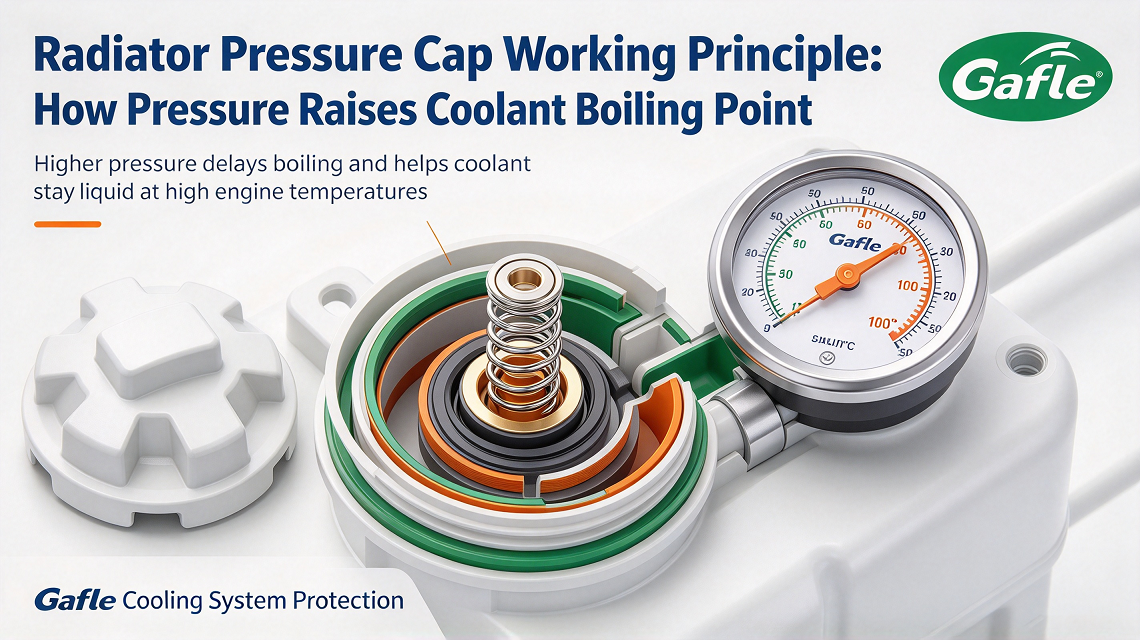
The device responsible for establishing and regulating this closed environment is the pressure cap. Rather than simply acting as a threaded dust seal, understanding how radiator pressure cap works highlights its role as a calibrated two-way relief valve.
When the engine reaches operating temperature, the liquid expands. Because liquid is nearly incompressible, thermal expansion compresses the trapped air pocket in the upper radiator tank or remote expansion bottle. As pressure builds against the calibrated spring mechanism inside the cap, it maintains the target operating ceiling (typically between 7 and 16 psi, depending on machine design).
If extreme loads generate excess volume and pressure exceeds the spring rating, the primary valve opens, venting excess fluid into an overflow reservoir. Conversely, when the machine shuts down and temperatures fall, the liquid contracts. Without a secondary path, this cooling creates a vacuum that can flatten soft silicone hoses or crack thin-wall aluminum tanks. A lighter, centrally located vacuum return valve in the cap draws coolant back out of the reservoir into the main loop, restoring balanced pressure.
Why Phase Change Matters: Cavitation and Film Boiling
The primary concern of thermal engineers is rarely the total volume of coolant boiling over like an old car on a highway shoulder; it is micro-boiling. Within cylinder heads, exhaust port passages, and around wet cylinder liners, metal wall temperatures far exceed the average bulk coolant temperature.
When internal pressure drops—due to a degraded cap seal or improper pump inlet design—localized vapor bubbles form instantly against hot metal surfaces. This creates two immediate mechanical failures:
- Thermal Blanketing (Film Boiling): Liquid coolant has a vastly higher heat transfer coefficient than vapor. The moment a vapor blanket forms against an aluminum combustion deck, thermal transfer plummets, causing localized hot spots, thermal fatigue, and warpage.
- Cavitation Erosion: Vapor bubbles generated at the low-pressure eye of a water pump impeller travel downstream into higher-pressure zones. As they collapse back into liquid form, the micro-implosions deliver shockwaves of thousands of pounds per square inch, pit-marking impellers and eroding thin liner walls over time.
Practical Design and Sourcing Considerations
When selecting hardware for high-demand thermal loops, higher pressure is not universally better. Sourcing and maintenance teams must balance boiling margins against structural durability:
- Hose and Joint Ratings: High-pressure loops (18–22 psi) demand reinforced EPDM or silicone hoses with robust constant-tension clamps. Cheap worm-gear clamps often develop cold-weather weep paths when cycling through extreme thermal expansion.
- Core Construction: Modern brazed aluminum cores handle internal burst pressures far better than older soldered copper-brass designs, but their tube wall profiles must be rated for sustained pressure cycles without fatigue cracking.
- Surge Tank Material: Molded nylon expansion tanks degrade under long-term exposure to heat, glycol, and cyclic pressure. Specifying adequate wall thickness and UV-resistant grades prevents hairline cracking near the neck where the pressure cap seats.
Frequently Asked Questions
Can I simply install a higher-pressure cap to solve an overheating problem?
No. Swapping an 8 psi cap for a 16 psi cap will raise the boiling point, but it does not improve the radiator's heat rejection capacity. If an engine is overheating due to scale accumulation, poor airflow, or an undersized core, raising the pressure only delays the boil-over while placing extra stress on gaskets, hoses, and heater cores.
Does pure water transfer heat better than a 50/50 glycol mix under pressure?
Yes. Pure water has a higher specific heat capacity and thermal conductivity than ethylene glycol. However, water lacks anti-corrosion additives and lubrication for pump seals, and its unpressurized boiling point is lower. A pressurized 50/50 mixture remains the engineering standard because it combines adequate heat capacity with broad freeze and boil-over protection.
Auditing Your Thermal Loop
If your machinery fleets or stationary power units show signs of unexplained coolant loss, pump cavitation, or localized liner pitting, start by testing the pressure cap relief pressure and verifying system hold down. Specifying the correct cap pressure rating—and ensuring the downstream plumbing can endure the mechanical stress—is one of the lowest-cost, highest-leverage steps in maintaining long-term powertrain reliability.
Welcome to contact GAFLE for more information & cooperation!
peter
ZHEJIANG GAFLE AUTO CHEMICL CO.,LTD
Tel:86-579-8222 1665
Fax:86-579-8246 4690
Cel/Wechart:86-13335993986
E-mail:peter@gafle.net
Web:www.gafle.net