Is a High Boiling Point Coolant Enough for a Race Engine?
The short answer is no: is high boiling point coolant enough for race engine problems? Usually not by itself. A coolant with a higher boiling point can help reduce the chance of localized boiling, but race engine overheating is rarely solved by fluid choice alone. For teams, builders, and track-day owners, the real question is whether the entire cooling system can move heat out of the engine fast enough under sustained load.
That distinction matters. In racing, the engine is not just getting hot; it is being heat-soaked by sustained rpm, long pulls, poor airflow in traffic, and sometimes reduced radiator time at speed because the car simply has less opportunity to dump heat between heavy throttle events. A high boiling point coolant may give a margin of safety, but it does not fix a restricted radiator, poor ducting, air trapped in the system, or a water pump that is not moving enough volume.
What the Boiling Point Actually Does
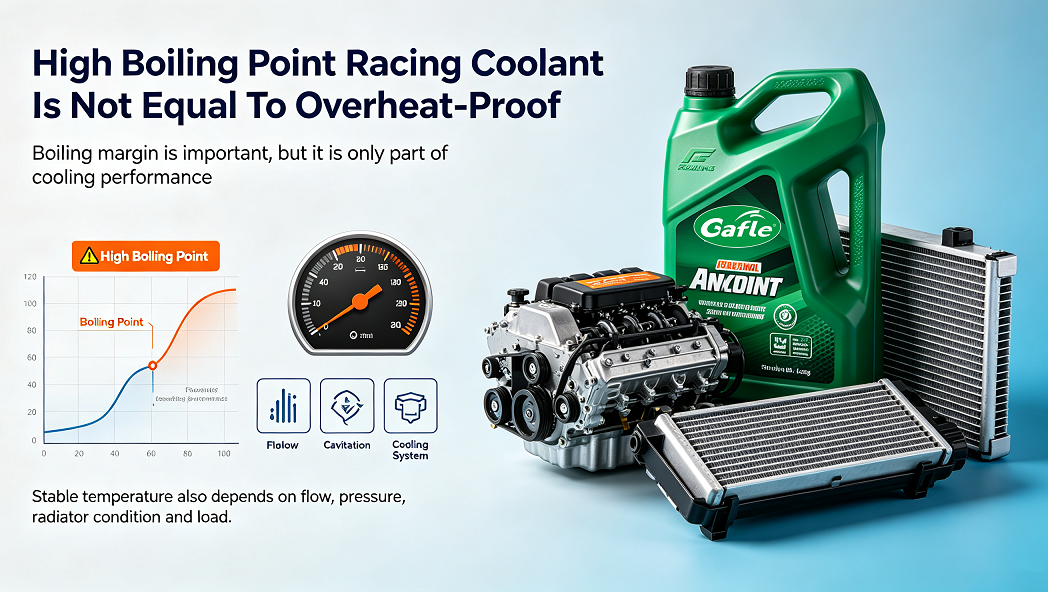
A coolant’s boiling point tells you when the fluid starts changing phase into vapor under pressure. Vapor is a poor heat carrier compared with liquid, so once boiling begins, cooling performance drops sharply. That is why race coolant discussions often start with temperature margins. If the coolant stays liquid, it can continue absorbing and transporting heat more reliably.
Still, there is a practical caution here: a higher boiling point does not mean the engine is operating “cooler” in the everyday sense. It only means the system can tolerate a hotter thermal load before boiling starts. If the engine’s combustion heat, friction, and underhood heat exceed the radiator’s rejection capacity, the gauge will still climb.
What Actually Drives Race Car Overheating
Most teams chasing cooling issues eventually find more than one contributor. The common factors causing race car overheating usually include:
Airflow problems
Radiators depend on clean airflow through the core. Poor duct sealing, blocked inlets, overly open engine bays, or exhaust heat recirculation can all reduce cooling performance. At speed, air needs a defined path; in the pits, fans and ducting become even more important.
Insufficient coolant circulation
A weak pump, cavitation, worn impeller design, or trapped air pockets can reduce flow. A coolant cannot remove heat it never reaches. This is one of the most overlooked issues on race engines that “seem fine” until the car is under load for several laps.
Radiator and system capacity
Core size, fin density, hose routing, thermostat choice, pressure cap condition, and coolant mix all influence how well the system works. If the radiator is marginal for the power level, a better fluid only buys time.
Heat load from setup and use
Boosted engines, aggressive ignition timing, lean conditions, and long high-rpm stints all raise thermal stress. The cooling system has to match the engine’s actual duty cycle, not just its catalog specification.
Where High Boiling Point Coolant Helps
High boiling point coolant can be useful in a race environment for three reasons. First, it adds a cushion against localized boiling in hot spots such as the cylinder head or around exhaust-side ports. Second, it can help maintain stable liquid contact with metal surfaces under heavy load. Third, it offers some forgiveness when ambient temperatures rise or airflow gets inconsistent.
For some programs, that margin is enough to prevent a problem from becoming a failure. But it should be viewed as one tool in the system, not the system itself. If the engine is already nearing its thermal limit, a fluid upgrade is often a bandage, not a cure.
Quick Buyer’s Framework
If you are deciding whether to change coolant, ask a few blunt questions. Does the engine overheat only at low speed, only at high speed, or only after repeated laps? Is the temperature rise gradual or sudden? Does the overflow tank show signs of pressure loss or boil-off? Are the hoses hard after a session, suggesting pressure buildup and heat stress?
Those clues point to the root cause. A steady rise at speed often suggests radiator capacity or airflow. A sudden spike can suggest a circulation issue or trapped air. Boil-off after shutdown may indicate heat soak, poor pressure control, or a system that is too close to its limit.
Common Mistakes Buyers Make
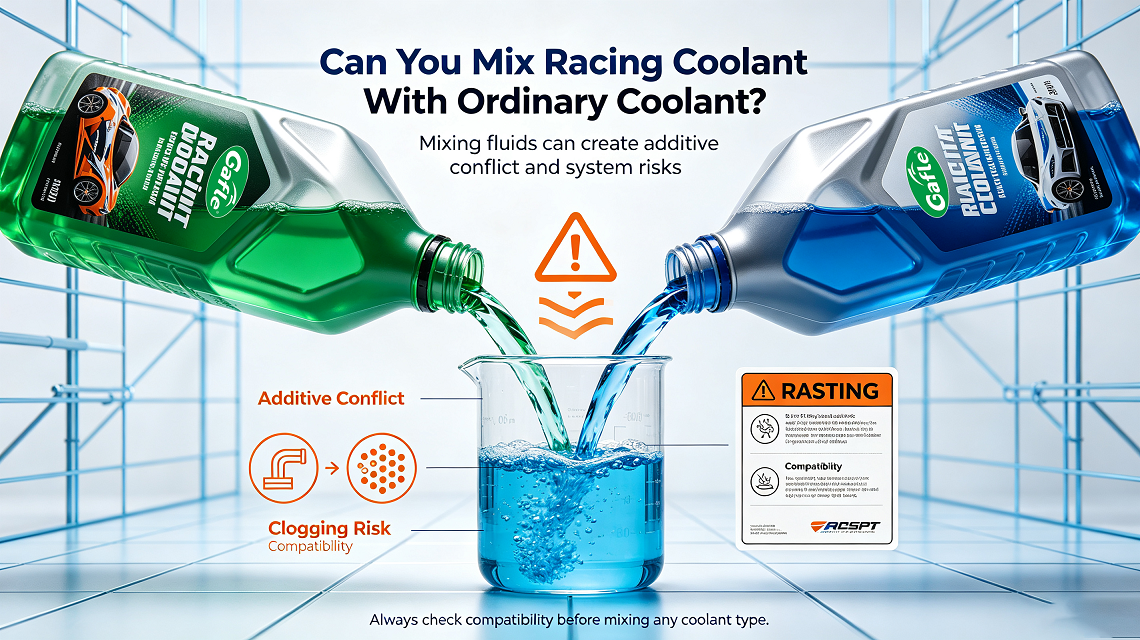
One common mistake is assuming all racing coolant products behave the same. Another is focusing on peak temperature alone instead of the full thermal cycle. Some buyers also ignore the compatibility of the coolant with the rest of the system, especially if they switch away from a conventional street mix. And in a racing context, the simplest error is using a fluid change as a substitute for basic inspection.
A practical aside: if the car is still trapping air after each fill, do not expect chemistry to rescue it. Bleeding the system properly often matters more than choosing a more exotic coolant.
What to Do Before You Upgrade Coolant
Before buying a high boiling point coolant, check the radiator, cap, hoses, pump, ducting, and bleed procedure. Make sure the car has the airflow it needs and that the cooling system is matched to the engine’s output. If you are running in a class or series with fluid restrictions, verify the rulebook first; not every product is appropriate for every sanctioning body.
When coolant choice becomes the final step rather than the first step, results are usually better. You are less likely to chase temperature issues with repeated product changes, and more likely to solve the actual bottleneck.
Practical Takeaway for Race Teams
If you are asking whether a high boiling point coolant is enough for a race engine, treat it as a margin enhancer, not a complete fix. It can help cooling performance, but only when the rest of the system is already doing its job. For persistent race engine overheating, the smartest move is to diagnose airflow, circulation, and heat rejection before blaming the fluid.
If you are spec’ing a race cooling package, start with the cause, not the symptom. That approach saves testing time, protects hardware, and gives you a better chance of finishing the session without seeing the temperature needle climb into dangerous territory.
Welcome to contact GAFLE for more information & cooperation!
peter
ZHEJIANG GAFLE AUTO CHEMICL CO.,LTD
Tel:86-579-8222 1665
Fax:86-579-8246 4690
Cel/Wechart:86-13335993986
E-mail:peter@gafle.net
Web:www.gafle.net