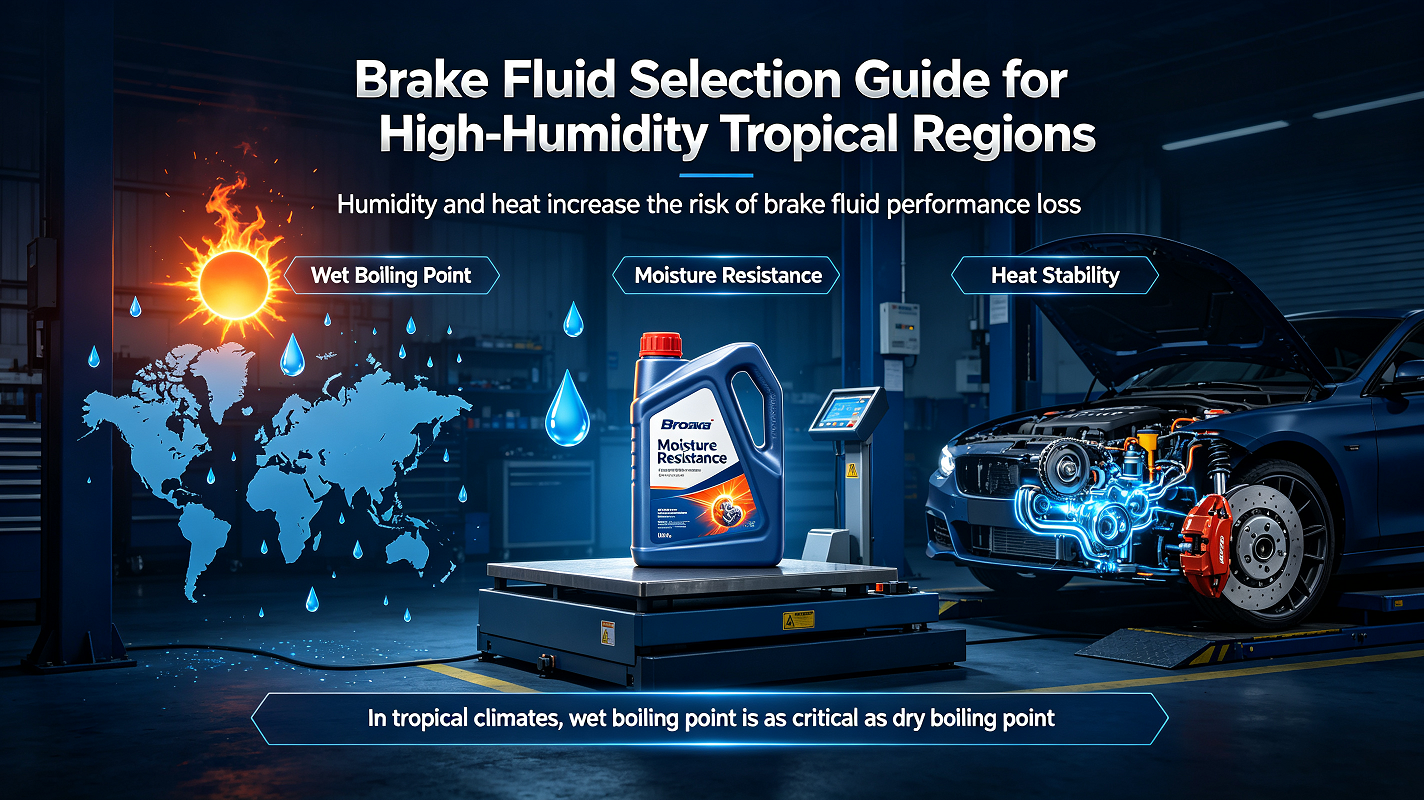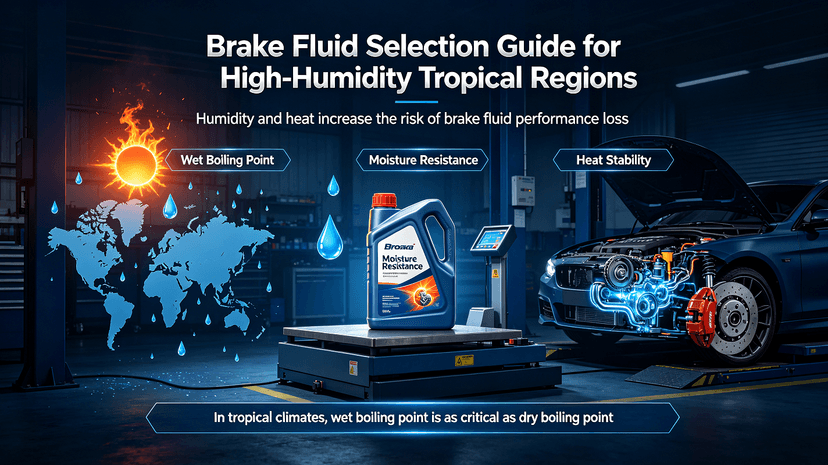
Why tropical climates are harder on brake systems than many buyers expect
is not a niche label for marketing brochures. It speaks to a real operating problem: heat, humidity, and repeated braking load all work against hydraulic performance. In tropical and coastal regions, moisture gets into brake fluid faster, and that matters because brake fluid is hygroscopic by design. It absorbs water over time. Once that happens, the fluid’s boiling point drops, corrosion risk rises, and pedal feel can become less predictable when the system is worked hard.
For engineers, sourcing managers, and maintenance teams, the decision is rarely about choosing a fancy product name. It is about asking whether the fluid can keep a stable wet boiling point, resist moisture-related degradation, and remain dependable in day-to-day service. That is especially important for fleets, motorcycles, light vehicles, and working equipment that live outdoors or move between air-conditioned storage and hot, wet roads.
What humidity changes inside a brake system
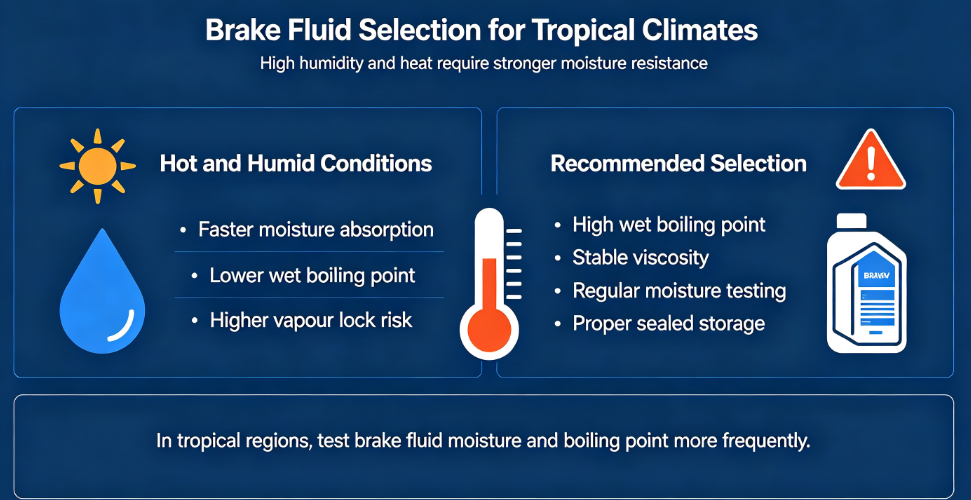
Brake systems are sealed, but they are not perfectly sealed from the world. Venting, service intervals, reservoir caps, hose permeability, and temperature cycling all allow water vapor to enter over time. In a humid climate, that process tends to move faster than in dry regions.
The practical result is straightforward. A fluid that performs acceptably when new may lose margin after service exposure. Under hard braking, that lost margin can translate into vapor formation, which compresses far more than liquid. The driver feels it as a soft pedal or reduced braking confidence. In commercial use, that is not just a maintenance issue; it can become a safety and uptime issue.
That is why buyers often compare a high humidity brake fluid against standard grades rather than assuming all fluids behave the same once installed. The real question is not just whether the fluid meets a specification on paper, but how much reserve it keeps after moisture uptake.
Wet boiling point matters more than many procurement sheets admit
The phrase wet boiling point brake fluid comes up often for good reason. Dry boiling point tells you what a fresh fluid can do in a lab. Wet boiling point tells you what remains after the fluid has absorbed a measured amount of moisture over time. In humid climates, that second number is usually the more practical one.
A buyer reviewing brake fluid for humid weather should think in terms of service life, climate exposure, and operating duty. A passenger car used lightly in a cool garage faces a different risk profile from a delivery van idling through coastal traffic or a machine working on a rainy construction site. The fluid choice should follow the environment, not only the label.
Key selection factors for humid and tropical service
1. Moisture tolerance
Look for fluid chemistry and performance data that address water absorption and retained boiling performance. If that information is missing, treat the product cautiously.
2. Compatibility with the system
Brake fluids are not universal in practice, even when they may appear similar at first glance. Seal materials, OEM requirements, and service history all matter. Mixing incompatible formulations can create bigger problems than the climate itself.
3. Service interval discipline
A strong fluid still degrades if left in service too long. In tropical conditions, maintenance timing is not a suggestion. It is part of the specification.
4. Heat load and vehicle duty
Repeated downhill braking, towing, stop-and-go traffic, and heavy payloads all increase fluid temperature. Combined with humidity, that combination is where weak fluid margins show up first.
Common mistakes buyers make
One common mistake is treating all high-temperature brake fluid claims as equivalent. Another is focusing on dry boiling point while ignoring moisture exposure. A third is assuming storage conditions matter less than operating conditions. In humid markets, storage, transport, and open-container handling can affect fluid quality before it ever reaches the vehicle.
There is also a procurement trap: buying the lowest-cost fluid and planning to compensate with shorter intervals, but then failing to enforce those intervals. That approach usually costs more in the long run, especially when maintenance labor and downtime are counted honestly.
Practical advice for engineers and sourcing teams
If you are building a specification, define the climate, duty cycle, and service interval together. Ask for product data that separates dry and wet performance. Verify that the fluid is appropriate for the vehicle platform and service environment. If the application is consistently hot and humid, the extra reserve in a fluid designed for tropical service is often worth more than a small upfront price difference.
If you are managing a fleet or workshop, train technicians to keep containers closed, avoid contamination, and document fluid replacement intervals carefully. Small handling mistakes can undermine otherwise sound product selection.
FAQ: quick buyer questions
Is tropical brake fluid a different category?
Sometimes it is best understood as a performance requirement rather than a formal category. The important point is moisture resilience and stable braking performance in hot, humid conditions.
Can standard brake fluid work in humid climates?
Yes, if it is compatible and maintained correctly, but the margin may be lower. That is why wet boiling performance deserves attention.
What should I ask a supplier?
Ask about moisture-related performance, system compatibility, and recommended service intervals for humid environments. If those answers are vague, keep looking.
Choosing with the climate in mind
For tropical markets, brake fluid selection is less about finding a dramatic new formula and more about respecting the environment the vehicle actually lives in. Heat and humidity are not background conditions; they are part of the load case. The best choice is the one that preserves braking stability, supports reasonable maintenance intervals, and fits the vehicle system without guesswork.
If you are evaluating tropical brake fluid for a fleet, a workshop program, or a new product specification, build the decision around wet performance and real service conditions first. That is where the risk sits, and that is where the useful answer usually is.
Welcome to contact GAFLE for more information & cooperation!
peter
ZHEJIANG GAFLE AUTO CHEMICL CO.,LTD
Tel:86-579-8222 1665
Fax:86-579-8246 4690
Cel/Wechart:86-13335993986
E-mail:peter@gafle.net
Web:www.gafle.net