Why brake bleeding mistakes matter more than many shops admit
Brake bleeding mistakes are not a minor service inconvenience. In a hydraulic brake system, trapped air changes pedal feel, lengthens stopping distance, and can make a vehicle behave unpredictably under load. For engineers, fleet managers, and service teams, the issue is less about routine maintenance and more about control: getting a consistent, compressible-free fluid column through the lines, calipers, wheel cylinders, and ABS-related passages.
The practical question this article helps answer is simple: where does brake bleeding go wrong, and what should a technician or buyer look for in a reliable brake bleeding process? That matters whether you are setting a workshop procedure, evaluating service quality, or trying to reduce repeat brake complaints after maintenance.
Quick reference: what usually goes wrong
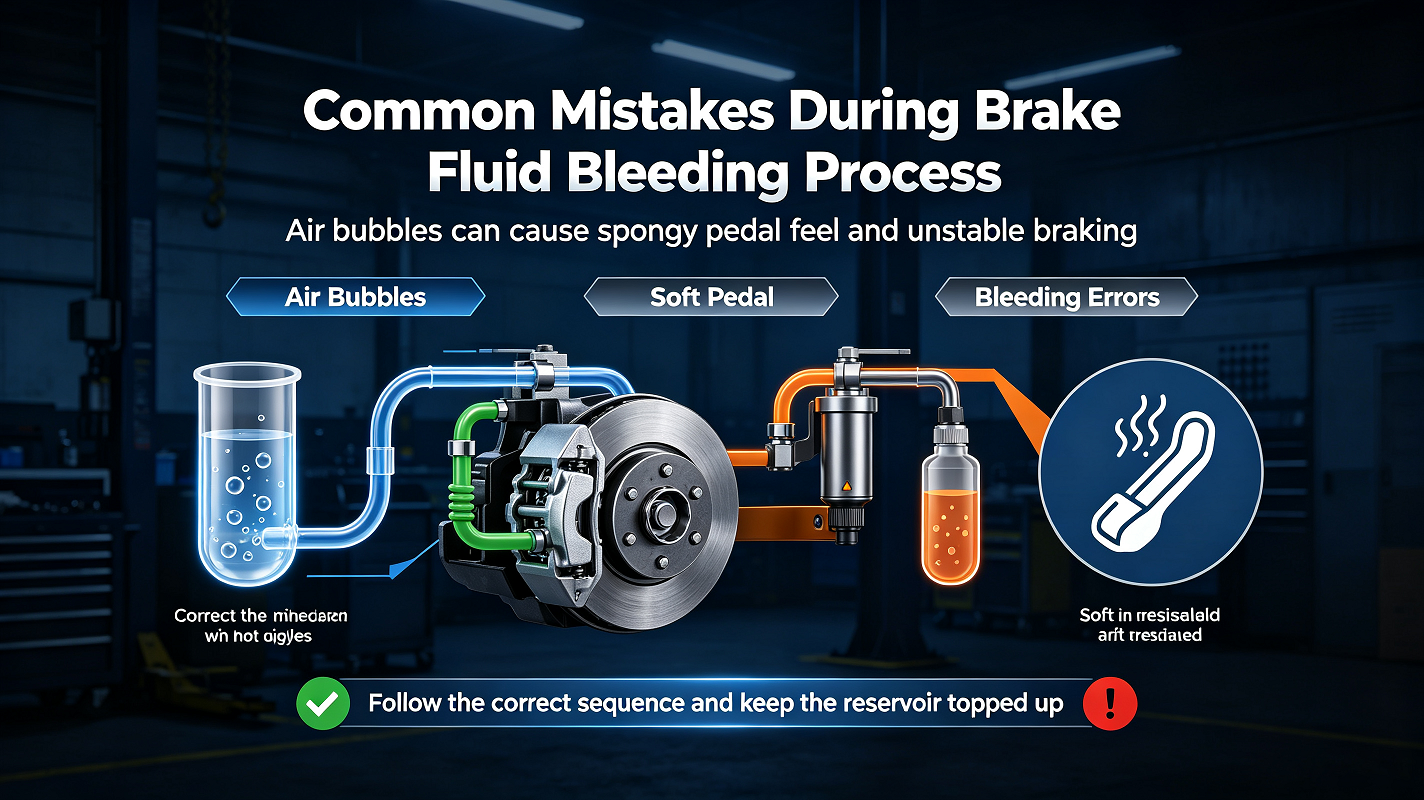
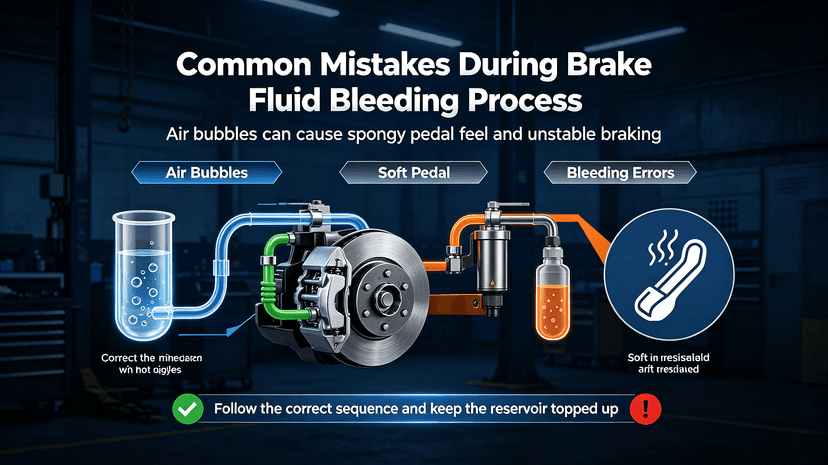
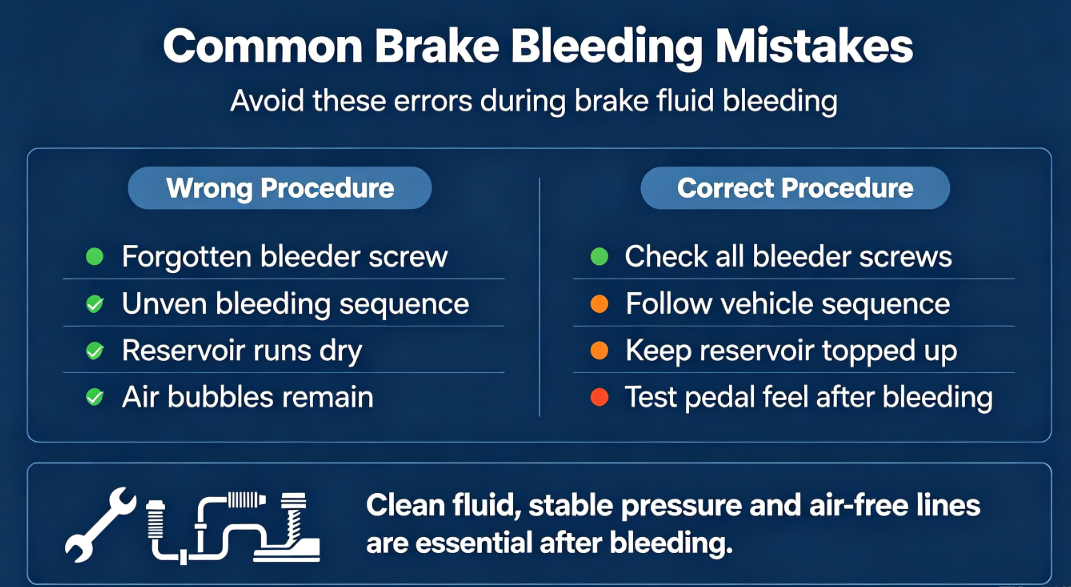
Most common mistakes when bleeding brake fluid fall into a handful of categories: pulling air into the system, using the wrong sequence, letting the reservoir run low, ignoring hose seepage, or not accounting for ABS modules and complex line routing. None of these are dramatic on their own, which is why they get missed. Together, they create the classic symptoms: a spongy pedal, inconsistent bite, or a brake pedal that slowly sinks under pressure.
Problems caused by improper brake bleeding are often mistaken for worn master cylinders, bad calipers, or failing pads. That leads to parts replacement before the root cause has been cleared. A good diagnosis starts with the fluid path, not the symptom at the pedal.
How air sneaks in during brake system bleeding
How to avoid air bubbles during brake bleeding is mostly a process-control question. Air enters when the reservoir is allowed to uncover the ports, when fittings are not sealed properly, or when the bleeder screw is opened and closed in a way that draws fluid back instead of expelling it. Even a small bubble can compress enough to change pedal travel noticeably.
In practice, the risk rises when one technician works alone, especially with a manual pedal-pumping method. If the pedal is released too quickly or a bleeder hose end sits above the fluid level in the catch bottle, the system can pull air back into the line. That is one reason pressure and vacuum methods are often preferred in busy shops: they can be more controlled, though they still depend on correct setup.
Common mistakes when bleeding brake fluid
Skipping the bleed sequence
Brake system bleeding usually needs a specific wheel order, often starting with the wheel farthest from the master cylinder and moving inward, though the exact sequence can vary by vehicle architecture. On some modern systems, the ABS unit or diagonal split layout changes the logic. Guessing here is a fast route to repeat bleeding.
Letting the reservoir run dry
This is a basic failure, but it remains common. Once the reservoir runs low, fresh air can enter the master cylinder and line network. At that point, the job expands from a corner bleed to a much larger purge operation. It is the kind of mistake that turns a routine brake bleeding guide into a half-day repair.
Overlooking hose and fitting leaks
Sometimes the system itself is fine, but the service setup is not. Loose hose connections, worn bleeder threads, cracked catch hoses, or poor seal quality can mimic system failure. A technician chasing a soft pedal may keep bleeding the brakes when the real issue is the setup tool or adapter.
Process habits that reduce repeat work
For shops and engineering teams, the best defense is a repeatable process. Use clean fluid from a sealed container. Keep the reservoir covered. Confirm bleed order against the specific vehicle architecture. Watch the fluid color and bubble stream, but do not assume clear fluid means the system is finished. A line can look clean while a pocket of air remains in a high point or an ABS cavity.
Also, be cautious after component replacement. Calipers, flex hoses, master cylinders, and proportioning components may all hold air differently. A vehicle that feels acceptable on the lift can still show a long pedal after road loading. That is not unusual, just inconvenient.
Buyer-facing advice for workshops and fleet operators
If you are sourcing brake service capability rather than performing the work yourself, ask how the shop handles brake bleeding mistakes as a matter of procedure. Do they verify reservoir level continuously? Do they have a method for ABS-equipped vehicles? Do they road-test for pedal consistency after bleeding, not just in the bay? Those questions tell you more than a generic promise of “full brake service.”
For fleet maintenance, the cost of a poor bleed is rarely limited to one vehicle. A soft pedal complaint can send a unit back into service, trigger downtime, and create uncertainty around maintenance quality. That is why a controlled brake bleeding process is worth treating as a quality step, not a quick add-on.
FAQ: practical questions buyers and technicians ask
What are the first signs of a bad bleed?
A soft or spongy pedal, longer pedal travel, delayed brake response, or a pedal that improves temporarily and then changes again under repeated use.
Can a vehicle still stop after improper bleeding?
Sometimes, yes. That is exactly why the problem is dangerous. Partial braking performance can hide the fault until panic stops, downhill driving, or loaded operation expose it.
Is re-bleeding always necessary after any brake repair?
Not every repair requires full system bleeding, but any time a hydraulic circuit is opened, air management becomes part of the job. Skipping that step is where many problems begin.
A practical next step
If your goal is fewer comebacks, standardize the brake bleeding guide you use in-house, document the sequence for the vehicle types you service, and inspect the setup tools as carefully as the brake components themselves. Most brake bleeding mistakes are preventable, but only if the process is treated as a controlled operation rather than a habit.
Welcome to contact GAFLE for more information & cooperation!
peter
ZHEJIANG GAFLE AUTO CHEMICL CO.,LTD
Tel:86-579-8222 1665
Fax:86-579-8246 4690
Cel/Wechart:86-13335993986
E-mail:peter@gafle.net
Web:www.gafle.net