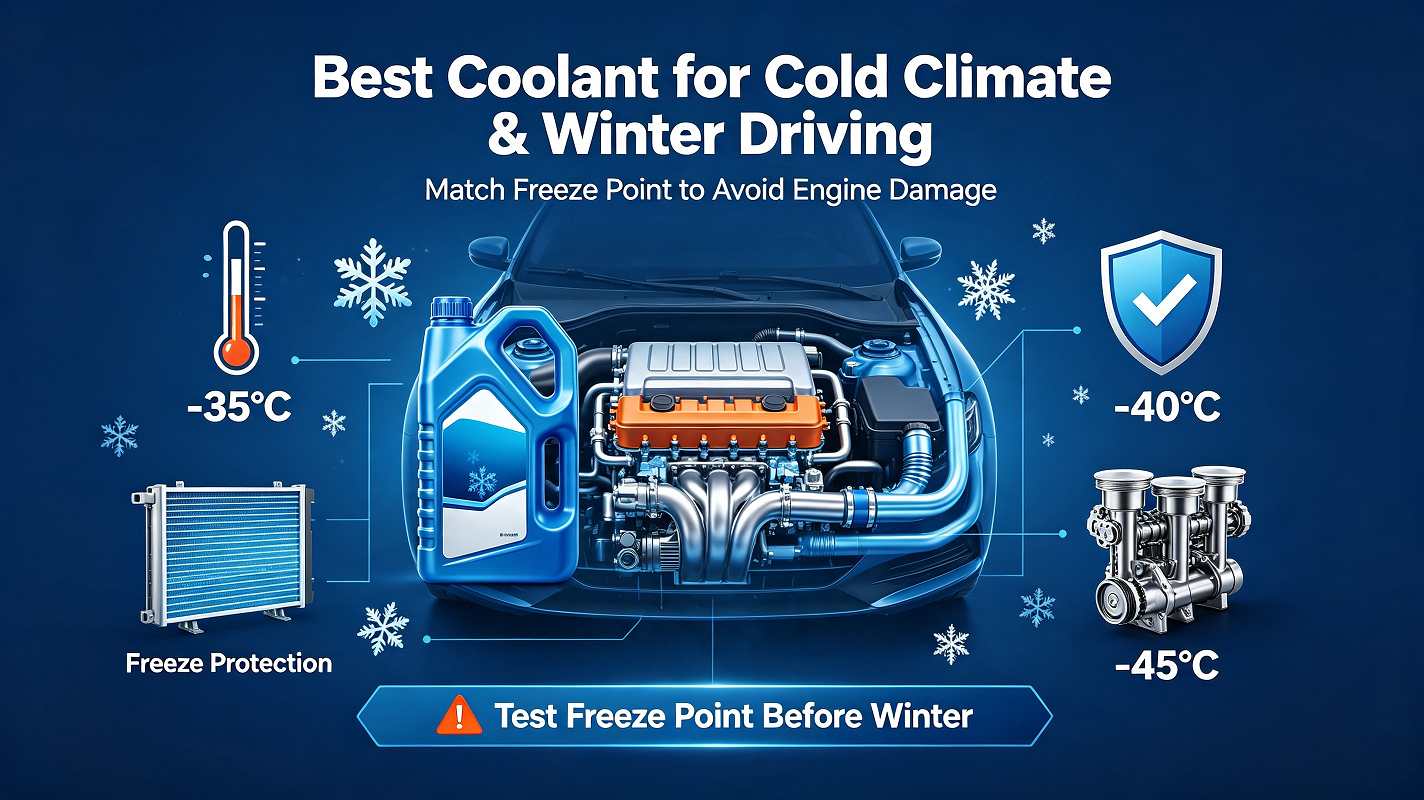
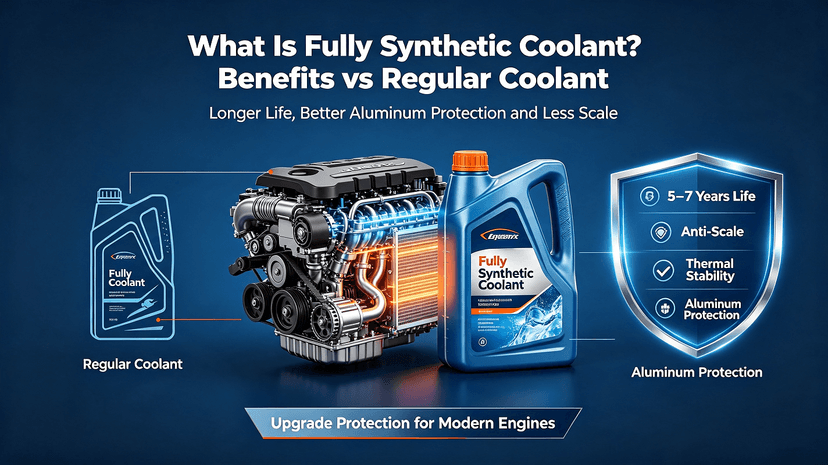
Most buyers and garage owners confuse regular coolant with fully synthetic coolant. Many think all colored antifreeze is the same, but formula technology determines service life, protection level and engine compatibility. Fully synthetic coolant has become the mainstream for modern cars, new trucks and fleet vehicles, while traditional coolant is gradually phased out in the aftermarket.
What Is Fully Synthetic Coolant?
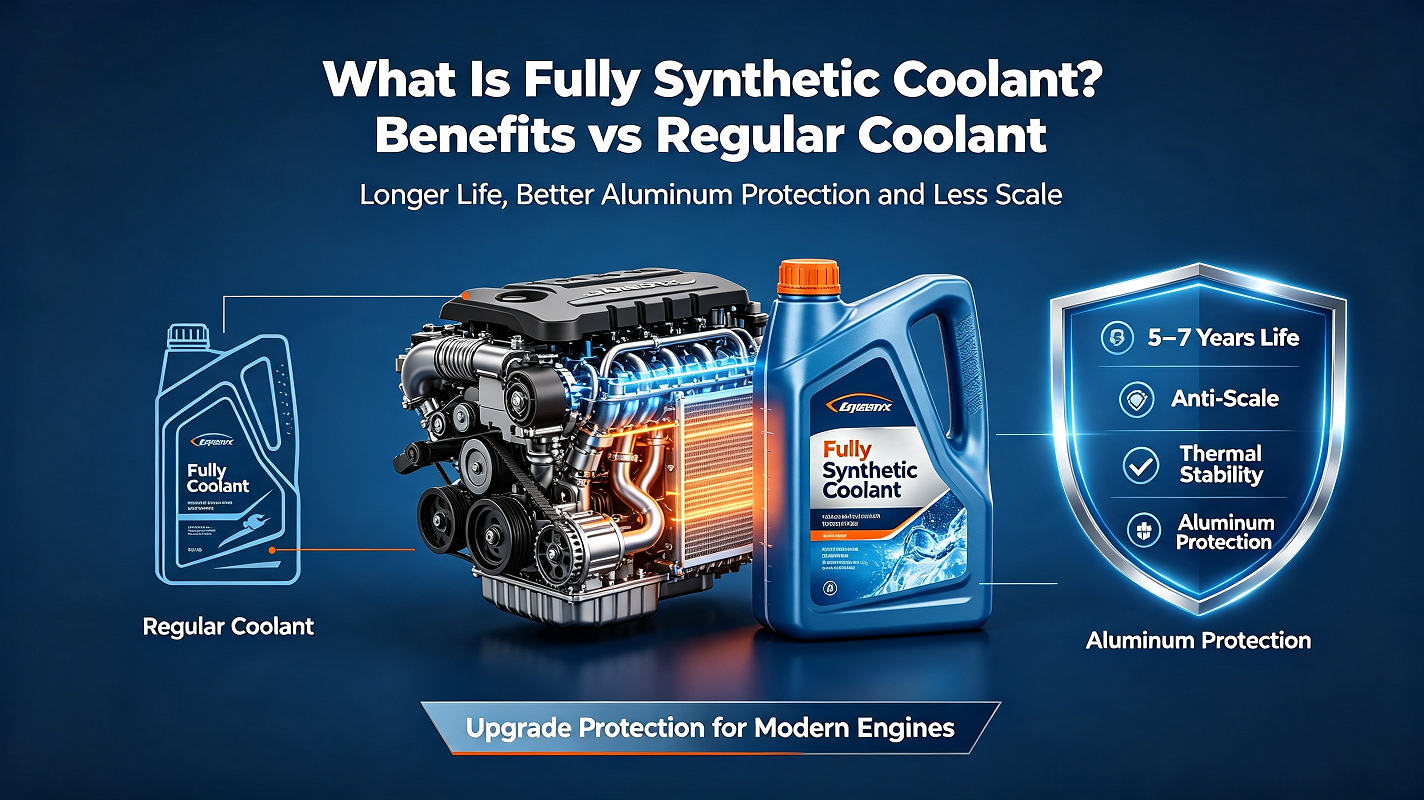
Fully synthetic coolant belongs to the OAT (Organic Acid Technology) family. It uses pure organic acid corrosion inhibitors without silicate, phosphate or amine additives. The formula is chemically stable, non-depositing and long-lasting.
Fully synthetic coolant is pre-mixed or concentrated glycol-based fluid designed for modern aluminum-intensive engines, turbocharged vehicles and high-load cooling systems. It delivers consistent all-season protection without the common drawbacks of traditional inorganic coolant.
Fully Synthetic Coolant vs Regular Conventional Coolant
1. Massive difference in service lifespan
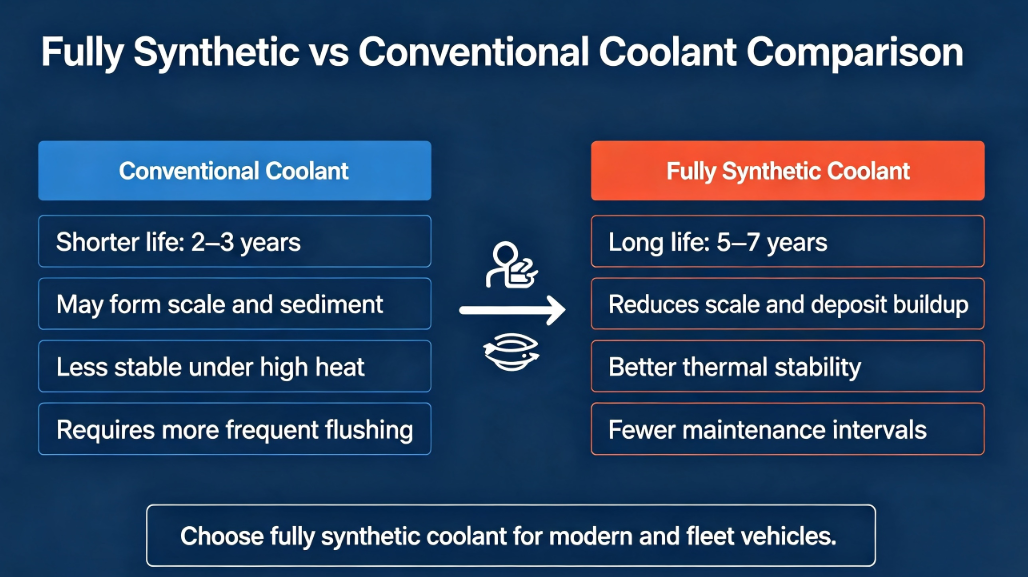
This is the most obvious advantage for both individual drivers and fleet operators. Traditional IAT conventional coolant requires replacement every 2–3 years or 40,000–60,000 km. In contrast, high-quality fully synthetic OAT coolant supports 5–7 years or 240,000 km of service. It drastically reduces maintenance frequency, saves workshop labor costs and lowers vehicle downtime for commercial fleets.
2. Zero scale and sediment buildup
Traditional inorganic coolant contains unstable mineral additives that easily produce scale, sticky deposits and silicate gel after repeated high-temperature circulation. These residues block radiators, narrow cooling channels and reduce heat dissipation efficiency. Fully synthetic formula features stable organic components that avoid scaling and sediment formation, keeping the entire cooling system clean for years.
3. Excellent high-temperature thermal stability
Modern turbocharged and high-power engines generate extreme heat during operation. Regular coolant tends to decompose and lose protective performance under sustained high temperatures, causing boil-over and engine overheating. Fully synthetic coolant resists thermal degradation, maintaining stable heat transfer and anti-corrosion performance even under heavy loads and hot climate conditions.
4. Advanced aluminum alloy protection
New-generation vehicle engines adopt a large number of lightweight aluminum parts, including cylinder heads, radiators and water pump assemblies. Ordinary coolant causes gradual electrochemical corrosion on aluminum surfaces. Fully synthetic organic acid formulas provide targeted, long-term anti-corrosion protection for aluminum components, extending the service life of core cooling system parts.
Is Fully Synthetic Coolant Universal for All Vehicles?
Fully synthetic OAT coolant is highly compatible with 95% of modern gasoline cars, diesel trucks, turbo vehicles and new energy fleet models. It is the most suitable upgrade for post-2010 vehicles.
For extremely old vintage cars and antique machinery originally equipped with traditional IAT coolant, a gradual transition with HOAT hybrid coolant is recommended to avoid minor seal adaptation issues. Overall, fully synthetic coolant remains the safest and most cost-effective option for most market scenarios.
Common Market Misconception
Many end users assume that if a vehicle runs normally, regular coolant is sufficient. In fact, traditional coolant causes invisible micro-corrosion and scale accumulation over time, slowly damaging the cooling system. Fully synthetic coolant eliminates these hidden risks, providing long
B2B Wholesale & Garage Core Selling Points
For global distributors and repair shops, fully synthetic coolant has obvious market advantages: longer service life attracts end customers, stable formula minimizes after-sales complaints, wide vehicle compatibility simplifies inventory management, and higher product grade brings better profit margins.
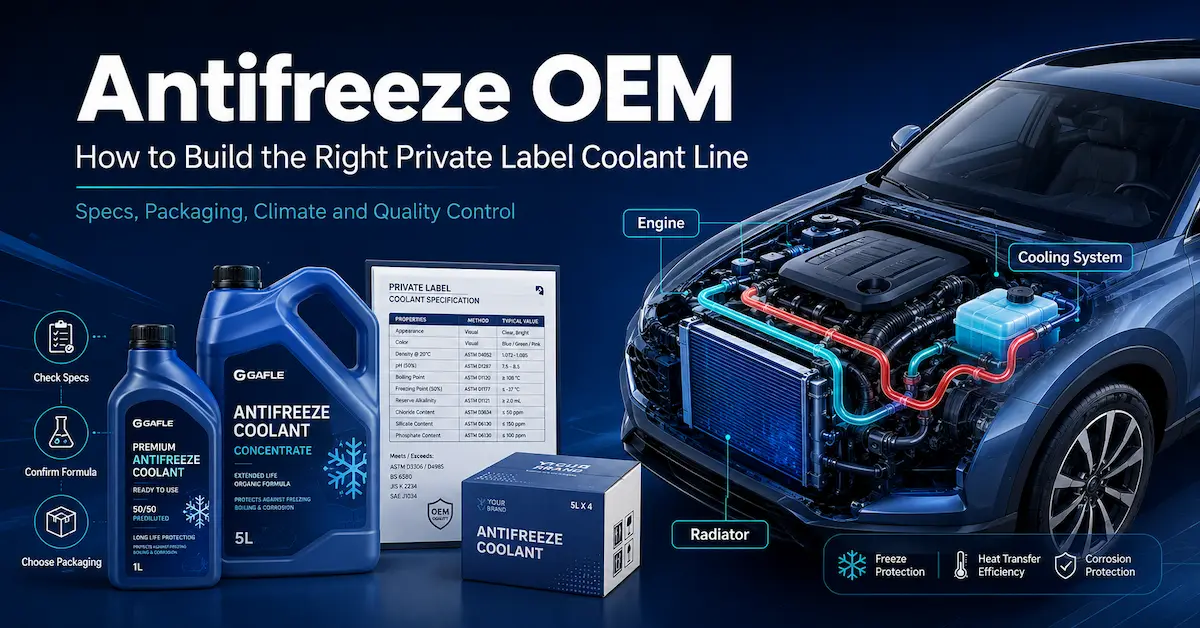
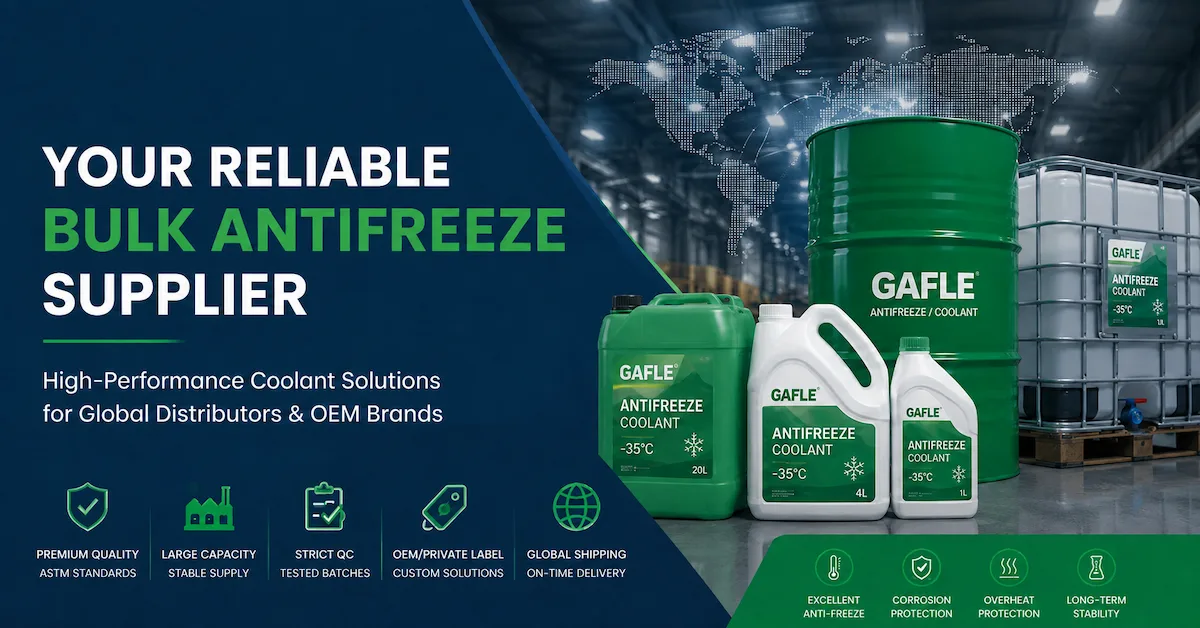
GAFLE fully synthetic OAT coolant provides professional all-season protection with anti-scale, anti-corrosion, anti-freeze and anti-boil performance. We support global bulk wholesale, OEM and private label customization, with complete TDS and MSDS technical documents for all products.
Welcome to contact GAFLE for more information & cooperation!
peter
ZHEJIANG GAFLE AUTO CHEMICL CO.,LTD
Tel:86-579-8222 1665
Fax:86-579-8246 4690
Cel/Wechart:86-13335993986
E-mail:peter@gafle.net
Web:www.gafle.net