What Does Antifreeze OEM Mean for B2B Buyers?
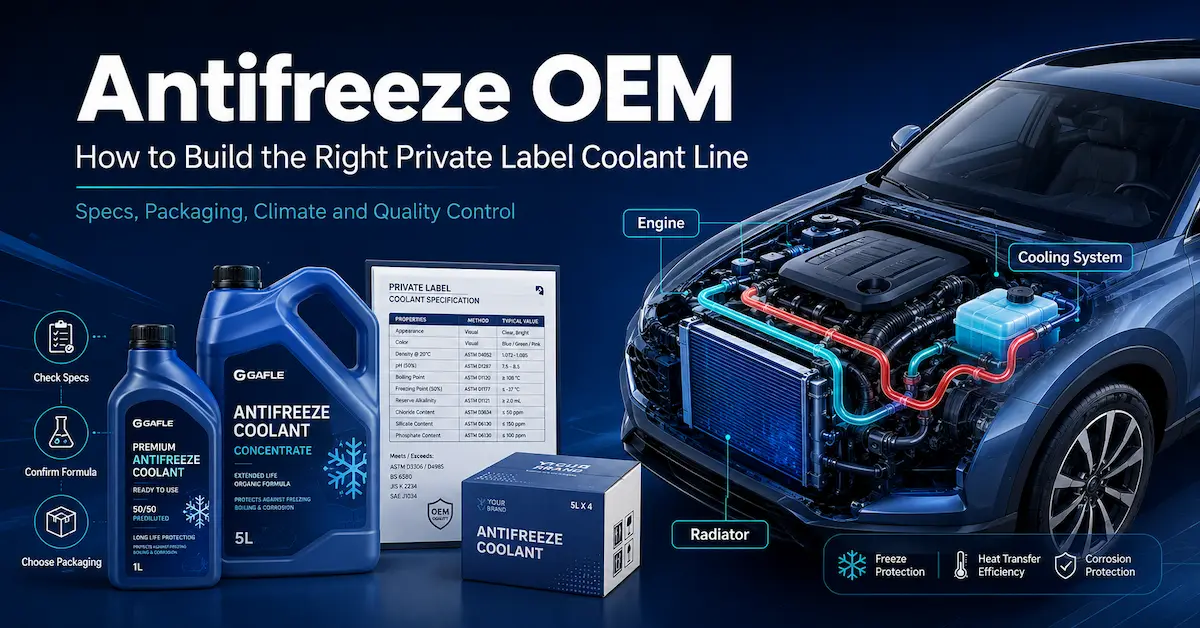
Antifreeze OEM is a manufacturing model in which a coolant producer manufactures antifreeze or engine coolant according to an agreed product specification and supplies it under the buyer's brand, packaging, or market requirements.
For automotive chemical distributors, importers, auto-parts brands, workshop suppliers, and fleet-service companies, OEM cooperation can provide much more control than simply purchasing an existing retail product.
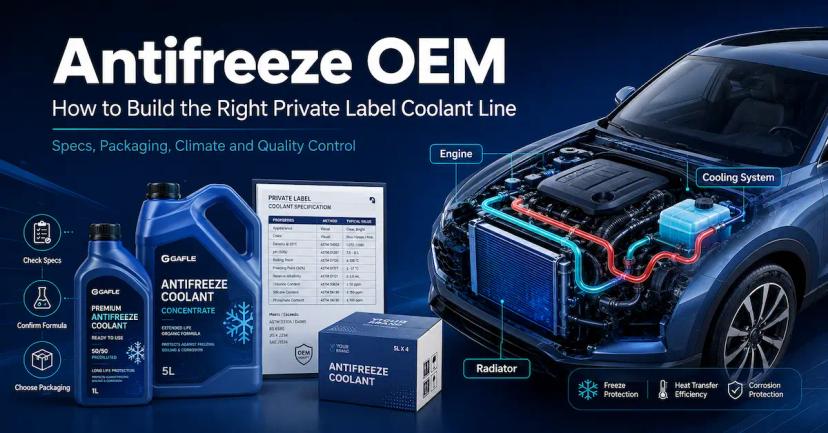
Depending on the project, an OEM antifreeze program may involve:
- Coolant specification selection
- Concentrate or prediluted formulation
- Coolant technology selection
- Target freeze-protection level
- Product color
- Bottle and cap configuration
- Label and carton design
- Local-language packaging
- Private-label branding
- Technical and safety documentation
- Export packaging requirements
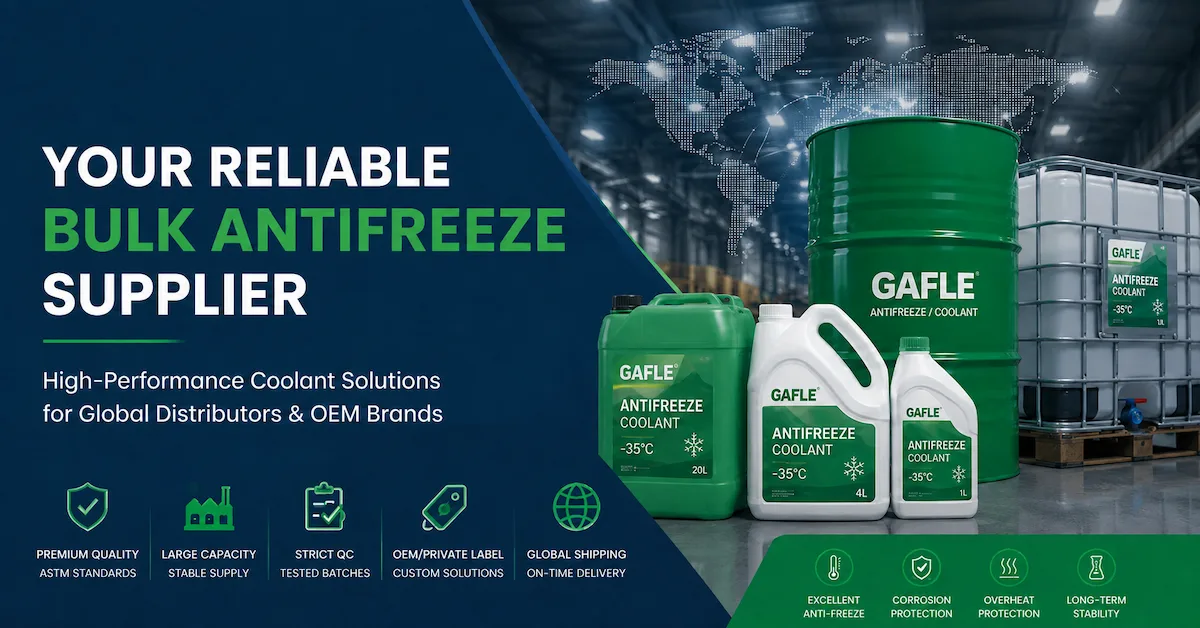
GAFLE currently lists OEM as a dedicated option within its Antifreeze/Coolant product range, alongside conventional coolant, energy-vehicle coolant, energy-storage battery thermal-management coolant, and non-contact liquid-cooling products.
For buyers planning a new product line, the key question is therefore not simply:
“Can you put our logo on antifreeze?”
A more useful question is:
“Can the manufacturer deliver the correct coolant specification, repeat it consistently, document it properly, and package it for our market?”
That distinction determines whether an OEM coolant project becomes a scalable product line or a recurring sourcing problem.
Who Should Consider an Antifreeze OEM Program?
Antifreeze OEM is especially relevant to companies that already have customers but do not want to build their own coolant production facility.
Automotive Chemical Distributors
Regional distributors may already sell brake fluid, lubricants, washer fluid, refrigerants, and other automotive chemicals.
Adding a private-label coolant line can allow them to offer a more complete portfolio while controlling:
- Product positioning
- Pack sizes
- Brand identity
- Distributor margin
- Market territory
- Reorder planning
Auto Parts and Lubricant Brands
A company selling engine oil, transmission fluid, filters, brake parts, or maintenance chemicals can use coolant OEM manufacturing to extend its existing brand.
This customer group usually values consistency between the new antifreeze line and its existing packaging, price tier, and dealer network.
Importers and National Wholesalers
Importers typically need more than a formula.
They may also require:
- Product documentation
- Local-language labels
- Shipping marks
- Carton specifications
- Batch identification
- Stable repeat supply
- Market-specific product positioning
For these buyers, OEM supplier evaluation should combine technical performance with export and production capability.
Fleet and Heavy-Duty Supply Companies
Companies supplying truck fleets, construction machinery, mining equipment, buses, agricultural machinery, or commercial workshops may need products designed around a particular service environment rather than a generic passenger-car coolant.
ASTM distinguishes coolant requirements for light-duty and heavy-duty applications. ASTM D3306 addresses glycol-base engine coolants for automobile and light-duty cooling systems, while ASTM D6210 addresses fully formulated glycol-base coolants for heavy-duty engine cooling systems.
Who May Not Need OEM Antifreeze?
OEM manufacturing may be unnecessary for:
- Buyers needing only small quantities of retail coolant
- Companies without their own distribution channel
- Buyers who do not yet know their target vehicle application
- Projects where the brand has no defined specification or packaging direction
- One-time purchases where standard branded products already meet the requirement
In these cases, starting with an existing product may be more practical before committing to a private-label program.
OEM Antifreeze vs Private Label Antifreeze
The terms OEM antifreeze and private label antifreeze are often used interchangeably in the automotive aftermarket, but the commercial scope can differ.
| Cooperation Model | Typical Approach | Customization Level | Best For |
|---|---|---|---|
| Standard branded coolant | Manufacturer's existing brand and specification | Low | Small distributors and workshops |
| Private label coolant | Established product with buyer's branding | Medium | Distributors launching quickly |
| Antifreeze OEM | Product and packaging configured around agreed buyer requirements | Medium to high | Established importers and automotive brands |
| Customized coolant development | More application-specific formulation and validation | High | Specialized markets and technical projects |
The exact terminology varies between suppliers.
Therefore, buyers should define what they actually want customized rather than relying only on the word “OEM.”
GAFLE's published coolant information states that OEM/private-label projects can include customized formula, color, packaging, labels, cartons, and export support.
Start the OEM Project With the Target Application
A common sourcing mistake is designing the bottle before defining the coolant.
For an Antifreeze OEM project, application requirements should come first.
Passenger Cars and Light-Duty Vehicles
For markets using ASTM requirements, ASTM D3306 covers glycol-base coolant used in automobiles and other light-duty cooling systems.
The specification recognizes both concentrates and prediluted coolant categories and includes ethylene-glycol- and propylene-glycol-based product types.
An OEM buyer should clarify:
- Target vehicle population
- Concentrate or premix
- Required OEM specifications
- Target climate
- Required coolant technology
- Packaging channel
- Local service practices
Heavy-Duty Vehicles and Equipment
Truck, construction, mining, agricultural, and other heavy-duty applications may require a different coolant specification.
ASTM D6210 covers fully formulated glycol-base coolant for heavy-duty engines and addresses protection against corrosion, cavitation, freezing, and boiling under the conditions defined by the standard.
This means a buyer supplying commercial diesel fleets should not automatically select a product merely because it performs well in passenger vehicles.
Climate-Specific Markets
An antifreeze OEM supplier should also understand where the product will be sold.
Typical questions include:
- What is the expected winter temperature?
- Is the product sold as concentrate or ready-to-use coolant?
- Is the target market tropical, temperate, or cold?
- Are vehicles mainly passenger cars or commercial vehicles?
- Does the market expect a particular coolant technology or OEM approval?
GAFLE currently publishes coolant options with different freeze-protection targets and supports project-specific product and packaging customization.
The final product specification should nevertheless be confirmed for the individual OEM project rather than inferred from another product.
Define the Technical Specification Before Requesting a Price
A message such as:
“Please quote OEM antifreeze.”
is not enough for a meaningful B2B quotation.
A stronger RFQ defines the product before negotiating cost.
Antifreeze OEM Specification Checklist
| Item | Information to Confirm |
| Target market | Country or region |
| Application | Passenger car, truck, fleet, equipment, etc. |
| Coolant format | Concentrate or prediluted |
| Base chemistry | Confirm according to project requirement |
| Coolant technology | IAT, OAT, HOAT or application-specific type |
| Freeze protection | Define according to climate and specification |
| Required standard | ASTM, OEM or local requirement |
| Product color | Standard or customized if applicable |
| Packaging | Retail bottle, service pack, drum or bulk format |
| Label language | Local-market requirement |
| Branding | OEM/private label requirements |
| Documents | TDS, SDS/MSDS, COA or other required files |
| Order volume | Trial quantity and projected annual demand |
| Destination | Country, port or delivery location |
A complete RFQ helps the manufacturer recommend the correct product and gives the buyer a fair basis for comparing quotations.
Concentrate or Ready-to-Use Coolant?
This is one of the most important OEM decisions.
Concentrated Antifreeze
Concentrate can provide greater flexibility for professional distributors or controlled blending operations.
Advantages may include:
- Flexible final concentration
- Different climate positioning
- Potentially lower transported liquid volume
- Professional workshop positioning
However, correct dilution and suitable water quality become part of the downstream process.
ASTM D6210, for example, specifies performance conditions involving defined glycol concentrations in water of suitable quality for heavy-duty coolant concentrates.
Prediluted Coolant
Prediluted coolant is prepared for direct application according to its intended specification.
It can be attractive to:
- Repair-shop networks
- Retail channels
- Fleet workshops
- Automotive parts distributors
- Consumers purchasing ready-to-use coolant
Its main operational benefit is greater control over the final factory-prepared mixture.
Which Is Better for OEM Buyers?
Neither format is automatically better.
The correct choice depends on:
distribution model + application + climate + logistics + customer capability
An experienced importer with controlled downstream blending requirements may prefer concentrate, while a retail or workshop brand may prefer ready-to-use coolant for greater convenience and consistency.
Coolant Chemistry Should Match the Market
Another important OEM decision is coolant technology.
Common terminology includes:
- IAT
- OAT
- HOAT
These technologies use different corrosion-inhibitor strategies and should not be selected solely by coolant color.
For private-label buyers, the priority should be compatibility with the target vehicles, technical requirements, and intended service conditions.
A red, green, blue, purple, or yellow coolant does not automatically identify its complete chemistry or prove vehicle compatibility.
Therefore:
Do not build an OEM antifreeze specification around color alone.
Color should be treated as a product-identification and branding variable after technical compatibility has been established.
What Can Be Customized in an Antifreeze OEM Project?
One of the major commercial advantages of OEM manufacturing is the ability to align the coolant with the buyer's market strategy.
Product Specification
Depending on project feasibility, buyers can discuss:
- Coolant type
- Concentration
- Freeze-protection target
- Application category
- Product color
- Market-specific technical requirements
GAFLE's published antifreeze content states that OEM and private-label programs can include formula and color customization.
Bottle and Packaging
Packaging should match the customer's sales channel.
A retail auto-parts store, professional workshop, fleet service company, and industrial distributor do not necessarily need the same package.
OEM discussions can cover:
- Bottle capacity
- Bottle shape
- Cap
- Label
- Outer carton
- Workshop packaging
- Bulk supply format
- Pallet and shipping configuration
GAFLE's current 5L coolant information specifically references customization of formula, color, bottle, cap, label, carton, and packaging language.
Private Label Design
Private-label projects may also require:
- Brand logo
- Product family design
- Color system
- Multilingual label content
- Product instructions
- Carton artwork
- Barcode or product identification
- Market-specific information
The artwork process should not be left until production is ready.
Technical content, safety information, legal labeling, brand appearance, and carton details should be approved before mass production.
Antifreeze OEM Quality Control: What Buyers Should Verify
A successful sample is only the beginning.
The more important question for a long-term OEM buyer is:
Can the manufacturer reproduce the approved specification batch after batch?
Raw Material Control
Ask how incoming materials are:
- Qualified
- Identified
- Stored
- Released for production
- Traceable to production batches
Raw-material consistency is an important foundation for finished-product consistency.
Production Control
Buyers should understand:
- Formula control
- Mixing procedures
- Production records
- Filling control
- Packaging inspection
- Batch identification
GAFLE's corporate information states that the company manufactures automotive chemicals and reports annual production capacity exceeding 80,000 tons across all product lines.
This figure refers to the company's overall product portfolio, not antifreeze alone.
Laboratory Verification
The testing plan should be matched to the coolant specification rather than reduced to a single freezing-point test.
Depending on the agreed standard and application, relevant evaluation may include:
- Freezing performance
- Physical and chemical properties
- Corrosion protection
- Foaming behavior
- pH
- Compatibility
- Cavitation-related performance for applicable heavy-duty coolant
- Simulated cooling-system performance
ASTM D2570, for example, is a laboratory method designed to evaluate the effect of circulating engine coolant on metal specimens and cooling-system components under controlled conditions.
The buyer should specify which test reports or acceptance criteria are required for the actual SKU.
Certifications Are Important, but They Do Not Replace Product Validation
Supplier certifications are useful when evaluating manufacturing capability.
According to GAFLE's current corporate information, the company's manufacturing facility holds:
- IATF 16949
- ISO 9001
- ISO 14001
- ISO 45001
GAFLE also states that it serves more than 90 international brands through OEM services.
These credentials strengthen supplier qualification, but procurement teams should still verify:
- The exact product specification
- Relevant test documents
- Packaging requirements
- Sample approval
- Batch requirements
- Market compliance
A factory certification is not a substitute for checking whether a specific coolant is suitable for a particular vehicle or application.
A Practical Antifreeze OEM Development Process
A structured process reduces revisions, delays, and specification mistakes.
Step 1: Target Market Analysis
Define:
- Country
- Climate
- Vehicle types
- Distribution channel
- Target customer
- Price positioning
Step 2: Product Requirement Confirmation
Determine:
- Light-duty or heavy-duty
- Concentrate or prediluted
- Coolant technology
- Required standard
- Target freeze protection
- Technical documentation
Step 3: Formula or Product Selection
The manufacturer matches an existing product or develops an appropriate OEM solution based on the agreed requirement.
Step 4: Sample Preparation
Samples should represent the intended commercial product as closely as possible.
Buyers can review:
- Appearance
- Color
- Product specification
- Packaging concept
- Label information
Step 5: Technical Verification
Samples should be evaluated against the agreed specification.
Where third-party or specific standardized testing is required, this should be defined before production approval.
Step 6: Packaging Development
Finalize:
- Bottle
- Cap
- Label
- Carton
- Brand graphics
- Language
- Product information
Step 7: Commercial Confirmation
Confirm:
- Order quantity
- Packaging quantities
- Production arrangement
- Payment terms
- Shipping terms
- Required documents
GAFLE does not publish one universal OEM MOQ or lead time for every antifreeze configuration. Those conditions should therefore be confirmed for the specific formula, packaging, and order rather than assumed from another project.
Step 8: Mass Production and Batch QC
Production should follow the approved specification and packaging artwork.
The buyer should agree in advance on the documents and acceptance requirements needed for shipment.
Step 9: Export and Reorder Planning
For distributors, the project should not stop with the first container.
Discuss:
- Annual purchasing forecast
- Reorder frequency
- Seasonal demand
- Packaging inventory
- Market expansion
- Additional coolant SKUs
This turns a one-off private-label order into a scalable supply program.
How MOQ and Cost Are Determined in Antifreeze OEM
OEM pricing is influenced by more than liquid cost.
Typical cost drivers include:
- Coolant specification
- Concentrate vs premix
- Raw-material system
- Required testing
- Bottle type
- Customized cap
- Label quantity
- Carton printing
- Number of SKUs
- Order quantity
- Export packaging
- Destination
- Documentation requirements
The same applies to MOQ.
A standard product using an existing bottle and simple label will normally involve a different production setup from a fully customized formula, bottle, carton, and multilingual product line.
For that reason, professional buyers should ask for:
MOQ by final SKU and packaging configuration
rather than asking only:
“What is your lowest MOQ?”
Main Risks in an Antifreeze OEM Project
Risk 1: Choosing Coolant by Color
Problem: Color is treated as the main compatibility criterion.
Better approach: Confirm chemistry, application, technical specification, and vehicle requirements first.
Risk 2: Using One Formula for Every Market
Problem: A product selected for one climate or vehicle population is exported everywhere.
Better approach: Segment product specifications by target market where necessary.
Risk 3: Comparing Suppliers Only by Price
Problem: Quotations may represent different formulas, packaging, standards, and quality requirements.
Better approach: Issue the same RFQ specification to each supplier.
Risk 4: Approving Artwork Before Technical Requirements
Problem: Packaging is completed before the coolant specification is finalized.
Better approach: Approve product specification first, then finalize label claims and packaging.
Risk 5: Ignoring Repeat-Batch Consistency
Problem: The buyer validates only the first sample.
Better approach: Define batch records, test documentation, and acceptance requirements for repeat orders.
Risk 6: Claiming Standards Without Verification
Problem: Product labels or marketing materials use standards that have not been confirmed for the specific SKU.
Better approach: Request supporting documentation before printing compliance claims.
How to Compare Antifreeze OEM Manufacturers
A useful supplier comparison should cover both technical and commercial capability.
| Evaluation Area | Questions to Ask |
| Application knowledge | Does the supplier understand your vehicles and market? |
| Product range | Can it support light-duty, heavy-duty or specialized coolant requirements? |
| Standards | Can the required performance specification be documented? |
| QC | How are raw materials, production and final batches controlled? |
| OEM flexibility | Can formula, color, packaging and labels be configured? |
| Documentation | Can required TDS, SDS/MSDS and related files be supplied? |
| Manufacturing capability | Can repeat orders be produced consistently? |
| Packaging | Are retail, workshop and bulk formats available? |
| Export support | Can the supplier support international B2B shipments? |
| Communication | Are specifications and revisions documented clearly? |
Price should be evaluated after these questions are answered.
Why Work With GAFLE for Antifreeze OEM?
Zhejiang Gafle Auto Chemical Co., Ltd. positions its business around research, development, and manufacturing of automotive chemicals, including engine coolant and antifreeze.
Its current corporate information reports:
- More than 80,000 tons annual capacity across all product lines
- OEM service for more than 90 international brands
- IATF 16949
- ISO 9001
- ISO 14001
- ISO 45001
For coolant buyers, GAFLE's Antifreeze/Coolant portfolio also extends beyond conventional engine coolant into EV and thermal-management categories.
This is relevant to distributors that want to build a wider coolant product matrix rather than source a single conventional antifreeze SKU.
Buyers comparing broader sourcing options can also review the Bulk Antifreeze Supplier Guide and GAFLE's complete automotive product portfolio.
What Information Should You Send for an Antifreeze OEM Quote?
Providing a structured inquiry can significantly reduce back-and-forth communication.
Send:
- Destination country
- Vehicle or equipment application
- Required standard or OEM specification
- Concentrate or premix requirement
- Desired freeze-protection level
- Preferred coolant technology, if already defined
- Bottle or bulk packaging requirement
- Estimated order quantity
- Private-label artwork requirements
- Required label language
- Technical documents required
- Target delivery schedule
If some of these items are not yet known, provide your target market and application first so the manufacturer can help narrow the product selection.
You can review GAFLE's About Us information and Download Center before discussing the project.
FAQ About Antifreeze OEM
1. What is Antifreeze OEM?
Antifreeze OEM generally means a manufacturer produces coolant according to agreed buyer requirements and supplies it using the customer's branding, packaging, or product specification.
2. Can GAFLE provide private-label antifreeze?
Yes. GAFLE's published information states that it supports OEM and private-label coolant projects including customization of formula, color, packaging, label, and carton.
3. Can antifreeze color be customized?
GAFLE publishes customized coolant-color options for OEM projects. However, color should not be used as the primary basis for determining coolant compatibility.
4. Can I order concentrated antifreeze?
Concentrated and prediluted coolant are both established product formats under standards such as ASTM D3306. The appropriate format should be selected according to application, distribution model, and dilution capability.
5. What is the difference between light-duty and heavy-duty antifreeze?
Light-duty and heavy-duty cooling systems can have different performance requirements. ASTM D3306 addresses automobile and light-duty coolant, while ASTM D6210 addresses fully formulated coolant for heavy-duty engines.
6. What is the MOQ for GAFLE Antifreeze OEM?
There is no single publicly stated MOQ covering every GAFLE antifreeze OEM project. MOQ can depend on the coolant specification, bottle, label, carton, customization level, and quantity per SKU, so buyers should request a project-specific quotation.
7. How long does Antifreeze OEM production take?
Production time depends on whether the project uses an existing product and package or requires additional formula, sample, testing, and packaging development. A project-specific lead time should be confirmed after requirements are finalized.
8. What documents should an OEM coolant buyer request?
Depending on the market and product, buyers may need TDS, SDS/MSDS, product specifications, COA or batch documentation, relevant test information, certificates, and packaging documents.
9. Can GAFLE customize bottles and labels?
GAFLE's current coolant information states that OEM/private-label customization can include bottle, cap, label, carton, color, formula, and packaging language.
10. How do I start an Antifreeze OEM project?
Start by defining the destination market, vehicle application, required coolant specification, product format, packaging, estimated quantity, and branding requirement. Then request samples and supporting documents before approving mass production.
Conclusion
A successful Antifreeze OEM project is not simply a label-customization exercise. It requires the buyer and manufacturer to align on vehicle application, coolant technology, concentrate or premix format, performance requirements, quality verification, packaging, documentation, and repeat-order planning.
For distributors and automotive brands, the strongest OEM programs are built around a clearly defined market first and a product specification second. Packaging and price should follow those technical decisions rather than replace them.
GAFLE supports OEM antifreeze and coolant solutions for international B2B customers, with conventional coolant as well as specialized thermal-management product categories. To evaluate a private-label project, contact GAFLE with your target market, required specification, packaging, and estimated purchasing volume.