The Mechanics of Thermal Breakdown in Heavy-Duty Engine Circuits
In high-output diesel applications, thermal management is often treated as a solved equation: mix glycol with deionized water, balance the inhibitor package, and maintain proper volume. However, modern emissions hardware—specifically high-efficiency Exhaust Gas Recirculation (EGR) coolers and compact turbocharger jackets—subjects fluids to localized skin temperatures that far exceed bulk fluid readings. Under these localized thermal spikes, glycol degradation coolant damage becomes a real operational hazard rather than a theoretical chemistry problem.
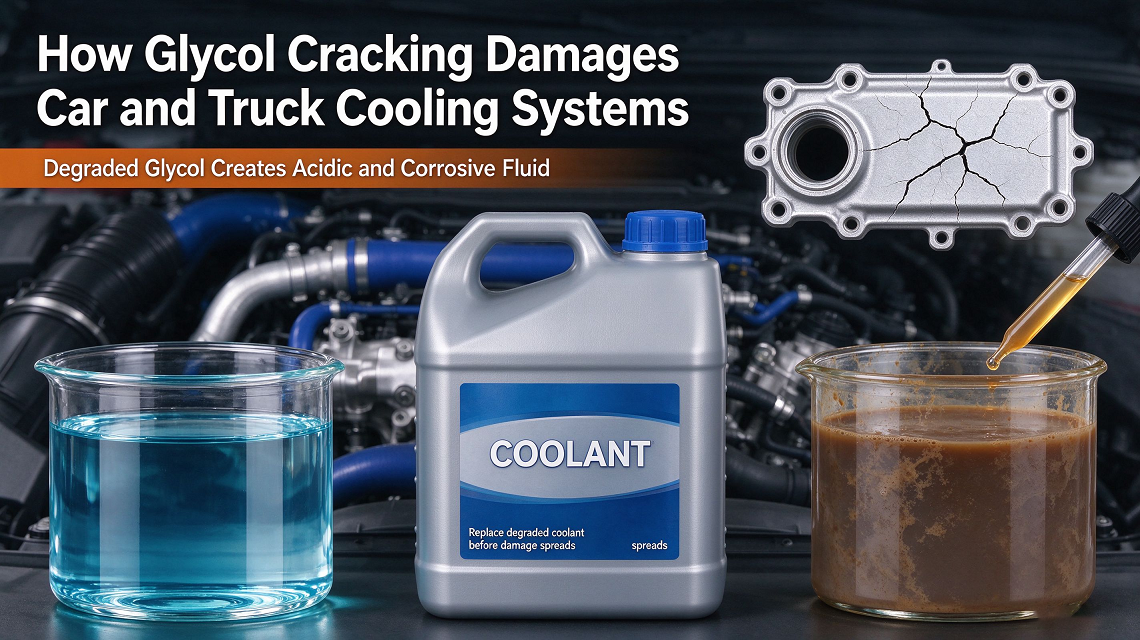
When standard base glycols (whether monoethylene or monopropylene) are exposed to temperatures exceeding 170°C (338°F), the molecular chains crack. This thermal decomposition converts benign heat-transfer compounds into corrosive organic acids, primarily formic, glycolic, and oxalic acids. Once these acids form, they rapidly consume the additive package, plunging the system into an acidic condition that attacks metallurgy, degrades elastomers, and precipitates insoluble salts throughout the engine jacket.
Recognizing the Signs of Glycol Cracking in Truck Engine Platforms
Field technicians often mistake early degradation for mechanical seal wear or normal fluid aging. Catching the transition early requires looking beyond freeze-point refractometers, which measure refractive index rather than chemical stability.
Key diagnostic indicators include:
- Precipitous pH Drop: While virgin heavy-duty formulations sit comfortably between 8.0 and 10.5, fluid suffering from glycol cracking will quickly slip below 7.5. Once pH drops below 6.5, cast iron cylinder blocks and wet sleeve liners lose their passive oxide layers, accelerating cylinder cavitation.
- Color Shift and Caramelization: As base glycols oxidize and break apart, clear or dye-tinted mixtures transition to a murky bronze, amber, or black hue, accompanied by an acrid, burnt odor.
- Drop-Out Sludge in Heat Exchangers: Acidic byproducts bond with degraded silicate or phosphate inhibitors, forming a gritty, gelatinous polymer paste that plugs cab heater cores and EGR passages.
- Accelerated Copper Leaching: High-heat zones strip copper from oil coolers and heater matrices, visible via inductively coupled plasma (ICP) testing showing elevated parts-per-million copper counts before iron shows up in high volumes.
When managing a commercial truck fleet, waiting for an over-temperature light on the dash means component damage has likely already occurred. By that stage, cylinder liner pitting or water pump mechanical seal blistering is usually already underway.
Evaluating a Factory Coolant Formula Against Glycol Cracking
Preventing chemical breakdown under extreme localized heating requires more than simply specifying an extended-life product. Engine engineers and procurement leads must examine the molecular stabilization chemistry within the fluid package.
A resilient factory coolant formula against glycol cracking relies on several distinct design considerations:
1. Heavy-Carboxylate Organic Acid Technology (OAT)
Traditional inorganic additive technology (IAT) relied on silicates and borates, which plate out rapidly and provide weak protection against high-temperature organic acid formation. Modern heavy-duty carboxylate chemistries use neutralized sebacate, 2-ethylhexanoic acid, and aromatic triazoles. These molecules do not coat entire passages blindly; instead, they selectively passivate sites undergoing active oxidation without diminishing thermal conductivity.
2. Buffered Reserve Alkalinity
Reserve alkalinity (RA) functions as a chemical shock absorber. A properly engineered thermal fluid incorporates specialized poly-basic buffers designed to neutralize formic and acetic acids on contact. Without sufficient RA, a brief thermal spike in an EGR cooler can tip an entire 40-liter circuit into an acidic state overnight.
3. Nitrite-Free Formulations for Aluminum Protection
While nitrites historically protected cast-iron wet liners against implosion-induced pitting, they decompose rapidly in high-temperature aluminum components. Modern alloy cylinder heads and integrated retarding circuits require nitrite-free organic formulations that stabilize base glycols without causing thermal pass-through varnishing.
Practical Fleet and Sourcing Guidelines
Mitigating premature thermal breakdown requires a combined approach bridging chemistry sourcing and preventative maintenance.
First, do not rely solely on test strips for extended drain intervals in severe-service duty cycles. Colorimetric test strips measure glycol concentration and general nitrite levels, but they frequently fail to detect the initial wave of glycol cracking before substantial pH collapse occurs. Implementing semi-annual ICP-OES spectrometry testing allows maintenance planners to identify formic acid generation, additive depletion, and early metal leaching simultaneously.
Second, match the fluid to the specific duty cycle. Severe stop-and-go refuse hauling, heavy construction haulage, and long-haul transport running through steep grade changes expose thermal circuits to sustained boundary-layer boiling. For these engines, choosing extended-life fluids with verified thermal degradation resistance ratings (such as ASTM D7583 for cavitation and ASTM D1384 for multi-metal corrosion) is far cheaper than overhauling scored cylinder liners or cleaning plugged oil coolers.
Finally, control makeup water quality strictly. Mixing concentrate with unconditioned tap water introduces calcium, magnesium, and chlorides. These minerals act as catalytic agents that accelerate the oxidation of glycol molecules when exposed to extreme liner temperatures, shortening the life of even premium inhibitors.
Welcome to contact GAFLE for more information & cooperation!
peter
ZHEJIANG GAFLE AUTO CHEMICL CO.,LTD
Tel:86-579-8222 1665
Fax:86-579-8246 4690
Cel/Wechart:86-13335993986
E-mail:peter@gafle.net
Web:www.gafle.net