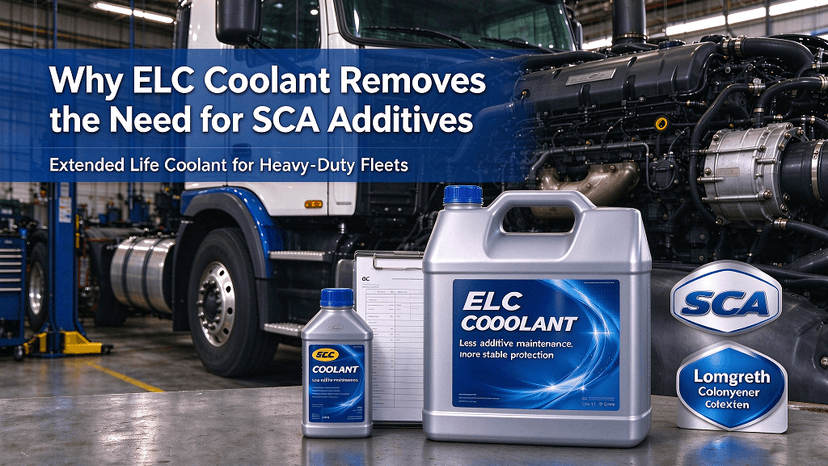
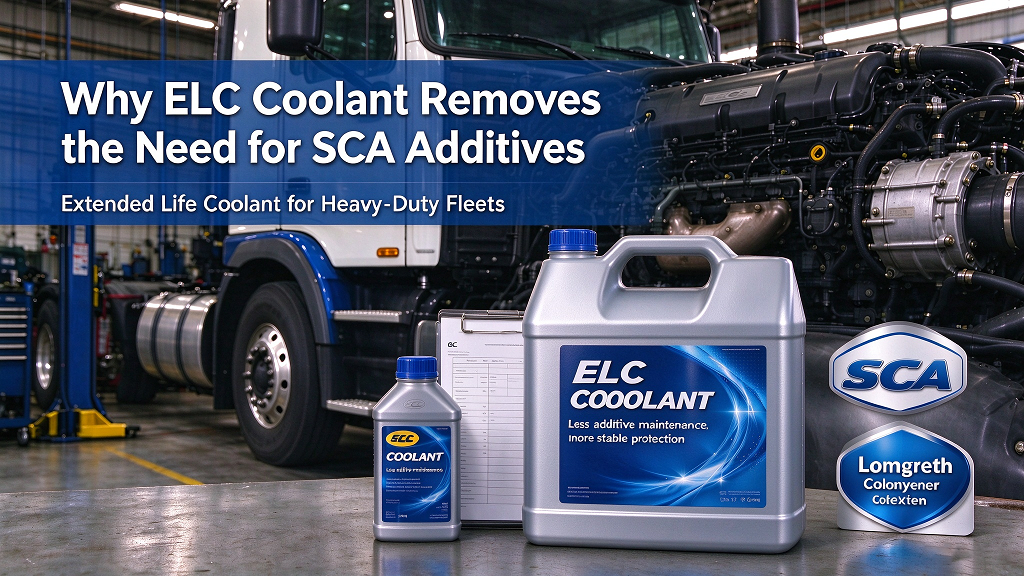
For fleet maintenance directors and heavy plant engineers, transitioning to an ELC heavy duty coolant no SCA required formulation represents a major operational shift away from the labor-intensive testing cycles of conventional inorganic fluids. Wet-sleeve diesel engines generate extreme acoustic vibration along cylinder walls, causing microscopic low-pressure cavitation bubbles that collapse with enough localized force to pit cast-iron liners. Historically, maintenance bays countered this destructive erosion by constantly monitoring and dosing supplemental additives into the circulating fluid. Modern Organic Acid Technology (OAT) removes that ongoing chemical maintenance burden entirely, yet operational missteps during field servicing remain surprisingly common across mixed equipment yards.
Why Traditional Systems Relied on Supplemental Additives
Conventional heavy-duty antifreeze relied on Inorganic Additive Technology (IAT), which depended on sacrificial salts such as nitrites, silicates, and molybdates. When pumped through an engine block, these salts plated every metallic surface indiscriminately, forming an immediate mechanical passivation barrier against localized liner cavitation and pitting.
The operational penalty was rapid depletion. Because these salts were continuously consumed during thermal cycling, technicians had to test reserve alkalinity and inhibitor concentrations every 15,000 to 25,000 miles using dip strips. If levels dropped, technicians replenished them by spinning on a fresh pre-charged filter or pouring in liquid cartridges. Overdosing risked silicate dropout—forming an abrasive green precipitate that clogged radiator cores and ate through water pump seals. Underdosing left cylinder sleeves vulnerable to pitting and eventual oil-pan perforation within months.
Carboxylate Chemistry: How Modern OAT Eliminates Routine Dosing
Understanding the mechanics of an ELC coolant SCA interaction clarifies why supplemental chemistry is obsolete—and actively hazardous—in modern carboxylate systems.
Extended life fluids rely on neutralized aliphatic mono- and dicarboxylic organic acids rather than short-lived inorganic salts. These carboxylate molecules do not blanket the entire cooling jacket with a thick, heat-insulating layer. Instead, they remain dissolved in the glycol-water matrix until an active anodic corrosion site develops. When micro-cavitation or localized oxidation exposes bare cast iron or aluminum, carboxylates polarize and bond specifically at that microscopic site, arresting degradation immediately.
Because carboxylate molecules react only where damage occurs, their depletion rate is virtually negligible across hundreds of thousands of operating miles. The glycol formulation preserves its heat transfer efficiency, eliminates abrasive dropout, and operates without continuous chemical replenishment.
Fleet Protocols and Operational Governance
Navigating extended life coolant SCA rules requires understanding the shift from sacrificial passivating barriers to selective organic acid chemistry.
A standard manufacturer ELC coolant guide for fleets emphasizes that mixing traditional supplemental additives into an organic acid matrix does far more harm than good. When technicians conditioned by years of old habits install traditional pre-charged filters onto an OAT-filled engine, the chemistries clash. Unnecessary inorganic salts saturate the mixture, destabilizing the organic inhibitors, accelerating silicate or phosphate dropout, and causing premature pump seal leakage.
Fleet managers generally encounter two distinct classifications of extended-life thermal management:
Full OAT (Nitrite-Free) Formulations
These fluids utilize purely organic carboxylate inhibitors and strictly prohibit any supplemental chemistry throughout their operating life. They typically deliver service spans of 600,000 to 1,000,000 highway miles (or up to 12,000 off-highway operating hours). Routine shop maintenance is simplified: verify freeze protection with an optical refractometer and evaluate fluid clarity.
NOAT (Nitrited Extended Life) Formulations
Commonly specified under standards such as Caterpillar EC-1, NOAT formulations contain a baseline concentration of nitrite and molybdate alongside organic carboxylates to protect wet sleeves. While NOAT does not require routine filter additions at standard drain intervals, it often specifies a single dose of an "extender" fluid at the mid-life mark (typically around 300,000 to 400,000 miles). Crucially, an extender is not a standard SCA; it replenishes specific carboxylate and nitrite levels without loading the system with excess inorganic salts.
Comparison: Legacy Regimes vs. Extended Life Systems
| Operating Parameter | Conventional IAT Fluid | Nitrited OAT (NOAT) | Full OAT (Nitrite-Free) |
|---|---|---|---|
| Cavitation Inhibitor | Sacrificial nitrites and molybdates | Carboxylates with initial nitrites | Targeted carboxylate passivators |
| Auxiliary Chemical Dosing | Required at every PM interval | None; one-time extender at mid-life | Strictly prohibited |
| Typical Service Life | 200,000 to 250,000 miles | 600,000 to 750,000 miles | 1,000,000 miles / 12,000 hours |
| Primary Risk Factor | Silicate dropout or underdosed pitting | Applying standard SCAs instead of extender | Cross-contamination with legacy chemistry |
Field Pitfalls: Where Maintenance Bays Stumble
Transitioning a fleet away from auxiliary chemical dosing is simple in theory, but maintenance departments frequently encounter avoidable breakdowns during execution:
- Top-Off Dilution: Adding conventional green fluid to an OAT system dilutes carboxylate strength. Once non-ELC volume exceeds 10% to 15%, the system loses its long-drain properties and falls into an ambiguous state where neither technology functions reliably.
- Untreated Tap Water: Diluting concentrated formulations with municipal tap or well water introduces calcium, magnesium, chlorides, and sulfates. Hard minerals bind with inhibitors, promoting scale build-up and localized thermal hot spots. Only deionized or reverse-osmosis water should be mixed with heavy-duty antifreeze concentrates.
- False Rejections from Test Strips: Traditional two-way and three-way test strips are formulated solely to measure nitrite and molybdate salts. Dipping conventional strips into a nitrite-free OAT system registers zero protection, often causing misinformed technicians to dose the system with supplemental additives.
Frequently Asked Questions
Can an OAT system recover if an SCA filter was accidentally installed?
If a single low-dose additive cartridge was installed, remove it immediately and inspect the expansion tank for turbidity or precipitation. If the fluid remains clear and carboxylate levels test within specification via OAT-specific titration strips, the fluid may remain in service. However, if heavy precipitation, cloudiness, or gelling appears, drain, flush with treated water, and refill with virgin premix.
What testing tools should technicians use during scheduled PMs?
Avoid floating hydrometers, which are temperature-sensitive and inaccurate. Use an optical or digital refractometer to measure freeze point and glycol concentration. Pair this with a calibrated digital pen or broad-range strip to confirm pH remains within the specified alkaline window (typically 8.0 to 9.0 for most carboxylate formulations).
Implementing a Clear Yard Standard
Eliminating auxiliary additive dosing reduces maintenance hours, prevents water pump seal erosion, and minimizes liner pitting across heavy equipment operations. Securing those gains requires mechanical discipline across the shop floor. Clearly tag radiator surge tanks, remove legacy additive spin-on filters from inventory shelves, and standardize on 50/50 pre-diluted drums so service staff never reach for unconditioned tap water or obsolete chemical boosters.
Welcome to contact GAFLE for more information & cooperation!
peter
ZHEJIANG GAFLE AUTO CHEMICL CO.,LTD
Tel:86-579-8222 1665
Fax:86-579-8246 4690
Cel/Wechart:86-13335993986
E-mail:peter@gafle.net
Web:www.gafle.net