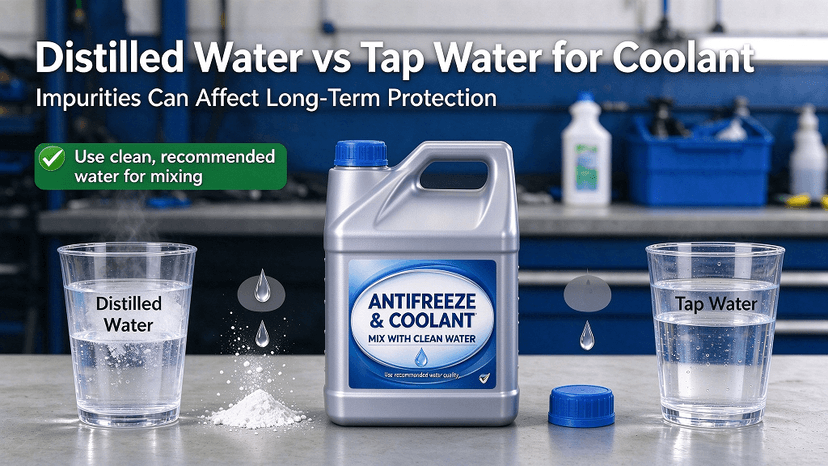
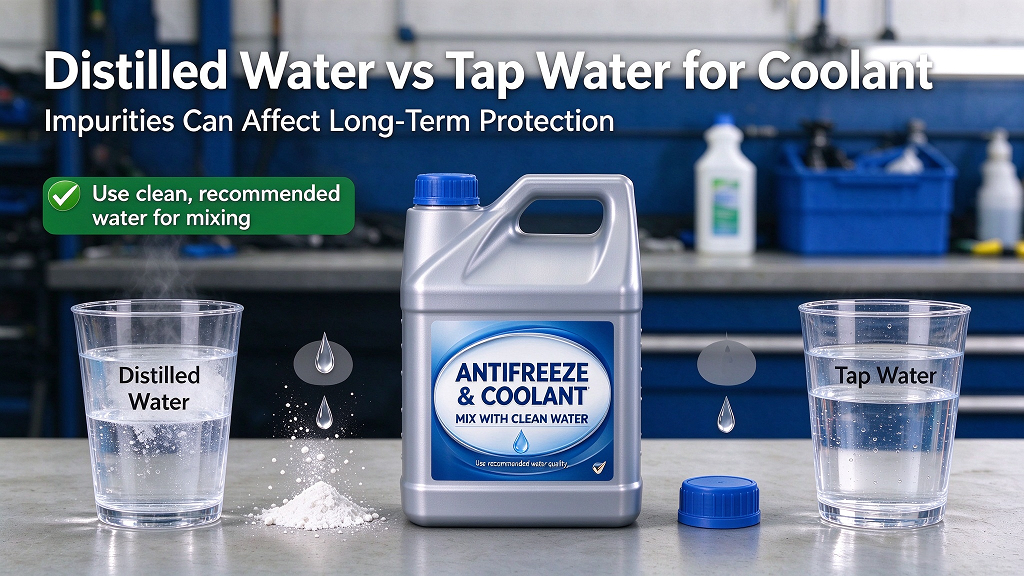
When mixing heavy-duty or passenger vehicle coolant concentrate in a shop environment, grabbing the nearest garden hose or utility sink faucet is an easy shortcut. Yet, asking any thermal systems engineer or fleet maintenance director why use distilled water for antifreeze yields an unequivocal answer: mineral content kills heat exchangers. Coolant formulation relies on delicate additive packages, and the chemistry of untreated water works directly against those additives from the moment the engine reaches operating temperature.
The Mineral Problem: Tap Water Risks When Mixing Coolant
Tap water is treated for human consumption, not thermal transfer loop stability. Municipal supplies contain varying levels of calcium, magnesium, chlorides, sulfates, and carbonate ions. In drinking water, these minerals are harmless or even beneficial; inside a pressurized, high-temperature cooling jacket, they present immediate hazards.
The primary tap water risks when mixing coolant center on precipitation. As the engine runs, localized surface temperatures around cylinder liners, exhaust ports, and turbocharger cooling passages can easily exceed 100°C (212°F). At these elevated temperatures, calcium and magnesium salts drop out of solution, forming hard, insoluble scale (primarily calcium carbonate and calcium sulfate) on internal metal surfaces.
Scale acts as an unintentional thermal insulator. A layer of scale just 1.5 mm thick can reduce heat transfer efficiency by roughly 10% to 15%. This creates hot spots across aluminum cylinder heads, warping metal, stressing head gaskets, and eventually triggering detonation or unmetered thermal fatigue.
Corrosion Inhibitor Depletion and Chemical Attack
Modern coolants rely on chemical inhibitors—organic acid technology (OAT), hybrid OAT (HOAT), or traditional silicates—to form a microscopic protective layer across copper, brass, cast iron, and aluminum alloys. When you introduce tap water, these additives are prematurely sacrificed.
Chlorides and sulfates present in tap water are aggressive corrosive agents. Chlorides attack aluminum passivity layers, inducing deep pitting corrosion that can puncture radiator tubes or heater cores within months. Sulfates attack copper and iron. Instead of maintaining the metal surfaces, the additive package in your coolant is consumed almost immediately neutralizing these incoming minerals.
Choosing proper coolant mixing water ensures that 100% of the additive chemistry remains available to neutralize combustion gas blow-by, resist cavitation, and stabilize pH levels over the fluid's full service life.
Distilled vs. Deionized vs. Tap Water: Technical Comparison
Engineers often debate whether distilled or deionized (DI) water is superior. While both remove the bulk of harmful ionic species, their production methods and residual behaviors differ slightly:
| Water Type | Typical TDS (ppm) | Conductivity (µS/cm) | Suitability for Coolant |
|---|---|---|---|
| Municipal Tap Water | 100 – 500+ | 200 – 800 | Not recommended; causes scaling and pitting. |
| Deionized (DI) Water | < 5 | 0.1 – 1.0 | Acceptable, but can be aggressive to metals if uninhibited before mixing. |
| Distilled Water | < 1 | 0.5 – 3.0 | Industry standard; neutral, pure, and free of biological or inorganic solids. |
Using distilled water for coolant blending offers the most consistent baseline. Distillation involves vaporizing liquid water and condensing the steam into a separate vessel, leaving virtually all non-volatile minerals, bacteria, and particulate debris behind. Deionized water is stripped of ions via resin beds, which is chemically clean, but unbuffered DI water can occasionally show higher initial aggressiveness toward soft metals if blended with low-inhibitor formulas.
Can You Mix Antifreeze with Tap Water in an Emergency?
A frequent question in field operations is: can you mix antifreeze with tap water if you are stranded or running low on inventory? The short answer is yes, but only as a temporary measure.
If an engine is overheating due to low fluid levels, adding tap water—or even a tap water antifreeze mix—is vastly better than letting the cooling jacket run dry. Dry running causes immediate catastrophic failures, including cracked cylinder heads and seized pistons.
However, running tap water should be treated strictly as an emergency triage step. Once the equipment returns to the shop or depot, the contaminated fluid should be drained completely, the system chemically flushed to strip out deposited carbonates, and refilled with a calibrated 50/50 blend of concentrated glycol and distilled water.
Water Pump Cavitation and Radiator Tube Clogging
Water pump impellers operate at high rotational speeds, generating localized low-pressure zones trailing behind the impeller vanes. If the boiling point or surface tension of the fluid is compromised by mineral contamination, vapor bubbles form and collapse violently against the impeller face—a destructive process known as cavitation erosion.
Furthermore, the solids generated by scale formation do not stay put. They circulate as abrasive micro-particles, abrading mechanical shaft seals and settling in the lowest-velocity zones of the cooling circuit. In modern radiators featuring micro-extruded aluminum tubes with wall thicknesses under 0.3 mm, particulate buildup restricts cooling capacity rapidly and risks physical blockages that chemical flushing cannot easily reverse.
Best Practices for Fleet Fluid Management
- Procure Pre-Diluted (50/50) Coolants When Feasible: For many operations, purchasing factory-diluted coolant eliminates technician blending errors, improper ratios, and shop-floor water contamination entirely.
- Verify In-House Blending Water: If using drums of concentrate, mandate the use of packaged distilled water. If using in-house filtration, ensure the system incorporates reverse osmosis (RO) combined with a deionization stage, and inspect Total Dissolved Solids (TDS) levels weekly using a calibrated meter (target < 10 ppm TDS).
- Monitor pH and Freeze Point: Regularly test cooling loops using refractometers rather than hydrometers, and track reserve alkalinity using test strips to catch early additive drop-out.
Frequently Asked Questions
Can I use reverse osmosis (RO) water instead of distilled water?
High-efficiency multi-stage RO water is generally acceptable for fleet top-offs if total dissolved solids measure below 10 to 20 ppm. However, standard single-pass domestic RO units may still allow small amounts of ionic bypass, making bottled distilled water the safer benchmark for heavy equipment.
Does boiling tap water make it suitable for coolant?
No. Boiling tap water kills biological contaminants (bacteria) and drives out dissolved gases, but it actually concentrates minerals like calcium and silica by boiling off pure vapor. Boiled tap water is worse for a cooling system than unboiled water.
Why does bottled drinking water damage radiators?
Bottled spring water and purified drinking water often have minerals deliberately added back for taste (such as magnesium sulfate, potassium chloride, and calcium chloride). Pouring bottled drinking water into a cooling system introduces the exact ionic compounds designed coolants are formulated to avoid.
Standardize Your Fluid Blending Protocol
Controlling what goes into a cooling system is one of the lowest-cost preventive measures available to maintenance teams. The price differential between a gallon of tap water and a gallon of distilled water is trivial compared to the cost of a replacement aluminum core, a failed mechanical water pump seal, or downtime from roadside thermal derates. Enforce strict fluid standards in your shop: rely on factory-premixed solutions or maintain dedicated reserves of certified distilled water for all concentrate dilution.
Welcome to contact GAFLE for more information & cooperation!
peter
ZHEJIANG GAFLE AUTO CHEMICL CO.,LTD
Tel:86-579-8222 1665
Fax:86-579-8246 4690
Cel/Wechart:86-13335993986
E-mail:peter@gafle.net
Web:www.gafle.net