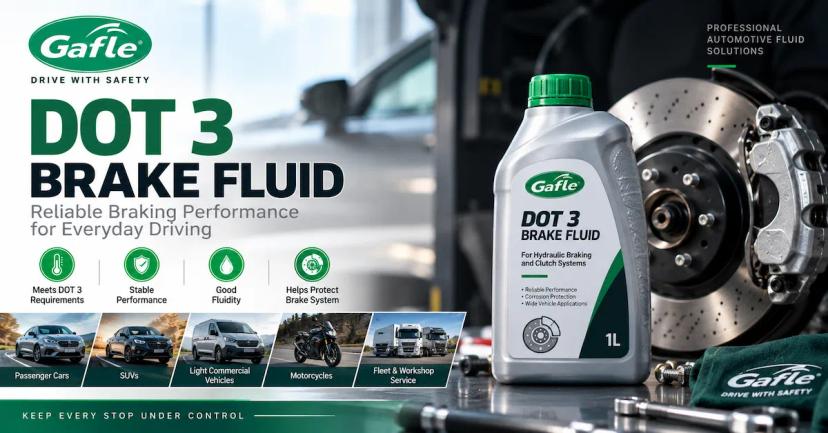
Why DOT 3 Brake Fluid Procurement Needs More Than a Grade Name
For distributors and private-label buyers, purchasing DOT 3 Brake Fluid is not simply a matter of finding a bottle marked DOT 3 and comparing the price per litre. The fluid becomes part of a safety-critical hydraulic system, while the finished product also has to survive storage, distribution, workshop handling, labeling, and repeat-order production. A useful sourcing process therefore begins by defining the required grade, vehicle population, destination market, packaging format, technical documents, acceptance criteria, and batch controls before asking suppliers to compete on price. GAFLE currently places DOT3 within a wider brake fluid product range that also includes DOT4, DOT5.1, OEM, performance-oriented, energy-vehicle, and off-road categories, which makes product classification an important first step rather than an administrative detail.
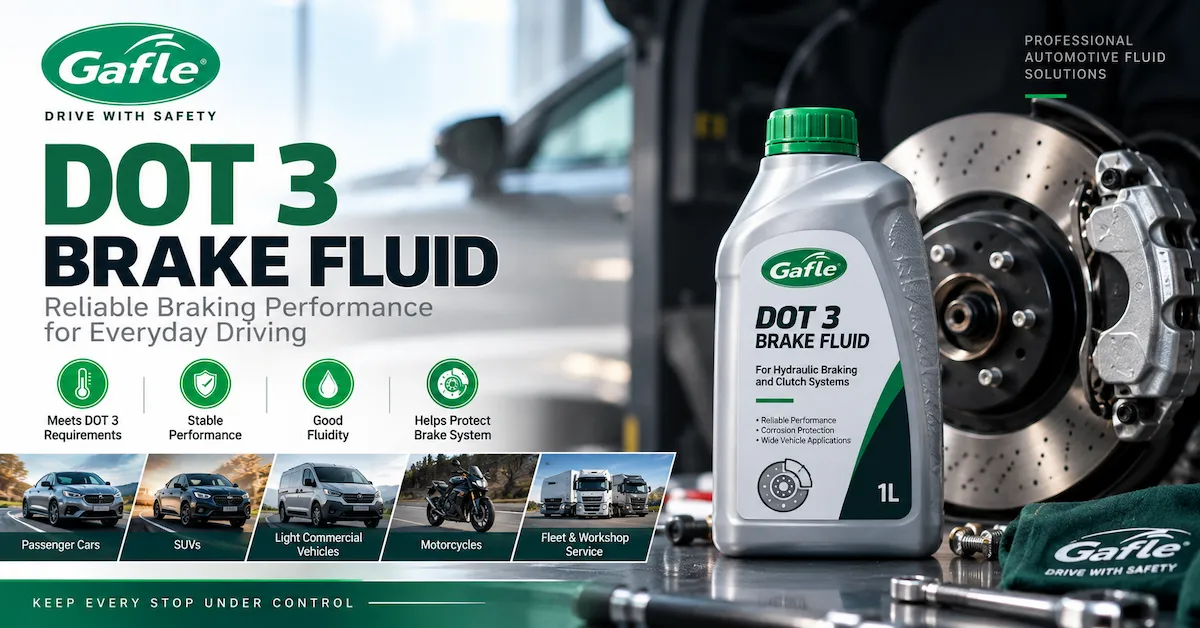
Who Should Use This DOT 3 Brake Fluid Sourcing Guide?
This guide is intended primarily for automotive chemical importers, aftermarket distributors, parts wholesalers, private-label brands, fleet procurement teams, workshop chains, and other B2B buyers responsible for approving a brake-fluid product rather than diagnosing an individual vehicle. Their questions usually extend beyond whether DOT 3 “works”: they need to determine which vehicle population actually requires the grade, what technical evidence supports the proposed product, how the approved sample will be reproduced in production, what packaging will protect the fluid through distribution, and how a future complaint can be traced to a batch. This article is not a substitute for a vehicle manufacturer's service instructions, and it is not intended to justify changing a vehicle from one brake-fluid specification to another. For a vehicle-specific decision, the manufacturer's manual, reservoir cap information, or approved service documentation should remain the starting point. GAFLE's existing guide on where DOT 3 fits and what to check before buying follows the same specification-first principle.
What DOT 3 Actually Defines—and What It Does Not
DOT 3 identifies a performance class for non-silicone hydraulic brake fluid; it is not a complete product specification and it does not tell a buyer everything about formulation, package quality, batch control, shelf handling, or vehicle approval. Under FMVSS No. 116, DOT 3 includes minimum performance requirements such as a dry equilibrium reflux boiling point of 205°C, a wet equilibrium reflux boiling point of 140°C, and a maximum low-temperature kinematic viscosity of 1,500 mm²/s at -40°C. These figures are regulatory reference values, not measured values for a particular GAFLE product. A buyer evaluating a supplier should therefore ask whether the proposed product has been tested against the applicable requirements, which test method and report identify the exact sample, and whether the supplier's stated product values are minimum guaranteed limits, specification limits, or typical laboratory results. This distinction matters because a marketing statement such as “high boiling point” does not tell purchasing teams what was tested, under which method, or what value will be controlled in future production.
Build a Written Purchasing Specification Before Requesting a Quote
A useful purchasing specification converts the phrase “we need DOT 3” into information that production, quality, packaging, sales, and the buyer can all interpret the same way. This is especially important for private-label programs because technical data, label claims, bottle design, cartons, and purchase orders can otherwise evolve independently. The table below is a procurement framework, not a set of claimed GAFLE product values; actual data should be confirmed for the product being quoted.
| Purchasing Item | What the Buyer Should Define or Request | Why It Matters |
|---|---|---|
| Product identification | Supplier model/code and buyer item code | Prevents different formulations from being treated as the same item |
| Fluid grade | DOT 3 and any additional applicable requirement | Establishes the basic technical class |
| Dry boiling performance | Applicable requirement and reported result | Supports thermal-performance review |
| Wet boiling performance | Applicable requirement and reported result | Helps evaluate performance after controlled moisture exposure |
| Low-temperature viscosity | Required temperature, limit, and result | Important where cold-temperature hydraulic response matters |
| Corrosion and compatibility | Applicable tests and product evidence | Supports review of system-material interaction |
| Test documentation | Test method, sample identity, report date, result | Connects technical claims to an identifiable product |
| Packaging | Capacity, bottle, closure, seal, label, carton | Controls storage, handling, branding, and logistics |
| Batch identification | Lot code and traceability requirement | Supports complaint investigation and repeat-order control |
| Market documentation | Required SDS, technical sheet, labeling and other documents | Reduces regulatory and customer-document gaps |
| Change control | Which changes require buyer notification or reapproval | Protects the approved product definition |
The key purchasing principle is that every important document should point back to the same product identity. A quotation for one formulation, a test report for another sample, and artwork carrying broader claims should not be combined into a single approval file simply because all three contain “DOT 3.”
Where DOT 3 Fits in a Distributor's Product Portfolio
DOT 3 continues to matter where vehicle manufacturers specify or permit the grade, so distributors should build inventory around the vehicles and service requirements in their actual market rather than around assumptions about which grade is “older” or “better.” A workshop network serving mixed vehicle populations may need DOT 3 alongside DOT 4 and other brake-fluid types, while a distributor concentrated in a particular vehicle segment may see a different demand mix. GAFLE already discusses this selection issue in its DOT 3 versus DOT 4 buyer guide, emphasizing specification, compatibility, duty cycle, and service requirements rather than treating the number on the label as a universal performance ranking.
| Fluid Class | Typical Purchasing Question | What Buyers Should Not Assume |
|---|---|---|
| DOT 3 | Does the target vehicle population require or permit this specification? | That it can be used wherever “brake fluid” is requested |
| DOT 4 | Does the application require DOT 4 or additional performance characteristics? | That a higher number automatically makes it correct for every DOT 3 application |
| DOT 5.1 | Does the system specifically require or permit this non-silicone higher-performance class? | That DOT 5.1 and silicone-based DOT 5 are the same fluid |
| Application-specific products | What vehicle, braking system, duty cycle, or specification is being addressed? | That “racing,” “EV,” or another application name proves universal suitability |
This comparison is useful for portfolio planning, but it does not authorize grade substitution. A distributor should keep vehicle requirements, local market demand, and supplier documentation connected throughout the product-selection process.
Dry and Wet Boiling Performance Should Be Reviewed Together
The dry boiling point attracts attention because it is easy to turn into a headline number, but bulk buyers should not evaluate DOT 3 Brake Fluid from one thermal figure alone. Glycol-based brake fluids are hygroscopic, meaning they can absorb moisture over time. That is why both dry and wet boiling performance are relevant to a technical review. When a supplier presents a boiling-point value, purchasing and quality teams should ask whether it is a specification threshold, a typical formulation value, or an actual result from an identifiable test sample. They should also confirm the testing method and units. If one supplier provides a typical dry result while another provides a guaranteed minimum wet result, putting the two numbers into a simple “Supplier A vs Supplier B” chart creates a misleading comparison. Comparable sourcing decisions require comparable definitions and conditions.
Low-Temperature Viscosity Is a Separate Purchasing Decision
A brake fluid can have good boiling performance without automatically having the low-temperature viscosity characteristics required for another application. This becomes particularly important when procurement teams operate across several climates or vehicle technologies. Buyers should therefore record the viscosity test temperature, result, applicable limit, and relevant product version instead of accepting a general statement such as “good low-temperature fluidity.” GAFLE's broader brake-fluid range includes application-specific categories beyond standard DOT3, which reinforces the need to match technical characteristics to the intended system rather than turning one formulation into a universal product claim. For markets where electronically controlled brake systems or specifically defined low-viscosity fluids are relevant, the buyer should qualify the appropriate product separately instead of assuming a conventional DOT 3 item meets those requirements.
Raw Materials and Formulation Consistency Matter More Than Marketing Language
B2B buyers normally cannot verify a brake-fluid formulation by looking at its color or bottle, so supplier evaluation must move upstream into formulation control. The useful questions concern approved raw materials, incoming identification, controlled recipes, weighing or dosing procedures, mixing conditions, contamination prevention, in-process checks, and the rules governing raw-material or formulation changes. GAFLE's published article on consistent brake fluid formulations describes consistency as the result of controlled R&D, qualified raw materials, standardized production, testing, and quality management rather than a characteristic that appears automatically at final inspection. For private-label brands, this matters because the real commercial objective is not receiving one good development sample; it is receiving subsequent production batches that continue to match the approved product definition.
How Manufacturing Process Control Affects Repeat Orders
A professional sourcing audit should follow the product through the manufacturing process instead of focusing only on the finished bottle. GAFLE's published brake fluid manufacturing process describes a sequence that includes raw-material handling, production, laboratory testing, filling, packaging, and final inspection. Buyers should use that process as a starting point for more specific questions: which controls apply to the quoted DOT 3 product, which parameters are checked before filling, how filling and closures are inspected, how nonconforming material is handled, how the finished batch receives its release status, and how records connect the packed product back to production. These questions convert a general “we have strict QC” statement into evidence that can be assessed during supplier qualification.
Separate Qualification Tests from Routine Batch Tests
One of the most important technical distinctions in bulk procurement is the difference between tests used to qualify a formulation and tests performed routinely on production batches. A comprehensive laboratory report may include many performance items, but that does not mean every item is repeated on every production lot. The buyer should therefore ask the supplier to identify which tests support initial product qualification, which are routine release checks, what acceptance limits apply, what sampling plan is used, and which records can be provided when required. GAFLE publishes additional information on its brake fluid quality-control process, but order-specific buyers should still link the general process to their exact product and documentation requirements. This approach is more useful than requesting a random stack of certificates that may not identify the product being purchased.
Review Certificates and Product Reports as Different Evidence
Management-system certificates, factory qualifications, product test reports, technical data sheets, and shipment-level inspection documents serve different purposes. A buyer should verify the legal company name, facility, issuing organization, certificate scope, applicable product, and current validity instead of assuming that a certification logo applies to every product in the supplier's catalogue. Product reports should then be evaluated separately by checking the sample name, product code, method, test date, results, and report scope. GAFLE's About Us page can support the initial company review, but a private-label or distribution project should request current documents relevant to the actual order before certification or compliance claims are reproduced on labels, catalogues, or customer-facing pages. This separation between company evidence and product evidence reduces the risk of turning a broad corporate credential into an unsupported product-specific claim.
Packaging Is Part of DOT 3 Brake Fluid Quality Control
Packaging is especially important for hygroscopic fluids because the package must protect the product before the end user opens it. For private-label procurement, bottle capacity, bottle material, closure, seal, label, carton, coding position, palletization, and storage instructions should therefore be approved as controlled parts of the product rather than left as design details. A new bottle or closure can affect filling, sealing, leakage risk, packing efficiency, and warehouse handling even when the fluid formulation remains unchanged. GAFLE's private-label brake fluid packaging guide describes packaging customization as part of the OEM workflow, while the Label service adds product information and verification functions. Buyers should approve physical samples and final artwork before mass production and should record the revision that becomes the reference for repeat orders.
Private Label Buyers Need a Controlled Artwork Approval Process
A label is not only a branding surface. It can contain the fluid grade, instructions, warnings, language, company information, batch information, barcode, claims, and market-specific details. That means artwork should not be finalized independently from the technical approval. The commercial team may want strong marketing language, while the quality or regulatory team needs those statements to remain within the evidence available for the selected formulation. A useful approval process therefore identifies who controls technical claims, who checks translation, who approves barcode and legal information, and which artwork revision is released to print. Where authenticity and channel control matter, GAFLE's Product and Brand Protection service can also be considered as part of the wider distribution strategy, but specific protection arrangements should be confirmed for the individual market.
MOQ, Capacity, and Lead Time Must Be Quoted for the Actual Project
A universal MOQ or lead-time figure is not useful when different orders use different fluids, bottle sizes, labels, cartons, languages, quantities, and delivery schedules. Instead of copying an indicative number into a sourcing policy, buyers should ask the manufacturer to separate product availability, packaging preparation, artwork approval, sample confirmation, production scheduling, inspection, and dispatch. GAFLE's published OEM brake fluid order workflow describes order confirmation, specification and packaging discussions as early project stages, illustrating why commercial timing depends on more than the filling operation itself. For a serious quotation comparison, request written MOQ and schedule information against the same specification from every supplier, and identify which dates depend on buyer approvals.
Compare Total Purchasing Risk, Not Only Price Per Litre
Unit price matters, but the lowest initial quotation can become expensive if the product definition is vague. Buyers should consider fluid cost, package cost, artwork or tooling where applicable, testing requirements, documentation, freight, pallet efficiency, incoming inspection, inventory exposure, market re-labeling risk, rejected packaging, complaint handling, and the cost of changing supplier after launch. A supplier that clearly defines specification, sample approval, batch controls, packaging, and change management may reduce downstream uncertainty even if the headline price is not the lowest. Conversely, a very attractive price should trigger more—not fewer—questions when the quotation does not identify product code, packaging assumptions, documentation, or acceptance criteria. This is particularly important for private-label brake fluid because the distributor's own brand will carry the reputation risk after the product reaches workshops and retailers.
A Practical Approval Workflow for Bulk DOT 3 Brake Fluid
A structured sourcing project can move through requirement definition, supplier technical review, quotation comparison, product-document review, sample approval, packaging approval, pilot or initial production where appropriate, final inspection, shipment, and repeat-order monitoring. The buyer should freeze the approved specification before mass production and make sure the purchase order references the same product code and packaging revision. The approved sample should be identified and retained according to an agreed system, while future changes to fluid formulation, critical raw materials, bottle, closure, label, or other agreed characteristics should be communicated according to the project's change-control requirements. GAFLE provides broader background on its brake-fluid manufacturing and OEM capabilities, but the important B2B action is to translate general factory capability into a documented order-specific process.
What Information Should You Send Before Requesting a DOT 3 Brake Fluid Quote?
A productive inquiry should tell the supplier what market and distribution channel the product is intended for, the required brake-fluid grade and any additional specification, the expected vehicle or service applications, desired packaging format, label language, brand requirements, required technical documents, initial order quantity, forecast volume, delivery destination, and target timing. If you already have a current product, share its specification or approved technical requirements rather than asking the new supplier to match a photograph of the bottle. If a custom formulation or unusual test requirement is involved, identify it before artwork or packaging development begins. Buyers who have prepared these details can use the GAFLE contact page to discuss a product and private-label program with fewer unanswered assumptions.
Frequently Asked Questions About DOT 3 Brake Fluid
1. Is DOT 3 Brake Fluid Still Relevant for the Aftermarket?
Yes, where the target vehicle manufacturer specifies or permits DOT 3, there remains a legitimate service and distribution requirement for the grade. Buyers should base inventory decisions on the actual vehicle population and service specifications in their market instead of assuming that every newer or older vehicle uses the same fluid.
2. Is DOT 4 Automatically a Better Replacement for DOT 3?
No. Higher grade numbering should not replace the vehicle manufacturer's specification. DOT 4 has different performance requirements, but the purchasing decision should still begin with the system requirement and approved service information. GAFLE's DOT 3 vs DOT 4 guide discusses this distinction in more detail.
3. What Is the Most Important DOT 3 Specification to Check?
There is no single parameter that replaces the full specification. Dry boiling point, wet boiling point, viscosity, corrosion behavior, compatibility, and other applicable test requirements each answer different questions. Buyers should review the relevant product evidence as a set rather than selecting a supplier from one headline value.
4. Is a Test Report Enough to Approve a Supplier?
No. A report supports the sample and tests it identifies; it does not prove that every future production batch will automatically be identical. Supplier approval should also examine product identification, manufacturing controls, routine batch testing, traceability, packaging, change control, and commercial execution.
5. Should Every Batch Receive the Same Full Qualification Test?
Not necessarily. Qualification testing and routine release testing can have different scopes. The buyer should ask the manufacturer to document which checks are routine for the quoted product, what acceptance criteria apply, and how conformity is recorded.
6. Can DOT 3 Brake Fluid Be Supplied Under a Private Label?
GAFLE publishes OEM and private-label brake-fluid services, including product and packaging customization. The exact product, packaging, artwork, MOQ, commercial terms, and technical documentation should be confirmed for each project rather than inferred from a general service statement. The OEM brake fluid workflow provides additional background.
7. What Should a Buyer Approve Before Printing Private-Label Packaging?
Approve the product identity, technical claims, fluid grade, required warnings and information, language, brand elements, bottle, closure, seal, label artwork, coding position, carton, and final artwork revision. Technical statements should correspond to evidence for the actual formulation.
8. Why Does Batch Traceability Matter for Brake Fluid?
Traceability helps connect a finished container to production and inspection records. If a complaint, packaging defect, or technical question appears later, a clear batch code allows the supplier and buyer to determine which production material is affected instead of treating all inventory as one undifferentiated product.
9. How Should Distributors Compare Two DOT 3 Suppliers?
Send both suppliers the same product, documentation, packaging, quantity, destination, and quality requirements. Then compare technical evidence, batch controls, packaging execution, change management, MOQ, schedule, total landed cost, and support—not merely the lowest quoted price per litre.
10. What Should I Send GAFLE for a Bulk DOT 3 Inquiry?
Provide the destination market, required grade and specifications, expected application, packaging format, label language, private-label requirements, technical-document needs, initial quantity, forecast demand, destination, and required timing. With these inputs, the supplier can evaluate the project against a defined purchasing requirement rather than guessing from a product name alone.
Conclusion
A reliable DOT 3 Brake Fluid sourcing decision is built on specification control, comparable technical evidence, repeatable manufacturing, appropriate packaging, and a clearly documented approval process. For distributors and private-label brands, the most important question is not simply whether a supplier can fill a container marked DOT 3; it is whether the supplier can identify the exact formulation, show relevant product evidence, reproduce the approved configuration across production batches, protect the fluid through packaging and distribution, and manage changes in a traceable way. GAFLE's brake fluid range, manufacturing content, and OEM resources provide useful starting points for supplier evaluation, while final product specifications, current documents, MOQ, packaging availability, and delivery terms should be confirmed for the individual order. If you are preparing a distribution or private-label program, send your required specification, target market, packaging format, quantity, and documentation requirements through GAFLE Contact Us so the project can be evaluated against a defined purchasing requirement rather than a generic grade name.