Why a free sample policy matters in automotive chemical sourcing
A Free Sample Policy sounds simple on paper, but in automotive chemicals it often decides whether a sourcing project moves forward or stalls. Buyers are rarely choosing a liquid by label alone. They are trying to judge whether an auto chemical sample will behave correctly in a real system, whether a coolant sample is compatible with metals and seals, and whether a brake fluid sample will fit the performance target without upsetting the rest of the assembly. That is a lot to ask from a small bottle.
For engineers and procurement teams, the value of a sample is not just “free.” It is the chance to reduce risk before committing to production volumes. The catch is that sample programs vary widely. Some suppliers use them to support qualification. Others use them as a sales filter. A practical buyer needs to know what is included, what is not, and what kind of decision the sample can actually support.
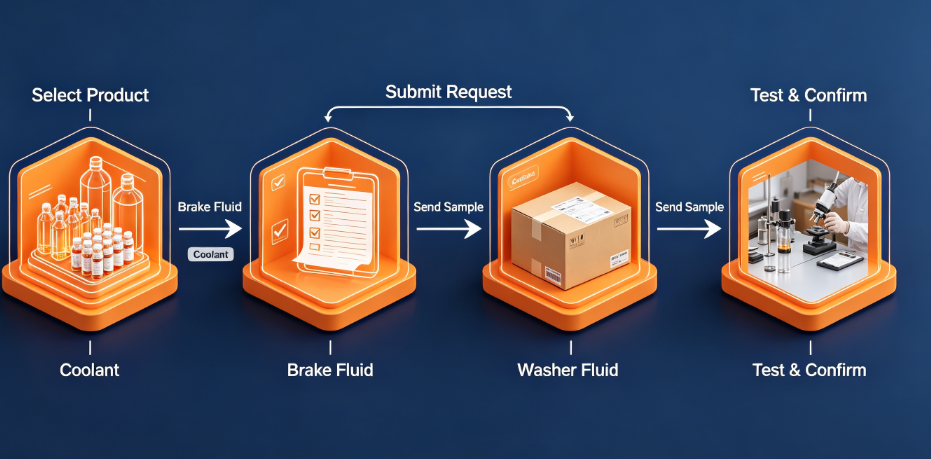
What a sample should help you learn
A good sample program gives you enough material to answer a narrow but important set of questions. Does the product mix cleanly? Does it separate on storage? Is the odor manageable on the shop floor? Does it wet surfaces as expected, resist foaming, or maintain clarity after temperature swings? These are the kinds of details that matter when a fluid is going into a cooling circuit, a braking system, or a service chemical application.
For technical buyers, the sample is also a documentation checkpoint. Even if the container is small, you still want the basic product description, intended use, handling notes, and any general safety information the supplier is willing to provide. A sample without context can create more confusion than confidence.
Quick buyer’s view: what to compare before requesting a sample
1. Purpose of the sample
Is it for internal lab screening, line trials, or customer approval? That one question changes the kind of feedback you need.
2. Product fit
An auto chemical sample should resemble the eventual bulk formulation closely enough to be meaningful. A diluted demo version may be useful for presentation, but it is not a substitute for qualification.
3. Test conditions
Ask yourself whether the sample will be tested in the same temperatures, materials, and storage conditions as the final application. A coolant sample that looks fine at room temperature may tell you very little about hot-cold cycling.
4. Hidden costs
Free sample policy language sometimes excludes freight, customs handling, or special packaging. That does not make the offer bad, but it does change the economics.
Where sample policies help, and where they do not
In a mature purchasing process, a sample can speed up internal alignment. Technical teams get a physical reference. Purchasing gets an early read on supplier responsiveness. Quality teams can start comparing paperwork and handling practices. That is the upside.
The limitation is obvious but easy to ignore: a sample is only a snapshot. It does not guarantee production consistency. It does not prove long-run shelf life across multiple batches. And it certainly does not replace proper validation for a safety-critical material such as brake fluid sample testing would require.
This is why experienced buyers treat the sample as one checkpoint, not the whole decision. If the supplier is vague about scale-up, batch traceability, or packaging format, the project can still go sideways later even after a promising bench result.
What to ask a supplier before you request a sample
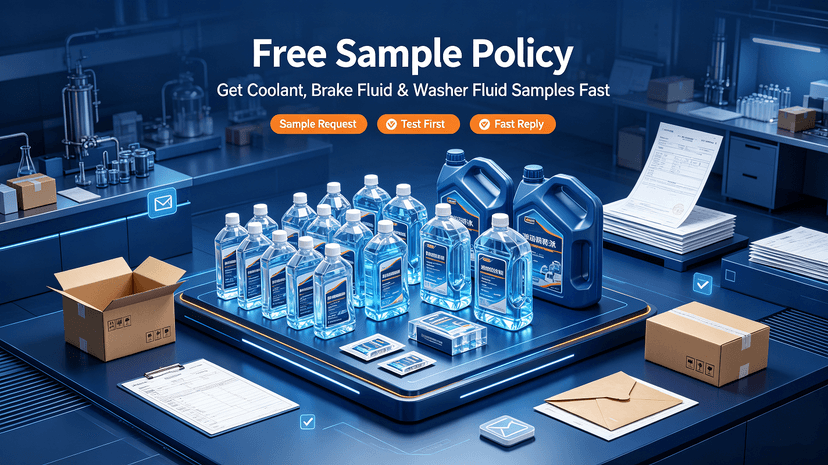
Keep the conversation practical. Ask what quantity is available, what the sample is meant to demonstrate, and whether the provided material is representative of normal production. If the supplier uses a named program such as a GAFLE sample policy, ask for the actual terms rather than relying on a sales summary. Small wording differences can matter.
It also helps to ask whether the sample is intended for one-time evaluation only or whether it can support multiple internal tests. Some materials are perfectly adequate for a quick compatibility check, but not enough for repeated bench work. That may sound obvious, but it is a common source of friction between engineering and procurement.
Common mistakes buyers make
One mistake is asking for a sample before defining the test method. Another is assuming “free” means unrestricted use. A third is treating a polished demo as proof that the full-scale product will perform the same way. In chemical sourcing, presentation can be neat and still be misleading.
Buyers also sometimes skip the practical storage question. A sample arrives, gets parked on a shelf, and by the time it is tested the team no longer knows whether the condition is still representative. That is a small operational miss, but it can poison the result.
Practical next step for sourcing teams
If you are evaluating a supplier’s Free Sample Policy, use it to clarify both product fit and commercial discipline. Ask for a representative sample, confirm what the sample is meant to prove, and check whether the offer includes only material or also freight and supporting documents. That single round of questions can save a lot of back-and-forth later.
For teams comparing an auto chemical sample, a coolant sample, or a brake fluid sample, the best policy is the one that helps you make a real technical decision without disguising the commercial terms. A good sample should open the door to qualification. It should not become a substitute for it.
Welcome to contact GAFLE for more information & cooperation!
peter
ZHEJIANG GAFLE AUTO CHEMICL CO.,LTD
Tel:86-579-8222 1665
Fax:86-579-8246 4690
Cel/Wechart:86-13335993986
E-mail:peter@gafle.net
Web:www.gafle.net