Why brake fluid demand in the Middle East is not a simple “hot weather” story
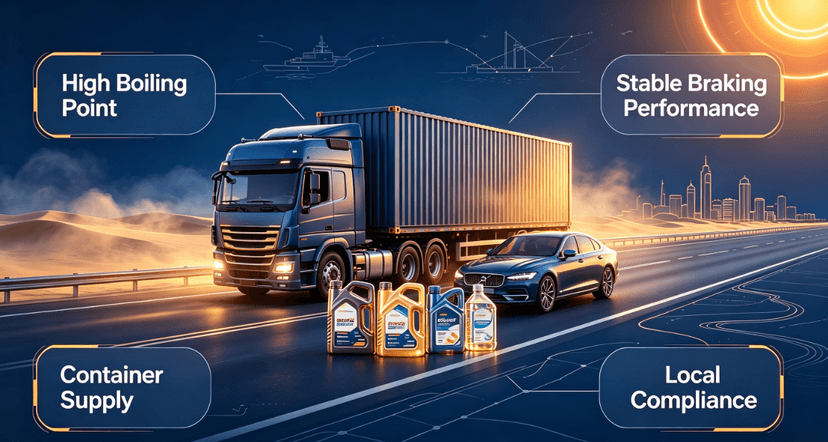
For anyone evaluating Middle East market brake fluid, the obvious assumption is that temperature is the whole issue. Heat does matter, of course. So do long driving distances, stop-start traffic in major cities, and the heavy-duty expectations placed on fleets, light commercial vehicles, and passenger cars alike. But the buying decision goes deeper than climate alone. What matters is how a brake fluid behaves under heat soak, humidity exposure, storage conditions, and the mixed vehicle parc found across the region.
That is why sourcing teams and distributors looking at the region often end up comparing not just product labels, but product behavior, packaging, compatibility, and supply reliability. A brake fluid can look fine on paper and still disappoint in a real workshop if it absorbs moisture too quickly, is awkward to store, or does not match the vehicle segment being serviced.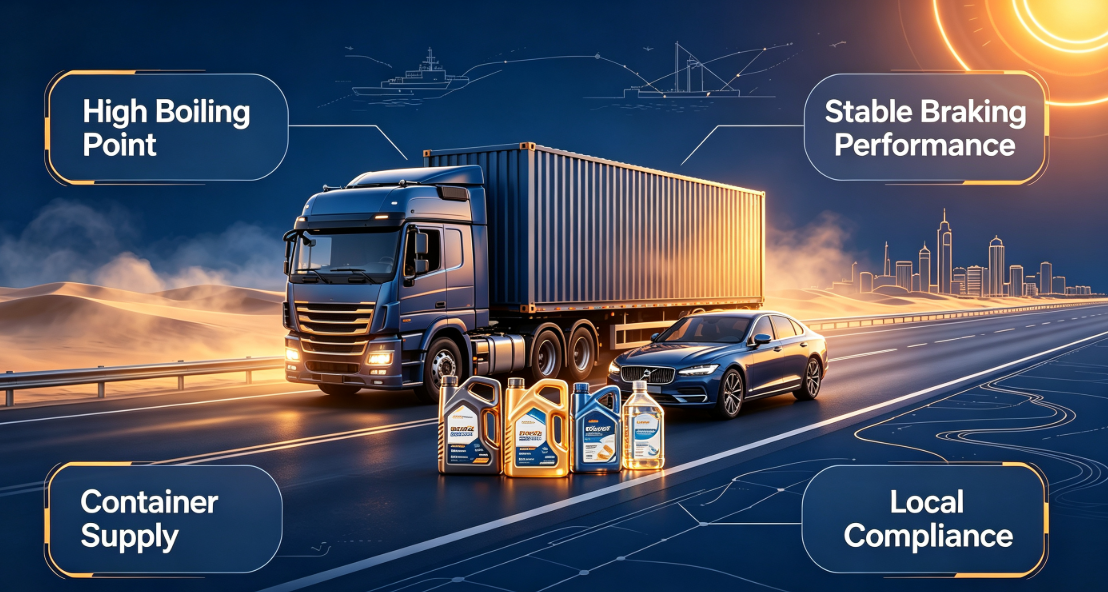
What buyers in the region are really trying to solve
In practice, buyers want a fluid that stays stable in demanding service conditions and can move through established distribution channels without unnecessary headaches. The same logic applies across much of the Middle East market automotive chemicals segment: heat resistance, shelf life, packaging integrity, and clear specification language all influence whether a product earns repeat orders.
Brake fluid sits in a sensitive part of the aftermarket. It is not a cosmetic add-on or a discretionary chemical. It is a safety-critical consumable. That means the buyer is usually balancing three questions at once:
1. Will it suit the vehicles on the road?
The region includes a wide spread of vehicle ages and brands, from newer sedans and SUVs to older fleet vehicles that may still rely on established fluid grades. A product such as DOT 3 brake fluid Middle East may fit certain applications well, but it should always be matched to the vehicle maker’s specification rather than chosen by climate alone.
2. Will it hold up in local conditions?
Brake fluid is sensitive to contamination and moisture pickup. In warm environments, packaging quality and storage discipline become more important than many first-time buyers expect. A drum or bottle that is not well sealed can create problems long before the product reaches the workshop.
3. Can it be supplied consistently?
For distributors, workshops, and private-label programs, consistency matters as much as formulation. If you are working with an automotive chemicals supplier UAE or another regional source, the practical concern is whether the supplier can keep labeling, packaging, and documentation stable from batch to batch. That may sound mundane, but it is exactly where many sourcing programs win or lose trust.
How brake fluid selection differs from coolant and other under-hood chemicals
It is easy to group brake fluid with other maintenance liquids, but that can blur the decision-making process. A high temp coolant, for example, is selected primarily for thermal management and engine protection. Brake fluid, by contrast, has to transmit force reliably and maintain its behavior under pressure. The performance profile is different, and so is the risk if the wrong grade is chosen.
That distinction matters for distributors that carry a broader portfolio of workshop chemicals. One product may be judged by boiling behavior, another by corrosion protection, and another by seal compatibility. If your catalog treats them all the same, technicians will notice quickly.
Key selection points for sourcing teams
A useful buyer review usually starts with the specification, then moves to packaging and market fit. For brake fluid in the Gulf and wider region, practical buyers tend to look at the following:
- Vehicle specification compatibility, especially for service bays handling mixed fleets
- Moisture resistance and packaging integrity during transport and storage
- Label clarity for mechanics and retail buyers
- Container size options for workshop, retail, and fleet channels
- Shelf presentation if the product will be sold through automotive aftermarket shelves
The last point is often overlooked. In a crowded aftermarket, a product that is technically suitable but poorly presented can lose out to a cleaner-looking alternative. That is not ideal engineering logic, but it is how the shelf works.
Common mistakes when buying brake fluid for the region
One recurring mistake is assuming one fluid grade can cover every application simply because the climate is severe. Another is importing a product without checking local channel expectations for labeling, language, or container format. A third is focusing too heavily on nominal specification while ignoring how the product will actually be stored in warehouses or retail yards.
Buyers should also be cautious about overpromising performance claims from suppliers. If a product description sounds too broad, it is worth asking for the exact intended use and the compatible vehicle types. Safety-critical products deserve that level of scrutiny.
Practical guidance for distributors and workshop buyers
If you are building a regional brake fluid program, start with the end user. A retail customer wants confidence and clear labeling. A workshop wants dependable fitment and easy handling. A fleet buyer wants predictability and supply continuity. These needs overlap, but they are not identical.
For companies expanding into related categories such as automotive chemicals in the GCC, it often helps to group brake fluid alongside complementary maintenance products rather than treat it as a standalone item. Still, each product needs its own spec discipline. That is especially true in markets where technicians are used to comparing imported brands against locally stocked alternatives.
What to ask before you place an order
Before committing to a sourcing plan, buyers should ask:
- Which vehicle specifications does the fluid support?
- How is the product packaged for hot-climate storage and transport?
- Are labels and container sizes aligned with the target channel?
- Can the supplier support repeat orders with consistent presentation?
- Is the product positioned for workshops, retail shelves, or fleet use?
Those questions help separate a workable product from a merely available one.
A sensible next step
If you are evaluating brake fluid for the Middle East, treat it as a channel decision, a specification decision, and a storage decision all at once. The best outcome is not simply a fluid that survives the climate. It is a fluid that fits the vehicles, the buyer base, and the practical realities of distribution.
For sourcing teams, that means narrowing the field early and asking hard questions before price becomes the only variable.
Welcome to contact GAFLE for more information & cooperation!
peter
ZHEJIANG GAFLE AUTO CHEMICL CO.,LTD
Tel:86-579-8222 1665
Fax:86-579-8246 4690
Cel/Wechart:86-13335993986
E-mail:peter@gafle.net
Web:www.gafle.net