Quick Answer: An IATF 16949 automotive fluids factory should be evaluated on two separate levels: whether its automotive quality management system certification is current and covers the relevant manufacturing site and activities, and whether the exact brake fluid, coolant or other automotive chemical meets your product specification. IATF 16949 is a quality-management-system standard, not a certificate approving every product in a supplier's catalogue. Before ordering, check the certificate, map your product to the manufacturing and quality controls, review test evidence and agree on batch-release and change-control requirements.
For an automotive-fluid importer, an IATF 16949 claim is an important reason to begin a supplier assessment, not a reason to skip it. An attractive certificate image does not identify which site manufactures an order, which process is covered, or whether the specific formula meets your market's technical requirements. These distinctions become especially important when one supplier offers several product families and private-label packaging options.
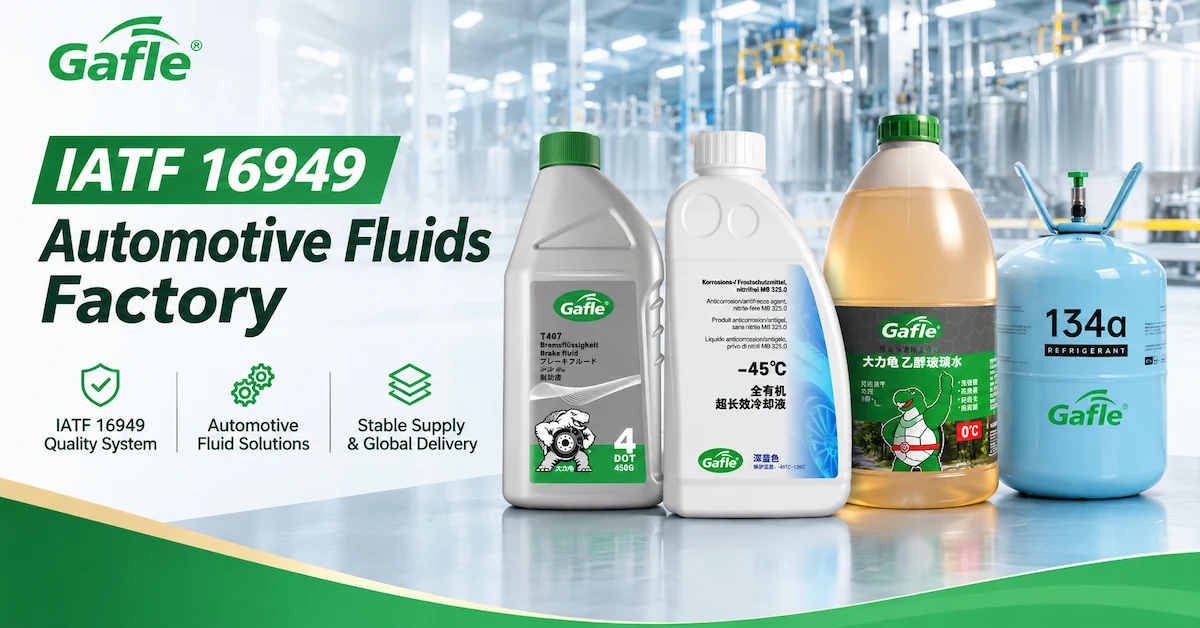
This guide provides a 10-point, evidence-based factory audit for overseas purchasing managers, automotive aftermarket distributors, technical engineers and quality teams. It focuses on the questions that turn an initial supplier inquiry into a controlled OEM or bulk-supply project. Throughout, GAFLE's public company and product information is identified separately from checks that buyers must complete with current supplier documents.
GAFLE · FACTORY QUALIFICATION
Explore GAFLE Automotive Products ↗Request a Factory Qualification Discussion ↗1. What Does IATF 16949 Mean for an Automotive Fluids Factory?
IATF 16949:2016 sets automotive-sector quality management system requirements used together with ISO 9001:2015. It focuses on consistent processes, customer-specific requirements, risk prevention, supplier management, traceability, corrective action and continual improvement. Its purpose is to help organizations control how automotive products are developed, manufactured and released—not to declare that any particular bottle is suitable for every vehicle.
The International Automotive Task Force's Global Oversight materials make an important distinction: certification is of the quality management system, not a stand-alone product or manufacturing-process certification. A supplier may manage production well and still need to demonstrate that the particular fluid under quotation complies with the agreed performance standard. Conversely, an isolated successful laboratory sample does not establish that the factory can repeatedly produce and ship equivalent batches.
For that reason, use two decision gates:
- Factory/system gate: Are the certificate, legal entity, site, permitted scope and relevant quality controls verifiable?
- Product/order gate: Does the precise formula, pack and lot satisfy the customer's specification, testing and delivery requirements?
A buyer should not approve the project until both gates pass. The IATF Rules for Achieving and Maintaining Recognition, 6th Edition, became effective in January 2025. These are rules for the certification scheme; they should not be confused with a new edition of the IATF 16949:2016 requirements.
2. Why Certificate Scope Matters When One Supplier Sells Several Fluids
The phrase automotive fluids factory can cover brake fluid, engine coolant, windshield washer fluid, automotive refrigerant and specialized thermal-management products. Those families do not have the same chemistry, test methods, risks or necessarily the same manufacturing arrangements. A company may offer them through one commercial catalogue while using different lines, sites or supply-chain partners.
GAFLE publishes brake fluid, windshield washer fluid, refrigerant gas and coolant/antifreeze categories within its wider automotive product catalogue. Its corporate pages state that the manufacturing business holds IATF 16949 and several ISO management-system certifications. That published statement should prompt a document request, not an assumption that every category or third-party activity is inside the IATF certificate's scope.
Ask the supplier to identify the legal manufacturer and actual production location for each quoted SKU. Then compare those details with the certificate. A buyer sourcing a DOT 4 brake fluid and an R1234yf refrigerant should not treat their technical files as interchangeable or presume they are made under identical process controls. If work is outsourced, clarify who owns specifications, change control, testing and shipment release.
| Product family | Main product-level checks | Typical supply risk to audit | GAFLE starting point |
|---|---|---|---|
| Brake fluid | DOT/ISO class, dry/wet boiling properties, viscosity, corrosion and compatibility | Moisture contamination, wrong-grade labeling, batch variation | Brake Fluid Range |
| Engine coolant/antifreeze | Approved formulation, concentration, freeze/boil protection, corrosion behavior and target OEM requirements | Incorrect dilution, additive mix-up, package or label mismatch | All Automotive Products |
| Windshield washer fluid | Stated low-temperature performance, cleaning properties, pack labeling and local chemical rules | Misstated freezing point, market-specific labeling | Washer Fluid Range |
| Automotive refrigerant | Correct refrigerant identity, purity, moisture/contaminant limits, container and applicable rules | Grade mix-up, container integrity, handling and export restrictions | Refrigerant Range |
These are examples of buyer audit topics, not a declaration that GAFLE has completed each test for every SKU. The exact acceptance criteria must be agreed before purchase.
3. The 10-Point IATF 16949 Factory Audit for Automotive Fluid Buyers
An effective audit follows the product from the sales quotation backward to the process that creates it and forward to the records used to release it. The following questions are suitable for a remote supplier-qualification meeting, document review or on-site visit.
Check 1 — Verify certificate identity, validity and scope
Request a legible current certificate showing the certified organization's name, manufacturing address, scope statement, certificate number, IATF number, issuing certification body and validity dates. Confirm the site and its activities against the actual production arrangement. Where available, verify current status through the IATF Global Oversight certificate-validity process or the recognized certification body. Do not rely on a cropped logo or a certificate copied from an old catalogue.
Check 2 — Identify the manufacturing and support sites
Ask whether formulation, blending, packaging, laboratory testing and product release are performed at the certificate's site or elsewhere. Remote support activities and subcontracted operations should be documented. Map who owns each step. A supplier's head-office certificate cannot simply be assumed to cover unrelated production at a second address.
Check 3 — Confirm customer-specific requirements
Provide your destination country, customer category and required technical standard. Ask how the factory records customer-specific requirements and converts them into drawings, formulas, inspection plans, packaging specifications and acceptance criteria. A general statement that “we follow IATF” is not a substitute for the requirements of your actual order.
Check 4 — Review incoming chemical and packaging controls
Select a representative base material, additive, bottle and closure and ask how each is qualified and received. Look for supplier approval, identity checks, specifications, quarantine rules and lot identification. Incoming material substitutions should not occur without the agreed review and approval process.
Check 5 — Examine formulation and process change control
Ask how the factory identifies the approved formula revision, batch instructions, mixing parameters and equipment cleaning conditions. Determine what triggers customer notification: a changed additive supplier, altered mixing process, different filling line, revised closure or modified label claim. A stable final product depends on controlling these inputs, not merely checking appearance at the end.
Check 6 — Examine risk analysis and control plans
A quality-led factory should be able to explain major process risks and the controls used to prevent or detect them. Automotive tools such as process FMEA, control plans, corrective-action records and, where required, APQP/PPAP deliverables may be relevant. Do not assume every aftermarket private-label order automatically needs a full PPAP package; agree the required submission level and customer-specific obligations in advance.
Check 7 — Evaluate laboratory competence and measurement
Request a list of relevant test methods, instruments, calibration arrangements, sample retention procedures and release authorities. Ask which tests are performed in-house, which use external laboratories and how results are reviewed. A test value without its method, units, acceptance limit and identified product is weak evidence for purchasing approval.
Check 8 — Trace one finished batch end to end
Select a recent representative lot and request a controlled example of the link between incoming materials, formula, processing record, in-process checks, finished-product test results, package artwork and shipment. Sensitive information may be redacted, but the traceability logic must remain understandable. This is one of the strongest demonstrations of real system operation.
Check 9 — Review nonconformity, complaints and corrective action
Ask what happens to a batch that does not meet specification. Review an anonymized example showing containment, root-cause investigation, corrective action and effectiveness verification. The goal is not to find a factory that claims it never has a problem; it is to evaluate how promptly and systematically problems are detected, managed and prevented from recurring.
Check 10 — Confirm OEM and repeat-order controls
For private-label work, examine who approves the final formula, artwork, packaging material and production sample. Agree how the factory will notify the buyer of changes, preserve reference samples, label lots and handle reorders. The buyer should be able to request the same approved product six months later without rebuilding the entire specification from emails.
GAFLE · FACTORY QUALIFICATION
Discuss a 10-Point Supplier Audit With GAFLE ↗4. Process Controls: From Approved Formula to Sealed Finished Goods
Automotive fluids require a repeatable production flow, although the exact operations differ by chemistry and product family. A practical audit begins with product definition, not the filling machine. First establish the formula or grade, application limitations and target standard. Then verify material intake, batching, in-process control, testing, filling, sealing, labeling and final shipment authorization.
For brake fluids, moisture control and contamination prevention deserve particular attention because unintended water uptake can affect boiling properties. Buyers can ask how bulk ingredients are stored, how transfers and open exposure are managed, and how lines are cleaned. They should not infer from a factory photograph that a particular moisture-control result is guaranteed.
For coolants, the appropriate control plan may focus instead on formulation identity, dilution ratio, inhibitor content, water quality and relevant corrosion testing. Automotive refrigerants introduce separate questions about identity, purity, cylinders or containers, and transport or destination requirements. A single generic “quality inspection” sheet is unlikely to answer each product's technical questions.
The central purchasing question is: Which critical characteristics are controlled during production, which are verified at release, and which are established through initial or periodic qualification? These three levels must be clear in the agreed specification.
5. What Product Standards Should Sit Beside IATF 16949?
IATF 16949 concerns the quality-management system. Product standards and vehicle requirements provide technical performance targets. Buyers need both categories of evidence without confusing them.
| Reference | What it addresses | What it does not prove on its own |
|---|---|---|
| IATF 16949:2016 | Automotive QMS and process management | Specific product approval or every lot's performance |
| ISO 9001:2015 | General QMS requirements | Automotive-fluid compliance or vehicle fitment |
| FMVSS No. 116 | Relevant motor-vehicle brake-fluid performance and labeling requirements | Approval by every vehicle manufacturer |
| ISO 4925:2026 | Non-petroleum-based brake fluids for compatible hydraulic systems | Approval of an individual formula without test evidence |
| ASTM D3306 (applicable edition) | Glycol-based coolant for automobile/light-duty service | Suitability for every heavy-duty engine or EV thermal circuit |
| Vehicle OEM specification | Particular vehicle or system requirements | That a product is approved without matching evidence |
| TDS / SDS / test report / COA | Product properties, safety, qualification results and batch records respectively | A substitute for all other documents |
ISO published ISO 4925:2026 in June 2026, replacing the 2020 edition. Buyers should therefore state which edition and class are contractually required and ask whether an older supplier document remains suitable for that requirement. A published standard threshold is not the actual measured value of a GAFLE product. For a technical overview, review GAFLE's DOT407 product, then request the current product-specific documents.
A useful technical file names the exact product code and formula revision, states applicable test methods, and distinguishes typical properties, guaranteed specification limits and actual batch results. Ask which results are included on each certificate of analysis and which longer tests are conducted at qualification or scheduled intervals.
6. A Product-and-Batch Approval Matrix for Importers
One of the most practical ways to evaluate an IATF 16949 automotive fluids factory is to use the same evidence categories for every product while allowing product-specific tests. This avoids both extremes: demanding irrelevant brake-fluid tests from a coolant supplier, and approving a product based only on a corporate certificate.
| Approval stage | Evidence to obtain | Pass condition | Buyer owner |
|---|---|---|---|
| Certificate and site | Current IATF document, scope and relevant site details | Identity, status and scope verified | Supplier Quality |
| Product specification | SKU, grade, applicable standard, TDS revision | Matches intended use and RFQ | Engineering |
| Qualification tests | Relevant complete product test evidence | Required limits demonstrated | Quality / Lab |
| Packaging | Bottle/can, closure, label, carton and markings | Approved sample and market requirements | Product / Compliance |
| Production lot | Traceable COA, release record, lot identification | Agreed batch criteria passed | Quality |
| Commercial order | MOQ, Incoterm, lead time, change policy | Written terms accepted | Purchasing |
| Repeat order | Formula, artwork and process revision status | No unapproved change; deviations resolved | Purchasing + Quality |
Hard-stop rule: if the required grade is wrong, certificate status cannot be verified where certification is contractually mandatory, or product testing fails a critical requirement, do not offset that failure with a lower price or a higher supplier score. Technical and compliance gates precede commercial ranking.
7. Why Batch Traceability Matters More Than a One-Time Factory Tour
A manufacturing tour shows equipment and working conditions at one moment. A traceability exercise reveals whether the system can reconstruct what happened to a particular order. For overseas buyers receiving thousands of units per shipment, that capability reduces the scale of investigation when a complaint appears.
Imagine a hypothetical distributor reports that packaging seals on a portion of a shipment appear inconsistent. A useful response needs the shipment reference, finished-goods batch number, filling date, closure lot, inspection record, retained sample and decision authority. The supplier should be able to distinguish affected from unaffected stock and document containment and correction. This is an illustrative procurement scenario, not a claim that such a problem occurred at GAFLE.
Ask how long records are retained under applicable customer, regulatory and internal requirements, and who can retrieve them. Record-retention terms differ by product and contract; do not assume one universal number. Review whether the factory has a clear method for identifying and controlling nonconforming material before it leaves the site.
Good traceability supports more reliable reorders, technical investigations and distributor confidence. It also gives a prospective brand owner a concrete question to ask before placing an initial private-label shipment.
8. GAFLE's Published Capabilities: What Can Buyers Use in Supplier Qualification?
Zhejiang Gafle Auto Chemical Co., Ltd. describes itself as a China-based automotive chemical manufacturer with brake-fluid and wider automotive-fluid product lines. Its published company information lists IATF 16949, ISO 9001, ISO 14001 and ISO and states that the company passed a 16949-system certification in 2019. It also presents OEM manufacturing and packaging services. These are useful company-reported supplier credentials, but current certificate validity and precise scope should be checked before relying on them contractually.
GAFLE's corporate materials further report more than 80,000 tons of annual capacity across all product lines and OEM relationships with more than 90 international brands. These are published claims, not independently audited figures in this article. Ask which production line, SKU, bottling format and available capacity apply to your planned order rather than interpreting company-wide capacity as guaranteed availability for one product.
A buyer seeking brake fluid can start at the GAFLE brake-fluid collection and the DOT407 product page. For wider range-building, review all GAFLE products and the windshield washer-fluid and refrigerant category pages. After defining the application, submit a request for product-specific documentation, samples, available packaging and a scope clarification.
GAFLE's website information establishes an invitation to qualify a supplier. It should not be read as proof that every fluid has IATF-certified product status, a specified OEM approval or an identical production route.
9. OEM / Private Label: How Quality-System Discipline Protects the Buyer
For private-label automotive chemicals, the hardest part is often not developing the first label. It is preserving a stable commercial specification through formulation approval, packaging procurement, sample testing, mass production and repeat shipments.
A workable OEM project should have five approval milestones. First, the buyer identifies the destination market, intended application and required technical standard. Second, engineering and the supplier select or develop a formula and agree on testing evidence. Third, purchasing and marketing approve the bottle, closure, label languages, carton and artwork. Fourth, the buyer signs off a representative sample and defines production acceptance rules. Fifth, the parties agree on lot documents, shipment release, claims handling and changes after approval.
The manufacturer should explain which steps are standard capabilities and which require project-specific development. For example, changing a label color is not equivalent to changing a brake-fluid formula or coolant corrosion-inhibitor package. Treat technical alterations as controlled changes, with requalification where necessary.
GAFLE publicly offers OEM and private-label cooperation. However, no single published MOQ, lead time, packaging selection or approval list should be assumed for every formula. To obtain a comparable quotation, provide volume by SKU and packaging version, not merely a total number of bottles. Relevant destination labeling, safety documents and logistics requirements should be agreed before artwork and pricing are finalized.
GAFLE · FACTORY QUALIFICATION
Request an OEM Automotive Fluids Proposal ↗10. How to Compare Factory Quotes Without Sacrificing Quality
Two suppliers can offer the same headline grade at different prices while quoting materially different products. One may include a tested formula, tamper-evident closure, custom labels, defined COA and shipment packaging; the other may quote an unverified generic bottle. A purchase team should normalize the scope before comparing costs.
Request an itemized quotation showing the exact product and formula identifier, performance specification, pack size, closure and seal, design/printing costs, MOQ per SKU, sample and testing arrangements, Incoterm with named place, lead time assumptions, payment terms and quote validity. Calculate total landed cost using accepted saleable units, freight, duties, local logistics and required inspection expenses.
At the same time, determine which supplier can support repeat purchasing: stable materials, change notification, responsive quality communication and document retention. A small price difference should not outweigh unresolved product-conformity risk. Nor should certification be used as an excuse to ignore commercial responsiveness.
An effective RFQ can be concise, but it must be specific enough to produce an actionable response. The following template gives both technical and commercial teams the information they need.
11. Copy-Ready RFQ for an IATF 16949 Automotive Fluids Factory
Subject: Factory Scope, Automotive Fluid Qualification & OEM Quotation — [Product] / [Market]
Dear GAFLE Team,
We are an automotive fluids [importer/distributor/private-label brand] supplying [destination market]. We are evaluating [brake fluid/coolant/washer fluid/refrigerant, exact grade or specification] for [vehicle or service application] and expect an initial order of [volume and packaging mix], with an annual forecast of [quantity].
Please provide the current IATF 16949 certificate showing the manufacturing site, scope and certificate reference, and clarify whether the proposed product's production and release activities fall within that scope. We would also appreciate the current product TDS/SDS, applicable test and qualification reports, sample batch COA format, packaging options, sample availability, MOQ per SKU, estimated production lead time and quotation under [Incoterm + named destination].
Please identify any subcontracted manufacturing, testing or filling steps and explain your formula/packaging change-notification process. Our quality team will review the evidence before sample and purchase-order approval.
Kind regards, [Name / Company / Email / Phone]
GAFLE · FACTORY QUALIFICATION
Send Your Supplier Qualification RFQ to GAFLE ↗12. Common Mistakes in IATF 16949 Automotive Fluid Sourcing
Mistake 1: Treating an IATF logo as product certification. It indicates a QMS claim that must be verified and interpreted within scope; it is not universal approval of a fluid.
Mistake 2: Ignoring the plant address and manufacturing route. Different sites, outsourced filling or external tests require clear responsibility and traceability.
Mistake 3: Comparing test figures without methods or units. A boiling-point headline does not replace a complete brake-fluid performance profile or a coolant's relevant corrosion evidence.
Mistake 4: Using old certificates or undated brochures. Confirm current status, correct entity, scope and the latest technical files.
Mistake 5: Assuming management-system certification equals OEM approval. Vehicle manufacturer approvals are separate, specific claims requiring supporting evidence.
Mistake 6: Approving custom packaging before formula selection. Grade, technical limits and target application should be defined before label claims or mass printing.
Mistake 7: Failing to lock repeat-order revisions. Uncontrolled material, formula, closure or artwork changes can undermine consistency even when the first sample passes.
Mistake 8: Comparing price before technical gates pass. The cheapest bottle is not the best purchase when its application, labeling or batch conformity remains uncertain.
13. Frequently Asked Questions About IATF 16949 Automotive Fluids Factories
1. Is IATF 16949 mandatory for every automotive fluids manufacturer?
Not universally. Whether certification is required depends on the supply chain, customer-specific requirements, applicable eligibility and contract. Some aftermarket projects may not require it, while an automotive OEM or Tier supplier may specify it. Verify the buyer's actual qualification requirements.
2. Does IATF 16949 certification mean all brake fluids and coolants are approved?
No. Certification addresses the quality management system within its defined scope. The exact product needs its own technical specification, evidence and any required vehicle-manufacturer approval. Different product families may have different manufacturing and testing arrangements.
3. How do I verify an automotive fluids factory's IATF certificate?
Request the current complete certificate, including legal entity, site address, scope, certificate number, IATF reference, issuing certification body and validity details. Check the current status through recognized IATF channels or the certification body, rather than relying on a website badge alone.
4. What is the difference between IATF 16949 and ISO 9001?
ISO 9001 establishes a general quality-management framework. IATF 16949:2016 adds automotive-sector requirements and is implemented alongside ISO 9001:2015. Neither document, by itself, confirms a particular brake fluid's DOT grade or a coolant's vehicle compatibility.
5. Did the IATF 6th Edition replace IATF 16949:2016?
No. The Rules for Achieving and Maintaining IATF Recognition, 6th Edition, govern the certification scheme and became effective in January 2025. That is different from the underlying IATF 16949:2016 QMS requirements.
6. Which documents should accompany an automotive brake fluid order?
As applicable, request the exact product TDS, SDS, qualification test evidence, approved packaging details, batch COA or agreed lot-release record, and supporting quality-system documents. Specify the agreed standards and whether typical values or guaranteed limits apply.
7. Can an IATF 16949 supplier offer OEM and private-label automotive fluids?
Yes, if the supplier has the relevant products, processes, packaging resources and commercial arrangements. Certification alone does not establish the available formula list, MOQ or lead time. Those details need a specific technical and commercial quotation.
8. Are brake-fluid and coolant tests interchangeable?
No. Brake fluid and engine coolant have different functions and performance requirements. Select test methods and acceptance criteria based on the intended product and relevant standards. A certificate or test result for one formulation should not be reused as proof for another.
9. What should I check before placing a repeat bulk order?
Confirm the formula and TDS revision, packaging artwork and closure configuration, any approved process changes, current certificate status where required, batch-release criteria, lead time and delivery terms. Retain a reference to the original approved samples and purchase specification.
10. Does GAFLE publish IATF 16949 certification information?
Yes. GAFLE's corporate pages publicly state that the company holds IATF 16949 and other management-system certifications, and its history mentions a 16949 milestone in 2019. Buyers should request the current certificate and verify the manufacturing scope for their proposed products before relying on the claim contractually.
Conclusion
Choosing an IATF 16949 automotive fluids factory is a two-part decision: verify the real factory and its quality-management-system scope, then qualify the exact fluid, formulation, package and production batch. The certificate helps a buyer assess management discipline; it does not remove the need for performance testing, application checks, traceable lot records, compliant labeling or effective change control.
For importers, OEM buyers and private-label distributors, the most reliable sourcing approach is to use a structured audit that follows the product from specification and incoming ingredients through manufacturing, laboratory review, packaging and repeat-order release. GAFLE's published company profile and automotive product range provide useful starting points. To determine whether its current certification scope, technical documents and available manufacturing arrangements match your project, contact GAFLE for a product-specific supplier qualification and quotation. Verify the scope, approve the product and document the repeat-order controls before committing to volume.