Quick Answer: A reliable brake fluid TDS supplier should provide a current, product-specific Technical Data Sheet identifying the exact fluid, relevant DOT or other specification, test methods, technical properties, and document revision. For bulk purchasing, importers should match that TDS to supporting test reports, a suitable Safety Data Sheet (SDS), agreed batch-release records or Certificate of Analysis (COA), and the approved package. A datasheet alone is not proof of universal vehicle compatibility or independent product approval.
When a distributor asks for a DOT 4 datasheet, a quick PDF response may look reassuring. But what if the document describes an older formulation, the quotation uses a different stock code, or the brochure's boiling point is a typical result rather than the guaranteed release specification? Those gaps can delay customs preparation, private-label artwork, technical sign-off, or an entire repeat order.
For automotive-fluid importers, workshop supply networks, and OEM/private-label brand owners, the goal is not merely to receive a TDS. It is to establish a traceable evidence chain from the selected formulation to the sample, approved specification, manufacturing batch, label, and shipment. This article provides a practical seven-check process for doing so, with GAFLE's brake-fluid portfolio as a potential sourcing starting point.
GAFLE | TECHNICAL SOURCING SUPPORT
Get the documents before approving the order
Explore GAFLE Brake Fluid Products ↗Request a Product-Specific Technical File ↗1. What Should a Brake Fluid Technical Data Sheet Include?
A Technical Data Sheet (TDS) describes the intended product and its technical characteristics. There is no one universal TDS layout that guarantees regulatory conformity. The value of the document depends on whether its identity, scope, values, methods, and claims are sufficiently precise for a buyer's application.
| Essential TDS field | What an importer should check | Why it matters |
|---|---|---|
| Product identity | Manufacturer, product name, code, fluid family and revision | Prevents mixing information from different formulations |
| Fluid classification | DOT grade and, where applicable, SAE, ISO class or vehicle requirement | Establishes the correct technical target |
| Dry ERBP | Value, unit, method and whether typical or guaranteed | Supports assessment of fresh-fluid boiling performance |
| ERBP Act | Value, unit, conditioning method and stated limit | Supports assessment after standardized moisture conditioning |
| Viscosity | Temperature, unit and result or limit, including −40°C when relevant | Helps evaluate cold hydraulic behavior |
| Other performance | Relevant corrosion, stability, water tolerance and rubber effects | Goes beyond a single headline boiling point |
| Application boundaries | Intended hydraulic brake or clutch systems and exclusions | Discourages unsupported universal-fit claims |
| Document control | Issuer, issue date, version and technical contact | Enables repeat-order comparison and change review |
A TDS that states only “high quality,” “excellent protection,” or “meets international standards” is not enough for a quality manager to approve a safety-related fluid. Ask which exact standard, edition, class, test method, and product code support each claim.
2. DOT 3, DOT 4 and DOT 5.1: Which Numbers Are Reference Limits?
Under U.S. FMVSS No. 116, brake fluids have performance and packaging requirements. The following selected numbers are standard minimum or maximum thresholds—not measured GAFLE product results. A supplier TDS should distinguish the applicable requirements from its own verified product values.
| Performance item | DOT 3 | DOT 4 | DOT 5.1 (non-silicone) |
|---|---|---|---|
| Minimum dry ERBP | 205°C | 230°C | 260°C |
| ERBP Minimum Act | 140°C | 155°C | 180°C |
| Maximum viscosity at −40°C | 1,500 mm²/s | 1,800 mm²/s | 900 mm²/s |
| Chemistry note | Non-silicone | Non-silicone | Non-silicone; distinct from silicone DOT 5 |
The DOT 5.1 designation is part of the non-silicone fluid distinction under FMVSS No. 116; it must never be confused with silicone-based DOT 5. Nor does a DOT grade establish approval for every vehicle. A repair workshop still needs the vehicle manufacturer's specified fluid and service guidance.
For international trade, buyers may also reference ISO 4925:2026, published in June 2026 and replacing the 2020 edition. It covers non-petroleum-based fluids for compatible hydraulic braking and clutch systems. A TDS citing ISO 4925 should identify the edition and class, rather than implying that a document referencing the withdrawn 2020 edition automatically demonstrates conformity to the 2026 requirements. For a broader overview, read GAFLE's ISO 4925 brake fluid selection guide.
3. Seven Checks for Approving a Brake Fluid TDS Supplier
Check 1 — Match the TDS to the actual commercial SKU
Compare the manufacturer name, formula or product code, grade, bottle label and quotation. “DOT 4” can describe multiple formulations. Ask the supplier to identify the precise product covered by the document. If samples arrive, use the same identifier on the sampling form and test request. Fail the review if documents cannot be connected to the offered material.
Check 2 — Identify the standard, class and edition
Record the exact claimed standard: for example, FMVSS No. 116 DOT 4, an applicable SAE reference, or ISO 4925 with a stated edition and class. A general phrase such as “European standard” cannot be audited. Where an OEM-specific claim is made, request evidence for that claim; a generic DOT declaration is not an automobile manufacturer's endorsement.
Check 3 — Verify values, units, temperatures and methods
The same-looking boiling point may refer to dry ERBP, wet ERBP, or a different test. Viscosity figures are meaningless without the temperature and unit. Ask for the method reference and reporting basis, particularly when comparing products intended for electronic hydraulic control systems or cold climates.
Check 4 — Separate typical data from contractual guarantees
Many datasheets publish typical laboratory results. A purchase specification may set different acceptance limits. Have the technical team record three separate columns: regulatory or customer requirement, supplier's approved guarantee, and actual batch result. Do not use a marketing headline as a substitute for an agreed release criterion.
Check 5 — Request supporting qualification evidence
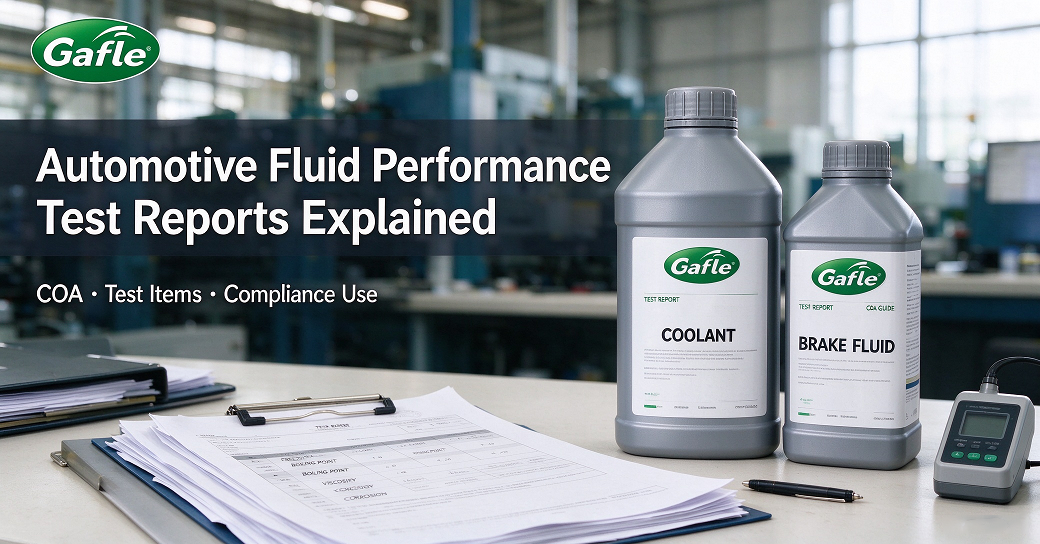
Ask what full test reports support relevant claims about boiling behavior, corrosion, water tolerance, compatibility, fluid stability and elastomer effects. Check report date, laboratory, tested product identity, method and result. Not every test needs to appear on every batch COA; agree which tests are used for qualification and which are repeated for routine lot release.
Check 6 — Connect the fluid to its finished packaging
A suitable fluid can still create supply risk when its closure, seal, label or batch coding is poorly controlled. Ask for the proposed bottle or container specification, sealing and tamper-evidence provisions, labeling requirements and traceability method. For products within U.S. regulatory scope, FMVSS No. 116 includes specific container sealing and labeling requirements. Destination-market rules must also be checked.
Check 7 — Lock revision control and repeat-order acceptance
Before the first purchase order, record the approved TDS revision, formula identification, packaging artwork, quality limits and the records expected for each shipment. Agree how formulation, raw material, labeling or packaging changes will be notified and approved. Without revision control, a satisfactory sample does not guarantee the next shipment is built to the same specification.
4. TDS vs SDS vs COA vs Test Report: What Each Document Proves
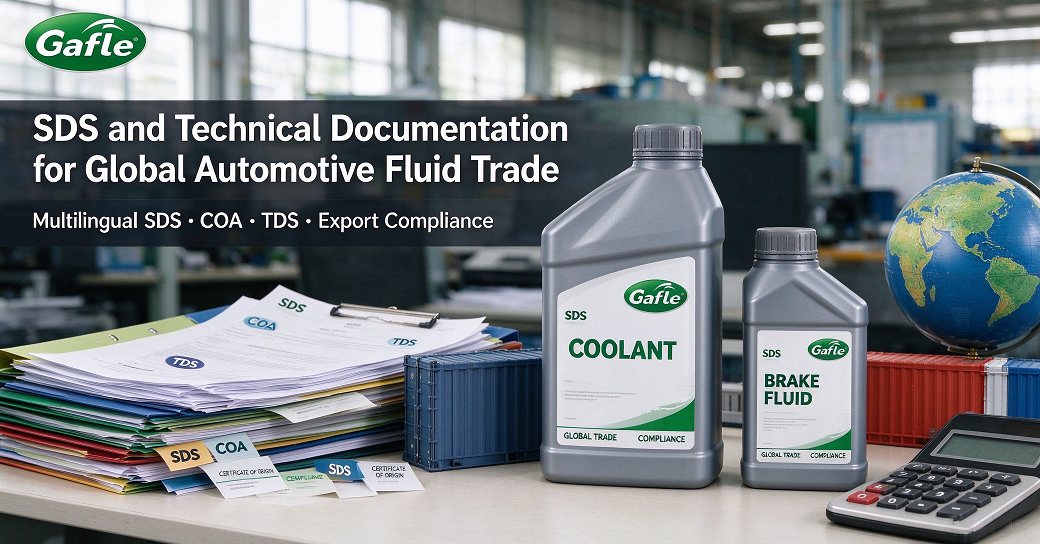
These files answer different questions. A capable brake fluid technical data sheet supplier should help the buyer understand how they relate rather than sending a folder of unidentified PDFs.
| Document | Primary question answered | What it cannot establish alone |
|---|---|---|
| TDS — Technical Data Sheet | What product is offered and what properties are declared? | Actual release results for a specified shipment |
| SDS — Safety Data Sheet | How should this material be classified, handled, stored and managed safely? | DOT performance conformity or vehicle approval |
| Test / qualification report | What was tested, using which method, with what result? | That all future lots remain unchanged |
| COA — Certificate of Analysis | What agreed results are recorded for a defined batch or lot? | Full qualification for every property absent from the COA |
| Packaging and label approval | What finished configuration was authorized? | The fluid's chemical performance |
The strongest file is consistent across documents. If the TDS says DOT 4, the SDS names a different formulation, the test report uses an unknown sample and the COA lacks a traceable lot, ask for correction before commercial approval. A recent version date alone does not solve an identity mismatch.
5. A Document-Matching Example for a DOT 4 Bulk Order
Consider a hypothetical importer sourcing a 1-liter private-label DOT 4 product for an automotive aftermarket network. The supplier's sales sheet lists a high dry boiling point, the proposed TDS says “typical,” and the preliminary COA shows only an appearance check. Nothing in that scenario proves a failed product—but the buyer lacks an adequate record of what is being guaranteed.
The importer should ask for the precise DOT 4 product code, a defined minimum dry and wet ERBP, the applicable viscosity requirement, evidence of broader qualification testing, and a written routine batch-release plan. The team should then approve a sample and identify the closure, artwork and lot-code arrangement. Only after these details are agreed should quotations from alternative suppliers be normalized by package, quantity and shipping terms.
This case is illustrative, not an assertion about GAFLE production or an actual customer order. It demonstrates a useful rule: a TDS is the beginning of the approval trail, not the complete approval trail.
6. Evaluating GAFLE as a Brake Fluid TDS Supplier
FORK, operated by Zhejiang Gafle Auto Chemical Co., Ltd., describes brake-fluid manufacturing, customized packaging and private-label services. Its public catalogue contains DOT 3, DOT 4, DOT 5.1 and application-oriented product categories. These pages can help identify a candidate for technical review, but they do not replace the current, supplier-issued TDS and product-specific qualification evidence.
| GAFLE starting point | Published product direction | Document request to make |
|---|---|---|
| DOT 3 product | DOT 3 glycol-based brake fluid | Current DOT 3 TDS, stated standard and test evidence |
| DOT407 DOT 4 product | DOT 4 hydraulic brake/clutch fluid | Product-specific dry/wet ERBP, viscosity, qualification and batch records |
| Brake fluid collection | DOT 3, DOT 4, DOT 5.1, OEM and specialty categories | Appropriate SKU selection and documents for the intended market |
A public description is not proof that downloadable TDS files are available for every GAFLE SKU. Request the latest document package directly and specify your market, grade, application and order format. Current corporate certification copies may also be relevant for supplier qualification, but a quality-management certificate is not an individual product performance test.
GAFLE | TECHNICAL SOURCING SUPPORT
Get the documents before approving the order
Request a GAFLE Brake Fluid TDS & Test Review ↗7. OEM and Private Label Orders: Add a Document-Control Agreement
Private-label buyers may keep a validated fluid formula while changing bottle size, label language or carton design. That does not make document control optional. Confirm whether the intended label statements follow the approved technical evidence and relevant destination regulations. Ask who authorizes each artwork revision and how the private-label SKU maps to the manufacturer's formulation.
For repeat supply, agree who maintains the technical master file, how updates are communicated, which tests require requalification, what will appear on a batch COA, and what happens when a lot does not meet the approved specification. These details reduce the risk of a later shipment arriving with an unfamiliar formula or unsupported claim.
GAFLE describes OEM and custom-packaging support; the actual MOQ, documents, sample schedule and delivery terms should be confirmed project by project. Buyers can also consult its Brake Fluid Wholesale sourcing guide for the larger purchase-to-reorder workflow.
8. RFQ Template: Ask a Supplier for the Right Technical File
Use this message before approving a trial or bulk order:
Subject: Request for Brake Fluid TDS, Test Evidence and Quotation — [DOT Grade] / [Country]
Dear GAFLE Team,
We are an [importer/distributor/private-label brand] supplying [target market]. We are reviewing [DOT grade / ISO class / vehicle requirement] brake fluid for [intended application] and would like to evaluate your available product options. Please confirm the exact product code and provide the current TDS, relevant SDS, standard/test evidence, proposed batch COA fields, sample availability, packaging/closure options and document revision details.
Our preferred pack is [size], initial requirement is [quantity by SKU], estimated annual demand is [forecast], and destination is [country/port]. Please indicate the appropriate MOQ, quotation basis, estimated lead time subject to approval, and your procedure for notifying us of changes to the formula or label. Our technical team will review the documents before authorizing the commercial sample and order.
Kind regards, [Company / Contact]
GAFLE | TECHNICAL SOURCING SUPPORT
Get the documents before approving the order
Send Your TDS Request to GAFLE ↗9. Frequently Asked Questions
1. What is a brake fluid TDS supplier?
It is a supplier that can provide technical data about a specific brake-fluid product, usually as part of manufacturing or distribution. A trustworthy supplier links its TDS to the exact formula, applicable standard and supporting evidence rather than supplying only a generic brochure.
2. Can I download a GAFLE brake fluid TDS online?
GAFLE publishes product descriptions, but publicly accessible, current TDS files for every SKU could not be confirmed during this review. Contact GAFLE and request the latest datasheet for the exact product under consideration.
3. Which parameters matter most in a DOT 4 TDS?
Start with product identity, applicable specification, dry ERBP, wet ERBP, temperature-specific viscosity and the status of each reported value. Then verify relevant corrosion, stability and elastomer compatibility evidence.
4. Is a TDS the same as an SDS or MSDS?
No. A TDS focuses on technical properties and intended use. An SDS addresses hazards, handling, storage and other safety information. “MSDS” is an older term often used for safety data sheets, not another name for the TDS.
5. Does a DOT 4 TDS prove compatibility with every vehicle?
No. DOT grade conformity is not a universal vehicle approval. Check the vehicle manufacturer's exact brake-fluid requirement and any applicable OEM-specific conditions before making a fitment claim.
6. Why do typical and guaranteed values differ?
A typical value describes expected performance based on stated data; a guaranteed minimum or maximum is the acceptance boundary agreed for the product. Importers should make clear which limits control shipment approval.
7. Should the COA include every test in the TDS?
Not necessarily. Full qualification tests and routine lot-release checks may have different frequencies. Agree the batch-release plan, test list, limits and traceability requirements with the supplier before ordering.
8. Why does the ISO 4925 edition matter?
ISO 4925:2026 replaces ISO 4925:2020. The buyer must specify the edition and class requested; an older TDS claim does not automatically establish conformity with the latest revision.
9. Can GAFLE provide documents for OEM brake fluid projects?
GAFLE describes OEM and private-label capabilities. Buyers can request appropriate product-specific documents and discuss which testing, approval and batch records can be provided for the proposed project; availability should be confirmed directly.
10. What should I send when requesting a brake fluid TDS and quote?
Provide target market, required grade or class, intended application, pack size, branding, quantity, document requirements, destination and desired schedule. This enables a more relevant technical shortlist and quotation.
Conclusion
Selecting a brake fluid TDS supplier is fundamentally a document-verification and product-approval decision. For importers and private-label brands, the best practice is to match the datasheet to the exact formula, identify the correct standard and edition, compare measured values with guaranteed limits, review supporting qualification evidence, and connect the approved product to its package and production lot. A TDS, SDS, test report and COA each play different roles; together, they help create an auditable purchasing file.
To evaluate GAFLE, begin with the brake fluid catalogue and relevant DOT407 or DOT3 options. Then contact GAFLE for a product-specific TDS, supporting test documentation and a quotation aligned with your intended market, packaging and order volume. Approve the evidence before approving the bulk order.